START UP INAGRICULTURE
AND ALLIED SECTORS
Submitted by:
Ananya Ray
Gracy Singh
2.
• Startups areproviding missing links within the Agri value chain and
delivering efficient technologies, products, and services to the
farmers.
• There are different 28 government schemes related to agriculture &
ailed sectors under startup.
• Various ministries are concerned with schemes related to
agriculture & ailed sectors under startup.
3.
MINISTRY OF AGRICULTUREAND FARMERS” WELFARE
1. Venture Capital Assistance Scheme
Help in assisting agripreneurs to form investments in fitting agribusiness projects
through financial participation
Benefits of the scheme:
Help in assisting agripreneurs to form
investments in fitting agribusiness
projects through financial participation
Provides funding for the preparation
of bankable Detailed Project Reports
(DPRs) through the Project Development
Facility (PDF).
Eligibility for the scheme:
Farmers
Producer Groups
Companies
Partnership/Proprietary Firms
Agripreneurs
Units in agri export zones
Self Help Groups
Agriculture graduates individually or in
groups for setting up agribusiness projects.
4.
2. Capital InvestmentSubsidy Scheme Under National Bamboo Mission
There are many activities under National Bamboo Mission which are to be
supported by a credit linked back ended subsidy by Financial Institutions (FIs)
including banks. Promoters can submit their project proposals to the eligible
financial institutions for the grant of subsidy.
• Pattern of Assistance: Owner's contribution-10%, Subsidy from Government of India
50% subject to the maximum ceiling (10% more ' for NER States), Bank loan-40%
Eligibility:
The eligible financing institutions under the scheme are:
i) State Cooperative Banks (SCBs), Regional Rural banks (RRBs), Commercial Banks ,
Scheduled Primary Urban cooperative Banks (PUCBs),State Co-operative Agricultural and
Rural Development Bank (SCARDBs), North Eastern Development Finance Corporation
(NEDFT), and such other institutions, Agricultural Development Finance Companies
(ADFCs),
ii) Cooperatives where they seek loan from National Cooperatives Development
Corporation (NCDC). Promoters can submit their project proposals to the eligible financial
institutions for the grant of subsidy.
5.
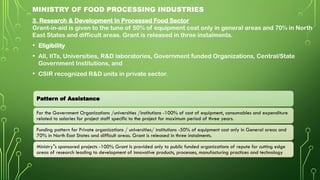
MINISTRY OF FOODPROCESSING INDUSTRIES
3. Research & Development In Processed Food Sector
Grant-in-aid is given to the tune of 50% of equipment cost only in general areas and 70% in North
East States and difficult areas. Grant is released in three instalments.
• Eligibility
• All, IITs, Universities, R&D laboratories, Government funded Organizations, Central/State
Government Institutions, and
• CSIR recognized R&D units in private sector.
Pattern of Assistance
For the Government Organizations /universities /institutions -100% of cost of equipment, consumables and expenditure
related to salaries for project staff specific to the project for maximum period of three years.
Funding pattern for Private organizations / universities/ institutions -50% of equipment cost only in General areas and
70% in North East States and difficult areas. Grant is released in three instalments.
Ministry s sponsored projects -100% Grant is provided only to public funded organizations of repute for cutting edge
‟
areas of research leading to development of innovative products, processes, manufacturing practices and technology
6.
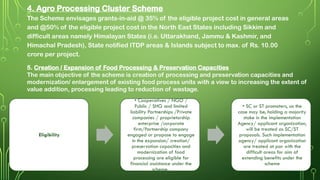
4. Agro ProcessingCluster Scheme
The Scheme envisages grants-in-aid @ 35% of the eligible project cost in general areas
and @50% of the eligible project cost in the North East States including Sikkim and
difficult areas namely Himalayan States (i.e. Uttarakhand, Jammu & Kashmir, and
Himachal Pradesh), State notified ITDP areas & Islands subject to max. of Rs. 10.00
crore per project.
5. Creation / Expansion of Food Processing & Preservation Capacities
The main objective of the scheme is creation of processing and preservation capacities and
modernization/ enlargement of existing food process units with a view to increasing the extent of
value addition, processing leading to reduction of wastage.
Eligibility
• Cooperatives / NGO /
Public / SHG and limited
liability Partnerships /Private
companies / proprietorship
enterprise /corporate
firm/Partnership company
engaged or propose to engage
in the expansion/ creation/
preservation capacities and
modernization of food
processing are eligible for
financial assistance under the
scheme.
• SC or ST promoters, as the
case may be, holding a majority
stake in the implementation
Agency/ applicant organization,
will be treated as SC/ST
proposals. Such implementation
agency/ applicant organization
are treated at par with the
difficult areas for aim of
extending benefits under the
scheme
7.
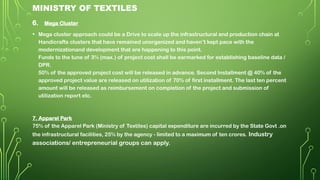
MINISTRY OF TEXTILES
6.Mega Cluster
• Mega cluster approach could be a Drive to scale up the infrastructural and production chain at
Handicrafts clusters that have remained unorganized and haven t kept pace with the
‟
modernizationand development that are happening to this point.
Funds to the tune of 3% (max.) of project cost shall be earmarked for establishing baseline data /
DPR.
50% of the approved project cost will be released in advance. Second Installment @ 40% of the
approved project value are released on utilization of 70% of first installment. The last ten percent
amount will be released as reimbursement on completion of the project and submission of
utilization report etc.
7. Apparel Park
75% of the Apparel Park (Ministry of Textiles) capital expenditure are incurred by the State Govt .on
the infrastructural facilities, 25% by the agency - limited to a maximum of ten crores. Industry
associations/ entrepreneurial groups can apply.
8.
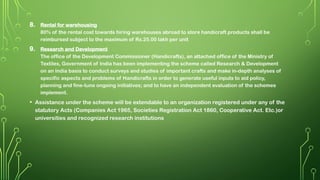
8. Rental forwarehousing
80% of the rental cost towards hiring warehouses abroad to store handicraft products shall be
reimbursed subject to the maximum of Rs.25.00 lakh per unit
9. Research and Development
The office of the Development Commissioner (Handicrafts), an attached office of the Ministry of
Textiles, Government of India has been implementing the scheme called Research & Development
on an India basis to conduct surveys and studies of important crafts and make in-depth analyses of
specific aspects and problems of Handicrafts in order to generate useful inputs to aid policy,
planning and fine-tune ongoing initiatives; and to have an independent evaluation of the schemes
implement.
• Assistance under the scheme will be extendable to an organization registered under any of the
statutory Acts (Companies Act 1965, Societies Registration Act 1860, Cooperative Act. Etc.)or
universities and recognized research institutions
9.
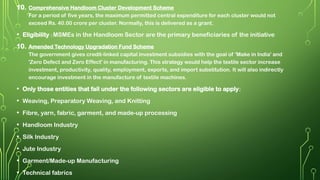
10. Comprehensive HandloomCluster Development Scheme
For a period of five years, the maximum permitted central expenditure for each cluster would not
exceed Rs. 40.00 crore per cluster. Normally, this is delivered as a grant.
• Eligibility : MSMEs in the Handloom Sector are the primary beneficiaries of the initiative
10. Amended Technology Upgradation Fund Scheme
The government gives credit-linked capital investment subsidies with the goal of 'Make in India' and
'Zero Defect and Zero Effect' in manufacturing. This strategy would help the textile sector increase
investment, productivity, quality, employment, exports, and import substitution. It will also indirectly
encourage investment in the manufacture of textile machines.
• Only those entities that fall under the following sectors are eligible to apply:
• Weaving, Preparatory Weaving, and Knitting
• Fibre, yarn, fabric, garment, and made-up processing
• Handloom Industry
• Silk Industry
• Jute Industry
• Garment/Made-up Manufacturing
• Technical fabrics
10.
MINISTRY OF MSMES
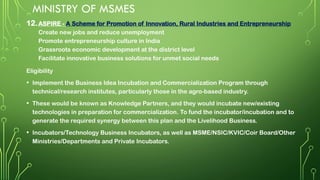
12.ASPIRE- A Scheme for Promotion of Innovation, Rural Industries and Entrepreneurship
Create new jobs and reduce unemployment
Promote entrepreneurship culture in India
Grassroots economic development at the district level
Facilitate innovative business solutions for unmet social needs
Eligibility
• Implement the Business Idea Incubation and Commercialization Program through
technical/research institutes, particularly those in the agro-based industry.
• These would be known as Knowledge Partners, and they would incubate new/existing
technologies in preparation for commercialization. To fund the incubator/incubation and to
generate the required synergy between this plan and the Livelihood Business.
• Incubators/Technology Business Incubators, as well as MSME/NSIC/KVIC/Coir Board/Other
Ministries/Departments and Private Incubators.
11.
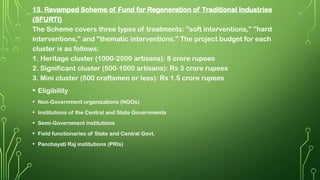
13. Revamped Schemeof Fund for Regeneration of Traditional Industries
(SFURTI)
The Scheme covers three types of treatments: "soft interventions," "hard
interventions," and "thematic interventions." The project budget for each
cluster is as follows:
1. Heritage cluster (1000-2500 artisans): 8 crore rupees
2. Significant cluster (500-1000 artisans): Rs 3 crore rupees
3. Mini cluster (500 craftsmen or less): Rs 1.5 crore rupees
• Eligibility
• Non-Government organizations (NGOs)
• Institutions of the Central and State Governments
• Semi-Government institutions
• Field functionaries of State and Central Govt.
• Panchayati Raj institutions (PRIs)
12.
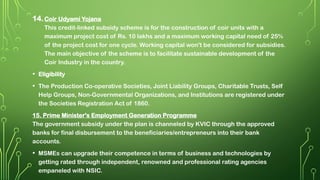
14.Coir Udyami Yojana
Thiscredit-linked subsidy scheme is for the construction of coir units with a
maximum project cost of Rs. 10 lakhs and a maximum working capital need of 25%
of the project cost for one cycle. Working capital won't be considered for subsidies.
The main objective of the scheme is to facilitate sustainable development of the
Coir Industry in the country.
• Eligibility
• The Production Co-operative Societies, Joint Liability Groups, Charitable Trusts, Self
Help Groups, Non-Governmental Organizations, and Institutions are registered under
the Societies Registration Act of 1860.
15. Prime Minister's Employment Generation Programme
The government subsidy under the plan is channeled by KVIC through the approved
banks for final disbursement to the beneficiaries/entrepreneurs into their bank
accounts.
• MSMEs can upgrade their competence in terms of business and technologies by
getting rated through independent, renowned and professional rating agencies
empaneled with NSIC.
13.
16. Science andTechnology (S&T) for Coir Institutions
By contacting the research center for help with technology transfer, incubation, testing, and
service facilities of the research institutions, the results of the study may be used at the field
level (The Central Coir Research Institute, Kalavoor and Central Institute of Coir Technology,
Bangalore)
• Eligibility
• All recently formed coir production/processing facilities will be qualified to apply for support. All
coir production and processing facilities that have been registered with the Coir Board in
accordance with the Coir Industry (Registration) Rules, 2008 and possess Udyog Aadhar are
eligible to apply for financial support for modernization under this scheme.
17. Interest Subsidy Eligibility Certificate (ISEC) for Khadi Institutions
According to the needs of the institutions, the ISEC Scheme makes loans accessible for working
capital at a reduced rate of interest of 4% annually. The Central Government, through KVIC, pays
the lending banks the difference between the actual lending rate and 4%.
• Eligibility
• The Khadi institutes have approved Khadi programmes and current Khadi certificates. The ISEC
Scheme exclusively supports the khadi and polyvastra sectors, however institutions registered
with the KVIC/State Khadi and Village Industries Boards (KVIBs) may apply for financing under
the Scheme.
14.
18. Coir VikasYojana
Provide coir yarn spinning rats, coir processing equipment, machinery, items, etc. with
a subsidy of 75% under Mahila Coir Yojana.
Aim at inculcating quality consciousness among the workers at grass root level and to
educate them on proper methods of producing standard quality fiber, yarn and
products.
Promote the establishment of coir-based units and the modernization of existing units
among coconut producers, business owners, and other stakeholders for improved
production, quality, and increased revenue.
• Eligibility
• MSMEs and Individuals.
15.
MINISTRY OF DEVELOPMENTOF NORTH EASTERN REGION
19.Initiative for Development of Entrepreneurs in Agriculture (IDEA)
The scheme aims to encourage agribusiness initiatives in the North-East Region and help make
agribusiness a successful Company
Maximum project size could be Rs.25 lakhs.
Term Loan from NEDFi = Maximum up to 75% of the project cost.
The promoter's contribution will be at least 25% of the project cost
Eligibility
• Graduates and Post graduates in agriculture and allied subjects
• Graduates, Post-graduates from other disciplines having experience and skill to undertake Agri
Business ventures
• The proposed units could be proprietorship, partnership or a company.
The promoter or their units must not be a defaulter in any government scheme and /or with any
bank or any other agencies.
• The proposed unit for which financial assistance is sought should be located within any of the
eight North-Eastern States.
16.
SMALL INDUSTRIES DEVELOPMENTBANK OF INDIA (SIDBI)
20.Tex Venture Fund
The Fund shall look for investing in companies involved in new and emerging fields
in the textile industry and allied products and services.
Maximum 50% of the project cost with a ceiling of Rs 3 crore is invested by SVCL.
(SIDBI Venture Capital Fund Ltd.)
Investments will typically be in innovative private power loom MSME companies.
• Eligibility
SCVL will invests in innovative business models in the the power loom and textile
related business models with a good management team.
Preference will be given to projects that offer new goods and technology or an
innovative business strategy with the ability to provide greater value proposition to
customers.
17.
21.The Samridhi Fund
TheSamridhi Fund is an approx. 430 crore social venture capital fund.
₹
Samridhi normally contributes funds in the range of INR 5-25 crore.
• SIDBI intends to establish the Samridhi Fund to give finance to social companies in Bihar, Uttar
Pradesh, Madhya Pradesh, Odisha, Chhattisgarh, Jharkhand, Rajasthan, and West Bengal that
can generate both financial and social benefits.
• Eligibility
• The following are the financing requirements:
• Be economically viable
• Provide poor access to markets
• Be socially relevant and influence the poor as customers, producers, or workers
• Increase capital flow to the aforementioned state
18.
22. Stand-Up India
StandUp India Scheme provides bank loans ranging from 10 lakh to 1 crore to at least one
scheduled caste (SC) or scheduled tribe borrower, as well as at least one woman, every
bank branch, for the establishment of a greenfield firm.
This business might be in manufacturing, services, or trading. In the case of non-
individual firms, a SC/ST or woman entrepreneur must possess at least 51 percent of the
ownership and controlling interest.
Eligibility
• SC/ST and/or female entrepreneurs over the age of 18
• Loans under the plan are exclusively accessible for greenfield projects. In this
context, Greenfield denotes the beneficiary's initial initiative in the
manufacturing, services, or trading sectors.
• In the event of non-individual firms, either SC/ST and/or Women Entrepreneurs
shall possess 51% of the ownership and controlling stakes.
• The borrower must not be in arrears with any bank or financial institution.
19.
NABARD WITH MINISTRYOF FINANCE
23.Swarojgar Credit Card
Swarojgar Credit Card (SCC) Scheme was launched in September 2003 to provide small
artisans, handloom weavers, and other self-employed persons, including micro-entrepreneurs,
SHGs, and others, with adequate, timely, and uninterrupted credit.
This plan provides a composite loan of Rs. 25,000 per applicant.
The security criteria, interest rate, and margin will be set by the RBI and will be posted on the
RBI website. This is granted for a five-year period.
• Eligibility Criteria
• Micro-entrepreneurs, Mall craftsmen, Handloom weavers, Service sector, Fishermen, self-
employed individuals, rickshaw proprietors, and other micro-enterprises, among others, are
eligible.
20.
NABARD
24.Dairy Entrepreneurship DevelopmentScheme
The Department of Animal Husbandry, Dairying, and Fisheries is executing the Dairy
Entrepreneurship Development Scheme (DEDS) to generate self-employment possibilities in the
dairy sector by offering back-end capital subsidies for bankable projects.
A back-end capital subsidy of 25% of the project cost for general farmers and 33% for SC/ST
farmers. The component-wise subsidy maximum will be subject to NABARD's indicated cost from
time to time.
• Eligible Beneficiaries
• Farmers, individual entrepreneurs, non-governmental organisations (NGOs), businesses, groups of
organised and unorganised sectors, and so on. Self-help Groups (SHGs), dairy cooperative societies,
milk unions, milk federations, and other organised sector groups exist.
• An individual will be eligible for help for all scheme components, but only once for each component.
• The plan can help more than one member of a family if they build up distinct apartments with
separate infrastructure in various areas. The distance between two such farms' borders should be at
least 500 metres.
21.
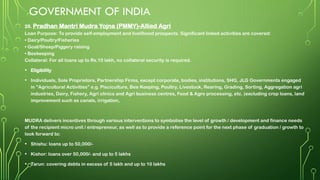
GOVERNMENT OF INDIA
25.Pradhan Mantri Mudra Yojna (PMMY)-Allied Agri
Loan Purpose: To provide self-employment and livelihood prospects. Significant linked activities are covered:
• Dairy/Poultry/Fisheries
• Goat/Sheep/Piggery raising
• Beekeeping
Collateral: For all loans up to Rs.10 lakh, no collateral security is required.
• Eligibility
• Individuals, Sole Proprietors, Partnership Firms, except corporate, bodies, institutions, SHG, JLG Governments engaged
in "Agricultural Activities" e.g. Pisciculture, Bee Keeping, Poultry, Livestock, Rearing, Grading, Sorting, Aggregation agri
industries, Dairy, Fishery, Agri clinics and Agri business centres, Food & Agro processing, etc. (excluding crop loans, land
improvement such as canals, irrigation,
MUDRA delivers incentives through various interventions to symbolise the level of growth / development and finance needs
of the recipient micro unit / entrepreneur, as well as to provide a reference point for the next phase of graduation / growth to
look forward to:
• Shishu: loans up to 50,000/-
• Kishor: loans over 50,000/- and up to 5 lakhs
• Tarun: covering debts in excess of 5 lakh and up to 10 lakhs
22.
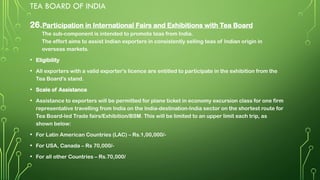
TEA BOARD OFINDIA
26.Participation in International Fairs and Exhibitions with Tea Board
The sub-component is intended to promote teas from India.
The effort aims to assist Indian exporters in consistently selling teas of Indian origin in
overseas markets.
• Eligibility
• All exporters with a valid exporter's licence are entitled to participate in the exhibition from the
Tea Board's stand.
• Scale of Assistance
• Assistance to exporters will be permitted for plane ticket in economy excursion class for one firm
representative travelling from India on the India-destination-India sector on the shortest route for
Tea Board-led Trade fairs/Exhibition/BSM. This will be limited to an upper limit each trip, as
shown below:
• For Latin American Countries (LAC) – Rs.1,00,000/-
• For USA, Canada – Rs 70,000/-
• For all other Countries – Rs.70,000/
23.
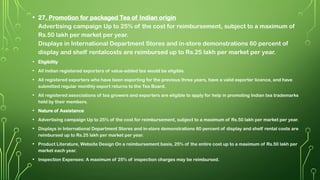
• 27. Promotionfor packaged Tea of Indian origin
Advertising campaign Up to 25% of the cost for reimbursement, subject to a maximum of
Rs.50 lakh per market per year.
Displays in International Department Stores and in-store demonstrations 60 percent of
display and shelf rentalcosts are reimbursed up to Rs.25 lakh per market per year.
• Eligibility
• All Indian registered exporters of value-added tea would be eligible.
• All registered exporters who have been exporting for the previous three years, have a valid exporter licence, and have
submitted regular monthly export returns to the Tea Board.
• All registered associations of tea growers and exporters are eligible to apply for help in promoting Indian tea trademarks
held by their members.
• Nature of Assistance
• Advertising campaign Up to 25% of the cost for reimbursement, subject to a maximum of Rs.50 lakh per market per year.
• Displays in International Department Stores and in-store demonstrations 60 percent of display and shelf rental costs are
reimbursed up to Rs.25 lakh per market per year.
• Product Literature, Website Design On a reimbursement basis, 25% of the entire cost up to a maximum of Rs.50 lakh per
market each year.
• Inspection Expenses: A maximum of 25% of inspection charges may be reimbursed.
24.
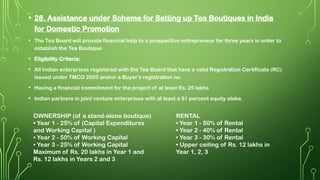
• 28. Assistanceunder Scheme for Setting up Tea Boutiques in India
for Domestic Promotion
• The Tea Board will provide financial help to a prospective entrepreneur for three years in order to
establish the Tea Boutique
• Eligibility Criteria:
• All Indian enterprises registered with the Tea Board that have a valid Registration Certificate (RC)
issued under TMCO 2003 and/or a Buyer's registration no.
• Having a financial commitment for the project of at least Rs. 25 lakhs
• Indian partners in joint venture enterprises with at least a 51 percent equity stake.
OWNERSHIP (of a stand-alone boutique)
• Year 1 - 25% of (Capital Expenditures
and Working Capital )
• Year 2 - 50% of Working Capital
• Year 3 - 25% of Working Capital
Maximum of Rs. 20 lakhs in Year 1 and
Rs. 12 lakhs in Years 2 and 3
RENTAL
• Year 1 - 50% of Rental
• Year 2 - 40% of Rental
• Year 3 - 30% of Rental
• Upper ceiling of Rs. 12 lakhs in
Year 1, 2, 3