Standard Treatment Guidelines Common Medical Emergencies – Dr J L Meena pg. 1
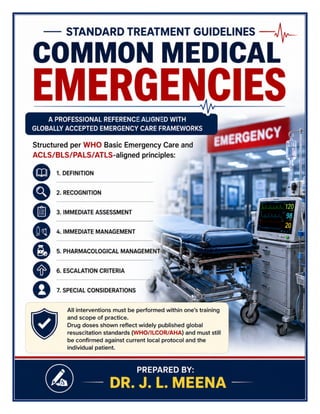
Standard Treatment Guidelines
Common Medical Emergencies
A Professional Reference Aligned with Globally Accepted Emergency Care Frameworks
Structured per WHO Basic Emergency Care and ACLS/BLS/PALS/ATLS-aligned principles: Definition → Recognition →
Immediate Assessment → Immediate Management → Pharmacological Management → Escalation Criteria → Special
Considerations
All interventions must be performed within one's training and scope of practice. Drug doses shown reflect widely published
global resuscitation standards (WHO/ILCOR/AHA) and must still be confirmed against current local protocol and the
individual patient.
Prepared by: Dr. J. L. Meena
Standard Treatment Guidelines Common Medical Emergencies – Dr J L Meena pg. 2
Foreword
Emergencies do not wait for convenience. Whether in a district hospital, a primary health centre, or the field, the
difference between a good outcome and a tragic one is often measured in minutes and in the clarity of the response.
This reference has been compiled to bring the core principles of globally accepted emergency care - as reflected in WHO
Basic Emergency Care, ACLS/BLS/PALS, ATLS, and related frameworks - into a single, structured document for quick
orientation and recall. It is meant to reinforce, not replace, the hands-on training every health worker and first
responder must undergo.
I hope this guideline serves as a useful companion for healthcare providers, students, and first responders working to
save lives in the critical first moments of a medical emergency.
Dr. J. L. Meena
Standard Treatment Guidelines Common Medical Emergencies – Dr J L Meena pg. 3
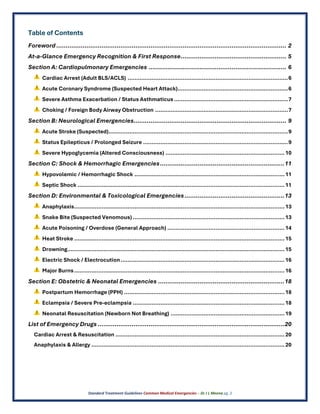
Table of Contents
Foreword .......................................................................................................................... 2
At-a-Glance Emergency Recognition & First Response........................................................ 5
Section A: Cardiopulmonary Emergencies ......................................................................... 6
⚠ Cardiac Arrest (Adult BLS/ACLS) .............................................................................................6
⚠ Acute Coronary Syndrome (Suspected Heart Attack)................................................................6
⚠ Severe Asthma Exacerbation / Status Asthmaticus ..................................................................7
⚠ Choking / Foreign Body Airway Obstruction .............................................................................7
Section B: Neurological Emergencies................................................................................. 9
⚠ Acute Stroke (Suspected)........................................................................................................9
⚠ Status Epilepticus / Prolonged Seizure ....................................................................................9
⚠ Severe Hypoglycemia (Altered Consciousness) .....................................................................10
Section C: Shock & Hemorrhagic Emergencies..................................................................11
⚠ Hypovolemic / Hemorrhagic Shock .......................................................................................11
⚠ Septic Shock ........................................................................................................................11
Section D: Environmental & Toxicological Emergencies.....................................................13
⚠ Anaphylaxis..........................................................................................................................13
⚠ Snake Bite (Suspected Venomous) ........................................................................................13
⚠ Acute Poisoning / Overdose (General Approach) ....................................................................14
⚠ Heat Stroke ..........................................................................................................................15
⚠ Drowning..............................................................................................................................15
⚠ Electric Shock / Electrocution...............................................................................................16
⚠ Major Burns..........................................................................................................................16
Section E: Obstetric & Neonatal Emergencies ...................................................................18
⚠ Postpartum Hemorrhage (PPH) .............................................................................................18
⚠ Eclampsia / Severe Pre-eclampsia ........................................................................................18
⚠ Neonatal Resuscitation (Newborn Not Breathing) ..................................................................19
List of Emergency Drugs ...................................................................................................20
Cardiac Arrest & Resuscitation ..................................................................................................20
Anaphylaxis & Allergy ................................................................................................................20
Standard Treatment Guidelines Common Medical Emergencies – Dr J L Meena pg. 4
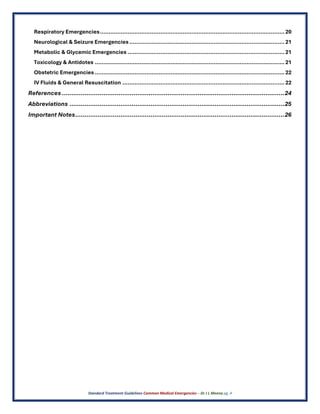
Respiratory Emergencies...........................................................................................................20
Neurological & Seizure Emergencies..........................................................................................21
Metabolic & Glycemic Emergencies ...........................................................................................21
Toxicology & Antidotes ..............................................................................................................21
Obstetric Emergencies ..............................................................................................................22
IV Fluids & General Resuscitation ..............................................................................................22
References ......................................................................................................................24
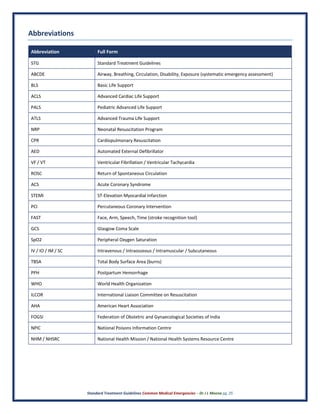
Abbreviations ..................................................................................................................25
Important Notes...............................................................................................................26
Standard Treatment Guidelines Common Medical Emergencies – Dr J L Meena pg. 5
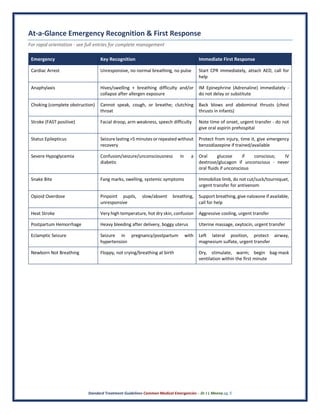
At-a-Glance Emergency Recognition & First Response
For rapid orientation - see full entries for complete management
Emergency Key Recognition Immediate First Response
Cardiac Arrest Unresponsive, no normal breathing, no pulse Start CPR immediately, attach AED, call for
help
Anaphylaxis Hives/swelling + breathing difficulty and/or
collapse after allergen exposure
IM Epinephrine (Adrenaline) immediately -
do not delay or substitute
Choking (complete obstruction) Cannot speak, cough, or breathe; clutching
throat
Back blows and abdominal thrusts (chest
thrusts in infants)
Stroke (FAST positive) Facial droop, arm weakness, speech difficulty Note time of onset, urgent transfer - do not
give oral aspirin prehospital
Status Epilepticus Seizure lasting >5 minutes or repeated without
recovery
Protect from injury, time it, give emergency
benzodiazepine if trained/available
Severe Hypoglycemia Confusion/seizure/unconsciousness in a
diabetic
Oral glucose if conscious; IV
dextrose/glucagon if unconscious - never
oral fluids if unconscious
Snake Bite Fang marks, swelling, systemic symptoms Immobilize limb, do not cut/suck/tourniquet,
urgent transfer for antivenom
Opioid Overdose Pinpoint pupils, slow/absent breathing,
unresponsive
Support breathing, give naloxone if available,
call for help
Heat Stroke Very high temperature, hot dry skin, confusion Aggressive cooling, urgent transfer
Postpartum Hemorrhage Heavy bleeding after delivery, boggy uterus Uterine massage, oxytocin, urgent transfer
Eclamptic Seizure Seizure in pregnancy/postpartum with
hypertension
Left lateral position, protect airway,
magnesium sulfate, urgent transfer
Newborn Not Breathing Floppy, not crying/breathing at birth Dry, stimulate, warm; begin bag-mask
ventilation within the first minute
Standard Treatment Guidelines Common Medical Emergencies – Dr J L Meena pg. 6
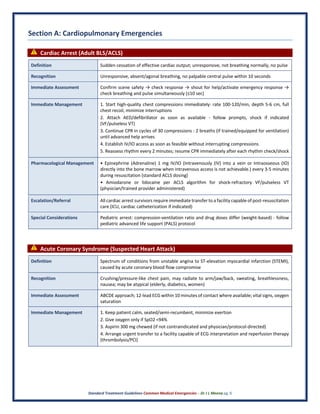
Section A: Cardiopulmonary Emergencies
⚠ Cardiac Arrest (Adult BLS/ACLS)
Definition Sudden cessation of effective cardiac output; unresponsive, not breathing normally, no pulse
Recognition Unresponsive, absent/agonal breathing, no palpable central pulse within 10 seconds
Immediate Assessment Confirm scene safety → check response → shout for help/activate emergency response →
check breathing and pulse simultaneously (≤10 sec)
Immediate Management 1. Start high-quality chest compressions immediately: rate 100-120/min, depth 5-6 cm, full
chest recoil, minimize interruptions
2. Attach AED/defibrillator as soon as available - follow prompts, shock if indicated
(VF/pulseless VT)
3. Continue CPR in cycles of 30 compressions : 2 breaths (if trained/equipped for ventilation)
until advanced help arrives
4. Establish IV/IO access as soon as feasible without interrupting compressions
5. Reassess rhythm every 2 minutes; resume CPR immediately after each rhythm check/shock
Pharmacological Management • Epinephrine (Adrenaline) 1 mg IV/IO (Intravenously (IV) into a vein or Intraosseous (IO)
directly into the bone marrow when intravenous access is not achievable.) every 3-5 minutes
during resuscitation (standard ACLS dosing)
• Amiodarone or lidocaine per ACLS algorithm for shock-refractory VF/pulseless VT
(physician/trained provider administered)
Escalation/Referral All cardiac arrest survivors require immediate transfer to a facility capable of post-resuscitation
care (ICU, cardiac catheterization if indicated)
Special Considerations Pediatric arrest: compression-ventilation ratio and drug doses differ (weight-based) - follow
pediatric advanced life support (PALS) protocol
⚠ Acute Coronary Syndrome (Suspected Heart Attack)
Definition Spectrum of conditions from unstable angina to ST-elevation myocardial infarction (STEMI),
caused by acute coronary blood flow compromise
Recognition Crushing/pressure-like chest pain, may radiate to arm/jaw/back, sweating, breathlessness,
nausea; may be atypical (elderly, diabetics, women)
Immediate Assessment ABCDE approach; 12-lead ECG within 10 minutes of contact where available; vital signs, oxygen
saturation
Immediate Management 1. Keep patient calm, seated/semi-recumbent, minimize exertion
2. Give oxygen only if SpO2 <94%
3. Aspirin 300 mg chewed (if not contraindicated and physician/protocol-directed)
4. Arrange urgent transfer to a facility capable of ECG interpretation and reperfusion therapy
(thrombolysis/PCI)
Standard Treatment Guidelines Common Medical Emergencies – Dr J L Meena pg. 7
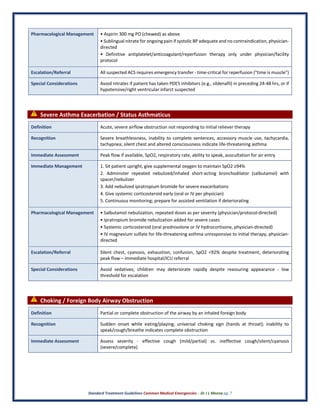
Pharmacological Management • Aspirin 300 mg PO (chewed) as above
• Sublingual nitrate for ongoing pain if systolic BP adequate and no contraindication, physician-
directed
• Definitive antiplatelet/anticoagulant/reperfusion therapy only under physician/facility
protocol
Escalation/Referral All suspected ACS requires emergency transfer - time-critical for reperfusion ("time is muscle")
Special Considerations Avoid nitrates if patient has taken PDE5 inhibitors (e.g., sildenafil) in preceding 24-48 hrs, or if
hypotensive/right ventricular infarct suspected
⚠ Severe Asthma Exacerbation / Status Asthmaticus
Definition Acute, severe airflow obstruction not responding to initial reliever therapy
Recognition Severe breathlessness, inability to complete sentences, accessory muscle use, tachycardia,
tachypnea; silent chest and altered consciousness indicate life-threatening asthma
Immediate Assessment Peak flow if available, SpO2, respiratory rate, ability to speak, auscultation for air entry
Immediate Management 1. Sit patient upright, give supplemental oxygen to maintain SpO2 ≥94%
2. Administer repeated nebulized/inhaled short-acting bronchodilator (salbutamol) with
spacer/nebulizer
3. Add nebulized ipratropium bromide for severe exacerbations
4. Give systemic corticosteroid early (oral or IV per physician)
5. Continuous monitoring; prepare for assisted ventilation if deteriorating
Pharmacological Management • Salbutamol nebulization, repeated doses as per severity (physician/protocol-directed)
• Ipratropium bromide nebulization added for severe cases
• Systemic corticosteroid (oral prednisolone or IV hydrocortisone, physician-directed)
• IV magnesium sulfate for life-threatening asthma unresponsive to initial therapy, physician-
directed
Escalation/Referral Silent chest, cyanosis, exhaustion, confusion, SpO2 <92% despite treatment, deteriorating
peak flow – immediate hospital/ICU referral
Special Considerations Avoid sedatives; children may deteriorate rapidly despite reassuring appearance - low
threshold for escalation
⚠ Choking / Foreign Body Airway Obstruction
Definition Partial or complete obstruction of the airway by an inhaled foreign body
Recognition Sudden onset while eating/playing; universal choking sign (hands at throat); inability to
speak/cough/breathe indicates complete obstruction
Immediate Assessment Assess severity - effective cough (mild/partial) vs. ineffective cough/silent/cyanosis
(severe/complete)
Standard Treatment Guidelines Common Medical Emergencies – Dr J L Meena pg. 8
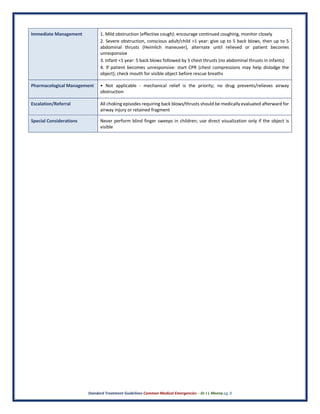
Immediate Management 1. Mild obstruction (effective cough): encourage continued coughing, monitor closely
2. Severe obstruction, conscious adult/child >1 year: give up to 5 back blows, then up to 5
abdominal thrusts (Heimlich maneuver), alternate until relieved or patient becomes
unresponsive
3. Infant <1 year: 5 back blows followed by 5 chest thrusts (no abdominal thrusts in infants)
4. If patient becomes unresponsive: start CPR (chest compressions may help dislodge the
object); check mouth for visible object before rescue breaths
Pharmacological Management • Not applicable - mechanical relief is the priority; no drug prevents/relieves airway
obstruction
Escalation/Referral All choking episodes requiring back blows/thrusts should be medically evaluated afterward for
airway injury or retained fragment
Special Considerations Never perform blind finger sweeps in children; use direct visualization only if the object is
visible
Standard Treatment Guidelines Common Medical Emergencies – Dr J L Meena pg. 9
Section B: Neurological Emergencies
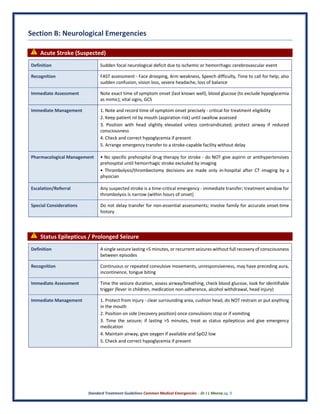
⚠ Acute Stroke (Suspected)
Definition Sudden focal neurological deficit due to ischemic or hemorrhagic cerebrovascular event
Recognition FAST assessment - Face drooping, Arm weakness, Speech difficulty, Time to call for help; also
sudden confusion, vision loss, severe headache, loss of balance
Immediate Assessment Note exact time of symptom onset (last known well), blood glucose (to exclude hypoglycemia
as mimic), vital signs, GCS
Immediate Management 1. Note and record time of symptom onset precisely - critical for treatment eligibility
2. Keep patient nil by mouth (aspiration risk) until swallow assessed
3. Position with head slightly elevated unless contraindicated; protect airway if reduced
consciousness
4. Check and correct hypoglycemia if present
5. Arrange emergency transfer to a stroke-capable facility without delay
Pharmacological Management • No specific prehospital drug therapy for stroke - do NOT give aspirin or antihypertensives
prehospital until hemorrhagic stroke excluded by imaging
• Thrombolysis/thrombectomy decisions are made only in-hospital after CT imaging by a
physician
Escalation/Referral Any suspected stroke is a time-critical emergency - immediate transfer; treatment window for
thrombolysis is narrow (within hours of onset)
Special Considerations Do not delay transfer for non-essential assessments; involve family for accurate onset-time
history
⚠ Status Epilepticus / Prolonged Seizure
Definition A single seizure lasting >5 minutes, or recurrent seizures without full recovery of consciousness
between episodes
Recognition Continuous or repeated convulsive movements, unresponsiveness, may have preceding aura,
incontinence, tongue biting
Immediate Assessment Time the seizure duration, assess airway/breathing, check blood glucose, look for identifiable
trigger (fever in children, medication non-adherence, alcohol withdrawal, head injury)
Immediate Management 1. Protect from injury - clear surrounding area, cushion head, do NOT restrain or put anything
in the mouth
2. Position on side (recovery position) once convulsions stop or if vomiting
3. Time the seizure; if lasting >5 minutes, treat as status epilepticus and give emergency
medication
4. Maintain airway, give oxygen if available and SpO2 low
5. Check and correct hypoglycemia if present
Standard Treatment Guidelines Common Medical Emergencies – Dr J L Meena pg. 10
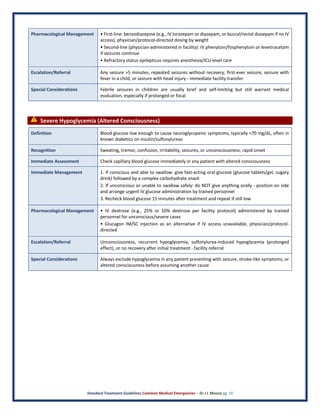
Pharmacological Management • First-line: benzodiazepine (e.g., IV lorazepam or diazepam, or buccal/rectal diazepam if no IV
access), physician/protocol-directed dosing by weight
• Second-line (physician-administered in facility): IV phenytoin/fosphenytoin or levetiracetam
if seizures continue
• Refractory status epilepticus requires anesthesia/ICU-level care
Escalation/Referral Any seizure >5 minutes, repeated seizures without recovery, first-ever seizure, seizure with
fever in a child, or seizure with head injury - immediate facility transfer
Special Considerations Febrile seizures in children are usually brief and self-limiting but still warrant medical
evaluation, especially if prolonged or focal
⚠ Severe Hypoglycemia (Altered Consciousness)
Definition Blood glucose low enough to cause neuroglycopenic symptoms, typically <70 mg/dL, often in
known diabetics on insulin/sulfonylureas
Recognition Sweating, tremor, confusion, irritability, seizures, or unconsciousness; rapid onset
Immediate Assessment Check capillary blood glucose immediately in any patient with altered consciousness
Immediate Management 1. If conscious and able to swallow: give fast-acting oral glucose (glucose tablets/gel, sugary
drink) followed by a complex carbohydrate snack
2. If unconscious or unable to swallow safely: do NOT give anything orally - position on side
and arrange urgent IV glucose administration by trained personnel
3. Recheck blood glucose 15 minutes after treatment and repeat if still low
Pharmacological Management • IV dextrose (e.g., 25% or 10% dextrose per facility protocol) administered by trained
personnel for unconscious/severe cases
• Glucagon IM/SC injection as an alternative if IV access unavailable, physician/protocol-
directed
Escalation/Referral Unconsciousness, recurrent hypoglycemia, sulfonylurea-induced hypoglycemia (prolonged
effect), or no recovery after initial treatment - facility referral
Special Considerations Always exclude hypoglycemia in any patient presenting with seizure, stroke-like symptoms, or
altered consciousness before assuming another cause
Standard Treatment Guidelines Common Medical Emergencies – Dr J L Meena pg. 11
Section C: Shock & Hemorrhagic Emergencies
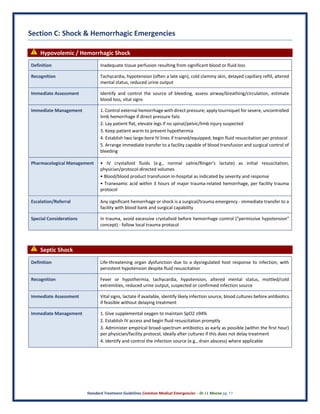
⚠ Hypovolemic / Hemorrhagic Shock
Definition Inadequate tissue perfusion resulting from significant blood or fluid loss
Recognition Tachycardia, hypotension (often a late sign), cold clammy skin, delayed capillary refill, altered
mental status, reduced urine output
Immediate Assessment Identify and control the source of bleeding, assess airway/breathing/circulation, estimate
blood loss, vital signs
Immediate Management 1. Control external hemorrhage with direct pressure; apply tourniquet for severe, uncontrolled
limb hemorrhage if direct pressure fails
2. Lay patient flat, elevate legs if no spinal/pelvic/limb injury suspected
3. Keep patient warm to prevent hypothermia
4. Establish two large-bore IV lines if trained/equipped; begin fluid resuscitation per protocol
5. Arrange immediate transfer to a facility capable of blood transfusion and surgical control of
bleeding
Pharmacological Management • IV crystalloid fluids (e.g., normal saline/Ringer's lactate) as initial resuscitation,
physician/protocol-directed volumes
• Blood/blood product transfusion in-hospital as indicated by severity and response
• Tranexamic acid within 3 hours of major trauma-related hemorrhage, per facility trauma
protocol
Escalation/Referral Any significant hemorrhage or shock is a surgical/trauma emergency - immediate transfer to a
facility with blood bank and surgical capability
Special Considerations In trauma, avoid excessive crystalloid before hemorrhage control ("permissive hypotension"
concept) - follow local trauma protocol
⚠ Septic Shock
Definition Life-threatening organ dysfunction due to a dysregulated host response to infection, with
persistent hypotension despite fluid resuscitation
Recognition Fever or hypothermia, tachycardia, hypotension, altered mental status, mottled/cold
extremities, reduced urine output, suspected or confirmed infection source
Immediate Assessment Vital signs, lactate if available, identify likely infection source, blood cultures before antibiotics
if feasible without delaying treatment
Immediate Management 1. Give supplemental oxygen to maintain SpO2 ≥94%
2. Establish IV access and begin fluid resuscitation promptly
3. Administer empirical broad-spectrum antibiotics as early as possible (within the first hour)
per physician/facility protocol, ideally after cultures if this does not delay treatment
4. Identify and control the infection source (e.g., drain abscess) where applicable
Standard Treatment Guidelines Common Medical Emergencies – Dr J L Meena pg. 12
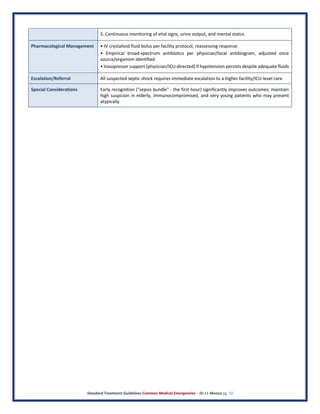
5. Continuous monitoring of vital signs, urine output, and mental status
Pharmacological Management • IV crystalloid fluid bolus per facility protocol, reassessing response
• Empirical broad-spectrum antibiotics per physician/local antibiogram, adjusted once
source/organism identified
• Vasopressor support (physician/ICU-directed) if hypotension persists despite adequate fluids
Escalation/Referral All suspected septic shock requires immediate escalation to a higher facility/ICU-level care
Special Considerations Early recognition ("sepsis bundle" - the first hour) significantly improves outcomes; maintain
high suspicion in elderly, immunocompromised, and very young patients who may present
atypically
Standard Treatment Guidelines Common Medical Emergencies – Dr J L Meena pg. 13
Section D: Environmental & Toxicological Emergencies
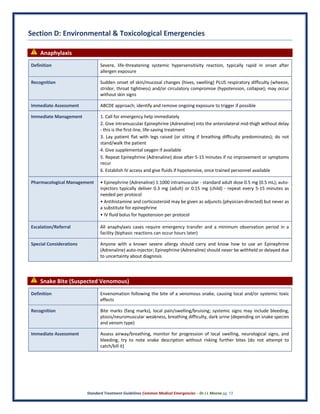
⚠ Anaphylaxis
Definition Severe, life-threatening systemic hypersensitivity reaction, typically rapid in onset after
allergen exposure
Recognition Sudden onset of skin/mucosal changes (hives, swelling) PLUS respiratory difficulty (wheeze,
stridor, throat tightness) and/or circulatory compromise (hypotension, collapse); may occur
without skin signs
Immediate Assessment ABCDE approach; identify and remove ongoing exposure to trigger if possible
Immediate Management 1. Call for emergency help immediately
2. Give intramuscular Epinephrine (Adrenaline) into the anterolateral mid-thigh without delay
- this is the first-line, life-saving treatment
3. Lay patient flat with legs raised (or sitting if breathing difficulty predominates); do not
stand/walk the patient
4. Give supplemental oxygen if available
5. Repeat Epinephrine (Adrenaline) dose after 5-15 minutes if no improvement or symptoms
recur
6. Establish IV access and give fluids if hypotensive, once trained personnel available
Pharmacological Management • Epinephrine (Adrenaline) 1:1000 intramuscular - standard adult dose 0.5 mg (0.5 mL); auto-
injectors typically deliver 0.3 mg (adult) or 0.15 mg (child) - repeat every 5-15 minutes as
needed per protocol
• Antihistamine and corticosteroid may be given as adjuncts (physician-directed) but never as
a substitute for epinephrine
• IV fluid bolus for hypotension per protocol
Escalation/Referral All anaphylaxis cases require emergency transfer and a minimum observation period in a
facility (biphasic reactions can occur hours later)
Special Considerations Anyone with a known severe allergy should carry and know how to use an Epinephrine
(Adrenaline) auto-injector; Epinephrine (Adrenaline) should never be withheld or delayed due
to uncertainty about diagnosis
⚠ Snake Bite (Suspected Venomous)
Definition Envenomation following the bite of a venomous snake, causing local and/or systemic toxic
effects
Recognition Bite marks (fang marks), local pain/swelling/bruising; systemic signs may include bleeding,
ptosis/neuromuscular weakness, breathing difficulty, dark urine (depending on snake species
and venom type)
Immediate Assessment Assess airway/breathing, monitor for progression of local swelling, neurological signs, and
bleeding; try to note snake description without risking further bites (do not attempt to
catch/kill it)
Standard Treatment Guidelines Common Medical Emergencies – Dr J L Meena pg. 14
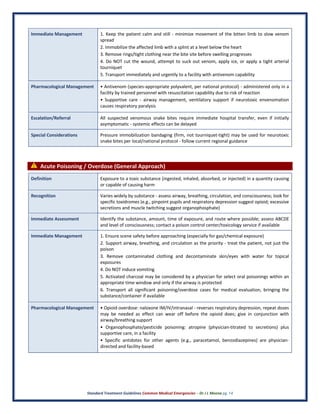
Immediate Management 1. Keep the patient calm and still - minimize movement of the bitten limb to slow venom
spread
2. Immobilize the affected limb with a splint at a level below the heart
3. Remove rings/tight clothing near the bite site before swelling progresses
4. Do NOT cut the wound, attempt to suck out venom, apply ice, or apply a tight arterial
tourniquet
5. Transport immediately and urgently to a facility with antivenom capability
Pharmacological Management • Antivenom (species-appropriate polyvalent, per national protocol) - administered only in a
facility by trained personnel with resuscitation capability due to risk of reaction
• Supportive care - airway management, ventilatory support if neurotoxic envenomation
causes respiratory paralysis
Escalation/Referral All suspected venomous snake bites require immediate hospital transfer, even if initially
asymptomatic - systemic effects can be delayed
Special Considerations Pressure immobilization bandaging (firm, not tourniquet-tight) may be used for neurotoxic
snake bites per local/national protocol - follow current regional guidance
⚠ Acute Poisoning / Overdose (General Approach)
Definition Exposure to a toxic substance (ingested, inhaled, absorbed, or injected) in a quantity causing
or capable of causing harm
Recognition Varies widely by substance - assess airway, breathing, circulation, and consciousness; look for
specific toxidromes (e.g., pinpoint pupils and respiratory depression suggest opioid; excessive
secretions and muscle twitching suggest organophosphate)
Immediate Assessment Identify the substance, amount, time of exposure, and route where possible; assess ABCDE
and level of consciousness; contact a poison control center/toxicology service if available
Immediate Management 1. Ensure scene safety before approaching (especially for gas/chemical exposure)
2. Support airway, breathing, and circulation as the priority - treat the patient, not just the
poison
3. Remove contaminated clothing and decontaminate skin/eyes with water for topical
exposures
4. Do NOT induce vomiting
5. Activated charcoal may be considered by a physician for select oral poisonings within an
appropriate time window and only if the airway is protected
6. Transport all significant poisoning/overdose cases for medical evaluation, bringing the
substance/container if available
Pharmacological Management • Opioid overdose: naloxone IM/IV/intranasal - reverses respiratory depression, repeat doses
may be needed as effect can wear off before the opioid does; give in conjunction with
airway/breathing support
• Organophosphate/pesticide poisoning: atropine (physician-titrated to secretions) plus
supportive care, in a facility
• Specific antidotes for other agents (e.g., paracetamol, benzodiazepines) are physician-
directed and facility-based
Standard Treatment Guidelines Common Medical Emergencies – Dr J L Meena pg. 15
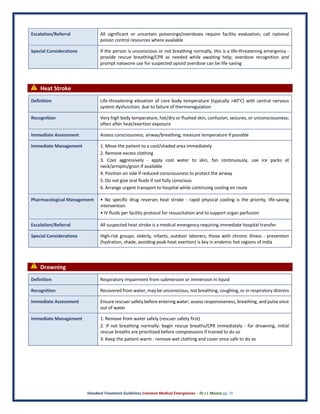
Escalation/Referral All significant or uncertain poisonings/overdoses require facility evaluation; call national
poison control resources where available
Special Considerations If the person is unconscious or not breathing normally, this is a life-threatening emergency -
provide rescue breathing/CPR as needed while awaiting help; overdose recognition and
prompt naloxone use for suspected opioid overdose can be life-saving
⚠ Heat Stroke
Definition Life-threatening elevation of core body temperature (typically >40°C) with central nervous
system dysfunction, due to failure of thermoregulation
Recognition Very high body temperature, hot/dry or flushed skin, confusion, seizures, or unconsciousness;
often after heat/exertion exposure
Immediate Assessment Assess consciousness, airway/breathing, measure temperature if possible
Immediate Management 1. Move the patient to a cool/shaded area immediately
2. Remove excess clothing
3. Cool aggressively - apply cool water to skin, fan continuously, use ice packs at
neck/armpits/groin if available
4. Position on side if reduced consciousness to protect the airway
5. Do not give oral fluids if not fully conscious
6. Arrange urgent transport to hospital while continuing cooling en route
Pharmacological Management • No specific drug reverses heat stroke - rapid physical cooling is the priority, life-saving
intervention
• IV fluids per facility protocol for resuscitation and to support organ perfusion
Escalation/Referral All suspected heat stroke is a medical emergency requiring immediate hospital transfer
Special Considerations High-risk groups: elderly, infants, outdoor laborers, those with chronic illness - prevention
(hydration, shade, avoiding peak-heat exertion) is key in endemic hot regions of India
⚠ Drowning
Definition Respiratory impairment from submersion or immersion in liquid
Recognition Recovered from water, may be unconscious, not breathing, coughing, or in respiratory distress
Immediate Assessment Ensure rescuer safety before entering water; assess responsiveness, breathing, and pulse once
out of water
Immediate Management 1. Remove from water safely (rescuer safety first)
2. If not breathing normally: begin rescue breaths/CPR immediately - for drowning, initial
rescue breaths are prioritized before compressions if trained to do so
3. Keep the patient warm - remove wet clothing and cover once safe to do so
Standard Treatment Guidelines Common Medical Emergencies – Dr J L Meena pg. 16
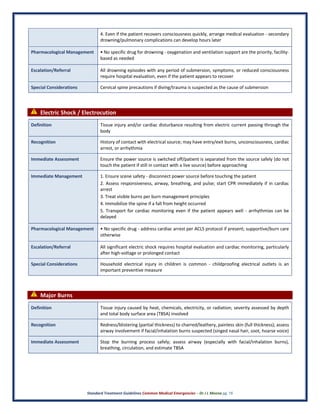
4. Even if the patient recovers consciousness quickly, arrange medical evaluation - secondary
drowning/pulmonary complications can develop hours later
Pharmacological Management • No specific drug for drowning - oxygenation and ventilation support are the priority, facility-
based as needed
Escalation/Referral All drowning episodes with any period of submersion, symptoms, or reduced consciousness
require hospital evaluation, even if the patient appears to recover
Special Considerations Cervical spine precautions if diving/trauma is suspected as the cause of submersion
⚠ Electric Shock / Electrocution
Definition Tissue injury and/or cardiac disturbance resulting from electric current passing through the
body
Recognition History of contact with electrical source; may have entry/exit burns, unconsciousness, cardiac
arrest, or arrhythmia
Immediate Assessment Ensure the power source is switched off/patient is separated from the source safely (do not
touch the patient if still in contact with a live source) before approaching
Immediate Management 1. Ensure scene safety - disconnect power source before touching the patient
2. Assess responsiveness, airway, breathing, and pulse; start CPR immediately if in cardiac
arrest
3. Treat visible burns per burn management principles
4. Immobilize the spine if a fall from height occurred
5. Transport for cardiac monitoring even if the patient appears well - arrhythmias can be
delayed
Pharmacological Management • No specific drug - address cardiac arrest per ACLS protocol if present; supportive/burn care
otherwise
Escalation/Referral All significant electric shock requires hospital evaluation and cardiac monitoring, particularly
after high-voltage or prolonged contact
Special Considerations Household electrical injury in children is common - childproofing electrical outlets is an
important preventive measure
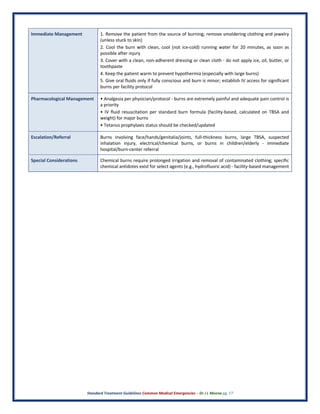
⚠ Major Burns
Definition Tissue injury caused by heat, chemicals, electricity, or radiation; severity assessed by depth
and total body surface area (TBSA) involved
Recognition Redness/blistering (partial thickness) to charred/leathery, painless skin (full thickness); assess
airway involvement if facial/inhalation burns suspected (singed nasal hair, soot, hoarse voice)
Immediate Assessment Stop the burning process safely; assess airway (especially with facial/inhalation burns),
breathing, circulation, and estimate TBSA
Standard Treatment Guidelines Common Medical Emergencies – Dr J L Meena pg. 17
Immediate Management 1. Remove the patient from the source of burning; remove smoldering clothing and jewelry
(unless stuck to skin)
2. Cool the burn with clean, cool (not ice-cold) running water for 20 minutes, as soon as
possible after injury
3. Cover with a clean, non-adherent dressing or clean cloth - do not apply ice, oil, butter, or
toothpaste
4. Keep the patient warm to prevent hypothermia (especially with large burns)
5. Give oral fluids only if fully conscious and burn is minor; establish IV access for significant
burns per facility protocol
Pharmacological Management • Analgesia per physician/protocol - burns are extremely painful and adequate pain control is
a priority
• IV fluid resuscitation per standard burn formula (facility-based, calculated on TBSA and
weight) for major burns
• Tetanus prophylaxis status should be checked/updated
Escalation/Referral Burns involving face/hands/genitalia/joints, full-thickness burns, large TBSA, suspected
inhalation injury, electrical/chemical burns, or burns in children/elderly - immediate
hospital/burn-center referral
Special Considerations Chemical burns require prolonged irrigation and removal of contaminated clothing; specific
chemical antidotes exist for select agents (e.g., hydrofluoric acid) - facility-based management
Standard Treatment Guidelines Common Medical Emergencies – Dr J L Meena pg. 18
Section E: Obstetric & Neonatal Emergencies
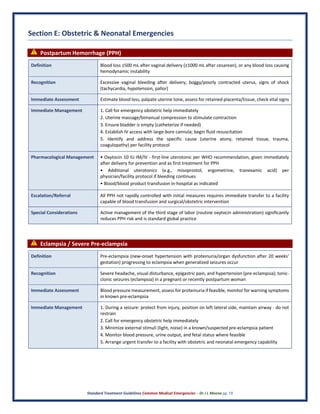
⚠ Postpartum Hemorrhage (PPH)
Definition Blood loss ≥500 mL after vaginal delivery (≥1000 mL after cesarean), or any blood loss causing
hemodynamic instability
Recognition Excessive vaginal bleeding after delivery, boggy/poorly contracted uterus, signs of shock
(tachycardia, hypotension, pallor)
Immediate Assessment Estimate blood loss, palpate uterine tone, assess for retained placenta/tissue, check vital signs
Immediate Management 1. Call for emergency obstetric help immediately
2. Uterine massage/bimanual compression to stimulate contraction
3. Ensure bladder is empty (catheterize if needed)
4. Establish IV access with large-bore cannula; begin fluid resuscitation
5. Identify and address the specific cause (uterine atony, retained tissue, trauma,
coagulopathy) per facility protocol
Pharmacological Management • Oxytocin 10 IU IM/IV - first-line uterotonic per WHO recommendation, given immediately
after delivery for prevention and as first treatment for PPH
• Additional uterotonics (e.g., misoprostol, ergometrine, tranexamic acid) per
physician/facility protocol if bleeding continues
• Blood/blood product transfusion in-hospital as indicated
Escalation/Referral All PPH not rapidly controlled with initial measures requires immediate transfer to a facility
capable of blood transfusion and surgical/obstetric intervention
Special Considerations Active management of the third stage of labor (routine oxytocin administration) significantly
reduces PPH risk and is standard global practice
⚠ Eclampsia / Severe Pre-eclampsia
Definition Pre-eclampsia (new-onset hypertension with proteinuria/organ dysfunction after 20 weeks'
gestation) progressing to eclampsia when generalized seizures occur
Recognition Severe headache, visual disturbance, epigastric pain, and hypertension (pre-eclampsia); tonic-
clonic seizures (eclampsia) in a pregnant or recently postpartum woman
Immediate Assessment Blood pressure measurement, assess for proteinuria if feasible, monitor for warning symptoms
in known pre-eclampsia
Immediate Management 1. During a seizure: protect from injury, position on left lateral side, maintain airway - do not
restrain
2. Call for emergency obstetric help immediately
3. Minimize external stimuli (light, noise) in a known/suspected pre-eclampsia patient
4. Monitor blood pressure, urine output, and fetal status where feasible
5. Arrange urgent transfer to a facility with obstetric and neonatal emergency capability
Standard Treatment Guidelines Common Medical Emergencies – Dr J L Meena pg. 19
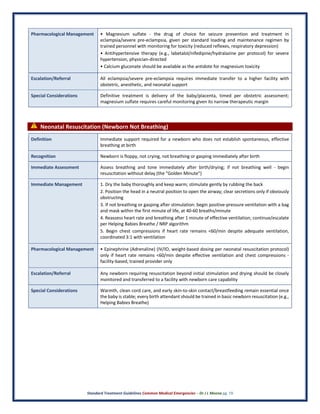
Pharmacological Management • Magnesium sulfate - the drug of choice for seizure prevention and treatment in
eclampsia/severe pre-eclampsia, given per standard loading and maintenance regimen by
trained personnel with monitoring for toxicity (reduced reflexes, respiratory depression)
• Antihypertensive therapy (e.g., labetalol/nifedipine/hydralazine per protocol) for severe
hypertension, physician-directed
• Calcium gluconate should be available as the antidote for magnesium toxicity
Escalation/Referral All eclampsia/severe pre-eclampsia requires immediate transfer to a higher facility with
obstetric, anesthetic, and neonatal support
Special Considerations Definitive treatment is delivery of the baby/placenta, timed per obstetric assessment;
magnesium sulfate requires careful monitoring given its narrow therapeutic margin
⚠ Neonatal Resuscitation (Newborn Not Breathing)
Definition Immediate support required for a newborn who does not establish spontaneous, effective
breathing at birth
Recognition Newborn is floppy, not crying, not breathing or gasping immediately after birth
Immediate Assessment Assess breathing and tone immediately after birth/drying; if not breathing well - begin
resuscitation without delay (the "Golden Minute")
Immediate Management 1. Dry the baby thoroughly and keep warm; stimulate gently by rubbing the back
2. Position the head in a neutral position to open the airway; clear secretions only if obviously
obstructing
3. If not breathing or gasping after stimulation: begin positive-pressure ventilation with a bag
and mask within the first minute of life, at 40-60 breaths/minute
4. Reassess heart rate and breathing after 1 minute of effective ventilation; continue/escalate
per Helping Babies Breathe / NRP algorithm
5. Begin chest compressions if heart rate remains <60/min despite adequate ventilation,
coordinated 3:1 with ventilation
Pharmacological Management • Epinephrine (Adrenaline) (IV/IO, weight-based dosing per neonatal resuscitation protocol)
only if heart rate remains <60/min despite effective ventilation and chest compressions -
facility-based, trained provider only
Escalation/Referral Any newborn requiring resuscitation beyond initial stimulation and drying should be closely
monitored and transferred to a facility with newborn care capability
Special Considerations Warmth, clean cord care, and early skin-to-skin contact/breastfeeding remain essential once
the baby is stable; every birth attendant should be trained in basic newborn resuscitation (e.g.,
Helping Babies Breathe)
Standard Treatment Guidelines Common Medical Emergencies – Dr J L Meena pg. 20
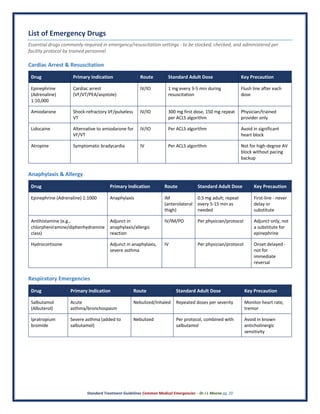
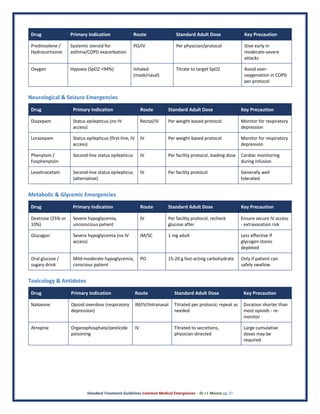
List of Emergency Drugs
Essential drugs commonly required in emergency/resuscitation settings - to be stocked, checked, and administered per
facility protocol by trained personnel
Cardiac Arrest & Resuscitation
Drug Primary Indication Route Standard Adult Dose Key Precaution
Epinephrine
(Adrenaline)
1:10,000
Cardiac arrest
(VF/VT/PEA/asystole)
IV/IO 1 mg every 3-5 min during
resuscitation
Flush line after each
dose
Amiodarone Shock-refractory VF/pulseless
VT
IV/IO 300 mg first dose, 150 mg repeat
per ACLS algorithm
Physician/trained
provider only
Lidocaine Alternative to amiodarone for
VF/VT
IV/IO Per ACLS algorithm Avoid in significant
heart block
Atropine Symptomatic bradycardia IV Per ACLS algorithm Not for high-degree AV
block without pacing
backup
Anaphylaxis & Allergy
Drug Primary Indication Route Standard Adult Dose Key Precaution
Epinephrine (Adrenaline) 1:1000 Anaphylaxis IM
(anterolateral
thigh)
0.5 mg adult; repeat
every 5-15 min as
needed
First-line - never
delay or
substitute
Antihistamine (e.g.,
chlorpheniramine/diphenhydramine
class)
Adjunct in
anaphylaxis/allergic
reaction
IV/IM/PO Per physician/protocol Adjunct only, not
a substitute for
epinephrine
Hydrocortisone Adjunct in anaphylaxis,
severe asthma
IV Per physician/protocol Onset delayed -
not for
immediate
reversal
Respiratory Emergencies
Drug Primary Indication Route Standard Adult Dose Key Precaution
Salbutamol
(Albuterol)
Acute
asthma/bronchospasm
Nebulized/Inhaled Repeated doses per severity Monitor heart rate,
tremor
Ipratropium
bromide
Severe asthma (added to
salbutamol)
Nebulized Per protocol, combined with
salbutamol
Avoid in known
anticholinergic
sensitivity
Standard Treatment Guidelines Common Medical Emergencies – Dr J L Meena pg. 21
Drug Primary Indication Route Standard Adult Dose Key Precaution
Prednisolone /
Hydrocortisone
Systemic steroid for
asthma/COPD exacerbation
PO/IV Per physician/protocol Give early in
moderate-severe
attacks
Oxygen Hypoxia (SpO2 <94%) Inhaled
(mask/nasal)
Titrate to target SpO2 Avoid over-
oxygenation in COPD
per protocol
Neurological & Seizure Emergencies
Drug Primary Indication Route Standard Adult Dose Key Precaution
Diazepam Status epilepticus (no IV
access)
Rectal/IV Per weight-based protocol Monitor for respiratory
depression
Lorazepam Status epilepticus (first-line, IV
access)
IV Per weight-based protocol Monitor for respiratory
depression
Phenytoin /
Fosphenytoin
Second-line status epilepticus IV Per facility protocol, loading dose Cardiac monitoring
during infusion
Levetiracetam Second-line status epilepticus
(alternative)
IV Per facility protocol Generally well
tolerated
Metabolic & Glycemic Emergencies
Drug Primary Indication Route Standard Adult Dose Key Precaution
Dextrose (25% or
10%)
Severe hypoglycemia,
unconscious patient
IV Per facility protocol, recheck
glucose after
Ensure secure IV access
- extravasation risk
Glucagon Severe hypoglycemia (no IV
access)
IM/SC 1 mg adult Less effective if
glycogen stores
depleted
Oral glucose /
sugary drink
Mild-moderate hypoglycemia,
conscious patient
PO 15-20 g fast-acting carbohydrate Only if patient can
safely swallow
Toxicology & Antidotes
Drug Primary Indication Route Standard Adult Dose Key Precaution
Naloxone Opioid overdose (respiratory
depression)
IM/IV/Intranasal Titrated per protocol; repeat as
needed
Duration shorter than
most opioids - re-
monitor
Atropine Organophosphate/pesticide
poisoning
IV Titrated to secretions,
physician-directed
Large cumulative
doses may be
required
Standard Treatment Guidelines Common Medical Emergencies – Dr J L Meena pg. 22
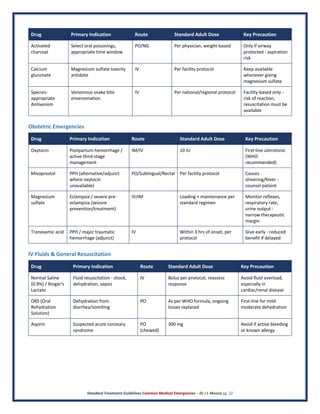
Drug Primary Indication Route Standard Adult Dose Key Precaution
Activated
charcoal
Select oral poisonings,
appropriate time window
PO/NG Per physician, weight-based Only if airway
protected - aspiration
risk
Calcium
gluconate
Magnesium sulfate toxicity
antidote
IV Per facility protocol Keep available
whenever giving
magnesium sulfate
Species-
appropriate
Antivenom
Venomous snake bite
envenomation
IV Per national/regional protocol Facility-based only -
risk of reaction,
resuscitation must be
available
Obstetric Emergencies
Drug Primary Indication Route Standard Adult Dose Key Precaution
Oxytocin Postpartum hemorrhage /
active third-stage
management
IM/IV 10 IU First-line uterotonic
(WHO
recommended)
Misoprostol PPH (alternative/adjunct
where oxytocin
unavailable)
PO/Sublingual/Rectal Per facility protocol Causes
shivering/fever -
counsel patient
Magnesium
sulfate
Eclampsia / severe pre-
eclampsia (seizure
prevention/treatment)
IV/IM Loading + maintenance per
standard regimen
Monitor reflexes,
respiratory rate,
urine output -
narrow therapeutic
margin
Tranexamic acid PPH / major traumatic
hemorrhage (adjunct)
IV Within 3 hrs of onset, per
protocol
Give early - reduced
benefit if delayed
IV Fluids & General Resuscitation
Drug Primary Indication Route Standard Adult Dose Key Precaution
Normal Saline
(0.9%) / Ringer's
Lactate
Fluid resuscitation - shock,
dehydration, sepsis
IV Bolus per protocol, reassess
response
Avoid fluid overload,
especially in
cardiac/renal disease
ORS (Oral
Rehydration
Solution)
Dehydration from
diarrhea/vomiting
PO As per WHO formula, ongoing
losses replaced
First-line for mild-
moderate dehydration
Aspirin Suspected acute coronary
syndrome
PO
(chewed)
300 mg Avoid if active bleeding
or known allergy
Standard Treatment Guidelines Common Medical Emergencies – Dr J L Meena pg. 23
• World Health Organization (WHO) - Basic Emergency Care: Approach to the Acutely Ill and Injured
(WHO/ICRC/IFEM)
• International Liaison Committee on Resuscitation (ILCOR) Consensus on Science with Treatment Recommendations
• American Heart Association (AHA) - Guidelines for CPR and Emergency Cardiovascular Care (ACLS, BLS, PALS)
• American College of Surgeons - Advanced Trauma Life Support (ATLS) Program
• World Health Organization (WHO) - Recommendations for Prevention and Treatment of Postpartum Haemorrhage
• World Health Organization (WHO) - Recommendations on Drug Treatment for Non-Severe Hypertensive Disorders
of Pregnancy / Eclampsia Management
• World Health Organization (WHO) / American Academy of Pediatrics - Helping Babies Breathe; Neonatal
Resuscitation Program (NRP)
• National Health Mission (NHM) / National Health Systems Resource Centre (NHSRC), Government of India -
Standard Treatment Guidelines and Emergency Care documents
• Federation of Obstetric and Gynaecological Societies of India (FOGSI) - Obstetric Emergency Protocols
• National Poisons Information Centre (NPIC), AIIMS - Toxicology and poisoning management guidance
Standard Treatment Guidelines Common Medical Emergencies – Dr J L Meena pg. 24
References
• World Health Organization (WHO) - Basic Emergency Care: Approach to the Acutely Ill and Injured
(WHO/ICRC/IFEM)
• International Liaison Committee on Resuscitation (ILCOR) Consensus on Science with Treatment Recommendations
• American Heart Association (AHA) - Guidelines for CPR and Emergency Cardiovascular Care (ACLS, BLS, PALS)
• American College of Surgeons - Advanced Trauma Life Support (ATLS) Program
• World Health Organization (WHO) - Recommendations for Prevention and Treatment of Postpartum Haemorrhage
• World Health Organization (WHO) - Recommendations on Drug Treatment for Non-Severe Hypertensive Disorders
of Pregnancy / Eclampsia Management
• World Health Organization (WHO) / American Academy of Pediatrics - Helping Babies Breathe; Neonatal
Resuscitation Program (NRP)
• National Health Mission (NHM) / National Health Systems Resource Centre (NHSRC), Government of India -
Standard Treatment Guidelines and Emergency Care documents
• Federation of Obstetric and Gynaecological Societies of India (FOGSI) - Obstetric Emergency Protocols
• National Poisons Information Centre (NPIC), AIIMS - Toxicology and poisoning management guidance
Standard Treatment Guidelines Common Medical Emergencies – Dr J L Meena pg. 25
Abbreviations
Abbreviation Full Form
STG Standard Treatment Guidelines
ABCDE Airway, Breathing, Circulation, Disability, Exposure (systematic emergency assessment)
BLS Basic Life Support
ACLS Advanced Cardiac Life Support
PALS Pediatric Advanced Life Support
ATLS Advanced Trauma Life Support
NRP Neonatal Resuscitation Program
CPR Cardiopulmonary Resuscitation
AED Automated External Defibrillator
VF / VT Ventricular Fibrillation / Ventricular Tachycardia
ROSC Return of Spontaneous Circulation
ACS Acute Coronary Syndrome
STEMI ST-Elevation Myocardial Infarction
PCI Percutaneous Coronary Intervention
FAST Face, Arm, Speech, Time (stroke recognition tool)
GCS Glasgow Coma Scale
SpO2 Peripheral Oxygen Saturation
IV / IO / IM / SC Intravenous / Intraosseous / Intramuscular / Subcutaneous
TBSA Total Body Surface Area (burns)
PPH Postpartum Hemorrhage
WHO World Health Organization
ILCOR International Liaison Committee on Resuscitation
AHA American Heart Association
FOGSI Federation of Obstetric and Gynaecological Societies of India
NPIC National Poisons Information Centre
NHM / NHSRC National Health Mission / National Health Systems Resource Centre
Standard Treatment Guidelines Common Medical Emergencies – Dr J L Meena pg. 26
Important Notes
• This document follows the structure and general principles of globally accepted emergency care frameworks - WHO
Basic Emergency Care, ILCOR/AHA resuscitation guidelines (BLS/ACLS/PALS), ATLS, and WHO/FOGSI obstetric and
neonatal emergency guidance.
• It is intended for orientation and educational reference only, and does NOT replace certified hands-on training and
certification in BLS, ACLS, PALS, ATLS, or Basic Emergency Care - these skills require supervised practical training.
• Drug doses referenced (e.g., Epinephrine (Adrenaline) in cardiac arrest/anaphylaxis, oxytocin in PPH, magnesium
sulfate in eclampsia, naloxone in opioid overdose) reflect standard, globally published resuscitation figures, but
must still be confirmed against current local protocol, patient weight/age, and clinical context by a trained/licensed
provider.
• In any life-threatening emergency, call for local emergency medical services immediately - India's emergency
number is 108 (ambulance, most states) or 112 (national emergency number) - do not delay activation of
emergency response to complete a full assessment.
• First responders should act within their level of training; advanced interventions (IV medications, defibrillation
interpretation, advanced airway management) should only be performed by those trained and authorized to do so.
ॐ जय माता द( ॐ
Standard Treatment Guidelines Common Medical Emergencies – Dr J L Meena pg. 27