Standard Treatment Guidelines Antenatal Intranatal Postnatal Care – Dr J L Meena pg. 1
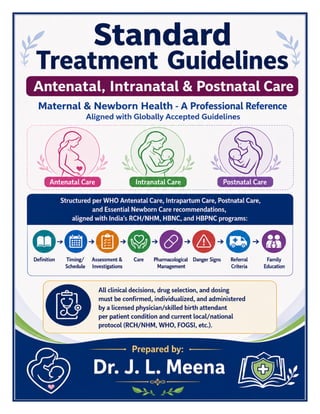
Standard Treatment Guidelines
Antenatal, Intranatal & Postnatal Care
Maternal & Newborn Health - A Professional Reference Aligned with Globally Accepted Guidelines
Structured per WHO Antenatal Care, Intrapartum Care, Postnatal Care, and Essential Newborn Care recommendations,
aligned with India's RCH/NHM, HBNC, and HBPNC programs: Definition → Timing/Schedule → Assessment & Investigations
→ Care → Pharmacological Management → Danger Signs → Referral Criteria → Family Education
All clinical decisions, drug selection, and dosing must be confirmed, individualized, and administered by a licensed
physician/skilled birth attendant per patient condition and current local/national protocol (RCH/NHM, WHO, FOGSI, etc.).
Prepared by: Dr. J. L. Meena
Standard Treatment Guidelines Antenatal Intranatal Postnatal Care – Dr J L Meena pg. 2
Foreword
The health of a mother and her newborn during pregnancy, childbirth, and the weeks that follow reflects the strength
of the entire care system around them. Most of the deaths and complications we still see in this period are preventable
with timely, well-organized, and respectful care at every contact - from the first antenatal visit to the final postnatal
check.
This reference has been compiled to bring together the essential elements of antenatal, intranatal, and postnatal care
for both mother and newborn, structured around globally accepted frameworks - WHO's guidance on antenatal,
intrapartum, postnatal, and essential newborn care - and aligned with India's RCH/NHM, Home-Based Newborn Care,
and Home-Based Postnatal Care programs.
It is intended as a quick, structured companion for healthcare providers, students, and field health workers, to reinforce
- never replace - proper clinical training and judgment. I hope it supports safer pregnancies, safer deliveries, and
healthier beginnings for every mother and child.
Dr. J. L. Meena
Standard Treatment Guidelines Antenatal Intranatal Postnatal Care – Dr J L Meena pg. 3
Table of Contents
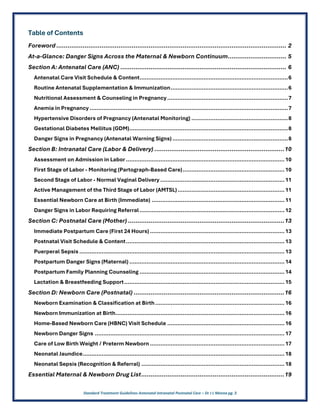
Foreword .......................................................................................................................... 2
At-a-Glance: Danger Signs Across the Maternal & Newborn Continuum............................... 5
Section A: Antenatal Care (ANC) ........................................................................................ 6
Antenatal Care Visit Schedule & Content......................................................................................6
Routine Antenatal Supplementation & Immunization....................................................................6
Nutritional Assessment & Counseling in Pregnancy......................................................................7
Anemia in Pregnancy ...................................................................................................................7
Hypertensive Disorders of Pregnancy (Antenatal Monitoring) ........................................................8
Gestational Diabetes Mellitus (GDM)............................................................................................8
Danger Signs in Pregnancy (Antenatal Warning Signs) ...................................................................8
Section B: Intranatal Care (Labor & Delivery) .....................................................................10
Assessment on Admission in Labor............................................................................................10
First Stage of Labor - Monitoring (Partograph-Based Care)...........................................................10
Second Stage of Labor - Normal Vaginal Delivery ........................................................................11
Active Management of the Third Stage of Labor (AMTSL)..............................................................11
Essential Newborn Care at Birth (Immediate) .............................................................................11
Danger Signs in Labor Requiring Referral....................................................................................12
Section C: Postnatal Care (Mother) ...................................................................................13
Immediate Postpartum Care (First 24 Hours) ..............................................................................13
Postnatal Visit Schedule & Content............................................................................................13
Puerperal Sepsis .......................................................................................................................13
Postpartum Danger Signs (Maternal) ..........................................................................................14
Postpartum Family Planning Counseling ....................................................................................14
Lactation & Breastfeeding Support.............................................................................................15
Section D: Newborn Care (Postnatal) ................................................................................16
Newborn Examination & Classification at Birth...........................................................................16
Newborn Immunization at Birth..................................................................................................16
Home-Based Newborn Care (HBNC) Visit Schedule ....................................................................16
Newborn Danger Signs ..............................................................................................................17
Care of Low Birth Weight / Preterm Newborn ..............................................................................17
Neonatal Jaundice.....................................................................................................................18
Neonatal Sepsis (Recognition & Referral) ...................................................................................18
Essential Maternal & Newborn Drug List............................................................................19
Standard Treatment Guidelines Antenatal Intranatal Postnatal Care – Dr J L Meena pg. 4
Antenatal..................................................................................................................................19
Intranatal..................................................................................................................................20
Postnatal (Mother).....................................................................................................................20
Newborn...................................................................................................................................21
References ......................................................................................................................22
Abbreviations ..................................................................................................................23
Important Notes...............................................................................................................24
Standard Treatment Guidelines Antenatal Intranatal Postnatal Care – Dr J L Meena pg. 5
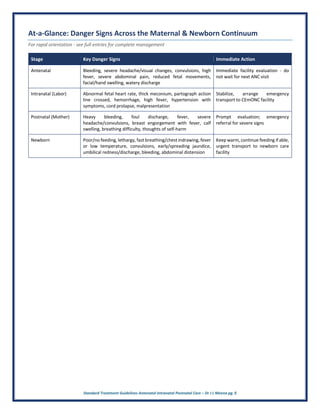
At-a-Glance: Danger Signs Across the Maternal & Newborn Continuum
For rapid orientation - see full entries for complete management
Stage Key Danger Signs Immediate Action
Antenatal Bleeding, severe headache/visual changes, convulsions, high
fever, severe abdominal pain, reduced fetal movements,
facial/hand swelling, watery discharge
Immediate facility evaluation - do
not wait for next ANC visit
Intranatal (Labor) Abnormal fetal heart rate, thick meconium, partograph action
line crossed, hemorrhage, high fever, hypertension with
symptoms, cord prolapse, malpresentation
Stabilize, arrange emergency
transport to CEmONC facility
Postnatal (Mother) Heavy bleeding, foul discharge, fever, severe
headache/convulsions, breast engorgement with fever, calf
swelling, breathing difficulty, thoughts of self-harm
Prompt evaluation; emergency
referral for severe signs
Newborn Poor/no feeding, lethargy, fast breathing/chest indrawing, fever
or low temperature, convulsions, early/spreading jaundice,
umbilical redness/discharge, bleeding, abdominal distension
Keep warm, continue feeding if able,
urgent transport to newborn care
facility
Standard Treatment Guidelines Antenatal Intranatal Postnatal Care – Dr J L Meena pg. 6
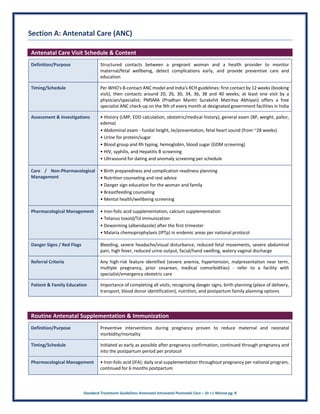
Section A: Antenatal Care (ANC)
Antenatal Care Visit Schedule & Content
Definition/Purpose Structured contacts between a pregnant woman and a health provider to monitor
maternal/fetal wellbeing, detect complications early, and provide preventive care and
education
Timing/Schedule Per WHO's 8-contact ANC model and India's RCH guidelines: first contact by 12 weeks (booking
visit), then contacts around 20, 26, 30, 34, 36, 38 and 40 weeks; at least one visit by a
physician/specialist; PMSMA (Pradhan Mantri Surakshit Matritva Abhiyan) offers a free
specialist ANC check-up on the 9th of every month at designated government facilities in India
Assessment & Investigations • History (LMP, EDD calculation, obstetric/medical history), general exam (BP, weight, pallor,
edema)
• Abdominal exam - fundal height, lie/presentation, fetal heart sound (from ~28 weeks)
• Urine for protein/sugar
• Blood group and Rh typing, hemoglobin, blood sugar (GDM screening)
• HIV, syphilis, and Hepatitis B screening
• Ultrasound for dating and anomaly screening per schedule
Care / Non-Pharmacological
Management
• Birth preparedness and complication readiness planning
• Nutrition counseling and rest advice
• Danger sign education for the woman and family
• Breastfeeding counseling
• Mental health/wellbeing screening
Pharmacological Management • Iron-folic acid supplementation, calcium supplementation
• Tetanus toxoid/Td immunization
• Deworming (albendazole) after the first trimester
• Malaria chemoprophylaxis (IPTp) in endemic areas per national protocol
Danger Signs / Red Flags Bleeding, severe headache/visual disturbance, reduced fetal movements, severe abdominal
pain, high fever, reduced urine output, facial/hand swelling, watery vaginal discharge
Referral Criteria Any high-risk feature identified (severe anemia, hypertension, malpresentation near term,
multiple pregnancy, prior cesarean, medical comorbidities) - refer to a facility with
specialist/emergency obstetric care
Patient & Family Education Importance of completing all visits, recognizing danger signs, birth planning (place of delivery,
transport, blood donor identification), nutrition, and postpartum family planning options
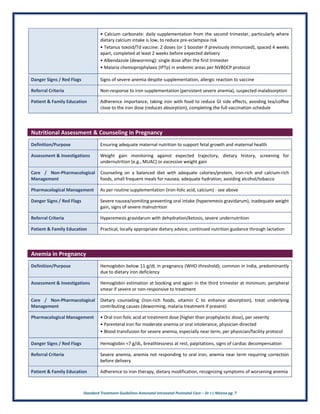
Routine Antenatal Supplementation & Immunization
Definition/Purpose Preventive interventions during pregnancy proven to reduce maternal and neonatal
morbidity/mortality
Timing/Schedule Initiated as early as possible after pregnancy confirmation, continued through pregnancy and
into the postpartum period per protocol
Pharmacological Management • Iron-folic acid (IFA): daily oral supplementation throughout pregnancy per national program,
continued for 6 months postpartum
Standard Treatment Guidelines Antenatal Intranatal Postnatal Care – Dr J L Meena pg. 7
• Calcium carbonate: daily supplementation from the second trimester, particularly where
dietary calcium intake is low, to reduce pre-eclampsia risk
• Tetanus toxoid/Td vaccine: 2 doses (or 1 booster if previously immunized), spaced 4 weeks
apart, completed at least 2 weeks before expected delivery
• Albendazole (deworming): single dose after the first trimester
• Malaria chemoprophylaxis (IPTp) in endemic areas per NVBDCP protocol
Danger Signs / Red Flags Signs of severe anemia despite supplementation, allergic reaction to vaccine
Referral Criteria Non-response to iron supplementation (persistent severe anemia), suspected malabsorption
Patient & Family Education Adherence importance, taking iron with food to reduce GI side effects, avoiding tea/coffee
close to the iron dose (reduces absorption), completing the full vaccination schedule
Nutritional Assessment & Counseling in Pregnancy
Definition/Purpose Ensuring adequate maternal nutrition to support fetal growth and maternal health
Assessment & Investigations Weight gain monitoring against expected trajectory, dietary history, screening for
undernutrition (e.g., MUAC) or excessive weight gain
Care / Non-Pharmacological
Management
Counseling on a balanced diet with adequate calories/protein, iron-rich and calcium-rich
foods, small frequent meals for nausea, adequate hydration, avoiding alcohol/tobacco
Pharmacological Management As per routine supplementation (iron-folic acid, calcium) - see above
Danger Signs / Red Flags Severe nausea/vomiting preventing oral intake (hyperemesis gravidarum), inadequate weight
gain, signs of severe malnutrition
Referral Criteria Hyperemesis gravidarum with dehydration/ketosis, severe undernutrition
Patient & Family Education Practical, locally appropriate dietary advice; continued nutrition guidance through lactation
Anemia in Pregnancy
Definition/Purpose Hemoglobin below 11 g/dL in pregnancy (WHO threshold); common in India, predominantly
due to dietary iron deficiency
Assessment & Investigations Hemoglobin estimation at booking and again in the third trimester at minimum; peripheral
smear if severe or non-responsive to treatment
Care / Non-Pharmacological
Management
Dietary counseling (iron-rich foods, vitamin C to enhance absorption), treat underlying
contributing causes (deworming, malaria treatment if present)
Pharmacological Management • Oral iron-folic acid at treatment dose (higher than prophylactic dose), per severity
• Parenteral iron for moderate anemia or oral intolerance, physician-directed
• Blood transfusion for severe anemia, especially near term, per physician/facility protocol
Danger Signs / Red Flags Hemoglobin <7 g/dL, breathlessness at rest, palpitations, signs of cardiac decompensation
Referral Criteria Severe anemia, anemia not responding to oral iron, anemia near term requiring correction
before delivery
Patient & Family Education Adherence to iron therapy, dietary modification, recognizing symptoms of worsening anemia
Standard Treatment Guidelines Antenatal Intranatal Postnatal Care – Dr J L Meena pg. 8
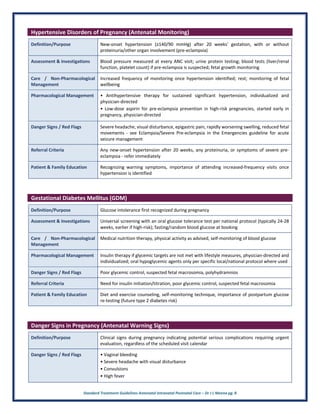
Hypertensive Disorders of Pregnancy (Antenatal Monitoring)
Definition/Purpose New-onset hypertension (≥140/90 mmHg) after 20 weeks' gestation, with or without
proteinuria/other organ involvement (pre-eclampsia)
Assessment & Investigations Blood pressure measured at every ANC visit; urine protein testing; blood tests (liver/renal
function, platelet count) if pre-eclampsia is suspected; fetal growth monitoring
Care / Non-Pharmacological
Management
Increased frequency of monitoring once hypertension identified; rest; monitoring of fetal
wellbeing
Pharmacological Management • Antihypertensive therapy for sustained significant hypertension, individualized and
physician-directed
• Low-dose aspirin for pre-eclampsia prevention in high-risk pregnancies, started early in
pregnancy, physician-directed
Danger Signs / Red Flags Severe headache, visual disturbance, epigastric pain, rapidly worsening swelling, reduced fetal
movements - see Eclampsia/Severe Pre-eclampsia in the Emergencies guideline for acute
seizure management
Referral Criteria Any new-onset hypertension after 20 weeks, any proteinuria, or symptoms of severe pre-
eclampsia - refer immediately
Patient & Family Education Recognizing warning symptoms, importance of attending increased-frequency visits once
hypertension is identified
Gestational Diabetes Mellitus (GDM)
Definition/Purpose Glucose intolerance first recognized during pregnancy
Assessment & Investigations Universal screening with an oral glucose tolerance test per national protocol (typically 24-28
weeks, earlier if high-risk); fasting/random blood glucose at booking
Care / Non-Pharmacological
Management
Medical nutrition therapy, physical activity as advised, self-monitoring of blood glucose
Pharmacological Management Insulin therapy if glycemic targets are not met with lifestyle measures, physician-directed and
individualized; oral hypoglycemic agents only per specific local/national protocol where used
Danger Signs / Red Flags Poor glycemic control, suspected fetal macrosomia, polyhydramnios
Referral Criteria Need for insulin initiation/titration, poor glycemic control, suspected fetal macrosomia
Patient & Family Education Diet and exercise counseling, self-monitoring technique, importance of postpartum glucose
re-testing (future type 2 diabetes risk)
Danger Signs in Pregnancy (Antenatal Warning Signs)
Definition/Purpose Clinical signs during pregnancy indicating potential serious complications requiring urgent
evaluation, regardless of the scheduled visit calendar
Danger Signs / Red Flags • Vaginal bleeding
• Severe headache with visual disturbance
• Convulsions
• High fever
Standard Treatment Guidelines Antenatal Intranatal Postnatal Care – Dr J L Meena pg. 9
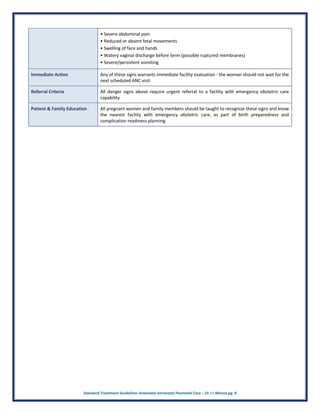
• Severe abdominal pain
• Reduced or absent fetal movements
• Swelling of face and hands
• Watery vaginal discharge before term (possible ruptured membranes)
• Severe/persistent vomiting
Immediate Action Any of these signs warrants immediate facility evaluation - the woman should not wait for the
next scheduled ANC visit
Referral Criteria All danger signs above require urgent referral to a facility with emergency obstetric care
capability
Patient & Family Education All pregnant women and family members should be taught to recognize these signs and know
the nearest facility with emergency obstetric care, as part of birth preparedness and
complication readiness planning
Standard Treatment Guidelines Antenatal Intranatal Postnatal Care – Dr J L Meena pg. 10
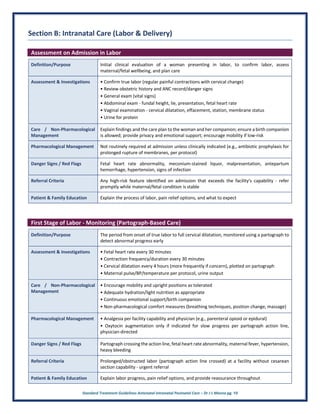
Section B: Intranatal Care (Labor & Delivery)
Assessment on Admission in Labor
Definition/Purpose Initial clinical evaluation of a woman presenting in labor, to confirm labor, assess
maternal/fetal wellbeing, and plan care
Assessment & Investigations • Confirm true labor (regular painful contractions with cervical change)
• Review obstetric history and ANC record/danger signs
• General exam (vital signs)
• Abdominal exam - fundal height, lie, presentation, fetal heart rate
• Vaginal examination - cervical dilatation, effacement, station, membrane status
• Urine for protein
Care / Non-Pharmacological
Management
Explain findings and the care plan to the woman and her companion; ensure a birth companion
is allowed; provide privacy and emotional support; encourage mobility if low-risk
Pharmacological Management Not routinely required at admission unless clinically indicated (e.g., antibiotic prophylaxis for
prolonged rupture of membranes, per protocol)
Danger Signs / Red Flags Fetal heart rate abnormality, meconium-stained liquor, malpresentation, antepartum
hemorrhage, hypertension, signs of infection
Referral Criteria Any high-risk feature identified on admission that exceeds the facility's capability - refer
promptly while maternal/fetal condition is stable
Patient & Family Education Explain the process of labor, pain relief options, and what to expect
First Stage of Labor - Monitoring (Partograph-Based Care)
Definition/Purpose The period from onset of true labor to full cervical dilatation, monitored using a partograph to
detect abnormal progress early
Assessment & Investigations • Fetal heart rate every 30 minutes
• Contraction frequency/duration every 30 minutes
• Cervical dilatation every 4 hours (more frequently if concern), plotted on partograph
• Maternal pulse/BP/temperature per protocol, urine output
Care / Non-Pharmacological
Management
• Encourage mobility and upright positions as tolerated
• Adequate hydration/light nutrition as appropriate
• Continuous emotional support/birth companion
• Non-pharmacological comfort measures (breathing techniques, position change, massage)
Pharmacological Management • Analgesia per facility capability and physician (e.g., parenteral opioid or epidural)
• Oxytocin augmentation only if indicated for slow progress per partograph action line,
physician-directed
Danger Signs / Red Flags Partograph crossing the action line, fetal heart rate abnormality, maternal fever, hypertension,
heavy bleeding
Referral Criteria Prolonged/obstructed labor (partograph action line crossed) at a facility without cesarean
section capability - urgent referral
Patient & Family Education Explain labor progress, pain relief options, and provide reassurance throughout
Standard Treatment Guidelines Antenatal Intranatal Postnatal Care – Dr J L Meena pg. 11
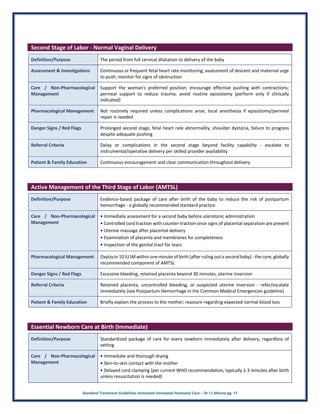
Second Stage of Labor - Normal Vaginal Delivery
Definition/Purpose The period from full cervical dilatation to delivery of the baby
Assessment & Investigations Continuous or frequent fetal heart rate monitoring; assessment of descent and maternal urge
to push; monitor for signs of obstruction
Care / Non-Pharmacological
Management
Support the woman's preferred position; encourage effective pushing with contractions;
perineal support to reduce trauma; avoid routine episiotomy (perform only if clinically
indicated)
Pharmacological Management Not routinely required unless complications arise; local anesthesia if episiotomy/perineal
repair is needed
Danger Signs / Red Flags Prolonged second stage, fetal heart rate abnormality, shoulder dystocia, failure to progress
despite adequate pushing
Referral Criteria Delay or complications in the second stage beyond facility capability - escalate to
instrumental/operative delivery per skilled provider availability
Patient & Family Education Continuous encouragement and clear communication throughout delivery
Active Management of the Third Stage of Labor (AMTSL)
Definition/Purpose Evidence-based package of care after birth of the baby to reduce the risk of postpartum
hemorrhage - a globally recommended standard practice
Care / Non-Pharmacological
Management
• Immediate assessment for a second baby before uterotonic administration
• Controlled cord traction with counter-traction once signs of placental separation are present
• Uterine massage after placental delivery
• Examination of placenta and membranes for completeness
• Inspection of the genital tract for tears
Pharmacological Management Oxytocin 10 IU IM within one minute of birth (after ruling out a second baby) - the core, globally
recommended component of AMTSL
Danger Signs / Red Flags Excessive bleeding, retained placenta beyond 30 minutes, uterine inversion
Referral Criteria Retained placenta, uncontrolled bleeding, or suspected uterine inversion - refer/escalate
immediately (see Postpartum Hemorrhage in the Common Medical Emergencies guideline)
Patient & Family Education Briefly explain the process to the mother; reassure regarding expected normal blood loss
Essential Newborn Care at Birth (Immediate)
Definition/Purpose Standardized package of care for every newborn immediately after delivery, regardless of
setting
Care / Non-Pharmacological
Management
• Immediate and thorough drying
• Skin-to-skin contact with the mother
• Delayed cord clamping (per current WHO recommendation, typically 1-3 minutes after birth
unless resuscitation is needed)
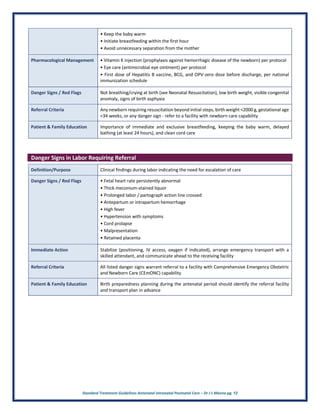
Standard Treatment Guidelines Antenatal Intranatal Postnatal Care – Dr J L Meena pg. 12
• Keep the baby warm
• Initiate breastfeeding within the first hour
• Avoid unnecessary separation from the mother
Pharmacological Management • Vitamin K injection (prophylaxis against hemorrhagic disease of the newborn) per protocol
• Eye care (antimicrobial eye ointment) per protocol
• First dose of Hepatitis B vaccine, BCG, and OPV-zero dose before discharge, per national
immunization schedule
Danger Signs / Red Flags Not breathing/crying at birth (see Neonatal Resuscitation), low birth weight, visible congenital
anomaly, signs of birth asphyxia
Referral Criteria Any newborn requiring resuscitation beyond initial steps, birth weight <2000 g, gestational age
<34 weeks, or any danger sign - refer to a facility with newborn care capability
Patient & Family Education Importance of immediate and exclusive breastfeeding, keeping the baby warm, delayed
bathing (at least 24 hours), and clean cord care
Danger Signs in Labor Requiring Referral
Definition/Purpose Clinical findings during labor indicating the need for escalation of care
Danger Signs / Red Flags • Fetal heart rate persistently abnormal
• Thick meconium-stained liquor
• Prolonged labor / partograph action line crossed
• Antepartum or intrapartum hemorrhage
• High fever
• Hypertension with symptoms
• Cord prolapse
• Malpresentation
• Retained placenta
Immediate Action Stabilize (positioning, IV access, oxygen if indicated), arrange emergency transport with a
skilled attendant, and communicate ahead to the receiving facility
Referral Criteria All listed danger signs warrant referral to a facility with Comprehensive Emergency Obstetric
and Newborn Care (CEmONC) capability
Patient & Family Education Birth preparedness planning during the antenatal period should identify the referral facility
and transport plan in advance
Standard Treatment Guidelines Antenatal Intranatal Postnatal Care – Dr J L Meena pg. 13
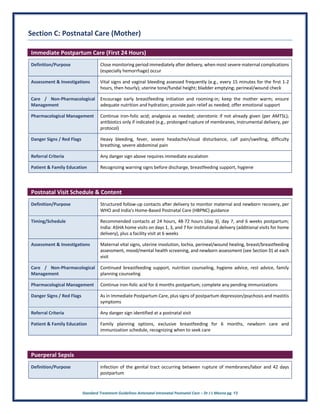
Section C: Postnatal Care (Mother)
Immediate Postpartum Care (First 24 Hours)
Definition/Purpose Close monitoring period immediately after delivery, when most severe maternal complications
(especially hemorrhage) occur
Assessment & Investigations Vital signs and vaginal bleeding assessed frequently (e.g., every 15 minutes for the first 1-2
hours, then hourly); uterine tone/fundal height; bladder emptying; perineal/wound check
Care / Non-Pharmacological
Management
Encourage early breastfeeding initiation and rooming-in; keep the mother warm; ensure
adequate nutrition and hydration; provide pain relief as needed; offer emotional support
Pharmacological Management Continue iron-folic acid; analgesia as needed; uterotonic if not already given (per AMTSL);
antibiotics only if indicated (e.g., prolonged rupture of membranes, instrumental delivery, per
protocol)
Danger Signs / Red Flags Heavy bleeding, fever, severe headache/visual disturbance, calf pain/swelling, difficulty
breathing, severe abdominal pain
Referral Criteria Any danger sign above requires immediate escalation
Patient & Family Education Recognizing warning signs before discharge, breastfeeding support, hygiene
Postnatal Visit Schedule & Content
Definition/Purpose Structured follow-up contacts after delivery to monitor maternal and newborn recovery, per
WHO and India's Home-Based Postnatal Care (HBPNC) guidance
Timing/Schedule Recommended contacts at 24 hours, 48-72 hours (day 3), day 7, and 6 weeks postpartum;
India: ASHA home visits on days 1, 3, and 7 for institutional delivery (additional visits for home
delivery), plus a facility visit at 6 weeks
Assessment & Investigations Maternal vital signs, uterine involution, lochia, perineal/wound healing, breast/breastfeeding
assessment, mood/mental health screening, and newborn assessment (see Section D) at each
visit
Care / Non-Pharmacological
Management
Continued breastfeeding support, nutrition counseling, hygiene advice, rest advice, family
planning counseling
Pharmacological Management Continue iron-folic acid for 6 months postpartum; complete any pending immunizations
Danger Signs / Red Flags As in Immediate Postpartum Care, plus signs of postpartum depression/psychosis and mastitis
symptoms
Referral Criteria Any danger sign identified at a postnatal visit
Patient & Family Education Family planning options, exclusive breastfeeding for 6 months, newborn care and
immunization schedule, recognizing when to seek care
Puerperal Sepsis
Definition/Purpose Infection of the genital tract occurring between rupture of membranes/labor and 42 days
postpartum
Standard Treatment Guidelines Antenatal Intranatal Postnatal Care – Dr J L Meena pg. 14
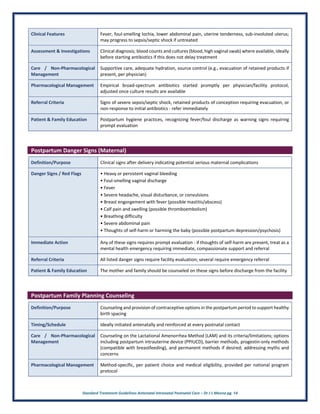
Clinical Features Fever, foul-smelling lochia, lower abdominal pain, uterine tenderness, sub-involuted uterus;
may progress to sepsis/septic shock if untreated
Assessment & Investigations Clinical diagnosis; blood counts and cultures (blood, high vaginal swab) where available, ideally
before starting antibiotics if this does not delay treatment
Care / Non-Pharmacological
Management
Supportive care, adequate hydration, source control (e.g., evacuation of retained products if
present, per physician)
Pharmacological Management Empirical broad-spectrum antibiotics started promptly per physician/facility protocol,
adjusted once culture results are available
Referral Criteria Signs of severe sepsis/septic shock, retained products of conception requiring evacuation, or
non-response to initial antibiotics - refer immediately
Patient & Family Education Postpartum hygiene practices, recognizing fever/foul discharge as warning signs requiring
prompt evaluation
Postpartum Danger Signs (Maternal)
Definition/Purpose Clinical signs after delivery indicating potential serious maternal complications
Danger Signs / Red Flags • Heavy or persistent vaginal bleeding
• Foul-smelling vaginal discharge
• Fever
• Severe headache, visual disturbance, or convulsions
• Breast engorgement with fever (possible mastitis/abscess)
• Calf pain and swelling (possible thromboembolism)
• Breathing difficulty
• Severe abdominal pain
• Thoughts of self-harm or harming the baby (possible postpartum depression/psychosis)
Immediate Action Any of these signs requires prompt evaluation - if thoughts of self-harm are present, treat as a
mental health emergency requiring immediate, compassionate support and referral
Referral Criteria All listed danger signs require facility evaluation; several require emergency referral
Patient & Family Education The mother and family should be counseled on these signs before discharge from the facility
Postpartum Family Planning Counseling
Definition/Purpose Counseling and provision of contraceptive options in the postpartum period to support healthy
birth spacing
Timing/Schedule Ideally initiated antenatally and reinforced at every postnatal contact
Care / Non-Pharmacological
Management
Counseling on the Lactational Amenorrhea Method (LAM) and its criteria/limitations; options
including postpartum intrauterine device (PPIUCD), barrier methods, progestin-only methods
(compatible with breastfeeding), and permanent methods if desired; addressing myths and
concerns
Pharmacological Management Method-specific, per patient choice and medical eligibility, provided per national program
protocol
Standard Treatment Guidelines Antenatal Intranatal Postnatal Care – Dr J L Meena pg. 15
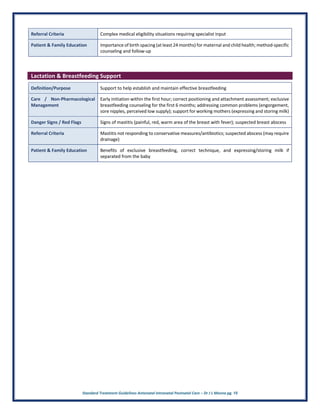
Referral Criteria Complex medical eligibility situations requiring specialist input
Patient & Family Education Importance of birth spacing (at least 24 months) for maternal and child health; method-specific
counseling and follow-up
Lactation & Breastfeeding Support
Definition/Purpose Support to help establish and maintain effective breastfeeding
Care / Non-Pharmacological
Management
Early initiation within the first hour; correct positioning and attachment assessment; exclusive
breastfeeding counseling for the first 6 months; addressing common problems (engorgement,
sore nipples, perceived low supply); support for working mothers (expressing and storing milk)
Danger Signs / Red Flags Signs of mastitis (painful, red, warm area of the breast with fever); suspected breast abscess
Referral Criteria Mastitis not responding to conservative measures/antibiotics; suspected abscess (may require
drainage)
Patient & Family Education Benefits of exclusive breastfeeding, correct technique, and expressing/storing milk if
separated from the baby
Standard Treatment Guidelines Antenatal Intranatal Postnatal Care – Dr J L Meena pg. 16
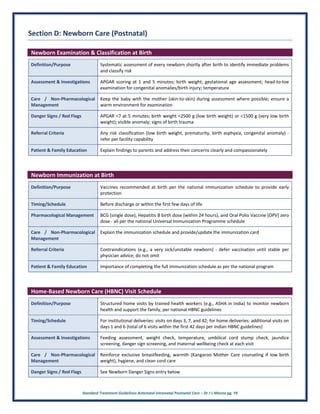
Section D: Newborn Care (Postnatal)
Newborn Examination & Classification at Birth
Definition/Purpose Systematic assessment of every newborn shortly after birth to identify immediate problems
and classify risk
Assessment & Investigations APGAR scoring at 1 and 5 minutes; birth weight; gestational age assessment; head-to-toe
examination for congenital anomalies/birth injury; temperature
Care / Non-Pharmacological
Management
Keep the baby with the mother (skin-to-skin) during assessment where possible; ensure a
warm environment for examination
Danger Signs / Red Flags APGAR <7 at 5 minutes; birth weight <2500 g (low birth weight) or <1500 g (very low birth
weight); visible anomaly; signs of birth trauma
Referral Criteria Any risk classification (low birth weight, prematurity, birth asphyxia, congenital anomaly) -
refer per facility capability
Patient & Family Education Explain findings to parents and address their concerns clearly and compassionately
Newborn Immunization at Birth
Definition/Purpose Vaccines recommended at birth per the national immunization schedule to provide early
protection
Timing/Schedule Before discharge or within the first few days of life
Pharmacological Management BCG (single dose), Hepatitis B birth dose (within 24 hours), and Oral Polio Vaccine (OPV) zero
dose - all per the national Universal Immunization Programme schedule
Care / Non-Pharmacological
Management
Explain the immunization schedule and provide/update the immunization card
Referral Criteria Contraindications (e.g., a very sick/unstable newborn) - defer vaccination until stable per
physician advice; do not omit
Patient & Family Education Importance of completing the full immunization schedule as per the national program
Home-Based Newborn Care (HBNC) Visit Schedule
Definition/Purpose Structured home visits by trained health workers (e.g., ASHA in India) to monitor newborn
health and support the family, per national HBNC guidelines
Timing/Schedule For institutional deliveries: visits on days 3, 7, and 42; for home deliveries: additional visits on
days 1 and 6 (total of 6 visits within the first 42 days per Indian HBNC guidelines)
Assessment & Investigations Feeding assessment, weight check, temperature, umbilical cord stump check, jaundice
screening, danger sign screening, and maternal wellbeing check at each visit
Care / Non-Pharmacological
Management
Reinforce exclusive breastfeeding, warmth (Kangaroo Mother Care counseling if low birth
weight), hygiene, and clean cord care
Danger Signs / Red Flags See Newborn Danger Signs entry below
Standard Treatment Guidelines Antenatal Intranatal Postnatal Care – Dr J L Meena pg. 17
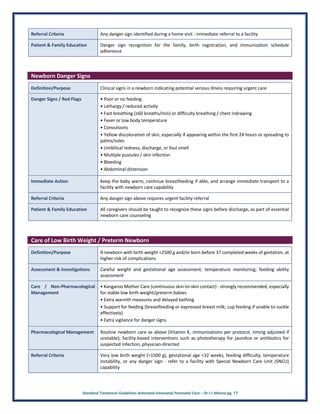
Referral Criteria Any danger sign identified during a home visit - immediate referral to a facility
Patient & Family Education Danger sign recognition for the family, birth registration, and immunization schedule
adherence
Newborn Danger Signs
Definition/Purpose Clinical signs in a newborn indicating potential serious illness requiring urgent care
Danger Signs / Red Flags • Poor or no feeding
• Lethargy / reduced activity
• Fast breathing (≥60 breaths/min) or difficulty breathing / chest indrawing
• Fever or low body temperature
• Convulsions
• Yellow discoloration of skin, especially if appearing within the first 24 hours or spreading to
palms/soles
• Umbilical redness, discharge, or foul smell
• Multiple pustules / skin infection
• Bleeding
• Abdominal distension
Immediate Action Keep the baby warm, continue breastfeeding if able, and arrange immediate transport to a
facility with newborn care capability
Referral Criteria Any danger sign above requires urgent facility referral
Patient & Family Education All caregivers should be taught to recognize these signs before discharge, as part of essential
newborn care counseling
Care of Low Birth Weight / Preterm Newborn
Definition/Purpose A newborn with birth weight <2500 g and/or born before 37 completed weeks of gestation, at
higher risk of complications
Assessment & Investigations Careful weight and gestational age assessment; temperature monitoring; feeding ability
assessment
Care / Non-Pharmacological
Management
• Kangaroo Mother Care (continuous skin-to-skin contact) - strongly recommended, especially
for stable low birth weight/preterm babies
• Extra warmth measures and delayed bathing
• Support for feeding (breastfeeding or expressed breast milk; cup feeding if unable to suckle
effectively)
• Extra vigilance for danger signs
Pharmacological Management Routine newborn care as above (Vitamin K, immunizations per protocol, timing adjusted if
unstable); facility-based interventions such as phototherapy for jaundice or antibiotics for
suspected infection, physician-directed
Referral Criteria Very low birth weight (<1500 g), gestational age <32 weeks, feeding difficulty, temperature
instability, or any danger sign - refer to a facility with Special Newborn Care Unit (SNCU)
capability
Standard Treatment Guidelines Antenatal Intranatal Postnatal Care – Dr J L Meena pg. 18
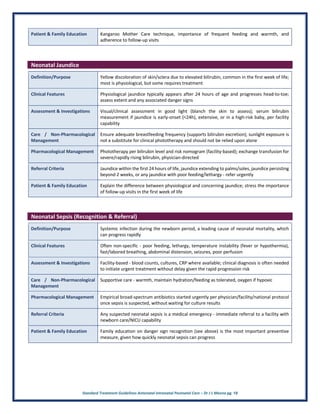
Patient & Family Education Kangaroo Mother Care technique, importance of frequent feeding and warmth, and
adherence to follow-up visits
Neonatal Jaundice
Definition/Purpose Yellow discoloration of skin/sclera due to elevated bilirubin, common in the first week of life;
most is physiological, but some requires treatment
Clinical Features Physiological jaundice typically appears after 24 hours of age and progresses head-to-toe;
assess extent and any associated danger signs
Assessment & Investigations Visual/clinical assessment in good light (blanch the skin to assess); serum bilirubin
measurement if jaundice is early-onset (<24h), extensive, or in a high-risk baby, per facility
capability
Care / Non-Pharmacological
Management
Ensure adequate breastfeeding frequency (supports bilirubin excretion); sunlight exposure is
not a substitute for clinical phototherapy and should not be relied upon alone
Pharmacological Management Phototherapy per bilirubin level and risk nomogram (facility-based); exchange transfusion for
severe/rapidly rising bilirubin, physician-directed
Referral Criteria Jaundice within the first 24 hours of life, jaundice extending to palms/soles, jaundice persisting
beyond 2 weeks, or any jaundice with poor feeding/lethargy - refer urgently
Patient & Family Education Explain the difference between physiological and concerning jaundice; stress the importance
of follow-up visits in the first week of life
Neonatal Sepsis (Recognition & Referral)
Definition/Purpose Systemic infection during the newborn period, a leading cause of neonatal mortality, which
can progress rapidly
Clinical Features Often non-specific - poor feeding, lethargy, temperature instability (fever or hypothermia),
fast/labored breathing, abdominal distension, seizures, poor perfusion
Assessment & Investigations Facility-based - blood counts, cultures, CRP where available; clinical diagnosis is often needed
to initiate urgent treatment without delay given the rapid progression risk
Care / Non-Pharmacological
Management
Supportive care - warmth, maintain hydration/feeding as tolerated, oxygen if hypoxic
Pharmacological Management Empirical broad-spectrum antibiotics started urgently per physician/facility/national protocol
once sepsis is suspected, without waiting for culture results
Referral Criteria Any suspected neonatal sepsis is a medical emergency - immediate referral to a facility with
newborn care/NICU capability
Patient & Family Education Family education on danger sign recognition (see above) is the most important preventive
measure, given how quickly neonatal sepsis can progress
Standard Treatment Guidelines Antenatal Intranatal Postnatal Care – Dr J L Meena pg. 19
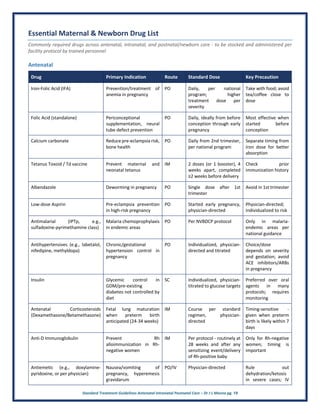
Essential Maternal & Newborn Drug List
Commonly required drugs across antenatal, intranatal, and postnatal/newborn care - to be stocked and administered per
facility protocol by trained personnel
Antenatal
Drug Primary Indication Route Standard Dose Key Precaution
Iron-Folic Acid (IFA) Prevention/treatment of
anemia in pregnancy
PO Daily, per national
program; higher
treatment dose per
severity
Take with food; avoid
tea/coffee close to
dose
Folic Acid (standalone) Periconceptional
supplementation, neural
tube defect prevention
PO Daily, ideally from before
conception through early
pregnancy
Most effective when
started before
conception
Calcium carbonate Reduce pre-eclampsia risk,
bone health
PO Daily from 2nd trimester,
per national program
Separate timing from
iron dose for better
absorption
Tetanus Toxoid / Td vaccine Prevent maternal and
neonatal tetanus
IM 2 doses (or 1 booster), 4
weeks apart, completed
≥2 weeks before delivery
Check prior
immunization history
Albendazole Deworming in pregnancy PO Single dose after 1st
trimester
Avoid in 1st trimester
Low-dose Aspirin Pre-eclampsia prevention
in high-risk pregnancy
PO Started early pregnancy,
physician-directed
Physician-directed;
individualized to risk
Antimalarial (IPTp, e.g.,
sulfadoxine-pyrimethamine class)
Malaria chemoprophylaxis
in endemic areas
PO Per NVBDCP protocol Only in malaria-
endemic areas per
national guidance
Antihypertensives (e.g., labetalol,
nifedipine, methyldopa)
Chronic/gestational
hypertension control in
pregnancy
PO Individualized, physician-
directed and titrated
Choice/dose
depends on severity
and gestation; avoid
ACE inhibitors/ARBs
in pregnancy
Insulin Glycemic control in
GDM/pre-existing
diabetes not controlled by
diet
SC Individualized, physician-
titrated to glucose targets
Preferred over oral
agents in many
protocols; requires
monitoring
Antenatal Corticosteroids
(Dexamethasone/Betamethasone)
Fetal lung maturation
when preterm birth
anticipated (24-34 weeks)
IM Course per standard
regimen, physician-
directed
Timing-sensitive -
given when preterm
birth is likely within 7
days
Anti-D Immunoglobulin Prevent Rh
alloimmunization in Rh-
negative women
IM Per protocol - routinely at
28 weeks and after any
sensitizing event/delivery
of Rh-positive baby
Only for Rh-negative
women; timing is
important
Antiemetic (e.g., doxylamine-
pyridoxine, or per physician)
Nausea/vomiting of
pregnancy, hyperemesis
gravidarum
PO/IV Physician-directed Rule out
dehydration/ketosis
in severe cases; IV
Standard Treatment Guidelines Antenatal Intranatal Postnatal Care – Dr J L Meena pg. 20
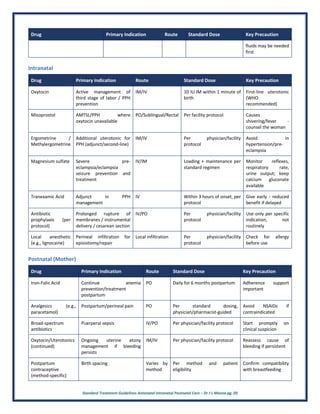
Drug Primary Indication Route Standard Dose Key Precaution
fluids may be needed
first
Intranatal
Drug Primary Indication Route Standard Dose Key Precaution
Oxytocin Active management of
third stage of labor / PPH
prevention
IM/IV 10 IU IM within 1 minute of
birth
First-line uterotonic
(WHO
recommended)
Misoprostol AMTSL/PPH where
oxytocin unavailable
PO/Sublingual/Rectal Per facility protocol Causes
shivering/fever -
counsel the woman
Ergometrine /
Methylergometrine
Additional uterotonic for
PPH (adjunct/second-line)
IM/IV Per physician/facility
protocol
Avoid in
hypertension/pre-
eclampsia
Magnesium sulfate Severe pre-
eclampsia/eclampsia
seizure prevention and
treatment
IV/IM Loading + maintenance per
standard regimen
Monitor reflexes,
respiratory rate,
urine output; keep
calcium gluconate
available
Tranexamic Acid Adjunct in PPH
management
IV Within 3 hours of onset, per
protocol
Give early - reduced
benefit if delayed
Antibiotic
prophylaxis (per
protocol)
Prolonged rupture of
membranes / instrumental
delivery / cesarean section
IV/PO Per physician/facility
protocol
Use only per specific
indication, not
routinely
Local anesthetic
(e.g., lignocaine)
Perineal infiltration for
episiotomy/repair
Local infiltration Per physician/facility
protocol
Check for allergy
before use
Postnatal (Mother)
Drug Primary Indication Route Standard Dose Key Precaution
Iron-Folic Acid Continue anemia
prevention/treatment
postpartum
PO Daily for 6 months postpartum Adherence support
important
Analgesics (e.g.,
paracetamol)
Postpartum/perineal pain PO Per standard dosing,
physician/pharmacist-guided
Avoid NSAIDs if
contraindicated
Broad-spectrum
antibiotics
Puerperal sepsis IV/PO Per physician/facility protocol Start promptly on
clinical suspicion
Oxytocin/Uterotonics
(continued)
Ongoing uterine atony
management if bleeding
persists
IM/IV Per physician/facility protocol Reassess cause of
bleeding if persistent
Postpartum
contraceptive
(method-specific)
Birth spacing Varies by
method
Per method and patient
eligibility
Confirm compatibility
with breastfeeding
Standard Treatment Guidelines Antenatal Intranatal Postnatal Care – Dr J L Meena pg. 21
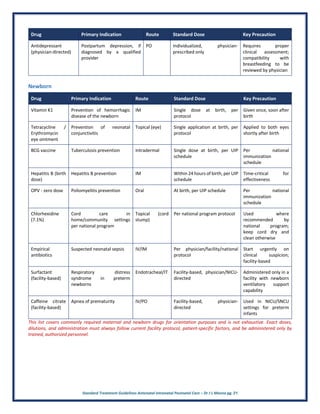
Drug Primary Indication Route Standard Dose Key Precaution
Antidepressant
(physician-directed)
Postpartum depression, if
diagnosed by a qualified
provider
PO Individualized, physician-
prescribed only
Requires proper
clinical assessment;
compatibility with
breastfeeding to be
reviewed by physician
Newborn
Drug Primary Indication Route Standard Dose Key Precaution
Vitamin K1 Prevention of hemorrhagic
disease of the newborn
IM Single dose at birth, per
protocol
Given once, soon after
birth
Tetracycline /
Erythromycin
eye ointment
Prevention of neonatal
conjunctivitis
Topical (eye) Single application at birth, per
protocol
Applied to both eyes
shortly after birth
BCG vaccine Tuberculosis prevention Intradermal Single dose at birth, per UIP
schedule
Per national
immunization
schedule
Hepatitis B (birth
dose)
Hepatitis B prevention IM Within 24 hours of birth, per UIP
schedule
Time-critical for
effectiveness
OPV - zero dose Poliomyelitis prevention Oral At birth, per UIP schedule Per national
immunization
schedule
Chlorhexidine
(7.1%)
Cord care in
home/community settings
per national program
Topical (cord
stump)
Per national program protocol Used where
recommended by
national program;
keep cord dry and
clean otherwise
Empirical
antibiotics
Suspected neonatal sepsis IV/IM Per physician/facility/national
protocol
Start urgently on
clinical suspicion;
facility-based
Surfactant
(facility-based)
Respiratory distress
syndrome in preterm
newborns
Endotracheal/IT Facility-based, physician/NICU-
directed
Administered only in a
facility with newborn
ventilatory support
capability
Caffeine citrate
(facility-based)
Apnea of prematurity IV/PO Facility-based, physician-
directed
Used in NICU/SNCU
settings for preterm
infants
This list covers commonly required maternal and newborn drugs for orientation purposes and is not exhaustive. Exact doses,
dilutions, and administration must always follow current facility protocol, patient-specific factors, and be administered only by
trained, authorized personnel.
Standard Treatment Guidelines Antenatal Intranatal Postnatal Care – Dr J L Meena pg. 22
References
• World Health Organization (WHO) - Recommendations on Antenatal Care for a Positive Pregnancy Experience
• World Health Organization (WHO) - Intrapartum Care for a Positive Childbirth Experience
• World Health Organization (WHO) - Recommendations on Maternal and Newborn Care for a Positive Postnatal
Experience
• World Health Organization (WHO) - Essential Newborn Care / Early Essential Newborn Care guidance
• World Health Organization (WHO) - Recommendations for Prevention and Treatment of Postpartum Haemorrhage;
Management of Hypertensive Disorders of Pregnancy
• Ministry of Health and Family Welfare, Government of India - Reproductive, Maternal, Newborn, Child and
Adolescent Health (RMNCH+A) / RCH Programme Guidelines
• Ministry of Health and Family Welfare, Government of India - Home Based Newborn Care (HBNC) Operational
Guidelines
• Ministry of Health and Family Welfare, Government of India - Home Based Postnatal Care (HBPNC) Guidelines
• National Health Mission (NHM) - Pradhan Mantri Surakshit Matritva Abhiyan (PMSMA) and Janani Suraksha Yojana
(JSY) programme documents
• Federation of Obstetric and Gynaecological Societies of India (FOGSI) - Good Clinical Practice Recommendations
• Universal Immunization Programme (UIP), Government of India - National Immunization Schedule
• Indian Academy of Pediatrics (IAP) - Newborn care and immunization guidelines
Standard Treatment Guidelines Antenatal Intranatal Postnatal Care – Dr J L Meena pg. 23
Abbreviations
Abbreviation Full Form
STG Standard Treatment Guidelines
ANC Antenatal Care
AMTSL Active Management of the Third Stage of Labor
APGAR Appearance, Pulse, Grimace, Activity, Respiration (newborn scoring system)
ASHA Accredited Social Health Activist
BCG Bacillus Calmette-Guérin (TB vaccine)
CEmONC Comprehensive Emergency Obstetric and Newborn Care
EDD Expected Date of Delivery
FOGSI Federation of Obstetric and Gynaecological Societies of India
GDM Gestational Diabetes Mellitus
HBNC Home-Based Newborn Care
HBPNC Home-Based Postnatal Care
Hb Hemoglobin
IFA Iron-Folic Acid
IPTp Intermittent Preventive Treatment of malaria in pregnancy
IU International Unit
IUCD / PPIUCD Intrauterine Contraceptive Device / Postpartum IUCD
KMC Kangaroo Mother Care
LAM Lactational Amenorrhea Method
LMP Last Menstrual Period
NHM National Health Mission
NICU / SNCU Neonatal Intensive Care Unit / Special Newborn Care Unit
OPV Oral Polio Vaccine
PMSMA Pradhan Mantri Surakshit Matritva Abhiyan
PPH Postpartum Hemorrhage
RCH Reproductive and Child Health
Td / TT Tetanus-diphtheria vaccine / Tetanus Toxoid
UIP Universal Immunization Programme
WHO World Health Organization
Standard Treatment Guidelines Antenatal Intranatal Postnatal Care – Dr J L Meena pg. 24
Important Notes
• This document follows the structure and general principles of globally accepted maternal and newborn care
frameworks - WHO's Antenatal, Intrapartum, Postnatal, and Essential Newborn Care recommendations - aligned
with India's RCH/NHM, HBNC, and HBPNC programs.
• It is intended for orientation and educational reference only, and does NOT replace certified clinical training in
skilled birth attendance, emergency obstetric care, or newborn resuscitation.
• Drug doses referenced (e.g., oxytocin in AMTSL, magnesium sulfate in eclampsia, Vitamin K in newborns) reflect
standard, globally published figures, but must still be confirmed against current local protocol and the individual
patient by a trained/licensed provider.
• For acute obstetric and newborn emergencies (postpartum hemorrhage, eclampsia, neonatal resuscitation), refer
to the companion Standard Treatment Guidelines - Common Medical Emergencies document for detailed
emergency management.
• Birth preparedness and complication readiness - identifying the place of delivery, a skilled birth attendant,
transport plan, and blood donor in advance - remains one of the most effective preventive measures against
maternal and newborn mortality.
• Emergency number in India: 108 (ambulance, most states) or 112 (national emergency number).
ॐ जय माता द( ॐ
Standard Treatment Guidelines Antenatal Intranatal Postnatal Care – Dr J L Meena pg. 25