SPAIN
AnaNeves,GabrielaSilvae MarisaSilva
10CT2
LANGUAGE
Language
Spain is a multilingual country.
The official language and the most spoken (by 98.9% of
the population) is Spanish (also called Castilian).
In addition, other languages are spoken:
• Catalan (9-17% of the population);
• Galician (5-7% of the population);
• Basque (1% of the population).
TOURISM
Tourism
Tourism in Spain is one of the major contributors to
the country’s economy. The variety of its customs,
culture, gastronomy and the climate are the main
reasons for the success in this area.
TYPICAL
FESTIVITIES
Typical festivities
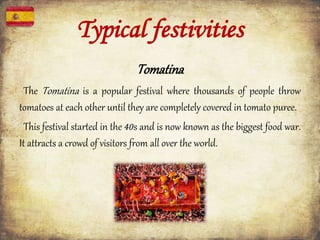
Tomatina
The Tomatina is a popular festival where thousands of people throw
tomatoes at each other until they are completely covered in tomato puree.
This festival started in the 40s and is now known as the biggest food war.
It attracts a crowd of visitors from all over the world.
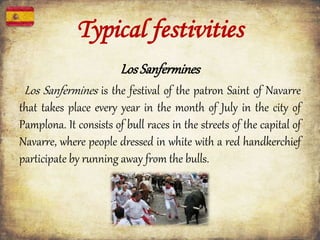
LosSanfermines
Los Sanfermines is the festival of the patron Saint of Navarre
that takes place every year in the month of July in the city of
Pamplona. It consists of bull races in the streets of the capital of
Navarre, where people dressed in white with a red handkerchief
participate by running away from the bulls.
Typical festivities
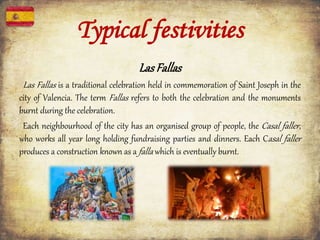
LasFallas
Las Fallas is a traditional celebration held in commemoration of Saint Joseph in the
city of Valencia. The term Fallas refers to both the celebration and the monuments
burnt during the celebration.
Each neighbourhood of the city has an organised group of people, the Casal faller,
who works all year long holding fundraising parties and dinners. Each Casal faller
produces a construction known as a falla which is eventually burnt.
Typical festivities
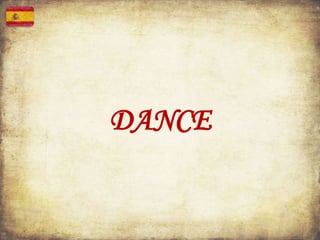
July Fair
The July Fair is one of the most anticipated festivals of the year
and it welcomes people from all around the world.
In this fair there are exhibitions of plants and horseback
riding, dance performances and a wide variety of products are
sold.
Typical festivities
DANCE
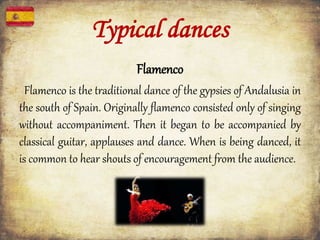
Dance
Besides being known for its songs and bullfights, Spain is also
known for its beautiful dances that show the sensuality of
women and the chivalry of man.
Typical dances
Flamenco
Flamenco is the traditional dance of the gypsies of Andalusia in
the south of Spain. Originally flamenco consisted only of singing
without accompaniment. Then it began to be accompanied by
classical guitar, applauses and dance. When is being danced, it
is common to hear shouts of encouragement from the audience.
Typical dances
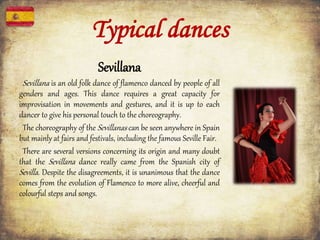
Sevillana
Sevillana is an old folk dance of flamenco danced by people of all
genders and ages. This dance requires a great capacity for
improvisation in movements and gestures, and it is up to each
dancer to give his personal touch to the choreography.
The choreography of the Sevillanas can be seen anywhere in Spain
but mainly at fairs and festivals, including the famous Seville Fair.
There are several versions concerning its origin and many doubt
that the Sevillana dance really came from the Spanish city of
Sevilla. Despite the disagreements, it is unanimous that the dance
comes from the evolution of Flamenco to more alive, cheerful and
colourful steps and songs.
Typical dances
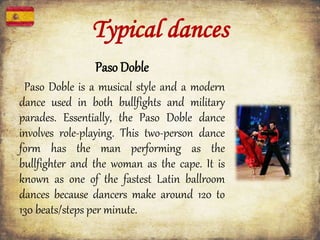
Paso Doble
Paso Doble is a musical style and a modern
dance used in both bullfights and military
parades. Essentially, the Paso Doble dance
involves role-playing. This two-person dance
form has the man performing as the
bullfighter and the woman as the cape. It is
known as one of the fastest Latin ballroom
dances because dancers make around 120 to
130 beats/steps per minute.
Typical dances
Spanish POP
The Spanish Pop is a dance that means "popular”. It is a
rhythm created to please all listeners from different regions and
it is mainly famous among the younger generations. The
Spanish POP originated in the 50’s having been influenced by
Bill Haley and His Comets .
Typical dances
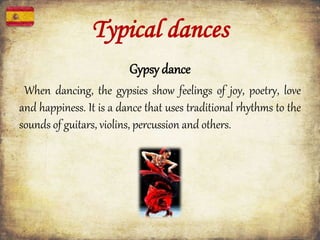
Gypsy dance
When dancing, the gypsies show feelings of joy, poetry, love
and happiness. It is a dance that uses traditional rhythms to the
sounds of guitars, violins, percussion and others.
TYPICAL FOOD
Typical food
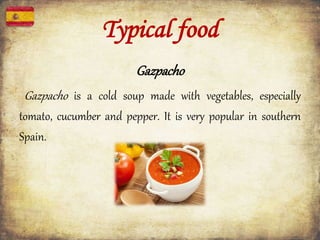
Gazpacho
Gazpacho is a cold soup made with vegetables, especially
tomato, cucumber and pepper. It is very popular in southern
Spain.
Typical food
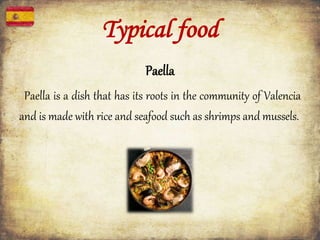
Paella
Paella is a dish that has its roots in the community of Valencia
and is made with rice and seafood such as shrimps and mussels.
Typical food
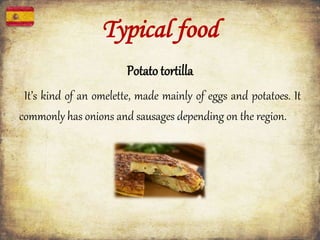
Potato tortilla
It’s kind of an omelette, made mainly of eggs and potatoes. It
commonly has onions and sausages depending on the region.
Typical food
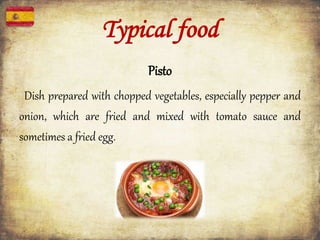
Pisto
Dish prepared with chopped vegetables, especially pepper and
onion, which are fried and mixed with tomato sauce and
sometimes a fried egg.
Typical food
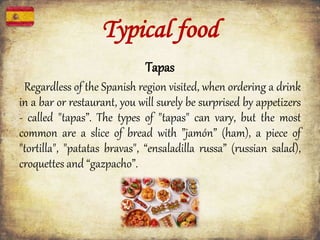
Tapas
Regardless of the Spanish region visited, when ordering a drink
in a bar or restaurant, you will surely be surprised by appetizers
- called "tapas”. The types of "tapas" can vary, but the most
common are a slice of bread with ”jamón” (ham), a piece of
"tortilla", "patatas bravas", “ensaladilla russa” (russian salad),
croquettes and “gazpacho”.
SPORTS
Sports
Sports in Spain are mainly dominated by judo, basketball,
cycling, tennis, handball and motor sports. However, the
country had world champions in sports as diverse as fencing,
paddle, water polo, boxing or athletics.
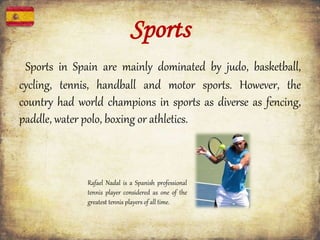
Rafael Nadal is a Spanish professional
tennis player considered as one of the
greatest tennis players of all time.
CURIOSITIES
Curiosities
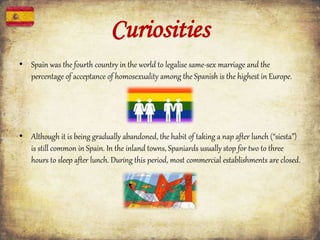
• Spain was the fourth country in the world to legalise same-sex marriage and the
percentage of acceptance of homosexuality among the Spanish is the highest in Europe.
• Although it is being gradually abandoned, the habit of taking a nap after lunch (“siesta”)
is still common in Spain. In the inland towns, Spaniards usually stop for two to three
hours to sleep after lunch. During this period, most commercial establishments are closed.
Curiosities
• In Spain dinner takes place between 9 and 10 pm. Its population has dinner 2
hours later than the rest of the Europeans.
• Spain has the second largest territory of the European continent, after France.
Curiosities
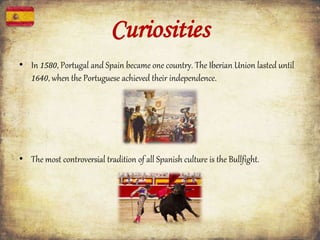
• In 1580, Portugal and Spain became one country. The Iberian Union lasted until
1640, when the Portuguese achieved their independence.
• The most controversial tradition of all Spanish culture is the Bullfight.
Curiosities
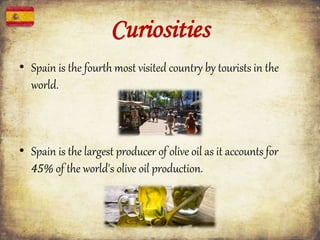
• Spain is the fourth most visited country by tourists in the
world.
• Spain is the largest producer of olive oil as it accounts for
45% of the world's olive oil production.
Curiosities
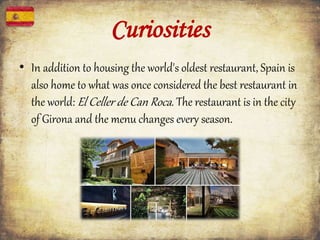
• In addition to housing the world's oldest restaurant, Spain is
also home to what was once considered the best restaurant in
the world: El Celler de Can Roca. The restaurant is in the city
of Girona and the menu changes every season.