Level 01: Easy starters 

What star is at the centre of the Solar System? 
The Sun 
Which planet is closest to the Sun? 
Mercury 
Which planet is the ‘third rock from the Sun’? 
Earth 

Level 02: A little harder 

Which is the biggest planet? 
Jupiter 
Which planet is famous for its rings? 
Saturn 
Which is the ‘red planet’? 
Mars 

Level 03: Name it 
A rock orbiting the Sun, between Mars and Jupiter. 
Asteroid 
The planet with the Great Red Spot.
Jupiter 
The hottest planet. 
Venus 

Level 04: Questions about distances 
Which is further from the Sun, Earth or Mars? 
Mars 
The average distance of the Earth from the Sun is 1 AU. What does AU stand for? 
Astronomical Unit 
Which giant planet is about 5 AU from the Sun? 
Jupiter 

Level 05: Moons 
How many moons has the Earth? 
1 
Which two planets have the most moons? 
Jupiter and Saturn 
Europa is a moon which might support life. Which vital substance does it have? 
Water (ice) 

Level 07: Earth 
Which liquid on Earth is necessary for life? 
Water 
Name two gases produced by living organisms. 
Oxygen, methane
If the Earth turned more slowly on its axis, how might we be affected? 
Longer days and longer nights; therefore bigger temperature differences between night and 
day.

Level 09: Venus 
Why is it impossible to see Venus’s surface from Earth? 
Atmosphere is thick with clouds and carbon dioxide
Which spacecraft mapped Venus’s surface? 
Magellan
Why is there no life on Venus? 
Too hot, no water, poisonous atmosphere

Level 10: Mars 
Astronauts might visit Mars one day. Why would they need to take their own air? 
No oxygen in thin atmosphere
Where might astronauts look for water on Mars? 
In crater shadows, polar ice caps, deep underground
Why does the Sun look smaller from Mars than from Earth? 
It’s further away.


How many planets are in the Solar System?

    • a. 8
    • b. 9
    • c. 10
    • d. 12
2. How old is the Solar System?

    • a. 65 million years
    • b. 1.2 billion years
    • c. 4.6 billion years
    • d. 13.7 billion years


3. What is the biggest moon in the Solar System?

    • a. The Moon
    • b. Ganymede
    • c. Titan
    • d. Triton


4. What is the least dense planet in the Solar System?
• a. Jupiter
    • b. Saturn
    • c. Uranus
    • d. Neptune


5. What is the most dense planet in the Solar System?

    • a. Mercury
    • b. Venus
    • c. Earth
    • d. Mars


6. Where is the tallest mountain in the Solar System?

    • a. Mercury
    • b. Venus
    • c. Earth
    • d. Mars


7. How many planets are known to have life?

    • a. 0
    • b. 1
    • c. 2
    • d. 3


8. What is the most abundant element in the Solar System?

    • a. oxygen
    • b. helium
    • c. carbon
    • d. hydrogen

A moon which might support life entirely covered with water(ice)?


Luna
Europa
taitan
callisto

A rock orbiting the Sun, between Mars and Jupiter. 

Comets
Moons
Gaint Rock
Asteroids

Answers: 1. a, 2. c, 3. b, 4. b, 5. c, 6. d, 7. b, 8. d, 9.b, 10. d


1. The solar system includes:
    nine stars
    ten planets
    nine planets

2. What is the sun?
    a planet
    a star
    a white hole

3. Which is the largest planet in the solar system?
    the sun
    the earth
    Jupiter

4. Which is the closest planet to the earth?
    the moon
    Mars
    Venus

5. What is an astronomical unit (AU)?
    the mean distance between the moon and the earth, about 384,400 km
    nine light-years
    the mean distance between the earth and the sun, about 150
    million km

6. Which is the closest planet to the sun?
    Pluto
    Mercury
    the Milky Way

7. Which is the farthest planet from the sun?
    Pluto
    Mars
    Uranus

8. What is the Milky Way?
    the way planets orbit the sun
a white star
       the galaxy of which the solar system is a part

9. Which is the only planet whose English name does not derive from Greek/
Roman mythology?
    the sun
    the earth
    Mercury

10. What is a moon?
    the natural satellite of the earth
    a small planet
    a satellite of any planet

11. Which planet is referred to as the Red Planet?
    Venus
    Mars
    Uranus

12. How many moons Saturn has?
    at least 30
    one
    none

13. The orbits of the planets are:
     circular
     elliptic
     it is impossible to know

14. What is an asteroid?
    a steroid
    a rocky object orbiting the sun
    a comet

15. What is a comet?
    a small moon
    an astronomical object with a long tail
    both answers are correct

16. What is the solar wind?
    the continuous flow of charged particles from the sun
    wind in the solar system
    solar energy

what is the largest ocean on the earth?
Indian ocean
atlantic ocean
Pacific ocean=
Which planet orbits closest to the sun?
Mercury=
Mars
Saturn
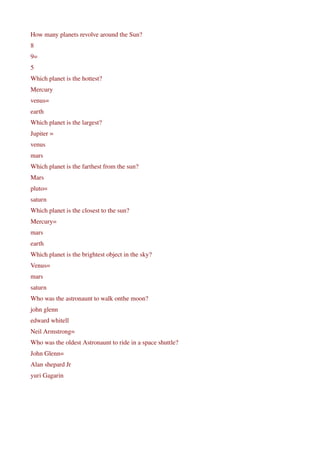
How many planets revolve around the Sun?
8
9=
5
Which planet is the hottest?
Mercury
venus=
earth
Which planet is the largest?
Jupiter =
venus
mars
Which planet is the farthest from the sun?
Mars
pluto=
saturn
Which planet is the closest to the sun?
Mercury=
mars
earth
Which planet is the brightest object in the sky?
Venus=
mars
saturn
Who was the astronaunt to walk onthe moon?
john glenn
edward whitell
Neil Armstrong=
Who was the oldest Astronaunt to ride in a space shuttle?
John Glenn=
Alan shepard Jr
yuri Gagarin
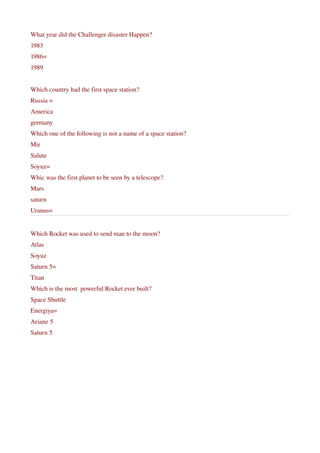
What year did the Challenger disaster Happen?
1983
1986=
1989


Which country had the first space station?
Russia =
America
germany
Which one of the following is not a name of a space station?
Mir
Salute
Soyuz=
Whic was the first planet to be seen by a telescope?
Mars
saturn
Uranus=


Which Rocket was used to send man to the moon?
Atlas
Soyuz
Saturn 5=
Titan
Which is the most  powerful Rocket ever built?
Space Shuttle
Energiya=
Ariane 5
Saturn 5