Social Media Marketing : A Beginner's Guide for Business Growth
Explore social media marketing essentials, platform selection, content strategies, engagement techniques, and the impact of AI to build a strong online presence and drive business success.
Social Media Marketing : A Beginner's Guide for Business Growth
1.
What Is SocialMedia Marketing? A Complete Beginner's
Guide to Building a Strong Online Presence
Introduction
The way businesses communicate with customers has changed dramatically
over the last decade. Gone are the days when television, newspapers, and
radio were the only effective ways to reach an audience. Today, billions of
people spend a significant portion of their day on platforms like Facebook,
Instagram, LinkedIn, YouTube, TikTok, and Pinterest. This shift has made social
media marketing one of the most powerful tools for businesses of every size.
Whether you're running a startup, managing a small business, or leading an
established company, understanding social media marketing is no longer
optional—it's essential. It allows businesses to connect with customers, build
trust, increase brand awareness, generate leads, and drive sales in ways that
traditional advertising simply cannot match.
Even businesses in Chennai are increasingly investing in social media strategies
to reach local audiences while expanding their visibility across India and
beyond.
This comprehensive beginner's guide explains everything you need to know
about social media marketing, including how it works, why it's important, the
different platforms available, and the key benefits it offers.
What Is Social Media Marketing?
Social media marketing (SMM) is the process of promoting a business, brand,
product, or service using social media platforms. It involves creating and
sharing valuable content, engaging with followers, running paid advertising
campaigns, analysing performance, and continuously improving strategies to
achieve business objectives.
Unlike traditional marketing, social media marketing creates two-way
communication. Instead of simply broadcasting advertisements, businesses can
interact directly with their audience, answer questions, receive feedback, and
build long-term relationships.
2.
Some of themost popular social media platforms include:
• Facebook
• Instagram
• LinkedIn
• YouTube
• TikTok
• X (formerly Twitter)
• Pinterest
• Threads
Each platform serves different purposes and attracts different audiences.
Choosing the right platform depends on your business goals and target
customers.
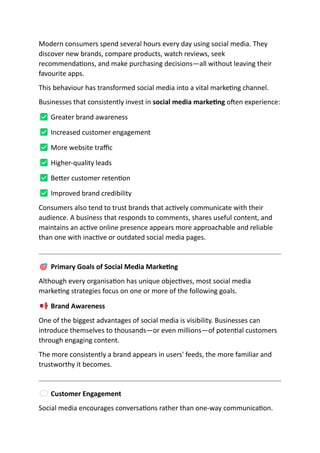
Why Social Media Marketing Matters More Than Ever
3.
Modern consumers spendseveral hours every day using social media. They
discover new brands, compare products, watch reviews, seek
recommendations, and make purchasing decisions—all without leaving their
favourite apps.
This behaviour has transformed social media into a vital marketing channel.
Businesses that consistently invest in social media marketing often experience:
Greater brand awareness
Increased customer engagement
More website traffic
Higher-quality leads
Better customer retention
Improved brand credibility
Consumers also tend to trust brands that actively communicate with their
audience. A business that responds to comments, shares useful content, and
maintains an active online presence appears more approachable and reliable
than one with inactive or outdated social media pages.
Primary Goals of Social Media Marketing
Although every organisation has unique objectives, most social media
marketing strategies focus on one or more of the following goals.
Brand Awareness
One of the biggest advantages of social media is visibility. Businesses can
introduce themselves to thousands—or even millions—of potential customers
through engaging content.
The more consistently a brand appears in users' feeds, the more familiar and
trustworthy it becomes.
Customer Engagement
Social media encourages conversations rather than one-way communication.
4.
Businesses can engageaudiences by:
• Replying to comments
• Answering questions
• Conducting polls
• Hosting live sessions
• Sharing user-generated content
This interaction builds stronger customer relationships.
Driving Website Traffic
Businesses frequently use social media posts to direct users toward:
• Company websites
• Product pages
• Blog articles
• Landing pages
• Contact forms
Increased website traffic often leads to more enquiries and conversions.
Lead Generation
Many companies use Facebook Lead Ads, LinkedIn Lead Forms, Instagram
promotions, and other campaign types to collect customer information.
These leads can later be nurtured through email marketing, phone calls, or
personalised follow-up campaigns.
Increasing Sales
Ultimately, many businesses use social media marketing to generate revenue.
5.
Well-planned campaigns caninfluence purchasing decisions by educating
customers, showcasing products, sharing testimonials, and promoting special
offers.
How Social Media Marketing Works
Successful social media marketing isn't about posting random images every
day. It follows a structured process designed to achieve measurable results.
Step 1: Define Clear Goals
Before creating content, businesses should identify what they hope to
accomplish.
Common goals include:
• Building brand awareness
• Increasing followers
• Generating enquiries
• Driving website traffic
• Improving customer service
• Boosting sales
Clear objectives help guide every marketing decision.
Step 2: Understand Your Target Audience
Knowing your audience is one of the most important aspects of social media
marketing.
Businesses should understand:
• Age group
• Gender
• Interests
• Occupation
• Buying behaviour
6.
• Income level
•Preferred social platforms
• Challenges they face
The more detailed the audience research, the more effective the content
becomes.
Step 3: Select the Right Platforms
Not every platform is suitable for every business.
For example:
Facebook
Excellent for:
• Local businesses
• Community engagement
• Paid advertising
• Events
• Lead generation
Instagram
Best for:
• Fashion
• Food
• Beauty
• Travel
• Lifestyle brands
• Restaurants
• Cafés
Excellent for:
• Homedécor
• DIY projects
• Fashion
• Recipes
• E-commerce inspiration
Choosing the right platforms ensures your marketing efforts reach the right
audience.
Creating High-Quality Content
Content is the foundation of every successful social media marketing strategy.
Businesses should focus on creating content that educates, entertains, inspires,
or solves customer problems.
Popular content formats include:
High-quality photographs
Videos
Short-form reels
Infographics
Educational carousels
Customer testimonials
Live streams
Industry news
Giveaways
Behind-the-scenes content also performs well because it helps humanise a
brand and builds trust with audiences.
9.
Why Consistency IsEssential
Many businesses fail because they post enthusiastically for a few weeks and
then disappear.
Successful brands remain visible by publishing content consistently.
A content calendar helps businesses plan:
• Educational posts
• Promotional campaigns
• Seasonal content
• Industry updates
• Customer success stories
• Product launches
Consistency strengthens brand recognition and keeps audiences engaged over
time.
Building Relationships Through Engagement
Social media is about conversations—not broadcasting advertisements.
Businesses should actively:
Reply to comments
Acknowledge customer feedback
Respond to direct messages
Thank customers for reviews
Encourage discussions
These interactions create stronger relationships and improve customer loyalty.
Brands that genuinely engage with their audience often outperform
competitors that only focus on selling products.
Measuring Success
10.
One of thebiggest advantages of digital marketing is measurable performance.
Businesses should regularly monitor metrics such as:
• Reach
• Impressions
• Engagement rate
• Click-through rate
• Website traffic
• Lead generation
• Conversion rate
• Return on advertising spend (ROAS)
By analysing this data, businesses can continually improve their campaigns and
make smarter marketing decisions.
Many growing businesses in Chennai are now relying on data-driven social
media strategies to maximise their return on investment rather than simply
increasing the number of posts they publish.
Organic vs Paid Social Media Marketing
One of the most common questions beginners ask is whether they should focus
on organic social media marketing or paid advertising. The truth is that both
approaches have their own advantages, and the best strategy often combines
the two.
Organic Social Media Marketing
Organic social media marketing refers to the content you publish without
paying the platform to promote it.
Examples include:
• Regular posts
• Reels
• Stories
• Educational videos
11.
• Infographics
• Customertestimonials
• Polls and quizzes
• Behind-the-scenes updates
Advantages of Organic Marketing
Builds trust over time
Creates long-term relationships
Improves brand credibility
Encourages customer engagement
Cost-effective for businesses with limited budgets
However, organic growth requires patience. Building a loyal audience takes
consistent effort and valuable content.
Paid Social Media Marketing
Paid social media marketing involves running advertisements on platforms such
as Facebook, Instagram, LinkedIn, YouTube, Pinterest, and TikTok.
These ads allow businesses to target users based on:
• Age
• Gender
• Location
• Interests
• Profession
• Shopping behaviour
• Device usage
• Previous website visits
Benefits of Paid Advertising
12.
Faster visibility
Highly targetedaudiences
Increased website traffic
More qualified leads
Higher conversion opportunities
Paid campaigns are particularly useful when launching a new product,
promoting an event, or generating leads within a short period.
The Growing Role of Artificial Intelligence in Social Media Marketing
Artificial Intelligence (AI) has transformed the way businesses approach social
media marketing.
Today, marketers use AI-powered tools to improve efficiency without replacing
creativity.
AI can assist with:
Caption generation
Image creation
Content scheduling
Hashtag recommendations
Performance analysis
Chatbots for customer support
Audience insights
AI helps businesses save time, but successful marketing still depends on
understanding customer needs, creating authentic content, and building
meaningful relationships.
Best Practices for Beginners
13.
If you're juststarting your journey with social media marketing, following
these best practices will help you achieve better results.
Set Realistic Goals
Don't expect thousands of followers overnight.
Focus on steady improvement by measuring engagement, website visits, and
lead generation instead of vanity metrics alone.
Provide Value Before Selling
People use social media to learn, connect, and be entertained.
A healthy content mix might include:
• Educational tips
• Industry insights
• Customer success stories
• Product demonstrations
• Frequently asked questions
• Behind-the-scenes updates
When your audience finds value in your content, they are more likely to trust
your business.
Maintain Consistent Branding
Your profile picture, logo, colours, typography, and tone of voice should remain
consistent across all social media platforms.
This consistency improves brand recognition and professionalism.
Create a Content Calendar
Planning your content in advance helps maintain consistency and reduces last-
minute stress.
14.
A content calendarmay include:
• Educational Mondays
• Customer stories
• Product highlights
• Industry news
• Promotional campaigns
• Seasonal posts
Monitor Performance Regularly
Review analytics every month to understand:
• Which posts performed best
• Which platforms generated the most engagement
• What type of content attracted new followers
• Which campaigns produced enquiries or sales
Successful marketers continuously refine their strategy based on data.
Common Social Media Marketing Mistakes
Even experienced marketers make mistakes. Beginners should avoid these
common pitfalls.
Posting Without a Strategy
Random posting usually leads to inconsistent results.
Always create content that supports your business objectives.
Focusing Only on Sales
Constant promotional posts often discourage followers.
Instead, aim to educate, inspire, and entertain alongside promoting your
products or services.
15.
Ignoring Comments andMessages
Social media is built on interaction.
Responding promptly to customer questions helps build trust and strengthens
relationships.
Using Low-Quality Visuals
Poor-quality images and videos can negatively affect your brand's reputation.
Investing in professional visuals or well-designed graphics makes a significant
difference.
Inconsistent Posting
Publishing several posts one week and disappearing for a month makes it
difficult to build momentum.
Consistency remains one of the biggest success factors in social media
marketing.
Why Many Businesses Work with Digital Marketing Agencies
Running successful social media campaigns requires more than simply creating
posts.
Businesses must understand:
• Audience research
• Content planning
• Graphic design
• Video creation
• Copywriting
• Advertising
16.
• Analytics
• Campaignoptimisation
For many organisations, managing all of these tasks internally becomes
challenging.
This is why many businesses choose experienced digital marketing agencies
that can develop strategies tailored to their goals and industry.
If you're looking to improve your online presence, generate quality leads, and
maximise your return on investment, Digital Avengers Consulting provides
professional digital marketing solutions for businesses of every size.
Learn more by visiting:
https://digitalavengersconsulting.com/
Whether you're a startup or an established organisation, working with
experienced professionals can help you create sustainable growth through
effective social media marketing.
Many businesses in Chennai have already recognised the importance of
combining creativity with data-driven marketing strategies to stay competitive.
The Future of Social Media Marketing
Social media continues to evolve rapidly.
Some of the biggest trends shaping the future include:
AI-assisted content creation
Short-form video dominance
Social commerce
Community-focused marketing
Influencer collaborations
Personalised customer experiences
Greater privacy and transparency
17.
Businesses that stayinformed about these trends will be better positioned to
build stronger customer relationships and remain competitive in an
increasingly digital marketplace.
Final Thoughts
Social media has transformed from a communication platform into one of the
world's most effective business growth tools.
Whether your objective is increasing brand awareness, generating leads,
improving customer engagement, or driving sales, social media marketing
offers opportunities that businesses of every size can leverage.
Success doesn't happen overnight.
It requires planning, consistency, creativity, audience understanding, and
continuous improvement based on real performance data.
Businesses that focus on providing value instead of simply promoting products
are far more likely to build loyal communities and achieve sustainable growth.
As social media platforms continue to evolve, businesses that adapt their
strategies and embrace innovation will remain ahead of the competition.
Frequently Asked Questions (FAQ)
1. What is social media marketing?
Social media marketing is the process of promoting a business, product, or
service through platforms such as Facebook, Instagram, LinkedIn, YouTube,
TikTok, and Pinterest to increase brand awareness, engage customers, and
generate business growth.
2. Is social media marketing suitable for small businesses?
Yes. Small businesses can use social media marketing to increase visibility, build
customer relationships, attract local audiences, and compete effectively
without requiring enormous marketing budgets.
18.
3. Which socialmedia platform is best for beginners?
The best platform depends on your audience.
Facebook and Instagram are suitable for many consumer businesses, while
LinkedIn is ideal for B2B organisations and professional services.
4. How often should businesses post on social media?
Consistency is more important than frequency.
Most businesses benefit from posting several times each week while
maintaining high-quality, valuable content.
5. Can social media marketing improve website traffic?
Absolutely.
Sharing valuable content with relevant calls-to-action encourages users to visit
your website, learn more about your services, and become potential
customers.
Ready to Grow Your Business?
If you're ready to build a stronger online presence through social media
marketing, generate more qualified leads, and create measurable business
growth, consider partnering with experienced professionals.
Explore the digital marketing solutions offered by Digital Avengers Consulting:
https://digitalavengersconsulting.com/
Take the next step towards growing your business in Chennai with a strategy
designed to deliver long-term results.