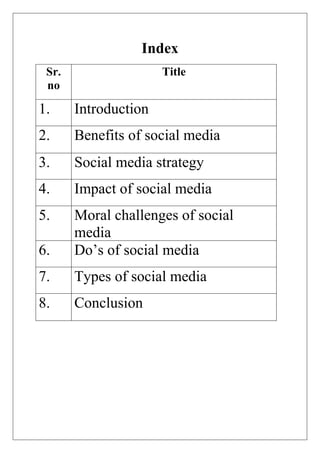
Index
Sr.
no
Title
1. Introduction
2. Benefits of social media
3. Social media strategy
4. Impact of social media
5. Moral challenges of social
media
6. Do’s of social media
7. Types of social media
8. Conclusion
Social Media
Social media are interactive computer-mediated technologies
that facilitate the creation or sharing of information, ideas,
career interests and other forms of expression via
virtual communities and networks.
 What Is Social Media?
Social media refers to websites and
applications that are designed to allow people to share
content quickly, efficiently, and in real-time. Many
people define social media as apps on their smartphone
or tablet, but the truth is, this communication tool started
with computers.
 There are some common features:
1. Social media are interactive Web 2.0 Internet-based
applications.
2. User-generated content, such as text posts or
comments, digital photos or videos, and data generated
through all online interactions, is the lifeblood of social
media.
3. Users create service-specific profiles and identities for
the website or app that are designed and maintained by
the social media organization.
4. Social media facilitate the development of online social
networks by connecting a user's profile with those of
other individuals or groups.
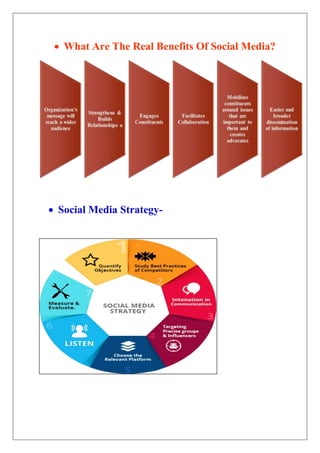
 What Are The Real Benefits Of Social Media?
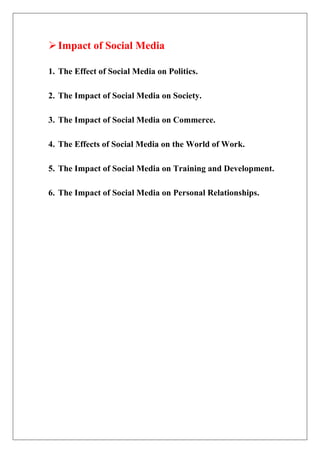
 Social Media Strategy-
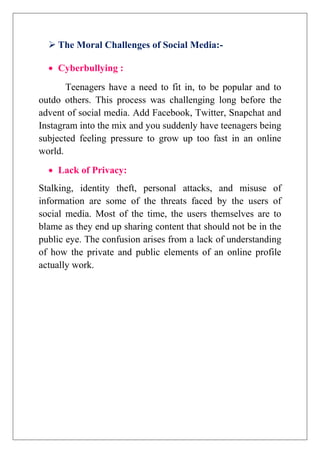
Impact of Social Media
1. The Effect of Social Media on Politics.
2. The Impact of Social Media on Society.
3. The Impact of Social Media on Commerce.
4. The Effects of Social Media on the World of Work.
5. The Impact of Social Media on Training and Development.
6. The Impact of Social Media on Personal Relationships.
 The Moral Challenges of Social Media:-
 Cyberbullying :
Teenagers have a need to fit in, to be popular and to
outdo others. This process was challenging long before the
advent of social media. Add Facebook, Twitter, Snapchat and
Instagram into the mix and you suddenly have teenagers being
subjected feeling pressure to grow up too fast in an online
world.
 Lack of Privacy:
Stalking, identity theft, personal attacks, and misuse of
information are some of the threats faced by the users of
social media. Most of the time, the users themselves are to
blame as they end up sharing content that should not be in the
public eye. The confusion arises from a lack of understanding
of how the private and public elements of an online profile
actually work.
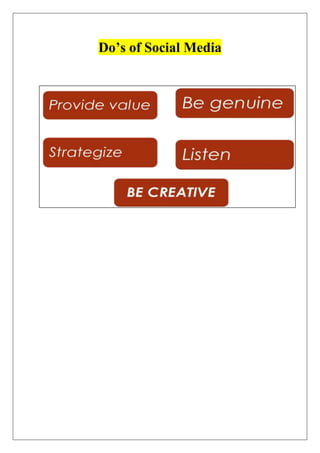
Do’s of Social Media
 Different types of Social Media-
1. Social networks—Connect with people.
 Examples: Facebook, Twitter, LinkedIn
2. Media sharing networks—Share photos, videos, and other
media
 Examples: Facebook, Twitter, LinkedIn, whatsapp
3. Discussion forums—Share news and ideas
 Examples: reddit, Quora, Digg
4. Bookmarking and content curation networks—Discover,
save, and share new content
 Examples: Pinterest, Flipboard
5. Consumer review networks—Find and review businesses
 Examples: Yelp, Zomato, TripAdvisor
6. Blogging and publishing networks—Publish content online
 Examples: WordPress, Tumblr, Medium
7. Interest-based networks—Share interests and hobbies
 Examples: Polyvore, Etsy, Fancy
8. Social shopping networks—Shop online
 Examples: Goodreads, Houzz, Last.fm
9. Sharing economy networks—Trade goods and services
 Examples: Airbnb, Uber, Taskrabbit
10. Anonymous social networks —Communicate anonymously
 Examples: Whisper, Ask.fm, After School
Conclusion
In conclusion, social media is, and will continue to be, harmful,
unless something is done about it. The power it has over people is
dangerous and often goes unnoticed. People should care because if
not addressed, or taken care, of social media could cause national and
international problems.