Sponsored by:
Report by:
Sector report
December 2022
Social Commerce
in Southeast Asia
2022
Objective
What this report seeks
to achieve
Who should
read it and why
1. To systematically analyse the growing space of Social Commerce
During COVID, Social Commerce became a widely discussed theme
among consumer companies, as buyers (and sellers) sought to
make e-commerce richer and more exciting. Yet, its understanding
remains broad, and at times vague.
2. To provide a quantitative framing to the narrative
Despite all the talk of Social Commerce transforming the online
retail landscape in Southeast Asia, there has been very limited data
on its market size and economics in the region.
3. To call out overlaps between different types of Social Commerce
Social Commerce is complex, and its different archetypes such as
Live Shopping or Community Group Buy often overlap. Sizing the
market requires identifying and quantifying these overlaps.
The target audience of this report
includes brands, retailers, and
investors in the online retail economy.
By reading this report, you can:
• learn about the opportunity size
and dynamics of Social Commerce
in Southeast Asia in detail,
• pick the most suitable channels and
business models for your company,
• identify the strategies and
capabilities needed to win, and
• understand the P&L economics of
different Social Commerce models.
2
3
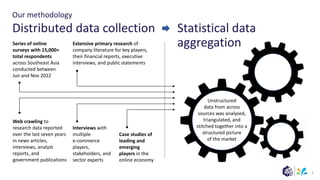
Our methodology
Distributed data collection Statistical data
aggregation
Unstructured
data from across
sources was analysed,
triangulated, and
stitched together into a
structured picture
of the market
Series of online
surveys with 15,000+
total respondents
across Southeast Asia
conducted between
Jun and Nov 2022
Extensive primary research of
company literature for key players,
their financial reports, executive
interviews, and public statements
Web crawling to
research data reported
over the last seven years
in news articles,
interviews, analyst
reports, and
government publications
Interviews with
multiple
e-commerce
players,
stakeholders, and
sector experts
Case studies of
leading and
emerging
players in the
online economy
Disclaimer
The information and analyses presented in this report
are outside-in, compiled on a best effort basis.
Publicly available data on online retail in Southeast
Asia remains limited. The sources used could therefore
not always be independently verified, and the validity of
these insights and analyses is not guaranteed.
The suggestions, recommendations, or other
submissions in this report do not constitute investment
or financial advice.
For any questions or comments, you can write to
info@cube.asia.
4
About us
Cube Asia delivers reliable data and insights
for online retail in Asia to help brands,
retail companies, and investors,
drive profitable growth
Better data and insights =
More profitable online growth
Find us at cube.asia, or email info@cube.asia
5
About our sponsor
Sprinklr is a leading enterprise software company for all customer-facing functions.
With advanced AI, Sprinklr’s unified customer experience management
(Unified-CXM) platform helps companies deliver human experiences
to every customer, every time, across any modern channel.
Sprinklr’s unified-CXM solution equips businesses to drive up
to 185% more revenue with omnichannel commerce
through extensive support for social channels
and conversational AI.
Learn more at www.sprinklr.com
6
100 pages condensed into 1 key message
Executive summary
The Future of
All e-commerce
is Social
42bn USD, or 25%, of e-commerce GMV across
Southeast Asia in 2022 is directly influenced by
social experiences.
The dynamics of these social experiences
are complex, extending across
four archetypes that offer
different flavors.
Brands and retailers who are
able to manage this complexity,
and incorporate one or more
of these archetypes in their
e-commerce channel strategies,
will be the winners of the future.
7
1. Overview of Social Commerce in
Southeast Asia
2. Social Commerce archetypes
A. Social Platform Commerce
B. Conversational Commerce
C. Live Shopping
D. Community Group Buy
3. Sprinklr and Unified-CXM
4. Learn more
(sponsored section)
Contents
8
How do we define Social Commerce?
Any form of e-commerce that is influenced heavily by social aspects of
human relationships such as real-time communication, authenticity,
trust, community, etc.
9
Social Commerce | Definition > Context > Archetypes > Impact
10
For the
purposes
of this
report
and the
market size
estimates
herein
…
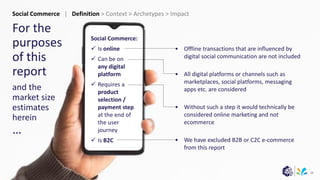
Social Commerce:
✓ Is online
✓ Can be on
any digital
platform
✓ Requires a
product
selection /
payment step
at the end of
the user
journey
✓ Is B2C
• Offline transactions that are influenced by
digital social communication are not included
• All digital platforms or channels such as
marketplaces, social platforms, messaging
apps etc. are considered
• Without such a step it would technically be
considered online marketing and not
ecommerce
• We have excluded B2B or C2C e-commerce
from this report
Social Commerce | Definition > Context > Archetypes > Impact
11
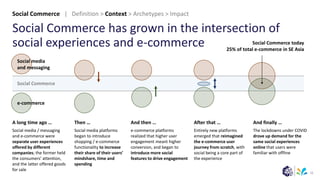
Social Commerce has grown in the intersection of
social experiences and e-commerce
A long time ago …
Social media / messaging
and e-commerce were
separate user experiences
offered by different
companies; the former held
the consumers’ attention,
and the latter offered goods
for sale
Then …
Social media platforms
began to introduce
shopping / e-commerce
functionality to increase
their share of their users’
mindshare, time and
spending
And then …
e-commerce platforms
realized that higher user
engagement meant higher
conversion, and began to
introduce more social
features to drive engagement
After that …
Entirely new platforms
emerged that reimagined
the e-commerce user
journey from scratch, with
social being a core part of
the experience
And finally …
The lockdowns under COVID
drove up demand for the
same social experiences
online that users were
familiar with offline
Social media
and messaging
e-commerce
Social Commerce
Social Commerce today
25% of total e-commerce in SE Asia
Social Commerce | Definition > Context > Archetypes > Impact
12
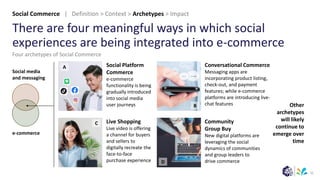
There are four meaningful ways in which social
experiences are being integrated into e-commerce
Social Platform
Commerce
e-commerce
functionality is being
gradually introduced
into social media
user journeys
Live Shopping
Live video is offering
a channel for buyers
and sellers to
digitally recreate the
face-to-face
purchase experience
Conversational Commerce
Messaging apps are
incorporating product listing,
check-out, and payment
features; while e-commerce
platforms are introducing live-
chat features
Community
Group Buy
New digital platforms are
leveraging the social
dynamics of communities
and group leaders to
drive commerce
Social media
and messaging
e-commerce
Other
archetypes
will likely
continue to
emerge over
time
Four archetypes of Social Commerce
A
C
B
D
Social Commerce | Definition > Context > Archetypes > Impact
13
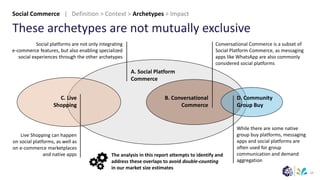
These archetypes are not mutually exclusive
Conversational Commerce is a subset of
Social Platform Commerce, as messaging
apps like WhatsApp are also commonly
considered social platforms
B. Conversational
Commerce
D. Community
Group Buy
A. Social Platform
Commerce
C. Live
Shopping
Social platforms are not only integrating
e-commerce features, but also enabling specialized
social experiences through the other archetypes
Live Shopping can happen
on social platforms, as well as
on e-commerce marketplaces
and native apps
While there are some native
group buy platforms, messaging
apps and social platforms are
often used for group
communication and demand
aggregation
The analysis in this report attempts to identify and
address these overlaps to avoid double-counting
in our market size estimates
Social Commerce | Definition > Context > Archetypes > Impact
14
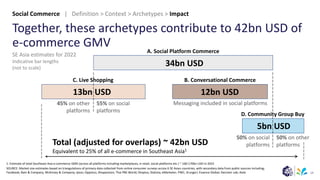
Together, these archetypes contribute to 42bn USD of
e-commerce GMV
34bn USD
12bn USD
5bn USD
13bn USD
A. Social Platform Commerce
C. Live Shopping B. Conversational Commerce
D. Community Group Buy
55% on social
platforms
45% on other
platforms
50% on other
platforms
50% on social
platforms
Messaging included in social platforms
Total (adjusted for overlaps) ~ 42bn USD
Equivalent to 25% of all e-commerce in Southeast Asia1
1: Estimate of total Southeast Asia e-commerce GMV (across all platforms including marketplaces, e-retail, social platforms etc.) ~ 160-170bn USD in 2022
SOURCE: Market size estimates based on triangulations of primary data collected from online consumer surveys across 6 SE Asian countries, with secondary data from public sources including;
Facebook; Bain & Company; McKinsey & Company; Ipsos; Oppotus; Shopavision; Thai PBS World; Shoplus; Statista; eMarketer; PWC; Krungsri; Essence Global; Decision Lab; iKala
SE Asia estimates for 2022
Indicative bar lengths
(not to scale)
Social Commerce | Definition > Context > Archetypes > Impact
15
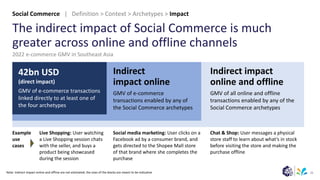
The indirect impact of Social Commerce is much
greater across online and offline channels
42bn USD
(direct impact)
GMV of e-commerce transactions
linked directly to at least one of
the four archetypes
Indirect
impact online
GMV of e-commerce
transactions enabled by any of
the Social Commerce archetypes
Indirect impact
online and offline
GMV of all online and offline
transactions enabled by any of the
Social Commerce archetypes
2022 e-commerce GMV in Southeast Asia
Example
use
cases
Live Shopping: User watching
a Live Shopping session chats
with the seller, and buys a
product being showcased
during the session
Social media marketing: User clicks on a
Facebook ad by a consumer brand, and
gets directed to the Shopee Mall store
of that brand where she completes the
purchase
Chat & Shop: User messages a physical
store staff to learn about what’s in stock
before visiting the store and making the
purchase offline
Note: Indirect impact online and offline are not estimated; the sizes of the blocks are meant to be indicative
Social Commerce | Definition > Context > Archetypes > Impact
16
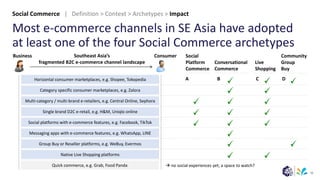
Most e-commerce channels in SE Asia have adopted
at least one of the four Social Commerce archetypes
Southeast Asia’s
fragmented B2C e-commerce channel landscape
Consumer
Business
Horizontal consumer marketplaces, e.g. Shopee, Tokopedia
Category specific consumer marketplaces, e.g. Zalora
Multi-category / multi-brand e-retailers, e.g. Central Online, Sephora
Single brand D2C e-retail, e.g. H&M, Uniqlo online
Social platforms with e-commerce features, e.g. Facebook, TikTok
Messaging apps with e-commerce features, e.g. WhatsApp, LINE
Native Live Shopping platforms
Group Buy or Reseller platforms, e.g. WeBuy, Evermos
Quick commerce, e.g. Grab, Food Panda
Social
Platform
Commerce
Live
Shopping
Conversational
Commerce
Community
Group
Buy
→ no social experiences yet; a space to watch?
A C D
B
Social Commerce | Definition > Context > Archetypes > Impact
(sponsored section)
Contents
17
1. Overview of Social Commerce in
Southeast Asia
2. Social Commerce archetypes
A. Social Platform Commerce
B. Conversational Commerce
C. Live Shopping
D. Community Group Buy
3. Sprinklr and Unified-CXM
4. Learn more
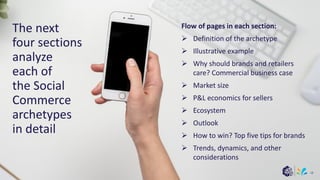
18
The next
four sections
analyze
each of
the Social
Commerce
archetypes
in detail
Flow of pages in each section:
➢ Definition of the archetype
➢ Illustrative example
➢ Why should brands and retailers
care? Commercial business case
➢ Market size
➢ P&L economics for sellers
➢ Ecosystem
➢ Outlook
➢ How to win? Top five tips for brands
➢ Trends, dynamics, and other
considerations
(sponsored section)
Contents
19
1. Overview of Social Commerce in
Southeast Asia
2. Social Commerce archetypes
A. Social Platform Commerce
B. Conversational Commerce
C. Live Shopping
D. Community Group Buy
3. Sprinklr and Unified-CXM
4. Learn more
What is Social Platform Commerce?
e-commerce where critical parts of the
purchase journey such as product
selection, payment, and order
confirmation, happen inside a
social platform
Social aspect of the experience =
A familiar environment, e.g. a social media or
messaging app, in which the primary activities that
users engage in are social in nature, with a pre-existing
trust that underlies these activities in this environment
20
Social Platform
Commerce
Definition > Example > Why should brands and retailers care? > Market size >
P&L economics for sellers > Ecosystem > Outlook > How to win? > Trends, dynamics, and other considerations
21
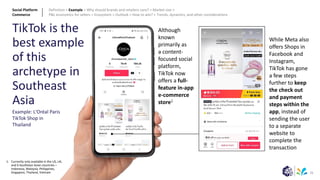
TikTok is the
best example
of this
archetype in
Southeast
Asia
Example: L'Oréal Paris
TikTok Shop in
Thailand
Although
known
primarily as
a content-
focused social
platform,
TikTok now
offers a full-
feature in-app
e-commerce
store1
1: Currently only available in the US, UK,
and 6 Southeast Asian countries –
Indonesia, Malaysia, Philippines,
Singapore, Thailand, Vietnam
While Meta also
offers Shops in
Facebook and
Instagram,
TikTok has gone
a few steps
further to keep
the check out
and payment
steps within the
app, instead of
sending the user
to a separate
website to
complete the
transaction
Social Platform
Commerce
Definition > Example > Why should brands and retailers care? > Market size >
P&L economics for sellers > Ecosystem > Outlook > How to win? > Trends, dynamics, and other considerations
22
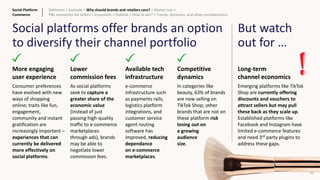
Social platforms offer brands an option
to diversify their channel portfolio
Lower
commission fees
As social platforms
seek to capture a
greater share of the
economic value
(instead of just
passing high-quality
traffic to e-commerce
marketplaces
through ads), brands
may be able to
negotiate lower
commission fees.
Available tech
infrastructure
e-commerce
infrastructure such
as payments rails,
logistics platform
integrations, and
customer service
agent routing
software has
improved, reducing
dependance
on e-commerce
marketplaces.
More engaging
user experience
Consumer preferences
have evolved with new
ways of shopping
online; traits like fun,
engagement,
community and instant
gratification are
increasingly important –
experiences that can
currently be delivered
more effectively on
social platforms.
Competitive
dynamics
In categories like
beauty, 63% of brands
are now selling on
TikTok Shop; other
brands that are not on
these platform risk
losing out on
a growing
audience
size.
Long-term
channel economics
Emerging platforms like TikTok
Shop are currently offering
discounts and vouchers to
attract sellers but may pull
these back as they scale up.
Established platforms like
Facebook and Instagram have
limited e-commerce features
and need 3rd party plugins to
address these gaps.
But watch
out for …
Social Platform
Commerce
Definition > Example > Why should brands and retailers care? > Market size >
P&L economics for sellers > Ecosystem > Outlook > How to win? > Trends, dynamics, and other considerations
23
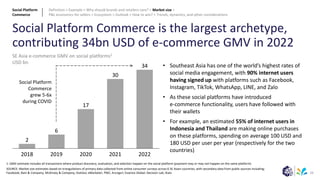
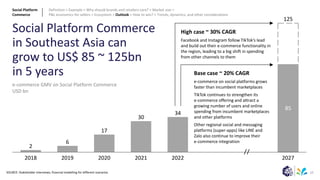
Social Platform Commerce is the largest archetype,
contributing 34bn USD of e-commerce GMV in 2022
SOURCE: Market size estimates based on triangulations of primary data collected from online consumer surveys across 6 SE Asian countries, with secondary data from public sources including;
Facebook; Bain & Company; McKinsey & Company; Statista; eMarketer; PWC; Krungsri; Essence Global; Decision Lab; iKala
2
6
17
30
34
2022
2018 2019 2020 2021
SE Asia e-commerce GMV on social platforms1
USD bn
Social Platform
Commerce
grew 5-6x
during COVID
1: GMV estimate includes all transactions where product discovery, evaluation, and selection happen on the social platform (payment may or may not happen on the same platform)
• Southeast Asia has one of the world’s highest rates of
social media engagement, with 90% internet users
having signed up with platforms such as Facebook,
Instagram, TikTok, WhatsApp, LINE, and Zalo
• As these social platforms have introduced
e-commerce functionality, users have followed with
their wallets
• For example, an estimated 55% of internet users in
Indonesia and Thailand are making online purchases
on these platforms, spending on average 100 USD and
180 USD per user per year (respectively for the two
countries)
Social Platform
Commerce
Definition > Example > Why should brands and retailers care? > Market size >
P&L economics for sellers > Ecosystem > Outlook > How to win? > Trends, dynamics, and other considerations
24
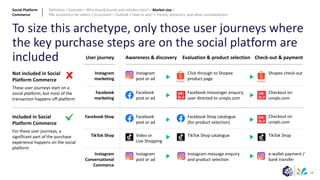
To size this archetype, only those user journeys where
the key purchase steps are on the social platform are
included
Not included in Social
Platform Commerce
These user journeys start on a
social platform, but most of the
transaction happens off platform
Included in Social
Platform Commerce
For these user journeys, a
significant part of the purchase
experience happens on the social
platform
User journey Awareness & discovery Evaluation & product selection Check-out & payment
Facebook
marketing
Facebook
post or ad
Facebook messenger enquiry;
user directed to uniqlo.com
Checkout on
uniqlo.com
Facebook Shop Facebook
post or ad
Facebook Shop catalogue
(for product selection)
Instagram
marketing
Instagram
post or ad
Click through to Shopee
product page
Shopee check-out
TikTok Shop Video or
Live Shopping
TikTok Shop catalogue TikTok Shop
Instagram
Conversational
Commerce
Instagram
post or ad
Instagram message enquiry
and product selection
e-wallet payment /
bank transfer
Checkout on
uniqlo.com
Social Platform
Commerce
Definition > Example > Why should brands and retailers care? > Market size >
P&L economics for sellers > Ecosystem > Outlook > How to win? > Trends, dynamics, and other considerations
25
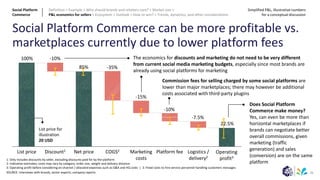
Social Platform Commerce can be more profitable vs.
marketplaces currently due to lower platform fees
Net price Marketing
costs
List price Discount1 COGS2 Platform fee Logistics /
delivery2
List price for
illustration
20 USD
-35%
-15%
-10%
-7.5%
-10%
100%
Operating
profit3
85%
22.5%
The economics for discounts and marketing do not need to be very different
from current social media marketing budgets, especially since most brands are
already using social platforms for marketing
Commission fees for selling charged by some social platforms are
lower than major marketplaces; there may however be additional
costs associated with third-party plugins
Does Social Platform
Commerce make money?
Yes, can even be more than
horizontal marketplaces if
brands can negotiate better
overall commissions, given
marketing (traffic
generation) and sales
(conversion) are on the same
platform
SOURCE: Interviews with brands, sector experts; company reports
1: Only includes discounts by seller, excluding discounts paid for by the platform
2: Indicative estimates; costs may vary by category, order size, weight and delivery distance
3: Operating profit before considering ex-channel / allocated expenses such as G&A and HQ costs | 3: Fixed costs to hire service personnel handling customers messages
Social Platform
Commerce
Definition > Example > Why should brands and retailers care? > Market size >
P&L economics for sellers > Ecosystem > Outlook > How to win? > Trends, dynamics, and other considerations
Simplified P&L, illustrative numbers
for a conceptual discussion
26
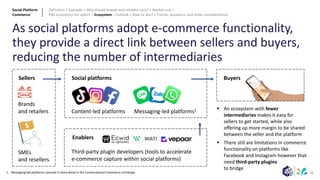
As social platforms adopt e-commerce functionality,
they provide a direct link between sellers and buyers,
reducing the number of intermediaries
Buyers
Messaging-led platforms1
Social platforms
Brands
and retailers
Sellers
Content-led platforms ▪ An ecosystem with fewer
intermediaries makes it easy for
sellers to get started, while also
offering up more margin to be shared
between the seller and the platform
▪ There still are limitations in commerce
functionality on platforms like
Facebook and Instagram however that
need third-party plugins
to bridge
Enablers
Third-party plugin developers (tools to accelerate
e-commerce capture within social platforms)
SMEs
and resellers
1: Messaging-led platforms covered in more detail in the Conversational Commerce archetype
Social Platform
Commerce
Definition > Example > Why should brands and retailers care? > Market size >
P&L economics for sellers > Ecosystem > Outlook > How to win? > Trends, dynamics, and other considerations
27
2
6
17
30
34
85
2018 2019 2022 2027
2020 2021
125
Definition > Example > Why should brands and retailers care? > Market size >
P&L economics for sellers > Ecosystem > Outlook > How to win? > Trends, dynamics, and other considerations
Base case ~ 20% CAGR
e-commerce on social platforms grows
faster than incumbent marketplaces
TIkTok continues to strengthen its
e-commerce offering and attract a
growing number of users and online
spending from incumbent marketplaces
and other platforms
Other regional social and messaging
platforms (super-apps) like LINE and
Zalo also continue to improve their
e-commerce integration
High case ~ 30% CAGR
Facebook and Instagram follow TIkTok’s lead
and build out their e-commerce functionality in
the region, leading to a big shift in spending
from other channels to them
Social Platform
Commerce
Social Platform Commerce
in Southeast Asia can
grow to US$ 85 ~ 125bn
in 5 years
e-commerce GMV on Social Platform Commerce
USD bn
SOURCE: Stakeholder interviews; financial modelling for different scenarios
28
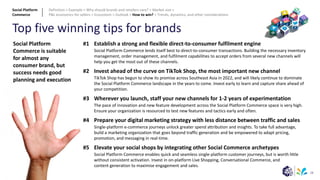
Top five winning tips for brands
#1
#2
#3
#4
#5
Establish a strong and flexible direct-to-consumer fulfilment engine
Social Platform Commerce lends itself best to direct-to-consumer transactions. Building the necessary inventory
management, order management, and fulfilment capabilities to accept orders from several new channels will
help you get the most out of these channels.
Invest ahead of the curve on TikTok Shop, the most important new channel
TikTok Shop has begun to show its promise across Southeast Asia in 2022, and will likely continue to dominate
the Social Platform Commerce landscape in the years to come. Invest early to learn and capture share ahead of
your competition.
Wherever you launch, staff your new channels for 1-2 years of experimentation
The pace of innovation and new feature development across the Social Platform Commerce space is very high.
Ensure your organization is resourced to test new features and tactics early and often.
Prepare your digital marketing strategy with less distance between traffic and sales
Single-platform e-commerce journeys unlock greater spend attribution and insights. To take full advantage,
build a marketing organization that goes beyond traffic generation and be empowered to adapt pricing,
promotion, and messaging in real-time.
Elevate your social shops by integrating other Social Commerce archetypes
Social Platform Commerce enables quick and seamless single-platform customer journeys, but is worth little
without consistent activation. Invest in on-platform Live Shopping, Conversational Commerce, and
content generation to maximise engagement and sales.
Social Platform
Commerce is suitable
for almost any
consumer brand, but
success needs good
planning and execution
Social Platform
Commerce
Definition > Example > Why should brands and retailers care? > Market size >
P&L economics for sellers > Ecosystem > Outlook > How to win? > Trends, dynamics, and other considerations
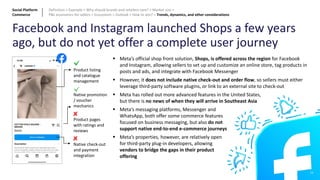
Facebook and Instagram launched Shops a few years
ago, but do not yet offer a complete user journey
Product listing
and catalogue
management
Native promotion
/ voucher
mechanics
Product pages
with ratings and
reviews
Native check-out
and payment
integration
▪ Meta’s official shop front solution, Shops, is offered across the region for Facebook
and Instagram, allowing sellers to set up and customize an online store, tag products in
posts and ads, and integrate with Facebook Messenger
▪ However, it does not include native check-out and order flow, so sellers must either
leverage third-party software plugins, or link to an external site to check-out
▪ Meta has rolled out more advanced features in the United States,
but there is no news of when they will arrive in Southeast Asia
▪ Meta’s messaging platforms, Messenger and
WhatsApp, both offer some commerce features
focused on business messaging, but also do not
support native end-to-end e-commerce journeys
▪ Meta’s properties, however, are relatively open
for third-party plug-in developers, allowing
vendors to bridge the gaps in their product
offering
29
Social Platform
Commerce
Definition > Example > Why should brands and retailers care? > Market size >
P&L economics for sellers > Ecosystem > Outlook > How to win? > Trends, dynamics, and other considerations
30
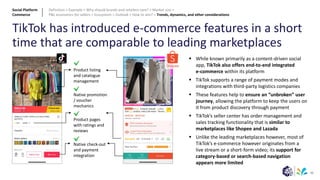
TikTok has introduced e-commerce features in a short
time that are comparable to leading marketplaces
▪ While known primarily as a content-driven social
app, TikTok also offers end-to-end integrated
e-commerce within its platform
▪ TikTok supports a range of payment modes and
integrations with third-party logistics companies
▪ These features help to ensure an “unbroken” user
journey, allowing the platform to keep the users on
it from product discovery through payment
▪ TikTok’s seller center has order management and
sales tracking functionality that is similar to
marketplaces like Shopee and Lazada
▪ Unlike the leading marketplaces however, most of
TikTok’s e-commerce however originates from a
live stream or a short-form video; its support for
category-based or search-based navigation
appears more limited
Product listing
and catalogue
management
Native promotion
/ voucher
mechanics
Product pages
with ratings and
reviews
Native check-out
and payment
integration
Social Platform
Commerce
Definition > Example > Why should brands and retailers care? > Market size >
P&L economics for sellers > Ecosystem > Outlook > How to win? > Trends, dynamics, and other considerations
31
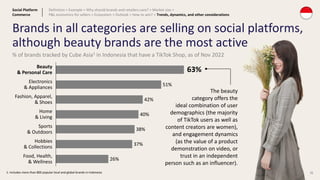
Brands in all categories are selling on social platforms,
although beauty brands are the most active
1: Includes more than 800 popular local and global brands in Indonesia
% of brands tracked by Cube Asia1 in Indonesia that have a TikTok Shop, as of Nov 2022
51%
42%
40%
38%
37%
26%
Home
& Living
Beauty
& Personal Care
Fashion, Apparel,
& Shoes
Electronics
& Appliances
Sports
& Outdoors
63%
Food, Health,
& Wellness
Hobbies
& Collections
The beauty
category offers the
ideal combination of user
demographics (the majority
of TikTok users as well as
content creators are women),
and engagement dynamics
(as the value of a product
demonstration on video, or
trust in an independent
person such as an influencer).
Social Platform
Commerce
Definition > Example > Why should brands and retailers care? > Market size >
P&L economics for sellers > Ecosystem > Outlook > How to win? > Trends, dynamics, and other considerations
(sponsored section)
Contents
32
1. Overview of Social Commerce in
Southeast Asia
2. Social Commerce archetypes
A. Social Platform Commerce
B. Conversational Commerce
C. Live Shopping
D. Community Group Buy
3. Sprinklr and Unified-CXM
4. Learn more
Additional insights in this section are
provided by our sponsor, Sprinklr – the
leading unified-CXM solutions provider that
supports Conversational Commerce and
Conversational AI.
Sprinklr’s unified-CXM solution provides
communication channel coverage of 30+
channels, covering social, messaging, SMS,
email, and voice, including support on
Facebook Messenger and WhatsApp.
Sprinklr is continuously expanding its channel
coverage to support customers globally.
33
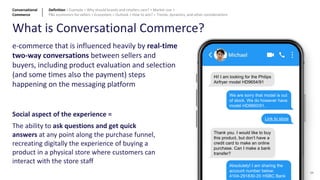
e-commerce that is influenced heavily by real-time
two-way conversations between sellers and
buyers, including product evaluation and selection
(and some times also the payment) steps
happening on the messaging platform
Social aspect of the experience =
The ability to ask questions and get quick
answers at any point along the purchase funnel,
recreating digitally the experience of buying a
product in a physical store where customers can
interact with the store staff
What is Conversational Commerce?
Hi! I am looking for the Philips
Airfryer model HD9654/91
We are sorry that model is out
of stock. We do however have
model HD9860/91.
Link to store
Thank you. I would like to buy
this product, but don’t have a
credit card to make an online
purchase. Can I make a bank
transfer?
Absolutely! I am sharing the
account number below:
4104-291830-20 HSBC Bank
Conversational
Commerce
Definition > Example > Why should brands and retailers care? > Market size >
P&L economics for sellers > Ecosystem > Outlook > How to win? > Trends, dynamics, and other considerations
34
35
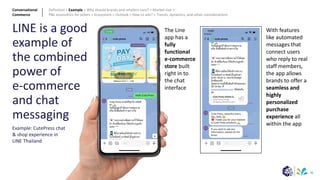
LINE is a good
example of
the combined
power of
e-commerce
and chat
messaging
Example: CutePress chat
& shop experience in
LINE Thailand
The Line
app has a
fully
functional
e-commerce
store built
right in to
the chat
interface
With features
like automated
messages that
connect users
who reply to real
staff members,
the app allows
brands to offer a
seamless and
highly
personalized
purchase
experience all
within the app
Conversational
Commerce
Definition > Example > Why should brands and retailers care? > Market size >
P&L economics for sellers > Ecosystem > Outlook > How to win? > Trends, dynamics, and other considerations
36
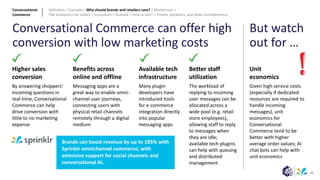
Conversational Commerce can offer high
conversion with low marketing costs
Better staff
utilization
The workload of
replying to incoming
user messages can be
allocated across a
wide pool (e.g. retail
store employees),
allowing staff to reply
to messages when
they are idle;
available tech plugins
can help with queuing
and distributed
management
Higher sales
conversion
By answering shoppers'
incoming questions in
real-time, Conversational
Commerce can help
drive conversion with
little to no marketing
expense
Unit
economics
Given high service costs
(especially if dedicated
resources are required to
handle incoming
messages), unit
economics for
Conversational
Commerce tend to be
better with higher
average order values; AI
chat bots can help with
unit economics
But watch
out for …
Benefits across
online and offline
Messaging apps are a
great way to enable omni-
channel user journeys,
connecting users with
physical retail channels
remotely through a digital
medium
Available tech
infrastructure
Many plugin
developers have
introduced tools
for e-commerce
integration directly
into popular
messaging apps
Brands can boost revenue by up to 185% with
Sprinklr omnichannel commerce, with
extensive support for social channels and
conversational AI.
Conversational
Commerce
Definition > Example > Why should brands and retailers care? > Market size >
P&L economics for sellers > Ecosystem > Outlook > How to win? > Trends, dynamics, and other considerations
37
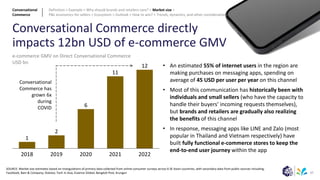
Conversational Commerce directly
impacts 12bn USD of e-commerce GMV
1
2
6
11
12
2019
2018 2020 2021 2022
e-commerce GMV on Direct Conversational Commerce
USD bn
SOURCE: Market size estimates based on triangulations of primary data collected from online consumer surveys across 6 SE Asian countries, with secondary data from public sources including;
Facebook; Bain & Company; Statista; Tech in Asia; Essence Global; Bangkok Post; Krungsri
Conversational
Commerce has
grown 6x
during
COVID
Conversational
Commerce
Definition > Example > Why should brands and retailers care? > Market size >
P&L economics for sellers > Ecosystem > Outlook > How to win? > Trends, dynamics, and other considerations
• An estimated 55% of internet users in the region are
making purchases on messaging apps, spending on
average of 45 USD per user per year on this channel
• Most of this communication has historically been with
individuals and small sellers (who have the capacity to
handle their buyers’ incoming requests themselves),
but brands and retailers are gradually also realizing
the benefits of this channel
• In response, messaging apps like LINE and Zalo (most
popular in Thailand and Vietnam respectively) have
built fully functional e-commerce stores to keep the
end-to-end user journey within the app
38
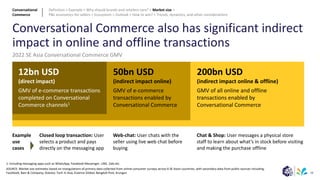
Conversational Commerce also has significant indirect
impact in online and offline transactions
2022 SE Asia Conversational Commerce GMV
1: Including messaging apps such as WhatsApp, Facebook Messenger, LINE, Zalo etc.
SOURCE: Market size estimates based on triangulations of primary data collected from online consumer surveys across 6 SE Asian countries, with secondary data from public sources including;
Facebook; Bain & Company; Statista; Tech in Asia; Essence Global; Bangkok Post; Krungsri
12bn USD
(direct impact)
GMV of e-commerce transactions
completed on Conversational
Commerce channels1
50bn USD
(indirect impact online)
GMV of e-commerce
transactions enabled by
Conversational Commerce
200bn USD
(indirect impact online & offline)
GMV of all online and offline
transactions enabled by
Conversational Commerce
Example
use
cases
Closed loop transaction: User
selects a product and pays
directly on the messaging app
Web-chat: User chats with the
seller using live web chat before
buying
Chat & Shop: User messages a physical store
staff to learn about what’s in stock before visiting
and making the purchase offline
Conversational
Commerce
Definition > Example > Why should brands and retailers care? > Market size >
P&L economics for sellers > Ecosystem > Outlook > How to win? > Trends, dynamics, and other considerations
39
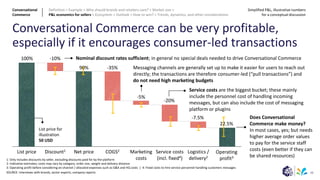
Conversational Commerce can be very profitable,
especially if it encourages consumer-led transactions
SOURCE: Interviews with brands, sector experts; company reports
Service costs
(incl. fixed4)
Net price
Discount1
List price Logistics /
delivery2
Marketing
costs
COGS2
-10%
100%
List price for
illustration
50 USD
-35%
-5%
-20%
-7.5%
22.5%
Messaging channels are generally set up to make it easier for users to reach out
directly; the transactions are therefore consumer-led (“pull transactions”) and
do not need high marketing budgets
Nominal discount rates sufficient; in general no special deals needed to drive Conversational Commerce
Service costs are the biggest bucket; these mainly
include the personnel cost of handling incoming
messages, but can also include the cost of messaging
platform or plugins
Does Conversational
Commerce make money?
In most cases, yes; but needs
higher average order values
to pay for the service staff
costs (even better if they can
be shared resources)
90%
1: Only includes discounts by seller, excluding discounts paid for by the platform
2: Indicative estimates; costs may vary by category, order size, weight and delivery distance
3: Operating profit before considering ex-channel / allocated expenses such as G&A and HQ costs | 4: Fixed costs to hire service personnel handling customers messages
Operating
profit3
Conversational
Commerce
Definition > Example > Why should brands and retailers care? > Market size >
P&L economics for sellers > Ecosystem > Outlook > How to win? > Trends, dynamics, and other considerations
Simplified P&L, illustrative numbers
for a conceptual discussion
40
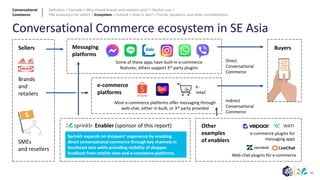
Conversational Commerce ecosystem in SE Asia
Buyers
Brands
and
retailers
Sellers Messaging
platforms
e-commerce
platforms
Other
examples
of enablers
Some of these apps have built-in e-commerce
features; others support 3rd party plugins
e-
retail
Most e-commerce platforms offer messaging through
web-chat, either in-built, or 3rd party provided
Direct
Conversational
Commerce
Indirect
Conversational
Commerce
SMEs
and resellers
Conversational
Commerce
Definition > Example > Why should brands and retailers care? > Market size >
P&L economics for sellers > Ecosystem > Outlook > How to win? > Trends, dynamics, and other considerations
Sprinklr expands on shoppers’ experience by enabling
direct conversational commerce through key channels in
Southeast Asia while providing visibility of shopper
feedback from retailer sites and e-commerce platforms.
e-commerce plugins for
messaging apps
Web-chat plugins for e-commerce
Enabler (sponsor of this report)
41
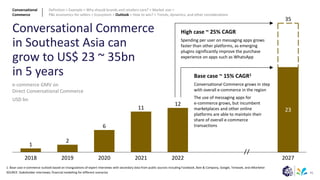
1: Base case e-commerce outlook based on triangulations of expert interviews with secondary data from public sources including Facebook, Bain & Company, Google, Temasek, and eMarketer
1
2
6
11
12
23
35
2021
2018 2020
2019 2027
2022
Conversational Commerce
in Southeast Asia can
grow to US$ 23 ~ 35bn
in 5 years
Definition > Example > Why should brands and retailers care? > Market size >
P&L economics for sellers > Ecosystem > Outlook > How to win? > Trends, dynamics, and other considerations
e-commerce GMV on
Direct Conversational Commerce
USD bn
Base case ~ 15% CAGR1
Conversational Commerce grows in step
with overall e-commerce in the region
The use of messaging apps for
e-commerce grows, but incumbent
marketplaces and other online
platforms are able to maintain their
share of overall e-commerce
transactions
High case ~ 25% CAGR
Spending per user on messaging apps grows
faster than other platforms, as emerging
plugins significantly improve the purchase
experience on apps such as WhatsApp
Conversational
Commerce
SOURCE: Stakeholder interviews; financial modelling for different scenarios
42
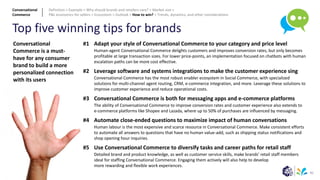
Top five winning tips for brands
#1
#2
#3
#4
#5
Adapt your style of Conversational Commerce to your category and price level
Human-agent Conversational Commerce delights customers and improves conversion rates, but only becomes
profitable at large transaction sizes. For lower price-points, an implementation focused on chatbots with human
escalation paths can be more cost effective.
Leverage software and systems integrations to make the customer experience sing
Conversational Commerce has the most robust enabler ecosystem in Social Commerce, with specialized
solutions for multi-channel agent routing, CRM, e-commerce integration, and more. Leverage these solutions to
improve customer experience and reduce operational costs.
Conversational Commerce is both for messaging apps and e-commerce platforms
The ability of Conversational Commerce to improve conversion rates and customer experience also extends to
e-commerce platforms like Shopee and Lazada, where up to 50% of purchases are influenced by messaging.
Automate close-ended questions to maximize impact of human conversations
Human labour is the most expensive and scarce resource in Conversational Commerce. Make consistent efforts
to automate all answers to questions that have no human value-add, such as shipping status notifications and
shop opening hour inquiries.
Use Conversational Commerce to diversify tasks and career paths for retail staff
Detailed brand and product knowledge, as well as customer service skills, make brands’ retail staff members
ideal for staffing Conversational Commerce. Engaging them actively will also help to develop

more rewarding and flexible work experiences.
Conversational
Commerce is a must-
have for any consumer
brand to build a more
personalized connection
with its users
Conversational
Commerce
Definition > Example > Why should brands and retailers care? > Market size >
P&L economics for sellers > Ecosystem > Outlook > How to win? > Trends, dynamics, and other considerations
43
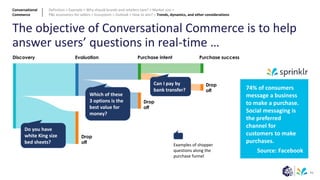
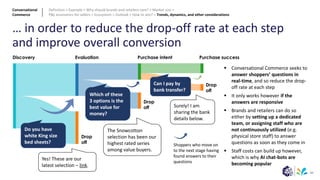
The objective of Conversational Commerce is to help
answer users’ questions in real-time …
Discovery Evaluation Purchase intent Purchase success
Drop
off
Drop
off
Drop
off
Do you have
white King size
bed sheets?
Which of these
3 options is the
best value for
money?
Can I pay by
bank transfer?
Examples of shopper
questions along the
purchase funnel
74% of consumers
message a business
to make a purchase.
Social messaging is
the preferred
channel for
customers to make
purchases.
Source: Facebook
Conversational
Commerce
Definition > Example > Why should brands and retailers care? > Market size >
P&L economics for sellers > Ecosystem > Outlook > How to win? > Trends, dynamics, and other considerations
Discovery Evaluation Purchase intent Purchase success
Do you have
white King size
bed sheets?
Which of these
3 options is the
best value for
money?
Can I pay by
bank transfer?
Drop
off
Drop
off
44
… in order to reduce the drop-off rate at each step
and improve overall conversion
Yes! These are our
latest selection – link.
The Snowcotton
selection has been our
highest rated series
among value buyers.
Surely! I am
sharing the bank
details below.
Drop
off
Shoppers who move on
to the next stage having
found answers to their
questions
▪ Conversational Commerce seeks to
answer shoppers’ questions in
real-time, and so reduce the drop-
off rate at each step
▪ It only works however if the
answers are responsive
▪ Brands and retailers can do so
either by setting up a dedicated
team, or assigning staff who are
not continuously utilized (e.g.
physical store staff) to answer
questions as soon as they come in
▪ Staff costs can build up however,
which is why AI chat-bots are
becoming popular
Conversational
Commerce
Definition > Example > Why should brands and retailers care? > Market size >
P&L economics for sellers > Ecosystem > Outlook > How to win? > Trends, dynamics, and other considerations
45
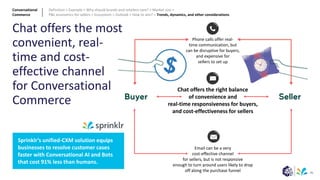
Chat offers the most
convenient, real-
time and cost-
effective channel
for Conversational
Commerce
Phone calls offer real-
time communication, but
can be disruptive for buyers,
and expensive for
sellers to set up
Chat offers the right balance
of convenience and
real-time responsiveness for buyers,
and cost-effectiveness for sellers
Email can be a very
cost-effective channel
for sellers, but is not responsive
enough to turn around users likely to drop
off along the purchase funnel
Sprinklr’s unified-CXM solution equips
businesses to resolve customer cases
faster with Conversational AI and Bots
that cost 91% less than humans.
Conversational
Commerce
Definition > Example > Why should brands and retailers care? > Market size >
P&L economics for sellers > Ecosystem > Outlook > How to win? > Trends, dynamics, and other considerations
46
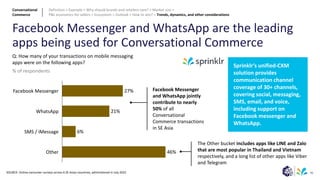
Facebook Messenger and WhatsApp are the leading
apps being used for Conversational Commerce
SOURCE: Online consumer surveys across 6 SE Asian countries, administered in July 2022
27%
21%
6%
46%
SMS / iMessage
Facebook Messenger
WhatsApp
Other
Q: How many of your transactions on mobile messaging
apps were on the following apps?
% of respondents
Facebook Messenger
and WhatsApp jointly
contribute to nearly
50% of all
Conversational
Commerce transactions
in SE Asia
The Other bucket includes apps like LINE and Zalo
that are most popular in Thailand and Vietnam
respectively, and a long list of other apps like Viber
and Telegram
Sprinklr’s unified-CXM
solution provides
communication channel
coverage of 30+ channels,
covering social, messaging,
SMS, email, and voice,
including support on
Facebook messenger and
WhatsApp.
Conversational
Commerce
Definition > Example > Why should brands and retailers care? > Market size >
P&L economics for sellers > Ecosystem > Outlook > How to win? > Trends, dynamics, and other considerations
(sponsored section)
Contents
47
1. Overview of Social Commerce in
Southeast Asia
2. Social Commerce archetypes
A. Social Platform Commerce
B. Conversational Commerce
C. Live Shopping
D. Community Group Buy
3. Sprinklr and Unified-CXM
4. Learn more
48
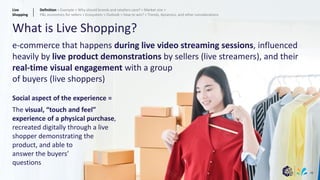
What is Live Shopping?
e-commerce that happens during live video streaming sessions, influenced
heavily by live product demonstrations by sellers (live streamers), and their
real-time visual engagement with a group
of buyers (live shoppers)
Social aspect of the experience =
The visual, “touch and feel”
experience of a physical purchase,
recreated digitally through a live
shopper demonstrating the
product, and able to
answer the buyers’
questions
Live
Shopping
Definition > Example > Why should brands and retailers care? > Market size >
P&L economics for sellers > Ecosystem > Outlook > How to win? > Trends, dynamics, and other considerations
49
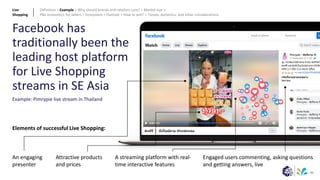
Facebook has
traditionally been the
leading host platform
for Live Shopping
streams in SE Asia
Example: Pimrypie live stream in Thailand
Elements of successful Live Shopping:
An engaging
presenter
Attractive products
and prices
A streaming platform with real-
time interactive features
Engaged users commenting, asking questions
and getting answers, live
Live
Shopping
Definition > Example > Why should brands and retailers care? > Market size >
P&L economics for sellers > Ecosystem > Outlook > How to win? > Trends, dynamics, and other considerations
50
Extensive influencer
and tech ecosystem
Influencers and KOLs moved
online in big numbers during
COVID. Along with that
emerged talent agencies,
studios, and tech
providers that allow
even small sellers
to produce high-
quality streams
even if they don’t
have in-house
capabilities.
Relevant for
experience products
Live Shopping is most
popular for categories
such as beauty, electronic
appliances, and fashion –
where the long-term
physical experience of
using the product is a big
contributor to the users’
satisfaction. Live Shopping,
especially with a trusted
presenter, helps to
highlight this experience.
Growing live video
consumption
Movement restrictions
during COVID created a
demand for more face-
to-face experiences
online. In addition, the
work from home
culture – which has
survived past COVID –
has opened up more
time and willingness for
consumers to consume
video content.
Unit
economics
Success in live
shopping requires
attractive deals, a good
presenter, and
seamless and engaging
tech UI/UX – costs that
can impact profitability.
This makes Live
Shopping more suitable
for occasional events
such as new product
launches than ongoing
sales.
Live Shopping offers brands a high
engagement sales channel
But watch out
for …
Buyer
retention
Live Shopping
draws many
viewers attracted
by big discounts.
Converting these
users to loyal,
repeat buyers
can however be
challenging.
Live
Shopping
Definition > Example > Why should brands and retailers care? > Market size >
P&L economics for sellers > Ecosystem > Outlook > How to win? > Trends, dynamics, and other considerations
51
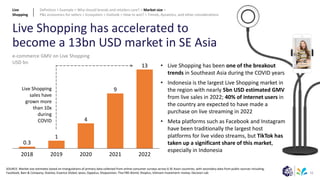
Live Shopping has accelerated to
become a 13bn USD market in SE Asia
SOURCE: Market size estimates based on triangulations of primary data collected from online consumer surveys across 6 SE Asian countries, with secondary data from public sources including;
Facebook; Bain & Company; Statista; Essence Global; Ipsos; Oppotus; Shopavision; Thai PBS World; Shoplus; Vietnam Investment review; Decision Lab
1
4
9
13
2018 2019 2020 2021
0.3
2022
e-commerce GMV on Live Shopping
USD bn
Live Shopping
sales have
grown more
than 10x
during
COVID
• Live Shopping has been one of the breakout
trends in Southeast Asia during the COVID years
• Indonesia is the largest Live Shopping market in
the region with nearly 5bn USD estimated GMV
from live sales in 2022; 40% of internet users in
the country are expected to have made a
purchase on live streaming in 2022
• Meta platforms such as Facebook and Instagram
have been traditionally the largest host
platforms for live video streams, but TikTok has
taken up a significant share of this market,
especially in Indonesia
Live
Shopping
Definition > Example > Why should brands and retailers care? > Market size >
P&L economics for sellers > Ecosystem > Outlook > How to win? > Trends, dynamics, and other considerations
52
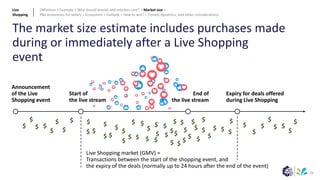
The market size estimate includes purchases made
during or immediately after a Live Shopping
event
Announcement
of the Live
Shopping event
Expiry for deals offered
during Live Shopping
Start of
the live stream
End of
the live stream
$
$
$ $
$
$ $
$
$
$
$
$ $
$ $
$ $ $
$
$
$
$
$
$
$ $
$
$ $
$
$$
$ $
$
$
$
$
$
$
$
$
$
$ $
$
$
$
$
$
$ $
$
$ $
Live Shopping market (GMV) =
Transactions between the start of the shopping event, and
the expiry of the deals (normally up to 24 hours after the end of the event)
Live
Shopping
Definition > Example > Why should brands and retailers care? > Market size >
P&L economics for sellers > Ecosystem > Outlook > How to win? > Trends, dynamics, and other considerations
53
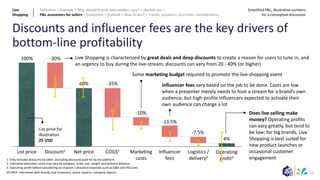
Discounts and influencer fees are the key drivers of
bottom-line profitability
SOURCE: Interviews with brands, live streamers, sector experts; company reports
Discount1
List price Net price Marketing
costs
COGS2 Influencer
fees
Logistics /
delivery2
1: Only includes discounts by seller, excluding discounts paid for by the platform
2: Indicative estimates; costs may vary by category, order size, weight and delivery distance
3: Operating profit before considering ex-channel / allocated expenses such as G&A and HQ costs
Operating
profit3
List price for
illustration
25 USD
-30%
-35%
-10%
-13.5%
100%
60%
-7.5%
4%
Live Shopping is characterized by great deals and deep discounts to create a reason for users to tune in, and
an urgency to buy during the live-stream; discounts can vary from 20 - 40% (or higher)
Influencer fees vary based on the job to be done. Costs are low
when a presenter merely needs to host a stream for a brand’s own
audience; but high-profile influencers expected to activate their
own audience can charge a lot
Does live selling make
money? Operating profits
can vary greatly, but tend to
be low; for big brands, Live
Shopping is best suited for
new product launches or
occasional customer
engagement
Some marketing budget required to promote the live-shopping event
Live
Shopping
Definition > Example > Why should brands and retailers care? > Market size >
P&L economics for sellers > Ecosystem > Outlook > How to win? > Trends, dynamics, and other considerations
Simplified P&L, illustrative numbers
for a conceptual discussion
54
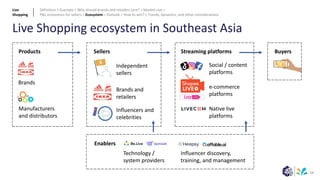
Live Shopping ecosystem in Southeast Asia
Enablers
Buyers
Brands and
retailers
Influencers and
celebrities
Independent
sellers
Sellers
Manufacturers
and distributors
Brands
Products Streaming platforms
e-commerce
platforms
Native live
platforms
Social / content
platforms
Technology /
system providers
Influencer discovery,
training, and management
Live
Shopping
Definition > Example > Why should brands and retailers care? > Market size >
P&L economics for sellers > Ecosystem > Outlook > How to win? > Trends, dynamics, and other considerations
55
1
4
9
13
26
2019 2020
2018 2021 2022 2027
0.3
50
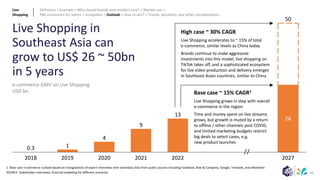
Live Shopping in
Southeast Asia can
grow to US$ 26 ~ 50bn
in 5 years
Live
Shopping
Definition > Example > Why should brands and retailers care? > Market size >
P&L economics for sellers > Ecosystem > Outlook > How to win? > Trends, dynamics, and other considerations
e-commerce GMV on Live Shopping
USD bn Base case ~ 15% CAGR1
Live Shopping grows in step with overall
e-commerce in the region
Time and money spent on live streams
grows, but growth is muted by a return
to offline / other channels post COVID,
and limited marketing budgets restrict
big deals to select cases, e.g.
new product launches
High case ~ 30% CAGR
Live Shopping accelerates to ~ 15% of total
e-commerce, similar levels as China today
Brands continue to make aggressive
investments into this model, live shopping on
TikTok takes off, and a sophisticated ecosystem
for live video production and delivery emerges
in Southeast Asian countries, similar to China
1: Base case e-commerce outlook based on triangulations of expert interviews with secondary data from public sources including Facebook, Bain & Company, Google, Temasek, and eMarketer
SOURCE: Stakeholder interviews; financial modelling for different scenarios
56
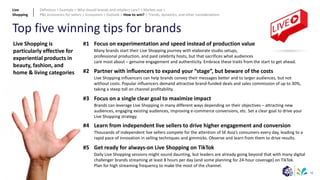
Top five winning tips for brands
#1
#2
#3
#4
#5
Focus on experimentation and speed instead of production value
Many brands start their Live Shopping journey with elaborate studio setups,
professional production, and paid celebrity hosts, but that sacrifices what audiences
care most about – genuine engagement and authenticity. Embrace these traits from the start to get ahead.
Partner with influencers to expand your “stage”, but beware of the costs
Live Shopping influencers can help brands convey their messages better and to larger audiences, but not
without costs. Popular influencers demand attractive brand-funded deals and sales commission of up to 30%,
taking a steep toll on channel profitability.
Focus on a single clear goal to maximize impact
Brands can leverage Live Shopping in many different ways depending on their objectives – attracting new
audiences, engaging existing audiences, improving e-commerce conversions, etc. Set a clear goal to drive your
Live Shopping strategy.
Learn from independent live sellers to drive higher engagement and conversion
Thousands of independent live sellers compete for the attention of SE Asia’s consumers every day, leading to a
rapid pace of innovation in selling techniques and gimmicks. Observe and learn from them to drive results.
Get ready for always-on Live Shopping on TikTok
Daily Live Shopping sessions might sound daunting, but leaders are already going beyond that with many digital
challenger brands streaming at least 8 hours per day (and some planning for 24-hour coverage) on TikTok.
Plan for high streaming frequency to make the most of the channel.
Live Shopping is
particularly effective for
experiential products in
beauty, fashion, and
home & living categories
Live
Shopping
Definition > Example > Why should brands and retailers care? > Market size >
P&L economics for sellers > Ecosystem > Outlook > How to win? > Trends, dynamics, and other considerations
57
SOURCE: Online consumer surveys across 6 SE Asian countries, administered in June-July 2022
100%
All respondents
92%
Know about Live
Shopping
79%
Have watched at least
1 Live Shopping
session in the last 12
months
44%
Have purchased at least
once in the last 12 months
8%
13%
35%
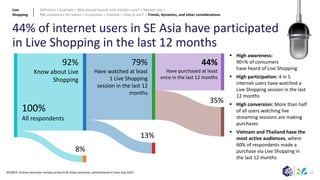
44% of internet users in SE Asia have participated
in Live Shopping in the last 12 months
▪ High awareness:
90+% of consumers
have heard of Live Shopping
▪ High participation: 4 in 5
internet users have watched a
Live Shopping session in the last
12 months
▪ High conversion: More than half
of all users watching live
streaming sessions are making
purchases
▪ Vietnam and Thailand have the
most active audiences, where
60% of respondents made a
purchase via Live Shopping in
the last 12 months
Live
Shopping
Definition > Example > Why should brands and retailers care? > Market size >
P&L economics for sellers > Ecosystem > Outlook > How to win? > Trends, dynamics, and other considerations
58
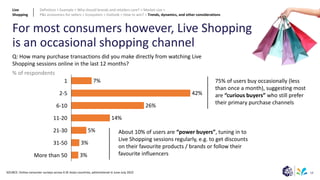
For most consumers however, Live Shopping
is an occasional shopping channel
SOURCE: Online consumer surveys across 6 SE Asian countries, administered in June-July 2022
7%
42%
26%
14%
5%
3%
3%
2-5
1
More than 50
11-20
6-10
21-30
31-50
Q: How many purchase transactions did you make directly from watching Live
Shopping sessions online in the last 12 months?
% of respondents
75% of users buy occasionally (less
than once a month), suggesting most
are “curious buyers” who still prefer
their primary purchase channels
About 10% of users are “power buyers”, tuning in to
Live Shopping sessions regularly, e.g. to get discounts
on their favourite products / brands or follow their
favourite influencers
Live
Shopping
Definition > Example > Why should brands and retailers care? > Market size >
P&L economics for sellers > Ecosystem > Outlook > How to win? > Trends, dynamics, and other considerations
59
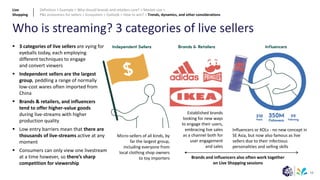
Who is streaming? 3 categories of live sellers
▪ 3 categories of live sellers are vying for
eyeballs today, each employing
different techniques to engage
and convert viewers
▪ Independent sellers are the largest
group, peddling a range of normally
low-cost wares often imported from
China
▪ Brands & retailers, and influencers
tend to offer higher-value goods
during live-streams with higher
production quality
▪ Low entry barriers mean that there are
thousands of live-streams active at any
moment
▪ Consumers can only view one livestream
at a time however, so there’s sharp
competition for viewership
Micro-sellers of all kinds, by
far the largest group,
including everyone from
local clothing shop owners
to toy importers
Established brands
looking for new ways
to engage their users,
embracing live sales
as a channel both for
user engagement
and sales
Influencers or KOLs - no new concept in
SE Asia, but now also famous as live
sellers due to their infectious
personalities and selling skills
Brands and influencers also often work together
on Live Shopping sessions
Live
Shopping
Definition > Example > Why should brands and retailers care? > Market size >
P&L economics for sellers > Ecosystem > Outlook > How to win? > Trends, dynamics, and other considerations
60
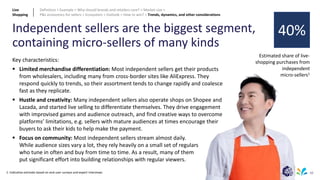
Independent sellers are the biggest segment,
containing micro-sellers of many kinds
Estimated share of live-
shopping purchases from
independent
micro-sellers1
40%
Key characteristics:
▪ Limited merchandise differentiation: Most independent sellers get their products
from wholesalers, including many from cross-border sites like AliExpress. They
respond quickly to trends, so their assortment tends to change rapidly and coalesce
fast as they replicate.
▪ Hustle and creativity: Many independent sellers also operate shops on Shopee and
Lazada, and started live selling to differentiate themselves. They drive engagement
with improvised games and audience outreach, and find creative ways to overcome
platforms’ limitations, e.g. sellers with mature audiences at times encourage their
buyers to ask their kids to help make the payment.
▪ Focus on community: Most independent sellers stream almost daily.
While audience sizes vary a lot, they rely heavily on a small set of regulars
who tune in often and buy from time to time. As a result, many of them
put significant effort into building relationships with regular viewers.
1: Indicative estimate based on end-user surveys and expert interviews
Live
Shopping
Definition > Example > Why should brands and retailers care? > Market size >
P&L economics for sellers > Ecosystem > Outlook > How to win? > Trends, dynamics, and other considerations
61
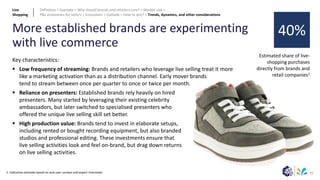
More established brands are experimenting
with live commerce
1: Indicative estimate based on end-user surveys and expert interviews
Key characteristics:
▪ Low frequency of streaming: Brands and retailers who leverage live selling treat it more
like a marketing activation than as a distribution channel. Early mover brands
tend to stream between once per quarter to once or twice per month.
▪ Reliance on presenters: Established brands rely heavily on hired
presenters. Many started by leveraging their existing celebrity
ambassadors, but later switched to specialised presenters who
offered the unique live selling skill set better.
▪ High production value: Brands tend to invest in elaborate setups,
including rented or bought recording equipment, but also branded
studios and professional editing. These investments ensure that
live selling activities look and feel on-brand, but drag down returns
on live selling activities.
Estimated share of live-
shopping purchases
directly from brands and
retail companies1
40%
Live
Shopping
Definition > Example > Why should brands and retailers care? > Market size >
P&L economics for sellers > Ecosystem > Outlook > How to win? > Trends, dynamics, and other considerations
62
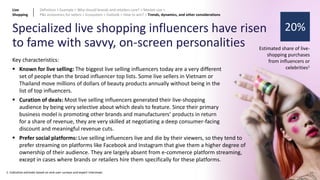
Specialized live shopping influencers have risen
to fame with savvy, on-screen personalities
20%
Estimated share of live-
shopping purchases
from influencers or
celebrities1
Key characteristics:
▪ Known for live selling: The biggest live selling influencers today are a very different
set of people than the broad influencer top lists. Some live sellers in Vietnam or
Thailand move millions of dollars of beauty products annually without being in the
list of top influencers.
▪ Curation of deals: Most live selling influencers generated their live-shopping
audience by being very selective about which deals to feature. Since their primary
business model is promoting other brands and manufacturers’ products in return
for a share of revenue, they are very skilled at negotiating a deep consumer-facing
discount and meaningful revenue cuts.
1: Indicative estimate based on end-user surveys and expert interviews
▪ Prefer social platforms: Live selling influencers live and die by their viewers, so they tend to
prefer streaming on platforms like Facebook and Instagram that give them a higher degree of
ownership of their audience. They are largely absent from e-commerce platform streaming,
except in cases where brands or retailers hire them specifically for these platforms.
Live
Shopping
Definition > Example > Why should brands and retailers care? > Market size >
P&L economics for sellers > Ecosystem > Outlook > How to win? > Trends, dynamics, and other considerations
63
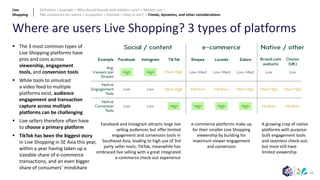
Where are users Live Shopping? 3 types of platforms
Facebook and Instagram attracts large live
selling audiences but offer limited
engagement and conversion tools in
Southeast Asia, leading to high use of 3rd
party seller tools; TikTok, meanwhile has
embraced live selling with a great integrated
e-commerce check-out experience
▪ The 3 most common types of
Live Shopping platforms have
pros and cons across
viewership, engagement
tools, and conversion tools
▪ While tools to simulcast
a video feed to multiple
platforms exist, audience
engagement and transaction
capture across multiple
platforms can be challenging
▪ Live sellers therefore often have
to choose a primary platform
e-commerce platforms make up
for their smaller Live Shopping
viewership by building for
maximum viewer engagement
and conversion
A growing crop of native
platforms with purpose-
built engagement tools
and seamless check-out;
but most still have
limited viewership
▪ TikTok has been the biggest story
in Live Shopping in SE Asia this year,
within a year having taken up a
sizeable share of e-commerce
transactions, and an even bigger
share of consumers’ mindshare
Live
Shopping
Definition > Example > Why should brands and retailers care? > Market size >
P&L economics for sellers > Ecosystem > Outlook > How to win? > Trends, dynamics, and other considerations
64
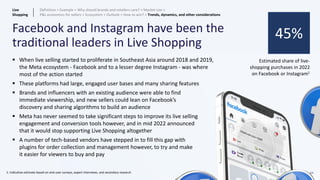
Facebook and Instagram have been the
traditional leaders in Live Shopping
Estimated share of live-
shopping purchases in 2022
on Facebook or Instagram1
▪ When live selling started to proliferate in Southeast Asia around 2018 and 2019,
the Meta ecosystem - Facebook and to a lesser degree Instagram - was where
most of the action started
▪ These platforms had large, engaged user bases and many sharing features
▪ Brands and influencers with an existing audience were able to find
immediate viewership, and new sellers could lean on Facebook’s
discovery and sharing algorithms to build an audience
▪ Meta has never seemed to take significant steps to improve its live selling
engagement and conversion tools however, and in mid 2022 announced
that it would stop supporting Live Shopping altogether
▪ A number of tech-based vendors have stepped in to fill this gap with
plugins for order collection and management however, to try and make
it easier for viewers to buy and pay
45%
1: Indicative estimate based on end-user surveys, expert interviews, and secondary research
Live
Shopping
Definition > Example > Why should brands and retailers care? > Market size >
P&L economics for sellers > Ecosystem > Outlook > How to win? > Trends, dynamics, and other considerations
65
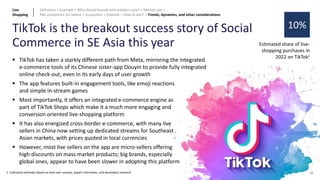
TikTok is the breakout success story of Social
Commerce in SE Asia this year
10%
Estimated share of live-
shopping purchases in
2022 on TikTok1
▪ TikTok has taken a starkly different path from Meta, mirroring the integrated
e-commerce tools of its Chinese sister-app Douyin to provide fully integrated
online check-out, even in its early days of user growth
▪ The app features built-in engagement tools, like emoji reactions
and simple in-stream games
▪ Most importantly, it offers an integrated e-commerce engine as
part of TikTok Shops which make it a much more engaging and
conversion oriented live-shopping platform
▪ It has also energized cross-border e-commerce, with many live
sellers in China now setting up dedicated streams for Southeast
Asian markets, with prices quoted in local currencies
▪ However, most live sellers on the app are micro-sellers offering
high discounts on mass market products; big brands, especially
global ones, appear to have been slower in adopting this platform
1: Indicative estimate based on end-user surveys, expert interviews, and secondary research
Live
Shopping
Definition > Example > Why should brands and retailers care? > Market size >
P&L economics for sellers > Ecosystem > Outlook > How to win? > Trends, dynamics, and other considerations
66
Live Shopping on e-commerce platforms is
primarily tailored to help engage and
convert traffic that already exists Estimated share of live-
shopping purchases in 2022
on e-commerce platforms1
▪ Live selling through e-commerce platforms in Southeast Asia was deliberately instigated
by the two dominating e-commerce marketplaces - Shopee and Lazada
▪ Learning best practices from Chinese e-commerce giants like Taobao and JD, they offer
live selling tools and experiences, and advertise “primetime
slots” with high viewership to brand partners
▪ But the bulk of Live Shopping on these platforms is
happening with independent sellers who stream daily
to a small audience with a product selection and style
similar to a weekend market or bazaar
▪ In response, large brands and retailers are creating
their own live selling environments on their online
stores to boost user engagement and conversion
40%
1: Indicative estimate based on end-user surveys, expert interviews, and secondary research
Live
Shopping
Definition > Example > Why should brands and retailers care? > Market size >
P&L economics for sellers > Ecosystem > Outlook > How to win? > Trends, dynamics, and other considerations
(sponsored section)
Contents
67
1. Overview of Social Commerce in
Southeast Asia
2. Social Commerce archetypes
A. Social Platform Commerce
B. Conversational Commerce
C. Live Shopping
D. Community Group Buy
3. Sprinklr and Unified-CXM
4. Learn more
68
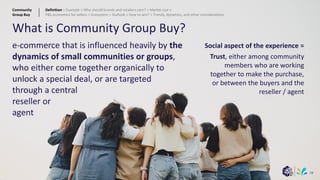
What is Community Group Buy?
e-commerce that is influenced heavily by the
dynamics of small communities or groups,
who either come together organically to
unlock a special deal, or are targeted
through a central
reseller or
agent
Social aspect of the experience =
Trust, either among community
members who are working
together to make the purchase,
or between the buyers and the
reseller / agent
Community
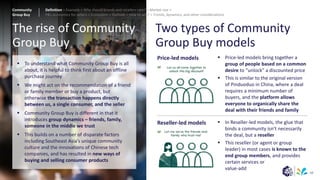
Group Buy
Definition > Example > Why should brands and retailers care? > Market size >
P&L economics for sellers > Ecosystem > Outlook > How to win? > Trends, dynamics, and other considerations
69
The rise of Community
Group Buy
Two types of Community
Group Buy models
▪ To understand what Community Group Buy is all
about, it is helpful to think first about an offline
purchase journey
▪ We might act on the recommendation of a friend
or family member or buy a product, but
otherwise the transaction happens directly
between us, a single consumer, and the seller
▪ Community Group Buy is different in that it
introduces group dynamics – friends, family,
someone in the middle we trust
▪ This builds on a number of disparate factors
including Southeast Asia’s unique community
culture and the innovations of Chinese tech
companies, and has resulted in new ways of
buying and selling consumer products
“
Price-led models
Reseller-led models
“
▪ Price-led models bring together a
group of people based on a common
desire to “unlock” a discounted price
▪ This is similar to the original version
of Pinduoduo in China, where a deal
requires a minimum number of
buyers, and the platform allows
everyone to organically share the
deal with their friends and family
▪ In Reseller-led models, the glue that
binds a community isn’t necessarily
the deal, but a reseller
▪ This reseller (or agent or group
leader) in most cases is known to the
end group members, and provides
certain services or
value-add
Community
Group Buy
Definition > Example > Why should brands and retailers care? > Market size >
P&L economics for sellers > Ecosystem > Outlook > How to win? > Trends, dynamics, and other considerations
WEBUY Group Chat
~ Group Leader
70
WeBuy is a good
example of a
Community Group
Buy platform in
Southeast Asia
1. A new deal
gets launched on
the WeBuy website
2. Group Leaders broadcast the deal to their
local communities through WhatsApp
3. Interested buyers can make the
purchase on the WeBuy website, have the
products delivered to the Group Leader’s
address, and pick them up later
Example: WeBuy purchase
journey in Singapore
924WIUEO98
924WIUEO98
Community
Group Buy
Definition > Example > Why should brands and retailers care? > Market size >
P&L economics for sellers > Ecosystem > Outlook > How to win? > Trends, dynamics, and other considerations
71
Useful for slow-
moving inventory
This model is often used
for liquidation of slow-
moving inventory (e.g.
old models of electronic
products or soon to
expire beauty or food
products) since it allows
for quick organic
demand aggregation
around a heavily
discounted offer.
"No cure No pay"
business model
With the burden of product
marketing shifting from the
brand to the reseller (or
agent) who is marketing the
deal to their local community
in return for a commission,
this model reduces the need
for fixed marketing spend.
This makes it particularly
relevant for new brands with
limited marketing budgets
Low-cost access
to Tier 2/3 cities
Infrastructure
limitations in Tier 2
and 3 cities can make
logistics expensive. By
delivering to hubs that
can aggregate demand
for distributed
communities however,
this model can reduce
the unit cost for
distribution.
Community Group Buy offers a
unique “no cure no pay” model
But watch out
for …
Customer loyalty
and brand communication
The primary draw for consumers buying
through communities is better prices,
making it difficult for brands to convert
them into loyal buyers of regular-priced
products. Also, with last-
mile communication being
done by independent
resellers, brands need
to be more careful of
how they are being
marketed.
Community
Group Buy
Definition > Example > Why should brands and retailers care? > Market size >
P&L economics for sellers > Ecosystem > Outlook > How to win? > Trends, dynamics, and other considerations
72
Community Group Buy is relatively small, comprising
around 3% of e-commerce GMV in Southeast Asia
SOURCE: Market size estimates based on triangulations of primary data collected from online consumer surveys across 6 SE Asian countries, with secondary data from public sources including;
Facebook; Bain & Company; Statista; Essence Global; Ipsos; Oppotus; Shopavision; Thai PBS World; Shoplus; Vietnam Investment review; Decision Lab
1
2
3
5
2018 2019 2021
2020 2022
0.5
e-commerce GMV on Community Group Buy
USD bn
Community
Group Buy grew
5x during
COVID
~ 3% of e-commerce GMV in Southeast Asia
• The biggest market for Community Group Buy in the
region is Indonesia (2bn USD in 2022), where apps such
as Kitabeli and Evermos have used this model to
accelerate e-commerce adoption in Tier 2/3 cities
• Many of these startups have been inspired by the
success of innovative business models such as
Pinduoduo in China and Meesho in India
• Availability of investor funding in the last few years also
helped, since the big discounts required to incentivized
deal sharing and/or the presence of an additional
intermediary (reseller) leaves less margin available for
the platforms to bootstrap growth
Community
Group Buy
Definition > Example > Why should brands and retailers care? > Market size >
P&L economics for sellers > Ecosystem > Outlook > How to win? > Trends, dynamics, and other considerations
73
Price-led models need big discounts to trigger
a viral response and build organic demand
SOURCE: Interviews with brands, sector experts; company reports
Discount1
List price Net price COGS2 Marketing
costs
Platform
fees
Logistics /
delivery2
1: Only includes discounts by seller, excluding discounts paid for by the platform
2: Indicative estimates; costs may vary by category, order size, weight and delivery distance
3: Operating profit before considering ex-channel / allocated expenses such as G&A and HQ costs | 3: Fixed costs to hire service personnel handling customers messages
List price for
illustration
20 USD
-35%
-5%
-5%
-7.5%
60%
-40%
100%
Operating
profit3
7.5%
Discounts are the biggest cost-bucket for price-led Community Group
Buy transactions; they offer a reasons for end users to make the effort
to share the deal with their friends and family, and build towards the
minimum order volume
Marketing costs tend to be low as the deal is
meant to “sell itself”
Platform costs are generally also low, e.g.
80-90% of Pinduoduo revenues from services such as advertising
This point also explains
why price-led models have
not taken off in SE Asia vs.
China; the region’s high
reliance on imports means
that companies here often
do not have the margins
available to offer such
steep discounts
Does Price-led Group Buy
make money? Yes, but only
for products with high room
for discounting, and where
users are driven much more
by prices than brand-affinity
Community
Group Buy
Definition > Example > Why should brands and retailers care? > Market size >
P&L economics for sellers > Ecosystem > Outlook > How to win? > Trends, dynamics, and other considerations
Simplified P&L, illustrative numbers
for a conceptual discussion
74
Reseller-led models do not need big discounts or
marketing costs, but can have high intermediary fees
SOURCE: Interviews with brands, sector experts; company reports
Marketing
costs
Intermediary
commissions
Net price
List price COGS2
Discount1 Logistics /
delivery2
1: Only includes discounts by seller, excluding discounts paid for by the platform
2: Indicative estimates; costs may vary by category, order size, weight and delivery distance
3: Operating profit before considering ex-channel / allocated expenses such as G&A and HQ costs | 3: Fixed costs to hire service personnel handling customers messages
List price for
illustration
20 USD
-35%
-5%
-25%
-7.5%
80%
-20%
100%
Operating
profit3
7.5%
Discounts can be less than price-led models but generally still needed to help resellers sell to their end-
users (who if not for a favorable price may choose to buy from other platforms)
Marketing costs tend to be low as this is a “no cure no pay” channel; most of
the marketing is done by the resellers to their communities
Intermediary fees can be high however, including ~
20% commission for the resellers, and ~ 5% if there is
a platform managing these resellers
Does Reseller-led Group Buy
make money? Yes, especially
for emerging brands or new
products, where the trust
between the reseller and the
buyer can help bridge the
lack of brand-awareness
Community
Group Buy
Definition > Example > Why should brands and retailers care? > Market size >
P&L economics for sellers > Ecosystem > Outlook > How to win? > Trends, dynamics, and other considerations
Simplified P&L, illustrative numbers
for a conceptual discussion
75
Community Group Buy ecosystem in Southeast Asia
Enablers
Buyers
Reseller-led Community
Group Buy platforms
Products
Resellers
Price-led Community
Group Buy platforms
Manufacturers
and distributors
Brands
Pinduoduo-like platforms that connect brands directly
to groups of buyers; limited examples in SE Asia
Platforms that allow micro-sellers to sign-up to become resellers
without procuring themselves or holding inventory
B2B e-commerce platforms1
Platforms that help brands sell to small shops / micro-sellers
1: B2B e-commerce platforms shown here only for comparison; these are not included in
Social Commerce in this report as they do not participate in the final B2C transaction,
generally leaving it up to the micro-seller / small shop to manage that relationship
Many brands are beginning to set up and manage their own
networks of resellers; on the other hand, many resellers
procure directly from manufacturers (e.g. in China) without
going through a Group Buy platform Resellers often use other forms of
Social Commerce such as live selling and
messaging as enablers for their sales
Micro-sellers,
small shop or
business
owners,
home makers
etc.
Buyers in this
model do not
necessarily
need to be
online, and
can ask the
resellers to
buy on their
behalf
Community
Group Buy
Definition > Example > Why should brands and retailers care? > Market size >
P&L economics for sellers > Ecosystem > Outlook > How to win? > Trends, dynamics, and other considerations
76
1
2
3
5
8
2018 2019 2021
2020 2022 2027
0.5
15
Community Group Buy
in Southeast Asia can
grow to US$ 8 ~ 15bn
in 5 years
Definition > Example > Why should brands and retailers care? > Market size >
P&L economics for sellers > Ecosystem > Outlook > How to win? > Trends, dynamics, and other considerations
e-commerce GMV on Community Group Buy
USD bn
Community
Group Buy
Base case ~ 9% CAGR
Community Group Buy tech startups
continue to drive e-commerce growth
for emerging brands and/or in Tier 2/3
geographies through the reseller-led
model
But they are unable to structurally
compete on prices with incumbent
marketplaces at scale
High case ~ 25% CAGR
New, sophisticated Pinduoduo-like business
models take hold in the region and are able to
deliver competitive price-led value propositions
leveraging group dynamics and gamification
Meanwhile, supply chains and logistics improve
significantly to enable cost-effective demand
aggregation much more effectively
SOURCE: Stakeholder interviews; financial modelling for different scenarios
77
Top five winning tips for brands
#1
#2
#3
#4
#5
Leverage reseller-led Group Buy to break into new markets with limited financial risk
Consumer brands that seek to break into new geographies and demographics can leverage reseller-led Group
Buy platforms due to their attractive combination of high frontier market exposure and fully commission-based
business model.
Invest in reseller brand training, education, and incentives to maximize impact
The critical success factor for reseller-led Group Buy is to ensure that agents feel equipped and incentivized to
market your products to their consumer base. Invest in regular brand training and education, as well as reseller
incentives, to maximize impact.
Monitor prices and reseller behaviour to protect your retail pricing power
Because Group Buy resellers get access to products at wholesale prices, participating can risk eroding brands’
retail pricing. To avoid this, monitor the end-user prices regularly and ensure that only a minimal share of
channel sales are to resellers buying for themselves.
Invest in rigorous logistics planning and optimization to avoid unhappy surprises
A high share of Group Buy sales in Southeast Asia are in frontier regions with poor logistics infrastructure. Keep
an eye on your unit economics, as the mid-mile and last-mile delivery charges can be substantial.
Consider starting your own reseller program if Group Buy becomes a big channel
While launching Group Buy through a platform helps to bring an instant community of resellers, it can make
sense to go direct eventually if sales become substantial. Running an independent program can
save approximately 5% in platform margin, which can be saved or passed on to resellers.
Community Group Buy
can be a great model for
brands with limited
fixed marketing
budgets, especially for
Tier 2 / 3 cities
Community
Group Buy
Definition > Example > Why should brands and retailers care? > Market size >
P&L economics for sellers > Ecosystem > Outlook > How to win? > Trends, dynamics, and other considerations
78
The sophistication of e-commerce buyers in most
markets tends to grow over time …
Growing level of
user sophistication
over time
Lack of Knowledge
to buy online
Lack of Capabilities
to buy online
Sophisticated users pick
their channel based on
Value for Money
Drivers of user sophistication:
▪ Greater smartphone penetration
▪ Growing use of digital payments
▪ Improving network speeds
▪ Government efforts to drive digital literacy
▪ Marketing initiatives by e-commerce platforms
▪ Low-income developing
countries tend to have
many users with
Knowledge or Capability
gaps
▪ As users build their
knowledge and
capabilities, they are able
to shop online more
effectively
▪ Sophisticated users begin
to shop around, and are
able to pick channels that
offer them the best Value
for Money
Indicative of
number of users
(illustrative)
Community
Group Buy
Definition > Example > Why should brands and retailers care? > Market size >
P&L economics for sellers > Ecosystem > Outlook > How to win? > Trends, dynamics, and other considerations
79
… and Community Group Buy platforms need to
evolve along with their end users
Growing level of
user sophistication
over time
Lack of Knowledge
to buy online
Lack of Capabilities
to buy online
Sophisticated users pick
their channel based on
Value for Money
Bridge the
Knowledge gap
Bridge the
Capability gap
Offer Value for Money
for the end-user
Successful
Community
Group Buy
models need
to … For these users, reseller or agent led models offer an
excellent approach to bridging this knowledge gap
These models can offer a compelling “no cure no pay”
offering to emerging brands, but have a limited “shelf-life” if
they do not become more sophisticated over time as their
end users evolve
For these users, having a reseller or agent is not enough; successful models need
price-leadership and/or creative business models to deliver Value for Money
The role of a reseller is reduced in these models (and hence the margin that
needs to be shared with the resellers), but the platforms need to be able to
compete better with other types of e-commerce (esp.
marketplaces) in offering better value for money
▪ Agent (or reseller) led
models work best for user
segments that are unable
or unwilling to shop online
themselves due to
knowledge or capability
gaps
Indicative of
number of users
(illustrative)
Community
Group Buy
Definition > Example > Why should brands and retailers care? > Market size >
P&L economics for sellers > Ecosystem > Outlook > How to win? > Trends, dynamics, and other considerations
80
Price-led platforms, originally inspired by Pinduoduo
in China, have had to customize for Southeast Asia
SOURCE: Company websites; WeBuy CEO interview
▪ WeBuy launched
in 2018 inspired by a
conversation between the
platform’s founder Vincent Xue and “an
investor in early stages of Pinduoduo.”
▪ It started with the objective of delivering
savings by encouraging friends and
families to aggregate demand in small
groups, similar to Pinduoduo
▪ But over time the platform has begun to
rely much more on group leaders to not
only push deals to the end-users, but also
offer aggregated deliveries to minimize
logistics costs
▪ Lazada launched a Pinduoduo-like
feature called Slash It in 2020, allowing
users to invite their friends to slash the
price of an item, but the feature is no
longer promoted actively
▪ Shopee also tested a group buy feature
in a few markets but does not market it
actively any more
▪ Both platforms seem to have concluded
that the stand-alone group buy model
(without active resellers) does not work;
and their current cost structures do not
offer room for any margin sharing with
resellers or agents
Started as a price-led
model, but now more
similar to a reseller
led model
Community
Group Buy
Definition > Example > Why should brands and retailers care? > Market size >
P&L economics for sellers > Ecosystem > Outlook > How to win? > Trends, dynamics, and other considerations
81
Many of
Pinduoduo’s
success
factors
in China
are not
applicable
in Southeast
Asia
Community
Group Buy
Definition > Example > Why should brands and retailers care? > Market size >
P&L economics for sellers > Ecosystem > Outlook > How to win? > Trends, dynamics, and other considerations
82
Reseller-led platforms have found more traction in
the developing markets of Southeast Asia
SOURCE: Company websites
▪ Targets female micro sellers in
Vietnam as agents, offering a wider range
of categories beyond beauty, including
home goods and small electronics
▪ Also offers credit to its agents
▪ Focuses on beauty products, working
mainly with female micro sellers in
Vietnam
▪ Offers a wide range of branded makeup,
hair and skincare products from well-
known brands
▪ Indonesian reseller platform
focusing primarily on fashion, but
also offers beauty and home goods
▪ Allows anyone to sign up and become a
reseller without holding inventory
▪ Positions itself as a beauty product
reseller and dropship platform in
Indonesia
▪ Allows customers to become
“beautypreneurs” by reselling from
250+ brands and 1,000+ SKUs
Community
Group Buy
Definition > Example > Why should brands and retailers care? > Market size >
P&L economics for sellers > Ecosystem > Outlook > How to win? > Trends, dynamics, and other considerations
83
Reseller-led community models can span across B2B
B2C, and C2C e-commerce
Business Business Consumer Consumer
B2B e-commerce B2C e-commerce C2C e-commerce
These platforms are digitizing
the upstream section of the
e-commerce value chain,
helping brands sell to small
shops / micro-sellers more
effectively
These platforms are digitizing
the upstream section of the
e-commerce value chain,
helping brands sell to small
shops / micro-sellers more
effectively
A large share of transactions on
these platforms are C2C, where
many individual micro-sellers
directly purchase products from
brands and resell them to other
consumers
Focus of this report
(B2C Social Commerce)
Community
Group Buy
Definition > Example > Why should brands and retailers care? > Market size >
P&L economics for sellers > Ecosystem > Outlook > How to win? > Trends, dynamics, and other considerations
84
There are some key differences between the two
models
“
Price-led models
Reseller-led models
“
Yes
▪ These models tend to
target end-users who
are not sophisticated
shoppers; it is the
reseller or group
leader’s role to help
reach these users
Not necessary
▪ The end-users for
these models tend to
sophisticated and
socially connected
shoppers able to use
tech to connect with
other shoppers
Group leader needed?
Medium
▪ The platform’s
primary customer is
not the end-user by
the reseller; in fact,
the reseller platform
can even be “hidden”
to the end user
High
▪ The platform needs to
be advanced (even
gamified) to make it
easier for end-users to
participate in
sophisticated deal
dynamics themselves
Platform sophistication
Optional
▪ The reseller can add
value to end users’
experience not just
through price, but also
convenience, security,
quality, variety of
products etc.
Required
▪ Since the model
requires greater effort
from the end-users, it
is only worth if users
are getting better
prices versus other e-
commerce channels
Price leadership? If so different, why
are the two models
considered to be
part of Community
Group Buy?
▪ Most start-ups offering
either of these two
models refer to the
community as being
the key differentiator
of their offering
▪ Both models also offer
brands a mechanism to
target end-users not
individually, but with
groups as the building
blocks
▪ Pinduoduo is often the
common inspiration
Community
Group Buy
Definition > Example > Why should brands and retailers care? > Market size >
P&L economics for sellers > Ecosystem > Outlook > How to win? > Trends, dynamics, and other considerations
85
India and China illustrate these differences
Growing level of
user sophistication
over time
Lack of Knowledge
to buy online
Lack of Capabilities
to buy online
Sophisticated users pick
their channel based on
Value for Money
Community Group Buy platforms in China tend to be
more gamified, and may or may not need an agent / reseller
INDIA
CHINA
▪ India has a significant user
population that is not buying
online (nearly 70% of the 700
million users who have internet)
▪ This offers fertile ground for
reseller-led models to step in to
address these knowledge
and/or capability gaps
▪ China on the other hand, has a
more sophisticated internet
population, with many users
already familiar with e-
commerce
▪ This reduces the need for pure
reseller-led models, and opens
up the opportunity for more
sophisticated, gamified
platforms like Pinduoduo
Most Community Group Buy platforms
started with an agent / reseller led model
Indicative of
number of users
(illustrative)
Community
Group Buy
Definition > Example > Why should brands and retailers care? > Market size >
P&L economics for sellers > Ecosystem > Outlook > How to win? > Trends, dynamics, and other considerations
86
India case study: Meesho started with a reseller-led
model, but switched to being price-led over time
Growing level of
user sophistication
over time
Lack of Knowledge
to buy online
Lack of Capabilities
to buy online
Sophisticated users pick
their channel based on
Value for Money
(when it started)
(when it pivoted away
from reseller model)
▪ Meesho started with users who
had no other channel to buy
online (or even compare prices)
except from its resellers
▪ As users became more
sophisticated, Meesho had to
switch to selling direct
supported by a price-led
proposition (or risk losing them
to other platforms)
▪ The company shifted to a
primarily price-led value
proposition, positioning itself
the “lowest prices” destination
for fashion (offering LPG –
Lowest Price Guarantee)
Indicative of
number of users
(illustrative)
Community
Group Buy
Definition > Example > Why should brands and retailers care? > Market size >
P&L economics for sellers > Ecosystem > Outlook > How to win? > Trends, dynamics, and other considerations
China case study: Pindudouo started with a price-led
value proposition right-away
Growing level of
user sophistication
over time
Lack of Knowledge
to buy online
Lack of Capabilities
to buy online
Sophisticated users pick
their channel based on
Value for Money
▪ Many of Pinduoduo’s users are
sophisticated online shoppers
with the knowledge and
capabilities to hunt for the best
Value for Money themselves
▪ Pinduoduo had to do more than
just offer them a reseller; they
had to build a sophisticated
platform that:
- Offers indisputably lower
prices than other channels,
- Owns the end user
relationship directly (rather
than through a reseller), and
- Gamifies the end-user
experience, driving direct and
active engagement with the
platform
The Pinduoduo user
workflow is more
complicated, and
designed for
sophisticated end users
looking for Value for
Money
Indicative of
number of users
(illustrative)
87
Community
Group Buy
Definition > Example > Why should brands and retailers care? > Market size >
P&L economics for sellers > Ecosystem > Outlook > How to win? > Trends, dynamics, and other considerations
Southeast Asian markets like Indonesia are between
India and China
Growing level of user sophistication
Lack of
Knowledge
Lack of
Capabilities
Sophisticated users pick
their channel based on
Value for Money
INDIA
CHINA
INDONESIA
Consumer
spending
Internet
users, %
$2,146 USD
per capita (2020)
75% (2022)
Consumer
spending
Internet
users, %
$1,068 USD
per capita (2020)
50% (2022)
Consumer
spending
Internet
users, %
$4,112 USD
per capita (2019)
75% (2022)
• Indonesians (on
average) are more
sophisticated vs.
Indians, and so
better able to do
online shopping
themselves
• This sets a higher
bar for reseller-
led platforms to
offer better value
for money vs.
e-commerce
platforms
88
Community
Group Buy
Definition > Example > Why should brands and retailers care? > Market size >
P&L economics for sellers > Ecosystem > Outlook > How to win? > Trends, dynamics, and other considerations
89
To be relevant for end-users at scale, the reseller-led
model needs to deliver value for money
65%
61%
50%
48%
31%
It’s cheaper
I get better product variety
It’s more convenient
Resellers offer me products
I cannot find in other channels
I trust the resellers
Q: I buy from resellers because (top 5 reasons) …
SOURCE: Indonesia consumer survey
• While reseller-led models emerged to
bring e-commerce to users who could
not buy online themselves, buyers in
most Southeast Asian countries now
are already (or are becoming)
sophisticated
• As a result, for the model to become a
meaningful share of a consumer’s
wallet, it will need to structurally
deliver better price (or at least value
for money) than leading e-commerce
marketplaces such as Shopee or
Tokopedia, which can be difficult given
their historical dominance
Community
Group Buy
Definition > Example > Why should brands and retailers care? > Market size >
P&L economics for sellers > Ecosystem > Outlook > How to win? > Trends, dynamics, and other considerations
90
Logistics / distribution is also a key success factor for
this model to work
The logistics cost needs
to be low
The model should allow for reliable and cost-
effective delivery to Tier 2/3 cities
Given the need for either
big discounts, or margin sharing
with a reseller, to activate community
dynamics, the margin available for logistics
costs in this model is relatively lower.
This is particularly true for the FMCG category,
which is the bulk of consumer spending for
many target customers of this model (price-
conscious customers).
The most successful examples of this model globally (e.g. Pinduoduo
in China and Meesho in India) have heavily relied on a network of 3PLs, choosing to invest
in asset light technologies to dynamically choose the least cost delivery option for their shipments.
Given that community buying models in many Southeast Asian
countries have emerged to serve geographies outside Tier 1
areas, they have to address infrastructure limitations in
these geographies while keeping their
costs low.
Successful models are
trying to innovate by
aggregating end-
user demand at
delivery hubs, e.g.
with their resellers or
agents, where they can deliver
in bulk cost-effectively.
Community
Group Buy
Definition > Example > Why should brands and retailers care? > Market size >
P&L economics for sellers > Ecosystem > Outlook > How to win? > Trends, dynamics, and other considerations
91
The reseller-led model
disrupts the retailer’s role
• The exhibit alongside illustrates the distribution of
jobs to be done, e.g. for a sale of Adidas branded
shoes through the JD Sports retailer in Singapore.
• In this instance the manufacturer and brand work
together to create the shoe, the distributor holds
inventory and brings it closer to points of sale in bulk,
and retailers do a long list of jobs including demand
aggregation, customer service, making products
available to consumers, etc.
• Finally, consumers purchase the products,
completing the loop.
• In this traditional model the margin of the selling
price is split between the retailer, the distributor, the
brand and the manufacturer.
Community
Group Buy
Definition > Example > Why should brands and retailers care? > Market size >
P&L economics for sellers > Ecosystem > Outlook > How to win? > Trends, dynamics, and other considerations
92
… by passing on the
retailer’s jobs to a reseller
• In the reseller-led Community Group Buy model, jobs
traditionally done by the retailer are split between
B2B distribution platforms and their resellers (or
agents).
• B2B distributors deal with brands and manufacturers,
hold inventory, provide trade credit and often ship
products to the agents, while agents are responsible
for generating demand in their local community,
performing customer service, and collecting
payments from customers.
• That in turn allows agents (who are often relatively
unsophisticated micro-sellers) to take over the
remaining tasks otherwise performed by the retailer,
effectively eliminating the retailer altogether.
Community
Group Buy
Definition > Example > Why should brands and retailers care? > Market size >
P&L economics for sellers > Ecosystem > Outlook > How to win? > Trends, dynamics, and other considerations
93
Reseller-led models risk price erosion over time
• The reseller-led model introduces
significant transparency into retail
distribution.
• Over time, multiple resellers
fighting over the same customer
segments are likely to offer prices
closer and closer to their wholesale
purchase level.
• This competition can erode channel
margins for brands, while exposing
wholesale prices to consumers.
• This is especially for open platforms
(as shown alongside) that market
directly to resellers, leaving it up to
them to distribute products to the
end users at a price of their choice.
Open Closed
Volume / wholesale
pricing is shown
online, easy to
purchase without
prior approval
Indicative discounts
are featured next to
named brands and
products, but open
purchase is not
possible
Indicative wholesale
discounts are shown
in aggregate, not for
specific brands; no
open purchase is
possible
Spectrum of pricing strategies for
reseller-led platforms
Community
Group Buy
Definition > Example > Why should brands and retailers care? > Market size >
P&L economics for sellers > Ecosystem > Outlook > How to win? > Trends, dynamics, and other considerations
94
Best-in-class brands use Community Group Buy as
one of multiple e-commerce channels
1: Inclusive of commission where applicable
SOURCE: Brand interviews
Channel cost,
indicative1
Marketing
cost
Logistics
cost
Customer
data retention Channel purpose
Share of sales for best-in-class,
indicative
Channel
20-30% Very low Low None 10 ~ 20%
“Reach and acquire
less e-commerce savvy
consumers”
Reseller-led
Community
Group Buy
5-10% Medium Limited “Be where the traffic is;
we cannot afford to not
be present because all my
competitors are here”
40 ~ 50%
High
Popular
e-commerce
platforms
0-5% Medium Medium High “Build closer
relationships with
customers and save on
retention marketing”
30 ~ 40%
Direct-to-
consumer
e-commerce
For most leading
brands who use
this model,
Community
Group Buy tends
to make up not
more than 10 ~
20% of their
total sales at
steady state
Community
Group Buy
Definition > Example > Why should brands and retailers care? > Market size >
P&L economics for sellers > Ecosystem > Outlook > How to win? > Trends, dynamics, and other considerations
(sponsored section)
Contents
95
1. Overview of Social Commerce in
Southeast Asia
2. Social Commerce archetypes
A. Social Platform Commerce
B. Conversational Commerce
C. Live Shopping
D. Community Group Buy
3. Sprinklr and Unified-CXM
4. Learn more
The rise in social commerce presents a clear necessity for brands to invest in
developing conversational commerce capabilities. To get there, they must start
with an integrated unified-CXM strategy. But why do brands really need a unified
CXM approach? And how can they get there?
2. CX at scale: Customers are present across 30+ digital channels
and they expect you to listen and respond at their convenience.
1. Personalized experiences: Consumers are 80% more likely
to convert if they get personalized attention.
3. Consistent experiences: Unified-CXM connects and
enables all customer-facing teams to take action in sync.
Get started with unified-CXM
A unified customer experience management approach can help businesses
win the trust and loyalty of customers by hitting their goals in 3 key areas:
3 reasons to adopt a unified CXM strategy
96
Establish your end-goals
Start by asking yourself what is
your strategic goal. Asking this
question will help you establish
the needs of your business.
Whatever path you choose for
your unified-CXM efforts, ensure
that you align with business
goals while creating the optimal
experience for your customers.
Tap into the power of artificial
intelligence
Ask yourself – what level of automation makes the
most sense for my business? For some brands, live
human interactions are key. Others prefer to automate
interactions where possible with conversational AI and
bots to guide customer conversations. Regardless of
the path you choose, leveraging AI is the key to
success in a unified-CXM strategy.
3 steps to outline your unified-CXM approach
Evaluate your current
customer experience
Take an honest look at the experience
you’re currently delivering to your
customer base. Is it consistent across
every interaction on every medium?
Before you begin your unified-CXM
journey, examine customer
satisfaction scores, frequency and
length of contacts, and, if applicable,
number of repeat purchases.
97
98
How to build your unified-CXM strategy
A large number of businesses are trying to understand how a unified-CXM approach can enable them in delivering better business outcomes. But
only a few businesses understand how a unified CX strategy can fuel their growth strategy. Here’s how they can start if they are venturing out on a
unified-CXM journey.
Take an honest look at the
experience you’re currently
delivering to your customer base. Is
it continued and consistent across all
channels and interactions? A poor
experience indicates to your
customers that you’re more
interested in a transaction than a
relationship. It’s the fastest way to
alienate the audience you’re trying
to reach.
Too many brands make the mistake of using the
channels they prefer instead of the channels their
customers use. Find out if there are additional
platforms where your customers are engaging but
you’re not responding. Examine audience habits and
how they tend to use certain platforms for a winning
strategy. For instance, platforms such as Twitter and
WhatsApp are more support and service-oriented.
Instagram, on the other hand, is more often skewed
toward product questions, with consumers showing
purchase intent.
Establish your end goals, whether that’s
serving existing demand or acquiring new
customers.
For some brands, the main challenge is
getting a handle on the high volume of
incoming direct messages. If you are
mainly looking to boost your
conversational commerce strategy, then
fielding queries effectively, relieving
agents, and achieving high levels of
automated support could be your
immediate priority.
Audit your existing
experience
Set your customer
journey goals
Start your journey with Sprinklr
Understand your customers’
preferred platforms
98
99
Prada Group leads digital innovation for
luxury brands with world-class customer
engagement and care
Results
92 million
mentions tracked in
2021 across 183
topics
70
custom dashboards
to gather key insights
Challenge
Prada Group embarked on an ambitious
journey to consolidate dozens of point
solutions onto Sprinklr’s Unified-CXM
platform. The Group wanted:
● A single, AI-powered platform to
manage benchmarking, insights,
advertising, and care
● Identify, reach, and engage its
Millennial and Gen Z audience
● Keep the company at the center
of larger cultural conversations Its
digital-first strategy
● Provide a holistic customer
experience that today’s
consumers demand
Solution
The Prada Group began its journey to unify digital
marketing in April 2020.
● Prada Group added Sprinklr customer care
solutions, which enabled sales agents to
provide their customers with the highest-
quality digital sales experience
● Agents are now communicating and
serving customers on Facebook,
Instagram and live chat.
● With conversational commerce capability,
the agents can now complete sales in
those same social channels where they
communicate with customers.
● Prada also added Sprinklr’s Modern
Research, Modern Advertising, and Social
Engagement and Sales products
99
100
Challenge
With its rapidly growing social and
online presence, L’Oréal was looking
to:
● Manage its exploding social
volume, which doubled over
the past two years
● Accurately and efficiently
manage its customer
experience at scale
● Identify a technology partner
that would help its team to
handle and resolve issues
with confidence
Solution
Sprinklr emerged as a natural choice for
L’Oréal’s business needs. L’Oréal was able
to:
● Optimize its case management
interactions with Sprinklr
Support/Engineering
● Reduce average first response by
50% and email volume by 40%
● Achieve 60% reduction in time to
resolve, and a +17% increase in
overall CSAT survey scores
How L’Oréal leveraged modern digital
channels with Sprinklr to scale its CX
Results
-60%
reduction in time
to resolution
+17%
increase in CSAT
(Customer Satisfaction
Transaction Survey)
'
100