SMARLA: Enhancing Safety Monitoring for Reinforcement Learning Agents
Introducing SMARLA, a runtime safety monitoring approach for DRL agents that predicts and prevents safety violations early, ensuring reliable operation in safety-critical domains like autonomous systems and robotics.
SMARLA: Enhancing Safety Monitoring for Reinforcement Learning Agents
1.
1
uOttawa.ca
uOttawa.ca | nanda-lab.ca
Schoolof Electrical Engineering & Computer Science | Nanda Lab
SMARLA: A Safety Monitoring Approach for
Reinforcement Learning Agents
A. Zolfagharian, M. Abdellatif, L. C. Briand, and Ramesh. S,
IEEE Transactions on Software Engineering, vol. , no. 01, pp. 1-
25, PrePrints 5555, doi: 10.1109/TSE.2024.3491496
2.
2
Motivation
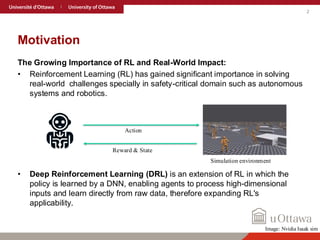
The Growing Importanceof RL and Real-World Impact:
• Reinforcement Learning (RL) has gained significant importance in solving
real-world challenges specially in safety-critical domain such as autonomous
systems and robotics.
• Deep Reinforcement Learning (DRL) is an extension of RL in which the
policy is learned by a DNN, enabling agents to process high-dimensional
inputs and learn directly from raw data, therefore expanding RL's
applicability.
Action
Reward & State
Simulation environment
Image: Nvidia Isaak sim
3.
3
Problem
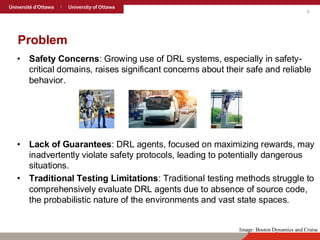
• Safety Concerns:Growing use of DRL systems, especially in safety-
critical domains, raises significant concerns about their safe and reliable
behavior.
• Lack of Guarantees: DRL agents, focused on maximizing rewards, may
inadvertently violate safety protocols, leading to potentially dangerous
situations.
• Traditional Testing Limitations: Traditional testing methods struggle to
comprehensively evaluate DRL agents due to absence of source code,
the probabilistic nature of the environments and vast state spaces.
Image: Boston Dynamics and Cruise
4.
4
Solution
• Project withGeneral Motors
• A Two-Phase Comprehensive Solution Toward RL Safety:
• Pre-Deployment Testing: Essential to identify unsafe behaviors in
DRL agents before deployment.
• Runtime Safety Monitoring: Continuous safety monitoring
ensures ongoing protection by predicting and mitigating potential
safety violations during operation.
STARLA:
• A search-based testing approach for DRL agents, with a focus on
detecting unsafe episodes.
SMARLA:
• A runtime safety monitoring approach that predicts and helps
prevent potential safety violations during the DRL agent operation.
5.
5
Problem
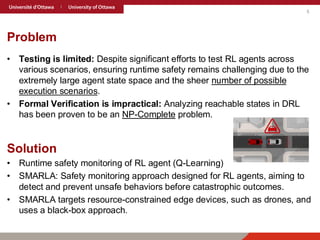
• Testing islimited: Despite significant efforts to test RL agents across
various scenarios, ensuring runtime safety remains challenging due to the
extremely large agent state space and the sheer number of possible
execution scenarios.
• Formal Verification is impractical: Analyzing reachable states in DRL
has been proven to be an NP-Complete problem.
Solution
• Runtime safety monitoring of RL agent (Q-Learning)
• SMARLA: Safety monitoring approach designed for RL agents, aiming to
detect and prevent unsafe behaviors before catastrophic outcomes.
• SMARLA targets resource-constrained edge devices, such as drones, and
uses a black-box approach.
6.
6
Safety Monitor’s Characteristics
KeyCharacteristics of an Ideal Safety Monitoring System:
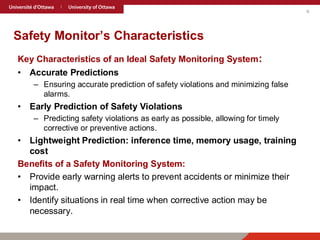
• Accurate Predictions
– Ensuring accurate prediction of safety violations and minimizing false
alarms.
• Early Prediction of Safety Violations
– Predicting safety violations as early as possible, allowing for timely
corrective or preventive actions.
• Lightweight Prediction: inference time, memory usage, training
cost
Benefits of a Safety Monitoring System:
• Provide early warning alerts to prevent accidents or minimize their
impact.
• Identify situations in real time when corrective action may be
necessary.
7.
7
Overview of SMARLA
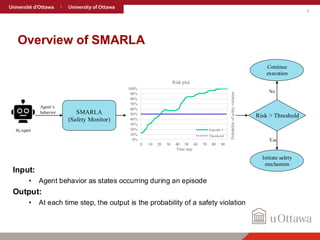
Input:
•Agent behavior as states occurring during an episode
Output:
• At each time step, the output is the probability of a safety violation
Agent’s
behavior SMARLA
(Safety Monitor)
0%
10%
20%
30%
40%
50%
60%
70%
80%
90%
100%
0 10 20 30 40 50 60 70 80 90
Probability
of
safety
violation
Time step
Risk plot
Episode 1
Threshold
Risk > Threshold
Continue
execution
Initiate safety
mechanism
No
Yes
8.
8
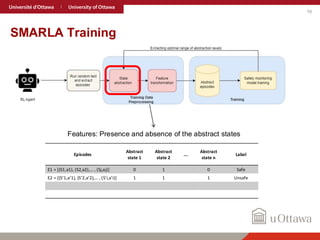
SMARLA Training
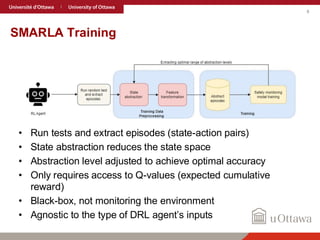
• Runtests and extract episodes (state-action pairs)
• State abstraction reduces the state space
• Abstraction level adjusted to achieve optimal accuracy
• Only requires access to Q-values (expected cumulative
reward)
• Black-box, not monitoring the environment
• Agnostic to the type of DRL agent’s inputs
9.
9
Approach – Q*State Abstraction
• We rely on a Q-irrelevance state abstraction technique.
• Q*(s,a) is the predicted overall reward (expected maximum reward)
from state s, when the agent selects action a in state s
• We consider two states in the same abstraction class when the overall
reward for all actions in both states is the same or similar (ceiling
values of Q*).
• The abstraction level can be changed by parameter 𝑑
Q∗ (s1,a)
𝑑
=
Q∗ (s2,a)
𝑑
Q*(s1,a1) Q*(s2,a1)
Q*(s2,a2)
Q*(s1,a2)
∀𝑎 ∈ 𝐴
10.
10
Features: Presence andabsence of the abstract states
SMARLA Training
Episodes
Abstract
state 1
Abstract
state 2
….
Abstract
state n
Label
E1 = [(S1,a1), (S2,a2),… , (Sj,aj)] 0 1 0 Safe
E2 = [(S’1,a’1), (S’2,a’2),… , (S’i,a’i)] 1 1 1 Unsafe
11.
11
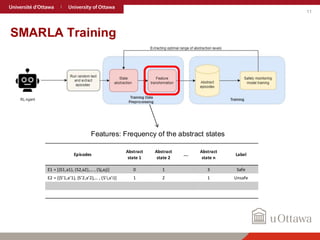
Features: Frequency ofthe abstract states
SMARLA Training
Episodes
Abstract
state 1
Abstract
state 2
….
Abstract
state n
Label
E1 = [(S1,a1), (S2,a2),… , (Sj,aj)] 0 1 3 Safe
E2 = [(S’1,a’1), (S’2,a’2),… , (S’i,a’i)] 1 2 1 Unsafe
12.
12
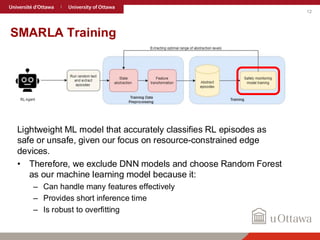
SMARLA Training
Lightweight MLmodel that accurately classifies RL episodes as
safe or unsafe, given our focus on resource-constrained edge
devices.
• Therefore, we exclude DNN models and choose Random Forest
as our machine learning model because it:
– Can handle many features effectively
– Provides short inference time
– Is robust to overfitting
14
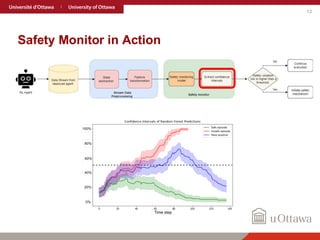
Confidence intervals
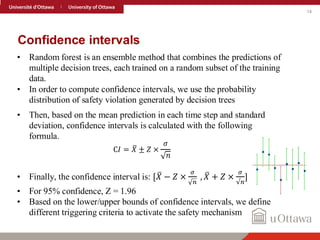
• Randomforest is an ensemble method that combines the predictions of
multiple decision trees, each trained on a random subset of the training
data.
• In order to compute confidence intervals, we use the probability
distribution of safety violation generated by decision trees
• Then, based on the mean prediction in each time step and standard
deviation, confidence intervals is calculated with the following
formula.
C𝐼 = ത
𝑋 ± 𝑍 ×
𝜎
𝑛
• Finally, the confidence interval is: [ ത
𝑋 − 𝑍 ×
𝜎
𝑛
, ത
𝑋 + 𝑍 ×
𝜎
√𝑛
]
• For 95% confidence, Z = 1.96
• Based on the lower/upper bounds of confidence intervals, we define
different triggering criteria to activate the safety mechanism
15.
15
Summary of Results
•RQ1: How accurately and early can we predict safety violations during the
execution of episodes?
– SMARLA demonstrated high accuracy in predicting safety violations (F1-score above 90%)
– SMARLA achieved early predictions (halfway through episodes) during the execution of episodes,
which may enable proactive prevention and mitigation of potential damages
• RQ2: How can the safety monitor determine when to trust the prediction of safety
violations?
– Compared different decision criteria based on confidence intervals
– Using the upper bound of confidence intervals allows for early detection of violations, reducing
prediction time steps by 20-45% compared to other methods, though it increases the false positive
rate slightly
• RQ3: What is the effect of the prediction threshold on the safety monitoring
system?
– The choice of prediction threshold affects both the timeliness and accuracy of safety violation
predictions and should be determined by the criticality of the faults in the environment.
• RQ4. What is the effect of the abstraction level on safety monitoring?
– It is important to identify the optimal range of abstraction levels, which varies greatly among RL
agents.
16.
16
RQ1: How accuratelyand early can we predict safety
violations during the execution of episodes?
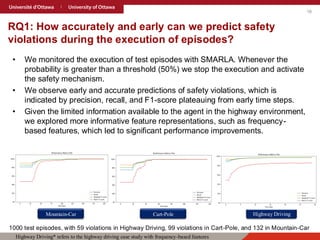
• We monitored the execution of test episodes with SMARLA. Whenever the
probability is greater than a threshold (50%) we stop the execution and activate
the safety mechanism.
• We observe early and accurate predictions of safety violations, which is
indicated by precision, recall, and F1-score plateauing from early time steps.
• Given the limited information available to the agent in the highway environment,
we explored more informative feature representations, such as frequency-
based features, which led to significant performance improvements.
Mountain-Car Cart-Pole Highway Driving
Highway Driving* refers to the highway driving case study with frequency-based features
1000 test episodes, with 59 violations in Highway Driving, 99 violations in Cart-Pole, and 132 in Mountain-Car
17.
17
RQ2. How canthe safety monitor determine when to trust
the prediction of safety violations?
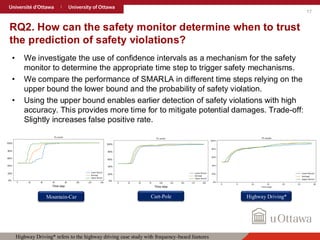
• We investigate the use of confidence intervals as a mechanism for the safety
monitor to determine the appropriate time step to trigger safety mechanisms.
• We compare the performance of SMARLA in different time steps relying on the
upper bound the lower bound and the probability of safety violation.
• Using the upper bound enables earlier detection of safety violations with high
accuracy. This provides more time for to mitigate potential damages. Trade-off:
Slightly increases false positive rate.
Mountain-Car Cart-Pole Highway Driving*
Highway Driving* refers to the highway driving case study with frequency-based features
18.
18
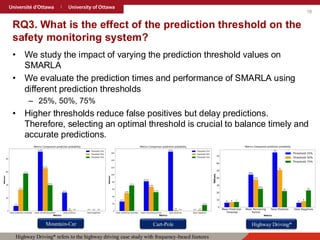
RQ3. What isthe effect of the prediction threshold on the
safety monitoring system?
• We study the impact of varying the prediction threshold values on
SMARLA
• We evaluate the prediction times and performance of SMARLA using
different prediction thresholds
– 25%, 50%, 75%
• Higher thresholds reduce false positives but delay predictions.
Therefore, selecting an optimal threshold is crucial to balance timely and
accurate predictions.
Mountain-Car Cart-Pole Highway Driving*
Highway Driving* refers to the highway driving case study with frequency-based features
19.
19
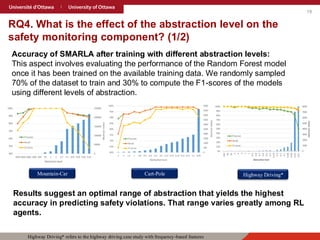
RQ4. What isthe effect of the abstraction level on the
safety monitoring component? (1/2)
Accuracy of SMARLA after training with different abstraction levels:
This aspect involves evaluating the performance of the Random Forest model
once it has been trained on the available training data. We randomly sampled
70% of the dataset to train and 30% to compute the F1-scores of the models
using different levels of abstraction.
Results suggest an optimal range of abstraction that yields the highest
accuracy in predicting safety violations. That range varies greatly among RL
agents.
Mountain-Car Cart-Pole Highway Driving*
Highway Driving* refers to the highway driving case study with frequency-based features
20.
21
Summary
• We proposeda black-box safety monitoring approach for
reinforcement learning agents.
• We rely on a machine learning model to predict safety violations of RL
agents early based on (state, action) pairs in episodes.
• We employ state abstraction to reduce the state space, enhancing the
ML model's learnability.
• SMARLA demonstrated high accuracy in predicting safety violations
of RL agents. Additionally, our empirical results showed an early
prediction of violations, allowing for timely prevention and damage
mitigation.
• Our method is agnostic to the RL agent's input, improving its
applicability across various RL environments and scenarios.
21.
22
uOttawa.ca
uOttawa.ca | nanda-lab.ca
Schoolof Electrical Engineering & Computer Science | Nanda Lab
SMARLA: A Safety Monitoring Approach for
Reinforcement Learning Agents
A. Zolfagharian, M. Abdellatif, L. C. Briand, and Ramesh. S,
IEEE Transactions on Software Engineering, vol. , no. 01, pp. 1-
25, PrePrints 5555, doi: 10.1109/TSE.2024.3491496
22.
23
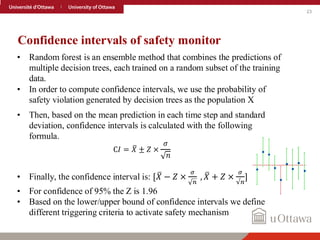
Confidence intervals ofsafety monitor
• Random forest is an ensemble method that combines the predictions of
multiple decision trees, each trained on a random subset of the training
data.
• In order to compute confidence intervals, we use the probability of
safety violation generated by decision trees as the population X
• Then, based on the mean prediction in each time step and standard
deviation, confidence intervals is calculated with the following
formula.
C𝐼 = ത
𝑋 ± 𝑍 ×
𝜎
𝑛
• Finally, the confidence interval is: [ ത
𝑋 − 𝑍 ×
𝜎
𝑛
, ത
𝑋 + 𝑍 ×
𝜎
√𝑛
]
• For confidence of 95% the Z is 1.96
• Based on the lower/upper bound of confidence intervals we define
different triggering criteria to activate safety mechanism
25
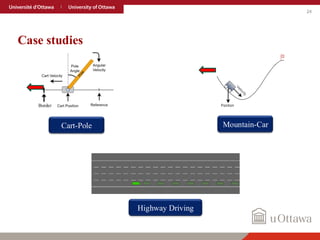
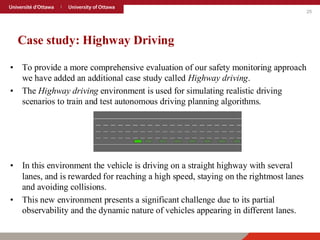
Case study: HighwayDriving
• To provide a more comprehensive evaluation of our safety monitoring approach
we have added an additional case study called Highway driving.
• The Highway driving environment is used for simulating realistic driving
scenarios to train and test autonomous driving planning algorithms.
• In this environment the vehicle is driving on a straight highway with several
lanes, and is rewarded for reaching a high speed, staying on the rightmost lanes
and avoiding collisions.
• This new environment presents a significant challenge due to its partial
observability and the dynamic nature of vehicles appearing in different lanes.
25.
26
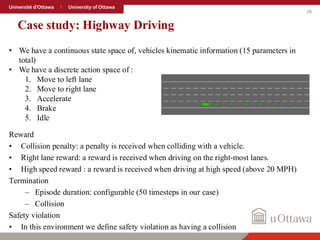
Case study: HighwayDriving
Reward
• Collision penalty: a penalty is received when colliding with a vehicle.
• Right lane reward: a reward is received when driving on the right-most lanes.
• High speed reward : a reward is received when driving at high speed (above 20 MPH)
Termination
– Episode duration: configurable (50 timesteps in our case)
– Collision
Safety violation
• In this environment we define safety violation as having a collision
• We have a continuous state space of, vehicles kinematic information (15 parameters in
total)
• We have a discrete action space of :
1. Move to left lane
2. Move to right lane
3. Accelerate
4. Brake
5. Idle
26.
27
Safety monitor training– Best results
• We train our safety monitor to predict collisions.
• For the training data, we generated 4,000 episodes.
• The training data includes:
• A total of 115,730 concrete states
• A failure rate of 5%
• An average episode length of 28.9 time steps
• A maximum episode length of 30 time steps
• 222 safety violations in total (in the training dataset)
• Labels: 1 for collision and 0 for no collision
• based on the collisions observed in the simulator
27.
28
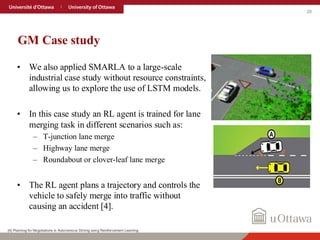
GM Case study
•We also applied SMARLA to a large-scale
industrial case study without resource constraints,
allowing us to explore the use of LSTM models.
• In this case study an RL agent is trained for lane
merging task in different scenarios such as:
– T-junction lane merge
– Highway lane merge
– Roundabout or clover-leaf lane merge
• The RL agent plans a trajectory and controls the
vehicle to safely merge into traffic without
causing an accident [4].
[4] Planning for Negotiations in Autonomous Driving using Reinforcement Learning
28.
29
GM Case study
State:
•States are lists containing:
– kinematic information of actors within a certain range of the host vehicle for example
velocity, position and acceleration
– kinematic information of the host vehicle
Reward:
Reward is defined in a way that optimizes the efficiency and comfort:
• Efficiency
– Reaching to the goal state as soon as possible
• Comfort
– Avoiding sudden and unnecessary movements (i.e., jerk-optimization)
Termination:
• Episodes may terminate with one the three following conditions: (1) successful, (2)
handover, (3) collision
Safety violation:
• Having a collision
29.
30
Feature Representations
Order ofabstract states - Temporal abstraction
• Temporal features consider the order in which abstract states occur,
allowing for the modeling of sequences and patterns. This is useful in
tasks like time-series analysis, natural language processing (e.g., for
understanding sentence structure)
• Temporal features can result in a significantly higher-dimensional
feature space, thereby holding a greater amount of information. This can
lead to increased computational complexity.
Features: Order of the abstract states
Episodes in intervals State 1 State 2 State 3 …. State n
Probability of
failure
[(S1,a1)] Abstract State ID: 1 Abstract State ID: 0 Abstract State ID: 0 Abstract State ID: 0 10%
[(S1,a1), (S2,a2)] Abstract State ID: 1 Abstract State ID: 7 Abstract State ID: 0 Abstract State ID: 0 20%
[(S1,a1), (S2,a2),(S3,a3)] Abstract State ID: 1 Abstract State ID: 7 Abstract State ID: 5 Abstract State ID: 0 15%
* n = Maximum length of episodes
30.
31
Model
• Recurrent NeuralNetworks (RNNs) are a class of neural networks that
are designed to work with sequences of data. They have loops within
them, allowing information to persist.
• Long Short-Term Memory (LSTM) are popular variants of RNNs that
address the vanishing gradient problem and are capable of capturing
long-range dependencies in data.
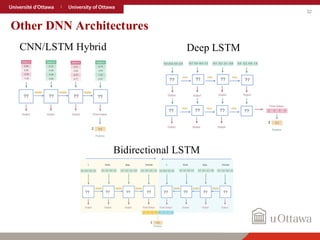
• We considered different types of LSTM models for example, simple
classification LSTM, Deep LSTM, Bidirectional LSTM and hybrid
CNN/LSTM
33
Summary
• We alsoimplemented SMARLA on a GM case study and achieved
highly accurate predictions of safety violations.
• We extended our method by implementing different feature
representations and considering LSTM models in the GM case study.
• We achieved a maximum F1 score of 98% using LSTM and temporal
features.
• Although LSTM models provided higher accuracy, SMARLA with
Random Forest without temporal features allowed for earlier
prediction time steps.