Artificial Intelligence and
HumanResource
Management at
Workplace
Akash Deep Mishra 3KA
Ayush Agarwal 11KA
Kamal Kant 24KA
Khushi Jain 27KA
Prashant Kumar 37KA
Utkarsh Raj 54KA
2.
Contents
• Introduction
• HowAI can be Integrated at Workplace
• Impact of AI in HR
• Ethical Consideration while Integrating AI in HRM
• Increasing HR productivity with Ethical AI
• Few Examples of how AI is transforming HR
• Best Practices for Integrating AI in HRM & 3 TIER Skilling Plan
• Challenges of AI in HRM
3.
Introduction
AI is anumbrella term that encompasses areas such as machine learning and
cognitive computing.
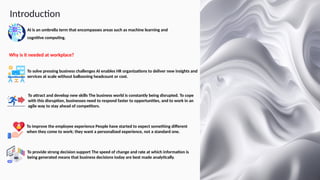
Why is it needed at workplace?
To solve pressing business challenges AI enables HR organizations to deliver new insights and
services at scale without ballooning headcount or cost.
To attract and develop new skills The business world is constantly being disrupted. To cope
with this disruption, businesses need to respond faster to opportunities, and to work in an
agile way to stay ahead of competitors.
To improve the employee experience People have started to expect something different
when they come to work; they want a personalized experience, not a standard one.
To provide strong decision support The speed of change and rate at which information is
being generated means that business decisions today are best made analytically.
4.
How AI canbe Integrated at Workplace
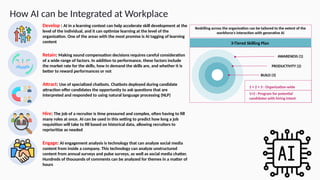
Develop : AI in a learning context can help accelerate skill development at the
level of the individual, and it can optimize learning at the level of the
organization. One of the areas with the most promise is AI tagging of learning
content
Retain: Making sound compensation decisions requires careful consideration
of a wide range of factors. In addition to performance, these factors include
the market rate for the skills, how in demand the skills are, and whether it is
better to reward performances or not
Attract: Use of specialized chatbots. Chatbots deployed during candidate
attraction offer candidates the opportunity to ask questions that are
interpreted and responded to using natural language processing (NLP)
Hire: The job of a recruiter is time pressured and complex, often having to fill
many roles at once. AI can be used in this setting to predict how long a job
requisition will take to fill based on historical data, allowing recruiters to
reprioritize as needed
Engage: AI engagement analysis is technology that can analyze social media
content from inside a company. This technology can analyze unstructured
content from annual surveys and pulse surveys, as well as social media chatter.
Hundreds of thousands of comments can be analyzed for themes in a matter of
hours
Reskilling across the organization can be tailored to the extent of the
workforce’s interaction with generative AI
3-Tiered Skilling Plan
AWARENESS (1)
PRODUCTIVITY (2)
BUILD (3)
1 + 2 + 3 : Organization-wide
1+2 : Program for potential
candidates with hiring intent
5.
Impact of AIin HR
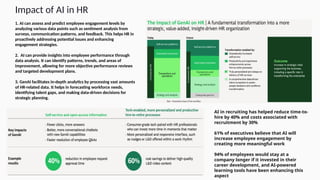
1. AI can assess and predict employee engagement levels by
analyzing various data points such as sentiment analysis from
surveys, communication patterns, and feedback. This helps HR in
proactively addressing potential issues and enhancing
engagement strategies.
2. AI can provide insights into employee performance through
data analysis. It can identify patterns, trends, and areas of
improvement, allowing for more objective performance reviews
and targeted development plans.
3. GenAI facilitates in-depth analytics by processing vast amounts
of HR-related data. It helps in forecasting workforce needs,
identifying talent gaps, and making data-driven decisions for
strategic planning.
AI in recruiting has helped reduce time-to-
hire by 40% and costs associated with
recruitment by 30%
61% of executives believe that AI will
increase employee engagement by
creating more meaningful work
94% of employees would stay at a
company longer if it invested in their
career development, and AI-powered
learning tools have been enhancing this
aspect
6.
Ethical Consideration whileIntegrating AI in HRM
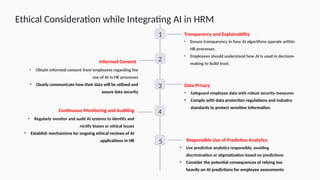
1 Transparency and Explainability
• Ensure transparency in how AI algorithms operate within
HR processes.
• Employees should understand how AI is used in decision-
making to build trust.
2
Informed Consent
• Obtain informed consent from employees regarding the
use of AI in HR processes
• Clearly communicate how their data will be utilized and
assure data security
3 Data Privacy
• Safeguard employee data with robust security measures
• Comply with data protection regulations and industry
standards to protect sensitive information
4
Continuous Monitoring and Auditing
• Regularly monitor and audit AI systems to identify and
rectify biases or ethical issues
• Establish mechanisms for ongoing ethical reviews of AI
applications in HR 5 Responsible Use of Predictive Analytics
• Use predictive analytics responsibly, avoiding
discrimination or stigmatization based on predictions
• Consider the potential consequences of relying too
heavily on AI predictions for employee assessments
7.
Increasing HR productivitywith Ethical AI
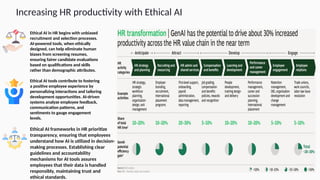
Ethical AI in HR begins with unbiased
recruitment and selection processes.
AI-powered tools, when ethically
designed, can help eliminate human
biases from screening resumes,
ensuring fairer candidate evaluations
based on qualifications and skills
rather than demographic attributes.
Ethical AI tools contribute to fostering
a positive employee experience by
personalizing interactions and tailoring
development opportunities. AI-driven
systems analyze employee feedback,
communication patterns, and
sentiments to gauge engagement
levels.
Ethical AI frameworks in HR prioritize
transparency, ensuring that employees
understand how AI is utilized in decision-
making processes. Establishing clear
guidelines and accountability
mechanisms for AI tools assures
employees that their data is handled
responsibly, maintaining trust and
ethical standards.
8.
Few Examples ofhow AI is transforming HR
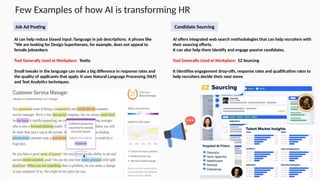
Job Ad Posting
Al can help reduce biased input /language in job descriptions. A phrase like
"We are looking for Design Superheroes, for example, does not appeal to
female jobseekers.
Tool Generally Used at Workplace: Textio
Small tweaks in the language can make a big difference in response rates and
the quality of applicants that apply. It uses Natural Language Processing (NLP)
and Text Analytics techniques.
Candidate Sourcing
Al offers integrated web search methodologies that can help recruiters with
their sourcing efforts.
It can also help them identify and engage passive candidates.
Tool Generally Used at Workplace: EZ Sourcing
It identifies engagement drop-offs, response rates and qualification rates to
help recruiters decide their next move
9.
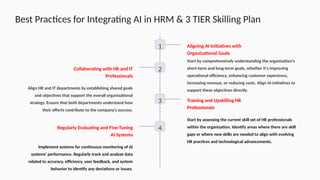
Best Practices forIntegrating AI in HRM & 3 TIER Skilling Plan
1 Aligning AI Initiatives with
Organizational Goals
Start by comprehensively understanding the organization's
short-term and long-term goals, whether it's improving
operational efficiency, enhancing customer experience,
increasing revenue, or reducing costs. Align AI initiatives to
support these objectives directly.
2
Collaborating with HR and IT
Professionals
Align HR and IT departments by establishing shared goals
and objectives that support the overall organizational
strategy. Ensure that both departments understand how
their efforts contribute to the company's success.
3 Training and Upskilling HR
Professionals
Start by assessing the current skill set of HR professionals
within the organization. Identify areas where there are skill
gaps or where new skills are needed to align with evolving
HR practices and technological advancements.
4
Regularly Evaluating and Fine-Tuning
AI Systems
Implement systems for continuous monitoring of AI
systems' performance. Regularly track and analyze data
related to accuracy, efficiency, user feedback, and system
behavior to identify any deviations or issues.
10.
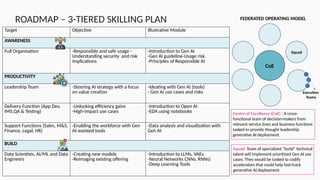
ROADMAP – 3-TIEREDSKILLING PLAN
Target Objective Illustrative Module
AWARENESS
Full Organisation -Responsible and safe usage -
Understanding security and risk
implications
-Introduction to Gen AI
-Gen AI guideline-Usage risk
-Principles of Responsible AI
PRODUCTIVITY
Leadership Team -Steering AI strategy with a focus
on value creation
-Ideating with Gen AI (tools)
- Gen AI use cases and risks
Delivery Function (App Dev,
IMS,QA & Testing)
-Unlocking efficiency gains
-High-impact use cases
-Introduction to Open AI
-EDA using notebooks
Support Functions (Sales, M&S,
Finance, Legal, HR)
-Enabling the workforce with Gen
AI-assisted tools
-Data analysis and visualization with
Gen AI
BUILD
Data Scientists, AI/ML and Data
Engineers
-Creating new models
-Reimaging existing offering
-Introduction to LLMs, VAEs
-Neural Networks CNNs, RNNs)
-Deep Learning Tools
CoE
Squad
Execution
Teams
FEDERATED OPERATING MODEL
Centre of Excellence (CoE) : A cross-
functional team of decision-makers from
relevant service lines and business functions
tasked to provide thought leadership
generative AI deployment.
Squad: Team of specialized “build” technical
talent will implement prioritized Gen AI use
cases. They would be tasked to codify
accelerators that could help fast-track
generative AI deployment
11.
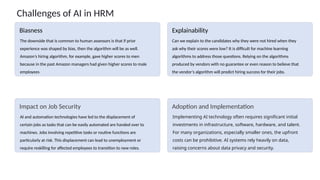
Challenges of AIin HRM
Biasness
The downside that is common to human assessors is that if prior
experience was shaped by bias, then the algorithm will be as well.
Amazon’s hiring algorithm, for example, gave higher scores to men
because in the past Amazon managers had given higher scores to male
employees
Explainability
Can we explain to the candidates why they were not hired when they
ask why their scores were low? It is difficult for machine learning
algorithms to address those questions. Relying on the algorithms
produced by vendors with no guarantee or even reason to believe that
the vendor’s algorithm will predict hiring success for their jobs.
Impact on Job Security
AI and automation technologies have led to the displacement of
certain jobs as tasks that can be easily automated are handed over to
machines. Jobs involving repetitive tasks or routine functions are
particularly at risk. This displacement can lead to unemployment or
require reskilling for affected employees to transition to new roles.
Adoption and Implementation
Implementing AI technology often requires significant initial
investments in infrastructure, software, hardware, and talent.
For many organizations, especially smaller ones, the upfront
costs can be prohibitive. AI systems rely heavily on data,
raising concerns about data privacy and security.