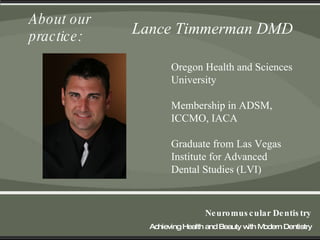
 
Lance Timmerman DMD Oregon Health and Sciences University Membership in ADSM, ICCMO, IACA Graduate from Las Vegas Institute for Advanced Dental Studies (LVI) About our practice:
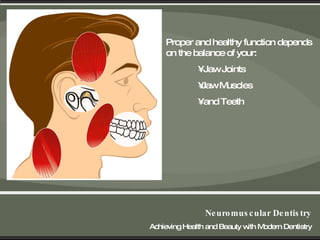
Proper and healthy function depends on the balance of your: Jaw Joints Jaw Muscles and Teeth
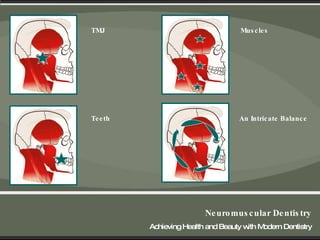
Teeth Muscles TMJ An Intricate Balance
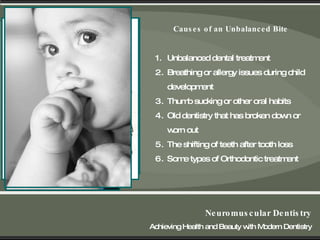
Unbalanced dental treatment  Breathing or allergy issues during child development Thumb sucking or other oral habits Old dentistry that has broken down or worn out The shifting of teeth after tooth loss Some types of Orthodontic treatment Causes of an Unbalanced Bite
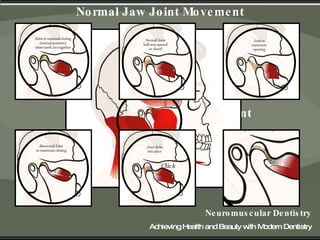
Abnormal Jaw Joint Movement Normal Jaw Joint Movement Click
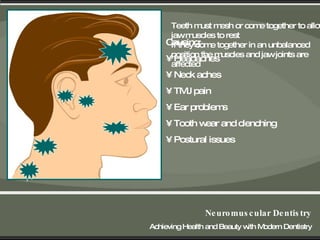
Causing: Headaches Neck aches TMJ pain Ear problems Tooth wear and clenching Postural issues Teeth must mesh or come together to allow jaw muscles to rest If they come together in an unbalanced position the muscles and jaw joints are affected
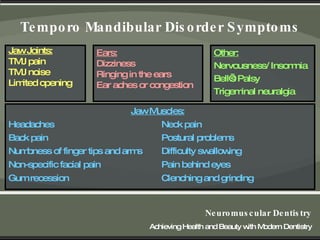
Jaw Muscles: Headaches  Neck pain  Back pain Postural problems Numbness of finger tips and arms Difficulty swallowing Non-specific facial pain   Pain behind eyes Gum recession Clenching and grinding Temporo Mandibular Disorder Symptoms Jaw Joints: TMJ pain  TMJ noise  Limited opening Ears: Dizziness  Ringing in the ears Ear aches or congestion Other: Nervousness/ Insomnia  Bell’s Palsy  Trigeminal neuralgia
Muscle  Tooth If muscles must strain to get your teeth together … you may set up a  Muscle vs. Tooth  war in your mouth. War
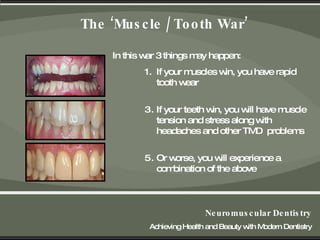
The ‘Muscle / Tooth War’ In this war 3 things may happen: If your muscles win, you have rapid tooth wear If your teeth win, you will have muscle tension and stress along with headaches and other TMD  problems Or worse, you will experience a combination of the above
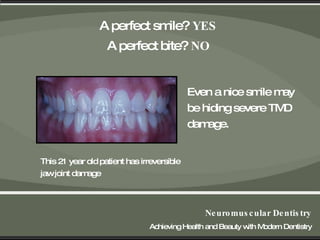
A perfect smile?  YES   A perfect bite?  NO   Even a nice smile may be hiding severe TMD damage.  This 21 year old patient has irreversible jaw joint damage
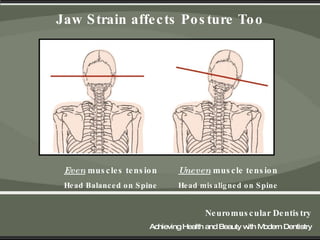
Even  muscles tension Head Balanced on Spine Uneven  muscle tension Head misaligned on Spine Jaw Strain affects Posture Too
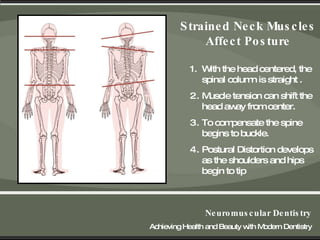
With the head centered, the spinal column is straight . Muscle tension can shift the head away from center.  To compensate the spine begins to buckle.  Postural Distortion develops as the shoulders and hips begin to tip Strained Neck Muscles Affect Posture
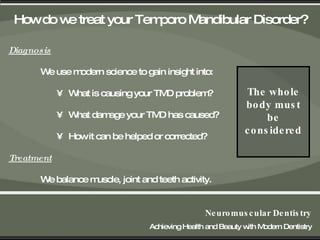
How do we treat your Temporo Mandibular Disorder?  Diagnosis We use modern science to gain insight into: What is causing your TMD problem? What damage your TMD has caused? How it can be helped or corrected? Treatment We balance muscle, joint and teeth activity. The whole body must be considered
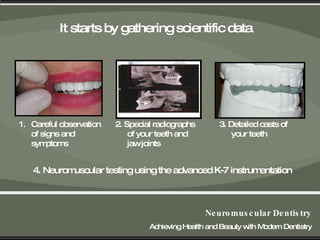
It starts by gathering scientific data  Careful observation of signs and symptoms 2. Special radiographs of your teeth and jaw joints 3. Detailed casts of your teeth 4. Neuromuscular testing using the advanced K-7 instrumentation
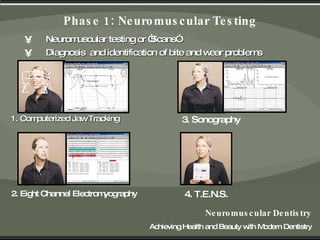
Neuromuscular testing or “Scans” Diagnosis  and identification of bite and wear problems 1. Computerized Jaw Tracking 4.   T.E.N.S.   Phase 1: Neuromuscular Testing 2.   Eight Channel Electromyography 3. Sonography
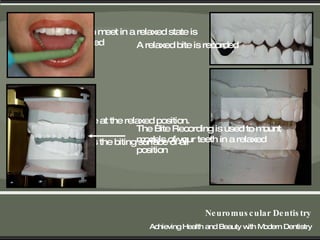
The way the teeth meet in a relaxed state is observed and noted An Orthotic is made at the relaxed position. The Orthotic covers the biting surface of all the lower teeth.  A relaxed bite is recorded  The Bite Recording is used to mount models of your teeth in a relaxed position
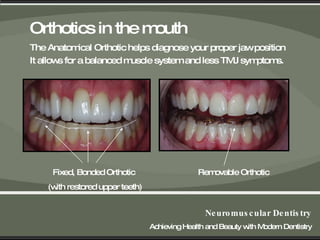
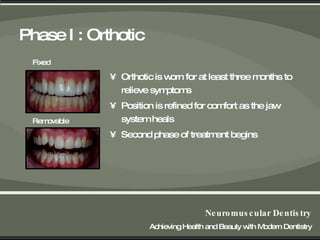
Orthotics in the mouth The Anatomical Orthotic helps diagnose your proper jaw position  It allows for a balanced muscle system and less TMJ symptoms. Fixed, Bonded Orthotic  (with restored upper teeth) Removable Orthotic
Phase I : Orthotic  Orthotic is worn for at least three months to relieve symptoms Position is refined for comfort as the jaw system heals Second phase of treatment begins Fixed Removable
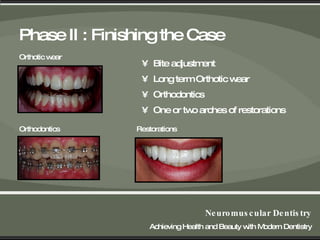
Bite adjustment Long term Orthotic wear Orthodontics One or two arches of restorations Phase II : Finishing the Case  Orthodontics Orthotic wear Restorations
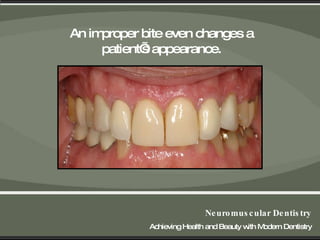
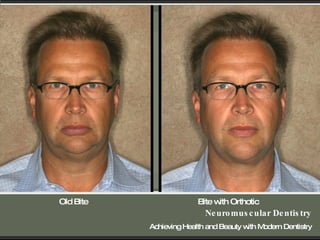
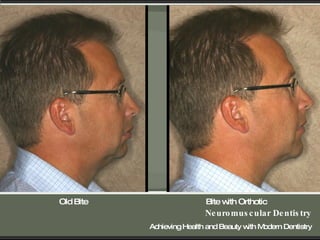
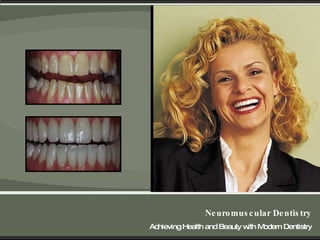
An improper bite even changes a patient’s appearance.
Old Bite Bite with Orthotic
 
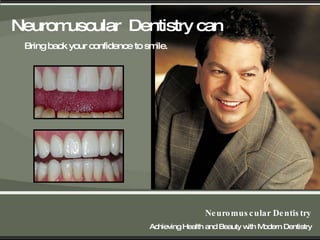
Bring back your confidence to smile. Neuromuscular  Dentistry can
Your TMJ: Perfect Function = Zero Pain