Exploring the InvestigativeWorld of Science
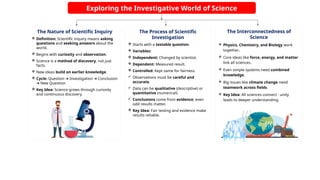
The Nature of Scientific Inquiry
Definition: Scientific inquiry means asking
questions and seeking answers about the
world.
Begins with curiosity and observation.
Science is a method of discovery, not just
facts.
New ideas build on earlier knowledge.
Cycle: Question Investigation Conclusion
➜ ➜
New Question
➜
Key Idea: Science grows through curiosity
and continuous discovery.
The Process of Scientific
Investigation
Starts with a testable question.
Variables:
Independent: Changed by scientist.
Dependent: Measured result.
Controlled: Kept same for fairness.
Observations must be careful and
accurate.
Data can be qualitative (descriptive) or
quantitative (numerical).
Conclusions come from evidence; even
odd results matter.
Key Idea: Fair testing and evidence make
results reliable.
The Interconnectedness of
Science
Physics, Chemistry, and Biology work
together.
Core ideas like force, energy, and matter
link all sciences.
Even simple systems need combined
knowledge.
Big issues like climate change need
teamwork across fields.
Key Idea: All sciences connect - unity
leads to deeper understanding.
2.
The Invisible LivingWorld
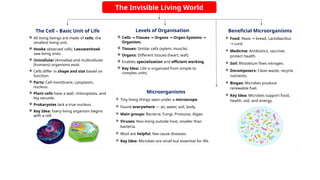
The Cell – Basic Unit of Life
All living beings are made of cells, the
smallest living unit.
Hooke observed cells; Leeuwenhoek
saw living ones.
Unicellular (Amoeba) and multicellular
(humans) organisms exist.
Cells differ in shape and size based on
function.
Parts: Cell membrane, cytoplasm,
nucleus.
Plant cells have a wall, chloroplasts, and
big vacuole.
Prokaryotes lack a true nucleus.
Key Idea: Every living organism begins
with a cell.
Levels of Organisation
Cells Tissues Organs Organ Systems
→ → → →
Organism.
Tissues: Similar cells (xylem, muscle).
Organs: Different tissues (heart, leaf).
Enables specialization and efficient working.
Key Idea: Life is organized from simple to
complex units.
Microorganisms
Tiny living things seen under a microscope.
Found everywhere — air, water, soil, body.
Main groups: Bacteria, Fungi, Protozoa, Algae.
Viruses: Non-living outside host, smaller than
bacteria.
Most are helpful, few cause diseases.
Key Idea: Microbes are small but essential for life.
Beneficial Microorganisms
Food: Yeast bread, Lactobacillus
→
curd.
→
Medicine: Antibiotics, vaccines
protect health.
Soil: Rhizobium fixes nitrogen.
Decomposers: Clean waste, recycle
nutrients.
Biogas: Microbes produce
renewable fuel.
Key Idea: Microbes support food,
health, soil, and energy.
3.
Health – TheUltimate Treasure
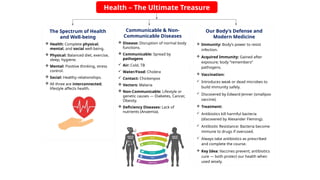
The Spectrum of Health
and Well-being
Health: Complete physical,
mental, and social well-being.
Physical: Balanced diet, exercise,
sleep, hygiene.
Mental: Positive thinking, stress
control.
Social: Healthy relationships.
All three are interconnected;
lifestyle affects health.
Communicable & Non-
Communicable Diseases
Disease: Disruption of normal body
functions.
Communicable: Spread by
pathogens
Air: Cold, TB
Water/Food: Cholera
Contact: Chickenpox
Vectors: Malaria
Non-Communicable: Lifestyle or
genetic causes — Diabetes, Cancer,
Obesity.
Deficiency Diseases: Lack of
nutrients (Anaemia).
Our Body’s Defense and
Modern Medicine
Immunity: Body’s power to resist
infection.
Acquired Immunity: Gained after
exposure; body “remembers”
pathogens.
Vaccination:
Introduces weak or dead microbes to
build immunity safely.
Discovered by Edward Jenner (smallpox
vaccine).
Treatment:
Antibiotics kill harmful bacteria
(discovered by Alexander Fleming).
Antibiotic Resistance: Bacteria become
immune to drugs if overused.
Always take antibiotics as prescribed
and complete the course.
Key Idea: Vaccines prevent; antibiotics
cure — both protect our health when
used wisely.
4.
Electricity: Magnetic andHeating Effects
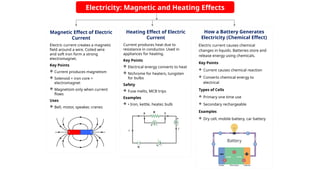
Magnetic Effect of Electric
Current
Electric current creates a magnetic
field around a wire. Coiled wire
and soft iron form a strong
electromagnet.
Key Points
Current produces magnetism
Solenoid + iron core =
electromagnet
Magnetism only when current
flows
Uses
Bell, motor, speaker, cranes
Heating Effect of Electric
Current
Current produces heat due to
resistance in conductor. Used in
appliances for heating.
Key Points
Electrical energy converts to heat
Nichrome for heaters, tungsten
for bulbs
Safety
Fuse melts, MCB trips
Examples
• Iron, kettle, heater, bulb
How a Battery Generates
Electricity (Chemical Effect)
Electric current causes chemical
changes in liquids. Batteries store and
release energy using chemicals.
Key Points
Current causes chemical reaction
Converts chemical energy to
electrical
Types of Cells
Primary one time use
Secondary rechargeable
Examples
Dry cell, mobile battery, car battery
5.
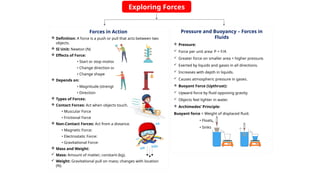
Exploring Forces
Forces inAction
Definition: A force is a push or pull that acts between two
objects.
SI Unit: Newton (N)
Effects of Force:
• Start or stop motion
• Change direction or speed
• Change shape
Depends on:
• Magnitude (strength)
• Direction
Types of Forces:
Contact Forces: Act when objects touch.
• Muscular Force
• Frictional Force
Non-Contact Forces: Act from a distance.
• Magnetic Force:
• Electrostatic Force:
• Gravitational Force:
Mass and Weight:
Mass: Amount of matter; constant (kg).
Weight: Gravitational pull on mass; changes with location
(N).
Pressure and Buoyancy – Forces in
Fluids
Pressure:
Force per unit area: P = F/A
Greater force on smaller area = higher pressure.
Exerted by liquids and gases in all directions.
Increases with depth in liquids.
Causes atmospheric pressure in gases.
Buoyant Force (Upthrust):
Upward force by fluid opposing gravity.
Objects feel lighter in water.
Archimedes’ Principle:
Buoyant force = Weight of displaced fluid.
• Floats
• Sinks
6.
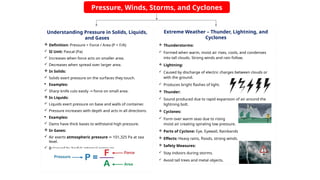
Pressure, Winds, Storms,and Cyclones
Understanding Pressure in Solids, Liquids,
and Gases
Definition: Pressure = Force / Area (P = F/A)
SI Unit: Pascal (Pa)
Increases when force acts on smaller area.
Decreases when spread over larger area.
In Solids:
Solids exert pressure on the surfaces they touch.
Examples:
Sharp knife cuts easily force on small area.
→
In Liquids:
Liquids exert pressure on base and walls of container.
Pressure increases with depth and acts in all directions.
Examples:
Dams have thick bases to withstand high pressure.
In Gases:
Air exerts atmospheric pressure 101,325 Pa at sea
≈
level.
Balanced by body’s internal pressure.
Extreme Weather – Thunder, Lightning, and
Cyclones
Thunderstorms:
Formed when warm, moist air rises, cools, and condenses
into tall clouds. Strong winds and rain follow.
Lightning:
Caused by discharge of electric charges between clouds or
with the ground.
Produces bright flashes of light.
Thunder:
Sound produced due to rapid expansion of air around the
lightning bolt.
Cyclones:
Form over warm seas due to rising
moist air creating spiraling low pressure.
Parts of Cyclone: Eye, Eyewall, Rainbands
Effects: Heavy rains, floods, strong winds.
Safety Measures:
Stay indoors during storms.
Avoid tall trees and metal objects.
7.
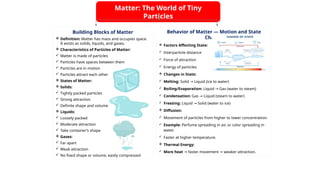
Matter: The Worldof Tiny
Particles
Building Blocks of Matter
Definition: Matter has mass and occupies space.
It exists as solids, liquids, and gases.
Characteristics of Particles of Matter:
Matter is made of particles
Particles have spaces between them
Particles are in motion
Particles attract each other
States of Matter:
Solids:
Tightly packed particles
Strong attraction
Definite shape and volume
Liquids:
Loosely packed
Moderate attraction
Take container’s shape
Gases:
Far apart
Weak attraction
No fixed shape or volume; easily compressed
Behavior of Matter — Motion and State
Change
Factors Affecting State:
Interparticle distance
Force of attraction
Energy of particles
Changes in State:
Melting: Solid Liquid (ice to water)
→
Boiling/Evaporation: Liquid Gas (water to steam)
→
Condensation: Gas Liquid (steam to water)
→
Freezing: Liquid Solid (water to ice)
→
Diffusion:
Movement of particles from higher to lower concentration.
Example: Perfume spreading in air, or color spreading in
water.
Faster at higher temperature.
Thermal Energy:
More heat faster movement weaker attraction.
→ →
8.
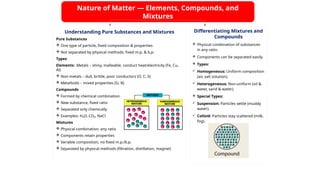
Nature of Matter— Elements, Compounds, and
Mixtures
Understanding Pure Substances and Mixtures
Pure Substances
One type of particle, fixed composition & properties
Not separated by physical methods; fixed m.p. & b.p.
Types
Elements: Metals – shiny, malleable, conduct heat/electricity (Fe, Cu,
Al)
Non-metals – dull, brittle, poor conductors (O, C, S)
Metalloids – mixed properties (Si, B)
Compounds
Formed by chemical combination
New substance, fixed ratio
Separated only chemically
Examples: H₂O, CO₂, NaCl
Mixtures
Physical combination, any ratio
Components retain properties
Variable composition, no fixed m.p./b.p.
Separated by physical methods (filtration, distillation, magnet)
Differentiating Mixtures and
Compounds
Physical combination of substances
in any ratio.
Components can be separated easily.
Types:
Homogeneous: Uniform composition
(air, salt solution).
Heterogeneous: Non-uniform (oil &
water, sand & water).
Special Types:
Suspension: Particles settle (muddy
water).
Colloid: Particles stay scattered (milk,
fog).
9.
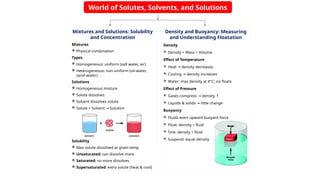
World of Solutes,Solvents, and Solutions
Mixtures and Solutions: Solubility
and Concentration
Mixtures
Physical combination
Types
Homogeneous: uniform (salt water, air)
Heterogeneous: non-uniform (oil-water,
sand-water)
Solutions
Homogeneous mixture
Solute dissolves
Solvent dissolves solute
Solute + Solvent Solution
→
Solubility
Max solute dissolved at given temp
Unsaturated: can dissolve more
Saturated: no more dissolves
Supersaturated: extra solute (heat & cool)
Density and Buoyancy: Measuring
and Understanding Floatation
Density
Density = Mass ÷ Volume
Effect of Temperature
Heat density decreases
→
Cooling density increases
→
Water: max density at 4°C; ice floats
Effect of Pressure
Gases compress density
→ ↑
Liquids & solids little change
→
Buoyancy
Fluids exert upward buoyant force
Float: density < fluid
Sink: density > fluid
Suspend: equal density
10.
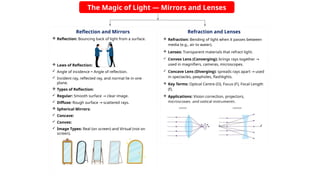
The Magic ofLight — Mirrors and Lenses
Reflection and Mirrors
Reflection: Bouncing back of light from a surface.
Laws of Reflection:
Angle of incidence = Angle of reflection.
Incident ray, reflected ray, and normal lie in one
plane.
Types of Reflection:
Regular: Smooth surface clear image.
→
Diffuse: Rough surface scattered rays.
→
Spherical Mirrors:
Concave:
Convex:
Image Types: Real (on screen) and Virtual (not on
screen).
Refraction and Lenses
Refraction: Bending of light when it passes between
media (e.g., air to water).
Lenses: Transparent materials that refract light.
Convex Lens (Converging): brings rays together →
used in magnifiers, cameras, microscopes.
Concave Lens (Diverging): spreads rays apart used
→
in spectacles, peepholes, flashlights.
Key Terms: Optical Centre (O), Focus (F), Focal Length
(f).
Applications: Vision correction, projectors,
microscopes, and optical instruments.
11.
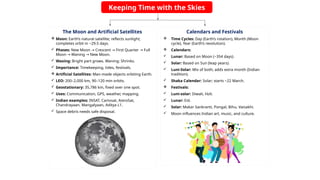
Keeping Time withthe Skies
The Moon and Artificial Satellites
Moon: Earth’s natural satellite; reflects sunlight;
completes orbit in ~29.5 days.
Phases: New Moon Crescent First Quarter Full
→ → →
Moon Waning New Moon.
→ →
Waxing: Bright part grows. Waning: Shrinks.
Importance: Timekeeping, tides, festivals.
Artificial Satellites: Man-made objects orbiting Earth.
LEO: 200–2,000 km, 90–120 min orbits.
Geostationary: 35,786 km, fixed over one spot.
Uses: Communication, GPS, weather, mapping.
Indian examples: INSAT, Cartosat, AstroSat,
Chandrayaan, Mangalyaan, Aditya L1.
Space debris needs safe disposal.
Calendars and Festivals
Time Cycles: Day (Earth’s rotation), Month (Moon
cycle), Year (Earth’s revolution).
Calendars:
Lunar: Based on Moon (~354 days).
Solar: Based on Sun (leap years).
Luni-Solar: Mix of both; adds extra month (Indian
tradition).
Shaka Calendar: Solar; starts ~22 March.
Festivals:
Luni-solar: Diwali, Holi.
Lunar: Eid.
Solar: Makar Sankranti, Pongal, Bihu, Vaisakhi.
Moon influences Indian art, music, and culture.
12.
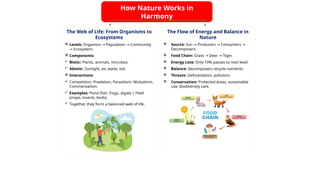
How Nature Worksin
Harmony
The Web of Life: From Organisms to
Ecosystems
Levels: Organism Population Community
→ →
Ecosystem.
→
Components:
Biotic: Plants, animals, microbes.
Abiotic: Sunlight, air, water, soil.
Interactions:
Competition, Predation, Parasitism, Mutualism,
Commensalism.
Examples: Pond (fish, frogs, algae) | Field
(crops, insects, birds).
Together, they form a balanced web of life.
The Flow of Energy and Balance in
Nature
Source: Sun Producers Consumers
→ → →
Decomposers.
Food Chain: Grass Deer Tiger.
→ →
Energy Loss: Only 10% passes to next level.
Balance: Decomposers recycle nutrients.
Threats: Deforestation, pollution.
Conservation: Protected areas, sustainable
use, biodiversity care.
13.
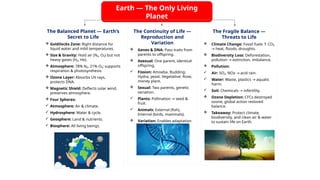
Earth — TheOnly Living
Planet
The Balanced Planet — Earth’s
Secret to Life
Goldilocks Zone: Right distance for
liquid water and mild temperatures.
Size & Gravity: Hold air (N₂, O₂) but not
heavy gases (H₂, He).
Atmosphere: 78% N₂, 21% O₂; supports
respiration & photosynthesis.
Ozone Layer: Absorbs UV rays,
protects DNA.
Magnetic Shield: Deflects solar wind,
preserves atmosphere.
Four Spheres:
Atmosphere: Air & climate.
Hydrosphere: Water & cycle.
Geosphere: Land & nutrients.
Biosphere: All living beings.
The Continuity of Life —
Reproduction and
Variation
Genes & DNA: Pass traits from
parents to offspring.
Asexual: One parent, identical
offspring.
Fission: Amoeba. Budding:
Hydra, yeast. Vegetative: Rose,
money plant.
Sexual: Two parents, genetic
variation.
Plants: Pollination seed &
→
fruit.
Animals: External (fish),
Internal (birds, mammals).
Variation: Enables adaptation
& evolution.
The Fragile Balance —
Threats to Life
Climate Change: Fossil fuels CO₂
↑
heat, floods, droughts.
→
Biodiversity Loss: Deforestation,
pollution extinction, imbalance.
→
Pollution:
Air: SO₂, NOx acid rain.
→
Water: Waste, plastics aquatic
→
harm.
Soil: Chemicals infertility.
→
Ozone Depletion: CFCs destroyed
ozone; global action restored
balance.
Takeaway: Protect climate,
biodiversity, and clean air & water
to sustain life on Earth.