Scalable iGaming Marketing Strategies for
Growth
The iGaming industry in 2026 operates under stricter regulations, higher acquisition costs, and
more informed users. Growth is no longer driven by volume-based campaigns. Instead, leading
operators focus on structured systems that balance acquisition efficiency with long-term value.
Industry data shows that acquisition costs in regulated markets can exceed $300 per user, while
over 70% of revenue often comes from returning players. This shift makes lifecycle optimization
essential.
This guide outlines how to build scalable iGaming marketing strategies using data,
segmentation, and multi-channel coordination.
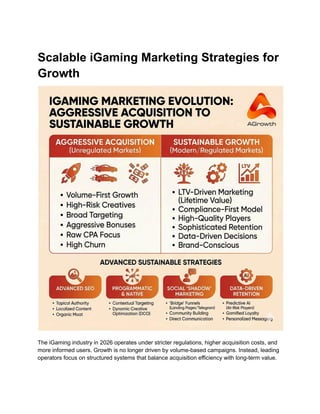
How iGaming Marketing Has Evolved
From Volume Acquisition to Value Optimization
Earlier strategies prioritized rapid user acquisition. While this approach increased registrations, it
often resulted in low retention and unstable performance.
Today, regulated markets reward quality over quantity. Operators focus on attracting users who:
●​ Complete onboarding
●​ Engage consistently
●​ Generate long-term revenue
This shift has made lifetime value (LTV) the primary performance indicator.
The Impact of Regulation on Marketing Strategy
Regulatory frameworks in markets such as the US and UK have reshaped marketing execution.
Key changes include:
●​ Reduced use of direct promotional messaging
●​ Increased focus on educational content
●​ Stronger emphasis on responsible messaging
●​ Strict alignment with platform policies
As a result, marketing strategies now prioritize clarity, transparency, and compliance.
Core iGaming Marketing Strategies
1. SEO and Content Authority
SEO remains one of the most stable acquisition channels.
High-performing operators build content ecosystems that include:
●​ Game guides and tutorials
●​ Platform comparisons
●​ Payment method insights
●​ Localized content
Localized SEO improves relevance by adapting terminology and content to regional
preferences.
2. Programmatic and Native Advertising
When social platforms are restrictive, native networks provide scalable alternatives.
Key advantages:
●​ Contextual placement on high-traffic websites
●​ Access to users in a discovery mindset
●​ Flexible creative testing
Dynamic creative optimization helps adjust messaging based on audience response.
3. Social Media and Community Funnels
Direct promotion on social platforms is limited. Instead, effective strategies use indirect funnels.
Typical structure:
●​ Content or educational posts
●​ Traffic directed to landing pages or communities
●​ Gradual transition to platform engagement
Private communities such as messaging groups or forums support ongoing interaction and
retention.
4. Data-Driven Retention and CRM
Retention is a primary driver of profitability.
Advanced approaches include:
●​ Predictive modeling to identify disengagement risk
●​ Trigger-based communication
●​ Personalized offers based on behavior
Automation enables timely engagement while maintaining relevance.
Building an Effective iGaming Marketing Plan
Step 1: Define Audience Segments
Segmentation should focus on behavioral patterns.
Key dimensions:
●​ Engagement level
●​ Preferred content or games
●​ Transaction frequency
●​ Device usage
●​ Geographic requirements
Behavior-based segmentation improves targeting accuracy.
Step 2: Set Business-Oriented Goals
Replace general metrics with measurable outcomes.
Examples:
●​ Reduce acquisition cost within a defined period
●​ Increase repeat engagement rate
●​ Extend average user lifecycle
●​ Improve return on ad spend
Clear goals ensure alignment with business performance.
Step 3: Develop a Multi-Channel System
A balanced strategy includes:
●​ Organic content
●​ Paid campaigns
●​ Affiliate partnerships
●​ CRM engagement
●​ Conversion optimization
Each channel contributes to a different stage of the funnel.
Step 4: Allocate Budget Based on Performance
Effective budget management includes:
●​ Prioritizing channels with strong LTV
●​ Maintaining testing budgets
●​ Protecting retention investment
●​ Avoiding over-reliance on single channels
Step 5: Implement Measurement Frameworks
Key practices:
●​ Cohort-based analysis
●​ Tracking long-term value
●​ Monitoring creative performance
●​ Aligning attribution with revenue
Accurate data supports better decision-making.
Execution Strategies That Improve Performance
Personalization Across the User Journey
Personalization increases engagement and retention.
Examples:
●​ Dynamic recommendations
●​ Behavior-based communication
●​ Customized landing experiences
Influencer and Content Partnerships
Partnerships help expand reach and credibility.
Effective execution:
●​ Focus on niche audiences
●​ Track performance with unique links
●​ Ensure compliance with platform policies
Paid Advertising Optimization
Paid media requires structured execution.
Best practices:
●​ Segment audiences by intent
●​ Refresh creatives regularly
●​ Scale based on performance metrics
●​ Maintain compliance
Affiliate Ecosystem Development
Affiliate channels support scalable growth.
Key elements:
●​ Transparent commission models
●​ Performance tracking
●​ Partner optimization
Mobile Optimization
Mobile performance directly impacts conversion.
Focus areas:
●​ Page speed
●​ Simplified onboarding
●​ Streamlined transactions
Conversion Funnel Optimization
Improving user experience increases efficiency.
Key areas:
●​ Reduce friction in onboarding
●​ Clarify value propositions
●​ Strengthen trust signals
Event and Engagement Campaigns
Structured campaigns increase activity.
Examples:
●​ Time-based challenges
●​ Reward systems
●​ Cross-channel promotion
Gamification for Retention
Gamification enhances engagement without excessive incentives.
Examples:
●​ Progress tracking
●​ Achievement systems
●​ Loyalty missions
Loyalty and Retention Systems
Retention systems support long-term growth.
Key components:
●​ Tier-based progression
●​ Points systems
●​ Behavior-triggered rewards
●​ Exclusive benefits
These systems increase user lifetime value.
Common Challenges in iGaming Marketing
Over-Focus on Acquisition
Balancing acquisition and retention improves efficiency.
Inconsistent Messaging
Alignment between ads and landing pages improves conversion.
Limited Localization
Adapting to local behavior improves performance.
Fragmented Data Systems
Centralized tracking improves visibility and optimization.
Frequently Asked Questions
What is the most important metric?​
Lifetime value provides the clearest measure of performance.
How long does optimization take?​
Initial results may appear quickly, while stable performance develops over time.
Is SEO still relevant?​
Yes, it supports long-term demand generation.
What role does automation play?​
Automation improves efficiency, personalization, and scalability.
Recommended Resources for iGaming Marketing
Strategies
iGaming Marketing Strategies​
A comprehensive guide covering acquisition, retention, and scalable marketing frameworks for
iGaming operators.
https://agrowth.io/blogs/knowledge/igaming-marketing-strategies ​
A comprehensive guide covering acquisition, retention, and scalable marketing frameworks for
iGaming operators.
🔹Bản ~3000 ký tự
Scalable iGaming Marketing Strategies for Growth
iGaming marketing in 2026 is no longer about scaling traffic as fast as possible. The real
challenge today is building a system that can balance acquisition cost, user quality, and
long-term value.
In highly competitive markets, customer acquisition costs can exceed $300 per user.
Meanwhile, more than 70% of total revenue often comes from returning players. This means
growth is no longer driven by volume, but by retention and lifecycle optimization.
Modern iGaming marketing strategies are built around three pillars:
First, acquisition efficiency. Instead of broad targeting, top operators focus on behavioral
segmentation. Users are grouped based on engagement level, transaction patterns, and content
preference. This allows campaigns to attract users who are more likely to stay active, not just
register.
Second, funnel structure. High-performing teams do not send traffic directly to registration. They
build a multi-step journey:​
content → pre-lander → platform → CRM follow-up​
Each step reduces friction and increases trust, improving overall conversion quality.
Third, retention systems. This is where most revenue is generated. Data-driven CRM flows,
personalized incentives, and gamification systems help maintain engagement over time.
Predictive models can identify users who are likely to disengage, allowing timely reactivation
campaigns.
Another key shift is channel diversification. Relying on a single platform is no longer effective.
Instead, successful operators combine:​
SEO for long-term demand​
Paid media for controlled scaling​
Affiliate partnerships for performance-based growth​
CRM for retention and reactivation
This multi-channel approach ensures stability and scalability.
Finally, measurement is critical. Vanity metrics such as traffic or registrations do not reflect real
performance. Instead, focus on:​
CAC vs LTV​
Retention rate​
Revenue per active user​
Cohort performance
Without accurate data, optimization becomes inconsistent.
In summary, iGaming marketing today is about building a system, not running isolated
campaigns. When acquisition, funnel design, and retention are aligned, growth becomes
predictable and sustainable.
👉Learn more: https://agrowth.io/blogs/knowledge/igaming-marketing-strategies
#iGaming #PerformanceMarketing #DigitalStrategy #UserAcquisition #GrowthMarketing #CRM
#SEO
🔹Bản ~1000 ký tự
iGaming marketing is shifting from volume-based acquisition to value-driven growth.
In many markets, acquisition costs are rising while long-term revenue depends heavily on
retention. This forces marketers to rethink their strategy.
Instead of sending traffic directly to registration, top operators build structured funnels:​
content → pre-lander → platform → retention flows
They also focus on behavioral segmentation rather than broad targeting, ensuring higher user
quality.
Retention plays a central role. Personalized CRM campaigns, gamification systems, and
predictive models help maintain engagement and increase lifetime value.
At the same time, channel diversification is key. Combining SEO, paid ads, affiliates, and CRM
creates a more stable and scalable system.
The takeaway is simple: growth comes from alignment between acquisition, funnel design, and
retention—not from traffic alone.
👉Read more: https://agrowth.io/blogs/knowledge/igaming-marketing-strategies
#iGaming #GrowthStrategy #MarketingInsights #DigitalGrowth #PerformanceAds
🔹Bản ~300 ký tự
iGaming marketing today is not about traffic—it’s about system design.
High-performing teams focus on:​
• Behavioral targeting​
• Structured funnels​
• Retention and CRM​
• LTV over short-term metrics
Growth becomes scalable when all parts work together.
👉https://agrowth.io/blogs/knowledge/igaming-marketing-strategies
#iGaming #Marketing #Growth
🔹Social ngắn (LinkedIn / X)
Most iGaming campaigns fail for one reason:
They focus on traffic, not systems.
Top operators optimize:​
• Who they attract (segmentation)​
• How they convert (funnels)​
• How they retain (CRM + LTV)
That’s where real growth happens.
👉https://agrowth.io/blogs/knowledge/igaming-marketing-strategies
#iGaming #GrowthMarketing #PerformanceMarketing
🔹Social dài (storytelling + helpful)
A few years ago, scaling an iGaming brand was simple:
Buy traffic. Push offers. Increase volume.
Today, that approach no longer works.
Acquisition costs have increased significantly, while most revenue now comes from returning
users—not first-time actions.
This changes everything.
The operators who are winning in 2026 are not spending more.​
They are building better systems.
They understand that growth happens across the entire journey:
Not just ads → but segmentation​
Not just clicks → but funnel design​
Not just conversion → but retention
Instead of sending users directly to registration, they guide them through structured
experiences:​
content → trust → engagement → conversion → retention
They use data to personalize every step.​
They invest in CRM as much as acquisition.​
They measure success based on lifetime value, not short-term results.
The biggest shift is mindset:
From campaigns → to systems​
From traffic → to value​
From short-term → to sustainable growth
If you are still optimizing only for clicks or registrations, you are likely missing the bigger picture.
The real opportunity lies in building a marketing engine that compounds over time.
👉Dive deeper here: https://agrowth.io/blogs/knowledge/igaming-marketing-strategies
#iGaming #GrowthStrategy #DigitalMarketing #PerformanceMarketing #UserRetention
#MarketingSystems