Why Summer ’26Is a
Structural Platform
Shift
Foundational Platform Shift
Summer ’26 redefines AI, automation, and productivity as
essential platform layers, not optional features.
Agentic Enterprise Concept
Humans and AI agents collaborate with shared context,
governance, and accountability across business processes.
Architectural Implications
New security defaults, agent orchestration, and decoupled UI
require revisiting execution models and ownership.
Urgency for Readiness
Delaying audits or refactoring risks broken integrations and
ungoverned AI; planning and leadership are critical.
4.
Release Priorities
Through an
ArchitectLens
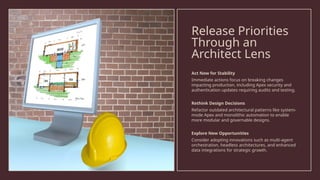
Act Now for Stability
Immediate actions focus on breaking changes
impacting production, including Apex security and
authentication updates requiring audits and testing.
Rethink Design Decisions
Refactor outdated architectural patterns like system-
mode Apex and monolithic automation to enable
more modular and governable designs.
Explore New Opportunities
Consider adopting innovations such as multi-agent
orchestration, headless architectures, and enhanced
data integrations for strategic growth.
5.
High-Level
Architecture Impact
Overview
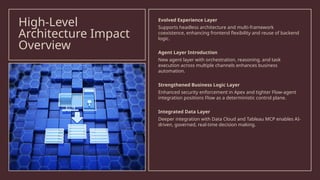
Evolved ExperienceLayer
Supports headless architecture and multi-framework
coexistence, enhancing frontend flexibility and reuse of backend
logic.
Agent Layer Introduction
New agent layer with orchestration, reasoning, and task
execution across multiple channels enhances business
automation.
Strengthened Business Logic Layer
Enhanced security enforcement in Apex and tighter Flow-agent
integration positions Flow as a deterministic control plane.
Integrated Data Layer
Deeper integration with Data Cloud and Tableau MCP enables AI-
driven, governed, real-time decision making.
Apex Security Model
Changesin API
Version 67.0
User Mode Database Operations
Database actions like SOQL, SOSL, and DML run in user mode by
default, enforcing permissions strictly.
Default With Sharing Declaration
Apex classes now default to 'with sharing', requiring explicit
declaration for system-level access.
Removal of WITH SECURITY_ENFORCED Clause
The WITH SECURITY_ENFORCED clause is replaced by WITH
USER_MODE, ensuring clearer security intent in code.
Architectural and Governance Implications
Architects must review legacy code, define system-mode access
guidelines, and strengthen governance.
8.
From Implicit Trust
toExplicit Security
Architecture
Transition to Explicit Security
Salesforce shifts from implicit trust to explicit security, making
secure behavior the default in Apex execution.
Zero-Trust Alignment
This change aligns Salesforce with zero-trust principles, requiring
continuous evaluation and justification of access.
Architectural Impact
Architects must reassess integration, batch jobs, and service
design to ensure proper permissions and declared execution
modes.
Importance of Verification
Increased focus on documentation, code reviews, and
automated testing to maintain visible and verifiable security
intent.
9.
Broader Platform
Security andPermission
Visibility Enhancements
Enhanced Permission Dependency Views
New views let admins visualize effects of permission changes
before saving to prevent access risks.
Granular Queue Access Controls
Improved controls allow precise management of queue access
and record visibility across the platform.
Improved Security Observability
Security behaviors are now more observable and explainable,
aiding architects in multi-team environments.
Stronger Governance and Collaboration
Enhancements foster transparent security, enabling better
collaboration between architects, admins, and security teams.
10.
Architect
Action
Items for
Security
Readiness
Comprehensive ApexCode Audit
Conduct a detailed Apex code audit focusing on sharing rules, database access, and
deprecated security clauses to ensure compliance.
Validate Integration and Processes
Verify integration users, batch jobs, and scheduled processes against new execution
defaults to detect permission gaps proactively.
Update Standards and Guidelines
Revise architectural standards and development guidelines to explicitly specify
security practices as a best practice.
Regression Testing for Data Access
Include regression tests that validate data access behavior under user-mode
execution to detect security issues early.
Team Communication and Training
Communicate changes clearly to development and admin teams to ensure
understanding and consistent security implementation.
Agentforce as a
First-Class
ArchitecturalLayer
Core Architectural Layer Transition
Agentforce evolves from experimental to a fundamental
architectural layer, enabling multi-agent orchestration with
shared context.
Role of Agents in Workflow
Agents interpret intent, delegate tasks, and maintain
conversational continuity beyond traditional business logic
layers.
Design and Governance Considerations
Probabilistic reasoning in agents demands clear boundaries,
error handling, lifecycle management, and governance
protocols.
Integration with Development Tools
Pro-code tools like Agentforce DX MCP Server and Vibe IDE
integrate agents into standard development workflows.
13.
Flow and Agent
Convergenceas a
Control Plane Pattern
Deterministic Control Plane
Flow defines the structure and guardrails of business processes
ensuring predictability and compliance.
Adaptive Agent Execution
Agents provide adaptive execution, handling contextual
decisions and natural language interactions within Flow
boundaries.
Separation for Maintainability
Separating Flow and Agents enhances maintainability,
governance and allows independent testing of core processes.
Scalable Enterprise Automation
This model supports scalable automation in complex scenarios
like customer service, balancing control with AI flexibility.
14.
Governance,
Observability, and Risk
inAgent-Based Systems
Agent Behavior Monitoring
Design mechanisms to monitor agent actions, log decisions, and
trace outcomes across workflows effectively.
Governance and Audit Trails
Implement shared context layers, audit trails, and clear
escalation paths to ensure governance and traceability.
Risk Management Strategies
Apply confidence thresholds, fallback behaviors, and human-in-
the-loop controls to manage risk in agent decisions.
Data Access and Security
Ensure data access boundaries for agents align with enhanced
security standards and compliance requirements.
Headless Experience
and Multi-Framework
UIStrategy
Decoupled Architecture Benefits
Separating business logic from UI allows design once and
deployment across multiple channels seamlessly.
Multi-Framework Support
Support for Lightning Web Components, React, and external
surfaces enables flexible UI development.
Governance Challenges
Without clear standards, headless architecture risks fragmented
experiences and inconsistent behavior.
Agility and Future-Proofing
Disciplined headless design improves agility, supports
omnichannel strategies, and adapts to UI evolution.
17.
Data, Analytics, and
AIIntegration with
Tableau MCP
AI-Driven Data Querying
Tableau MCP enables AI agents to query governed analytics,
ensuring decisions are based on trusted enterprise data.
Unified Data Strategy
A unified data strategy integrates CRM data, Data Cloud, and
analytics for consistent, reliable insights across the enterprise.
Data Quality and Governance
Data modeling, quality, and residency impact AI accuracy,
emphasizing the need for governance in data architecture.
Real-Time Insights and Activation
Consistent data architectures support real-time insights and
activation, driving reliable AI outcomes enterprise-wide.
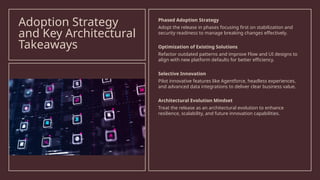
18.
Adoption Strategy
and KeyArchitectural
Takeaways
Phased Adoption Strategy
Adopt the release in phases focusing first on stabilization and
security readiness to manage breaking changes effectively.
Optimization of Existing Solutions
Refactor outdated patterns and improve Flow and UI designs to
align with new platform defaults for better efficiency.
Selective Innovation
Pilot innovative features like Agentforce, headless experiences,
and advanced data integrations to deliver clear business value.
Architectural Evolution Mindset
Treat the release as an architectural evolution to enhance
resilience, scalability, and future innovation capabilities.
#2
---
This slide references information from the following file: https://www.salesforce.com/blog/summer-26-release-architect-highlights/,https://www.salesforce.com/news/stories/summer-2026-product-release-announcement/
Why Summer ’26 Is a Structural Platform Shift, Release Priorities Through an Architect Lens, High-Level Architecture Impact Overview
#3
---
This slide references information from the following file: https://www.salesforce.com/blog/summer-26-release-architect-highlights/,https://www.salesforce.com/news/stories/summer-2026-product-release-announcement/
The Salesforce Summer ’26 release represents a structural inflection point rather than an incremental feature drop, particularly from a Salesforce Technical Architect perspective. While previous releases introduced AI, automation, and productivity enhancements as optional capabilities, Summer ’26 repositions these elements as foundational layers of the platform. The most significant signal is Salesforce’s explicit framing of the “Agentic Enterprise,” where humans and AI agents operate together across business processes with shared context, governance, and accountability. For architects, this means existing assumptions about execution models, security boundaries, and system ownership must be revisited. The release introduces enforced security defaults in Apex, promotes agent orchestration as a first-class architectural concern, and accelerates the decoupling of user experience from business logic through headless and multi-framework UI capabilities. These changes collectively affect how solutions are designed, governed, and evolved over time. Architecturally, Summer ’26 shifts Salesforce from a primarily transaction-oriented CRM platform into an orchestration-centric runtime where intent, context, and automation drive outcomes. This has implications for solution layering, integration strategies, and non-functional requirements such as observability and auditability. Architects must now think in terms of platform behavior under default conditions rather than relying on implicit system-mode execution or UI-bound logic. The release also increases the cost of inaction: delaying code audits, security reviews, or architectural refactoring can result in broken integrations, unexpected authorization failures, or ungoverned AI behavior in production. As a result, Summer ’26 should be approached as a mandatory architecture readiness milestone, requiring deliberate planning, stakeholder alignment, and technical leadership to ensure platform stability while enabling future innovation.
#4
---
This slide references information from the following file: https://www.salesforce.com/blog/summer-26-release-architect-highlights/,https://www.salesforce.com/news/stories/summer-2026-product-release-announcement/
Salesforce guidance for the Summer ’26 release can be effectively reframed into an architect-centric prioritization model: act now, rethink design decisions, and explore new opportunities. The “act now” category includes enforced or breaking changes that directly impact production stability, such as Apex security model updates in API version 67.0 and authentication or permission behavior changes. These items require immediate assessment, code audits, and regression testing. The second category, “rethink design decisions,” addresses areas where previous architectural patterns remain functional but are no longer optimal. Examples include heavy reliance on system-mode Apex, tightly coupled Lightning UI logic, or monolithic automation designs that do not account for agent collaboration or shared context. Summer ’26 provides alternatives that encourage more explicit, governable, and composable designs. The final category, “explore design opportunities,” includes Agentforce multi-agent orchestration, headless experience architecture, and deeper Data Cloud and Tableau integration. While these are not mandatory on day one, they represent the strategic direction of the platform and should inform roadmap planning. For architects, the key is sequencing: stabilize and secure first, refactor where assumptions are invalidated, and then selectively adopt new capabilities where they provide measurable value. This prioritization model helps prevent both reactive firefighting and uncontrolled experimentation, ensuring that Summer ’26 adoption strengthens the overall enterprise architecture rather than fragmenting it.
#5
---
This slide references information from the following file: https://www.salesforce.com/blog/summer-26-release-architect-highlights/,https://www.salesforce.com/news/stories/summer-2026-product-release-announcement/
At a high level, the Summer ’26 release introduces meaningful changes across all major architectural layers of the Salesforce platform. The experience layer evolves through headless architecture and multi-framework support, enabling React and other frameworks to coexist with Lightning Web Components while consuming shared backend logic. Above the traditional business logic layer, a new agent layer emerges, where Agentforce provides orchestration, reasoning, and task execution capabilities across channels. The business logic layer itself is tightened through more explicit security enforcement in Apex and closer integration between Flow and agents, positioning Flow as a deterministic control plane rather than just an automation tool. At the data layer, deeper integration with Data Cloud and Tableau MCP ensures that AI-driven decisions are grounded in governed, real-time data. For architects, the key takeaway is that these layers are no longer loosely related enhancements; they are increasingly interdependent. Decisions made in one layer, such as security posture in Apex or data residency choices in Data Cloud, directly affect agent behavior, user experience flexibility, and compliance outcomes. Understanding these cross-layer dependencies is essential to designing resilient, scalable solutions in the Summer ’26 era.
#6
---
This slide references information from the following file: https://www.salesforce.com/blog/summer-26-release-architect-highlights/
Apex Security Model Changes in API Version 67.0, From Implicit Trust to Explicit Security Architecture, Broader Platform Security and Permission Visibility Enhancements, Architect Action Items for Security Readiness
#7
---
This slide references information from the following file: https://www.salesforce.com/blog/summer-26-release-architect-highlights/
One of the most impactful and immediate changes in the Summer ’26 release is the evolution of the Apex security and execution model in API version 67.0. Database operations such as SOQL, SOSL, and DML now run in user mode by default, enforcing object permissions and field-level security unless explicitly overridden. Additionally, Apex classes without an explicit sharing declaration now default to “with sharing,” reversing long-standing assumptions where system-level access was often implicit. The removal of the WITH SECURITY_ENFORCED clause, replaced by WITH USER_MODE, further reinforces Salesforce’s shift toward explicit, declarative security intent in code. For architects, these changes demand a comprehensive review of custom code, particularly in orgs with legacy implementations or managed package dependencies. Code that previously functioned without errors may now return fewer records, surface authorization exceptions, or fail compilation when upgraded to v67.0. Beyond technical remediation, this change has architectural implications: system-mode execution should now be treated as a deliberate exception rather than a convenience. Architects must define clear guidelines for when system-mode access is justified, document these decisions, and ensure they align with enterprise security and compliance requirements. This shift ultimately improves platform trust and auditability but requires proactive governance and disciplined development practices.
#8
---
This slide references information from the following file: https://www.salesforce.com/blog/summer-26-release-architect-highlights/
The broader architectural significance of the Apex security changes lies in Salesforce’s transition from implicit trust to explicit security architecture. Historically, many Salesforce implementations relied on system-mode execution as a safety net, allowing developers to bypass sharing and FLS under the assumption that business logic was inherently trusted. Summer ’26 challenges this model by making secure behavior the default and requiring architects and developers to consciously declare exceptions. This aligns Salesforce more closely with zero-trust principles, where access is always evaluated and justified. For architects, this necessitates a reassessment of integration patterns, batch processing strategies, and service-layer design. Integration users, scheduled jobs, and background processes must be reviewed to ensure they have appropriate permissions or explicitly declared execution modes. Documentation, code reviews, and automated testing become more critical, as security intent must be both visible and verifiable. While this increases upfront effort, it reduces long-term risk by minimizing accidental data exposure and simplifying compliance audits. Summer ’26 therefore acts as a forcing function, encouraging architects to formalize security as a core architectural concern rather than a secondary configuration detail.
#9
---
This slide references information from the following file: https://www.salesforce.com/blog/summer-26-release-architect-highlights/
Beyond Apex, the Summer ’26 release introduces several platform-level security and permission visibility improvements that support stronger governance. Enhanced permission dependency views allow administrators and architects to see the downstream effects of permission changes before they are saved, reducing the risk of unintended access escalation. Changes to queue access inheritance and other granular controls provide more precise authority over record visibility. From an architectural standpoint, these enhancements make security behavior more observable and explainable, which is essential in large, multi-team environments. Architects can now design permission models with greater confidence, knowing that their impact can be reviewed and audited more easily. This also supports better collaboration between architects, admins, and security teams, as access decisions are no longer hidden behind complex, opaque configurations. Collectively, these changes reinforce Salesforce’s move toward a platform where security is transparent, predictable, and aligned with enterprise governance standards.
#10
---
This slide references information from the following file: https://www.salesforce.com/blog/summer-26-release-architect-highlights/
To ensure readiness for the Summer ’26 security changes, Salesforce Technical Architects should lead a structured set of action items. First, perform a comprehensive Apex code audit focusing on sharing declarations, database access patterns, and deprecated security clauses. Second, validate integration users, batch jobs, and scheduled processes against the new execution defaults to identify permission gaps early. Third, update architectural standards and development guidelines to reflect explicit security intent as a best practice. Fourth, incorporate regression testing scenarios that specifically validate data access behavior under user-mode execution. Finally, communicate these changes to development and admin teams to ensure shared understanding and consistent implementation. By treating security readiness as an architectural initiative rather than a last-minute fix, organizations can avoid production disruptions while strengthening their overall security posture in alignment with Salesforce’s platform direction.
#11
---
This slide references information from the following file: https://salesforcedictionary.com/news/salesforce-summer-26-official-release-may-2026,https://www.salesforce.com/news/stories/summer-2026-product-release-announcement/
Agentforce as a First-Class Architectural Layer, Flow and Agent Convergence as a Control Plane Pattern, Governance, Observability, and Risk in Agent-Based Systems
#12
---
This slide references information from the following file: https://salesforcedictionary.com/news/salesforce-summer-26-official-release-may-2026,https://www.salesforce.com/news/stories/summer-2026-product-release-announcement/
Summer ’26 marks the point where Agentforce transitions from an experimental capability to a core architectural layer of the Salesforce platform. Multi-agent orchestration allows multiple specialized agents to collaborate on a single end-to-end workflow while maintaining shared context and a unified customer experience. For architects, this introduces a new layer that sits above traditional business logic, responsible for intent interpretation, task delegation, and conversational continuity. Unlike simple bots or automation rules, agents operate with probabilistic reasoning, which introduces new design considerations around determinism, error handling, and governance. Architects must define clear boundaries between agent responsibilities and deterministic logic implemented in Flow or Apex. They must also consider lifecycle management for agents, including versioning, deployment, monitoring, and rollback. The availability of pro-code tools such as the Agentforce DX MCP Server and Vibe IDE further signals Salesforce’s intent to integrate agents into standard development workflows. This elevates agents from UI-level enhancements to platform services that must be designed, reviewed, and governed like any other critical architectural component.
#13
---
This slide references information from the following file: https://salesforcedictionary.com/news/salesforce-summer-26-official-release-may-2026,https://www.salesforce.com/news/stories/summer-2026-product-release-announcement/
The convergence of Flow and Agentforce in the Summer ’26 release establishes a powerful architectural pattern where Flow acts as a deterministic control plane and agents provide adaptive execution. Flows define the structure, sequence, and guardrails of business processes, while agents handle contextual decision-making, natural language interaction, and task execution within those boundaries. This separation of concerns is critical for maintainability and governance. Architects can ensure compliance and predictability through Flow logic while still benefiting from the flexibility of AI-driven behavior. This pattern also improves testability, as core process paths remain deterministic and can be validated independently of agent reasoning. For complex enterprise scenarios, such as customer service or IT support, this model enables scalable automation without sacrificing control. Architects should standardize this pattern, defining when agent involvement is appropriate and how exceptions or failures are handled. Doing so ensures that AI enhances, rather than destabilizes, enterprise automation.
#14
---
This slide references information from the following file: https://salesforcedictionary.com/news/salesforce-summer-26-official-release-may-2026,https://www.salesforce.com/news/stories/summer-2026-product-release-announcement/
Introducing agents into core business processes raises important governance and observability considerations. Unlike traditional code, agent behavior may vary based on context, data, and model interpretation. Architects must therefore design mechanisms to monitor agent actions, log decisions, and trace outcomes across multi-agent workflows. Shared context layers, audit trails, and clear escalation paths to deterministic logic are essential. Risk management strategies should include defined confidence thresholds, fallback behaviors, and human-in-the-loop controls for high-impact decisions. Additionally, architects must consider data access boundaries for agents, ensuring alignment with the stricter security defaults introduced in Summer ’26. By proactively addressing these concerns, organizations can harness the productivity benefits of Agentforce while maintaining trust, compliance, and operational stability.
#15
---
This slide references information from the following file: https://www.salesforce.com/blog/platform-summer-26-release/
Headless Experience and Multi-Framework UI Strategy, Data, Analytics, and AI Integration with Tableau MCP, Adoption Strategy and Key Architectural Takeaways
#16
---
This slide references information from the following file: https://www.salesforce.com/blog/platform-summer-26-release/
The Summer ’26 release accelerates Salesforce’s move toward headless experience architecture through the Headless Experience Layer and multi-framework runtime support. By decoupling business logic from UI rendering, architects can design once and deploy across multiple channels, including Lightning Web Components, React applications, and external surfaces. This approach supports modern composable architecture principles, enabling teams to adopt micro-frontend strategies and tailor user experiences without duplicating backend logic. For architects, the challenge lies in governance: without clear standards, headless flexibility can lead to fragmented experiences and inconsistent behavior. API design, versioning, and performance considerations become central architectural concerns. When implemented with discipline, headless architecture increases agility, supports omnichannel strategies, and future-proofs the experience layer against rapid UI evolution.
#17
---
This slide references information from the following file: https://www.salesforce.com/blog/platform-summer-26-release/
Summer ’26 strengthens the integration between data, analytics, and AI through capabilities such as Tableau MCP, which allows AI agents to query governed analytics directly. This ensures that AI-driven recommendations and decisions are grounded in trusted, enterprise-grade data rather than isolated transactional views. For architects, this reinforces the importance of a unified data strategy that spans core CRM data, Data Cloud, and analytical assets. Data modeling, quality, and residency decisions now have direct implications for agent accuracy and reliability. By designing data architectures that prioritize consistency and governance, architects enable more reliable AI outcomes while supporting real-time insights and activation across the enterprise.
#18
---
This slide references information from the following file: https://www.salesforce.com/blog/platform-summer-26-release/
Successfully adopting the Summer ’26 release requires a phased architectural strategy. Initial efforts should focus on stabilization, addressing breaking changes, and ensuring security readiness. The next phase should optimize existing solutions by refactoring outdated patterns, improving Flow and UI designs, and aligning with new defaults. Finally, organizations can selectively innovate by piloting Agentforce, headless experiences, and advanced data integrations where they deliver clear business value. The key takeaway for architects is that Summer ’26 is not optional; it redefines baseline platform behavior. By approaching it as an architectural evolution rather than a feature upgrade, Technical Architects can position their organizations for greater resilience, scalability, and innovation in the agent-driven future of Salesforce.