RUTACEAE
Dr. B. KARUNAI SELVI
ASSOCIATE PROFESSOR OF BOTANY
V.V.VANNIAPERUMAL COLLEGE FOR WOMEN
VIRUDHUNAGAR- 626 001
TAMIL NADU, INDIA
karunaiselvi@vvvcollege.org
Rutaceae
Distribution
 The family is commonly is
called orange family.
 The family comprises 150
genera and 1300 species out
of which India contributes 71
species.
 The members of the family
are distributed in tropical
and temperate regions and
they are predominant in
South Africa and Australia.
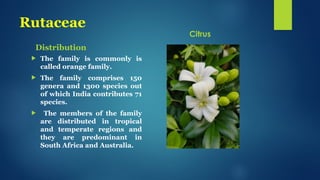
Citrus
Vegetative characters
Habit
 The plant are generally
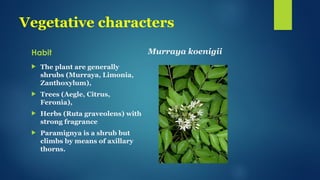
shrubs (Murraya, Limonia,
Zanthoxylum),
 Trees (Aegle, Citrus,
Feronia),
 Herbs (Ruta graveolens) with
strong fragrance
 Paramignya is a shrub but
climbs by means of axillary
thorns.
Murraya koenigii
Vegetative characters
Root & Stem
 Tap root, branched often
infected with fungus.
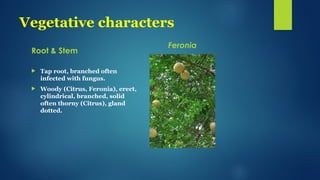
 Woody (Citrus, Feronia), erect,
cylindrical, branched, solid
often thorny (Citrus), gland
dotted.
Feronia
Vegetative characters
Leaves
 Alternate (Citrus, Murraya)
or opposite (Evodia),
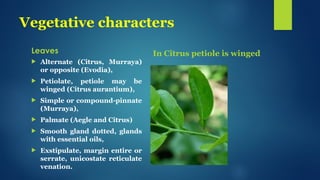
 Petiolate, petiole may be
winged (Citrus aurantium),
 Simple or compound-pinnate
(Murraya),
 Palmate (Aegle and Citrus)
 Smooth gland dotted, glands
with essential oils,
 Exstipulate, margin entire or
serrate, unicostate reticulate
venation.
In Citrus petiole is winged
Floral characters
Inflorescence & Flower
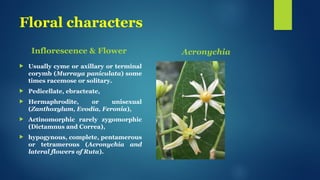
 Usually cyme or axillary or terminal
corymb (Murraya paniculata) some
times racemose or solitary.
 Pedicellate, ebracteate,
 Hermaphrodite, or unisexual
(Zanthoxylum, Evodia, Feronia),
 Actinomorphic rarely zygomorphic
(Dictamnus and Correa),
 hypogynous, complete, pentamerous
or tetramerous (Acronychia and
lateral flowers of Ruta).
Acronychia
Floral characters
Calyx & Corolla
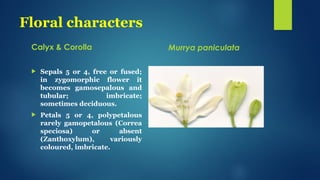
 Sepals 5 or 4, free or fused;
in zygomorphic flower it
becomes gamosepalous and
tubular; imbricate;
sometimes deciduous.
 Petals 5 or 4, polypetalous
rarely gamopetalous (Correa
speciosa) or absent
(Zanthoxylum), variously
coloured, imbricate.
Murrya paniculata
Floral characters
Androecium
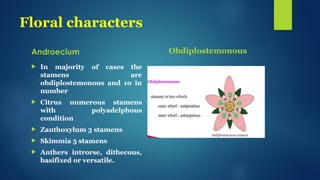
 In majority of cases the
stamens are
obdiplostemonous and 10 in
number
 Citrus numerous stamens
with polyadelphous
condition
 Zanthoxylum 3 stamens
 Skimmia 5 stamens
 Anthers introrse, dithecous,
basifixed or versatile.
Obdiplostemonous
Floral characters
Gynoecium
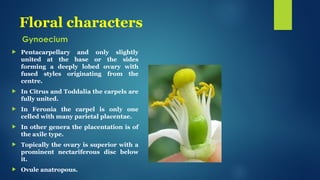
 Pentacarpellary and only slightly
united at the base or the sides
forming a deeply lobed ovary with
fused styles originating from the
centre.
 In Citrus and Toddalia the carpels are
fully united.
 In Feronia the carpel is only one
celled with many parietal placentae.
 In other genera the placentation is of
the axile type.
 Topically the ovary is superior with a
prominent nectariferous disc below
it.
 Ovule anatropous.
Floral characters
Fruit & Seed
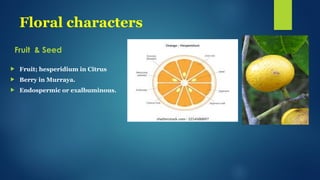
 Fruit; hesperidium in Citrus
 Berry in Murraya.
 Endospermic or exalbuminous.
Reproductive characters
Pollination
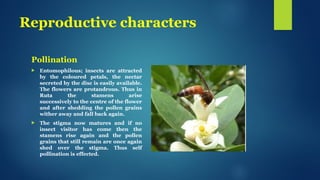
 Entomophilous; insects are attracted
by the coloured petals, the nectar
secreted by the disc is easily available.
The flowers are protandrous. Thus in
Ruta the stamens arise
successively to the centre of the flower
and after shedding the pollen grains
wither away and fall back again.
 The stigma now matures and if no
insect visitor has come then the
stamens rise again and the pollen
grains that still remain are once again
shed over the stigma. Thus self
pollination is effected.
Economic Importance of Rutaceae
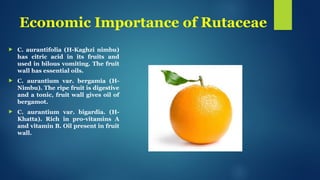
 C. aurantifolia (H-Kaghzi nimbu)
has citric acid in its fruits and
used in bilous vomiting. The fruit
wall has essential oils.
 C. aurantium var. bergamia (H-
Nimbu). The ripe fruit is digestive
and a tonic, fruit wall gives oil of
bergamot.
 C. aurantium var. bigardia. (H-
Khatta). Rich in pro-vitamins A
and vitamin B. Oil present in fruit
wall.
References
 www.google.com
 https://www.inaturalist.org/taxa/50623-Rutaceae
 https://
www.amazon.in/Creative-Farmer-Murraya-Koenigii-Authentic/dp/B
07SRFQ62J
 https://www.gettyimages.in/photos/oranges
 https://www.shutterstock.com/search/hesperidium
THANK YOU