Jit Kumar Gupta
Former Advisor- Town Planning- PUDA
jit.kumar1944@gmail.com
Role , Relevance &
Importance of
Town Planning in
Making Human Living
More Qualitative
Demography
& Typology of
Human
Settlements
Defining – Urban & Rural India
 India- has Two kinds of settlements;
 Urban and Rural
 Village has no definition Village defined by exclusion- definition speaks of urban only
 Urban settlements are defined as ;
 Statutory towns-
 includes an area having
 - municipality,
 -corporation,
 -cantonment board -- a notified town area committee/Nagar Panchayat
 Census Town—
 - a habitation that has;
 - a population- minimum of 5,000;
 - Avocation-at least 75% male working population engaged in non-agricultural
 population-- density - minimum 400 people per sq km.
 Profession of Town Planning deals with planned development of Urban and Rural
Settlements- to empower them and make them more qualitative, productive& Livable
DEMOGRAPHY- Indian
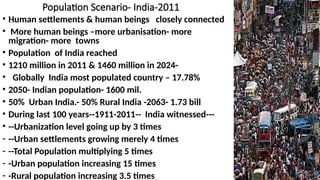
Population Scenario- India-2011
• Human settlements & human beings closely connected
• More human beings –more urbanisation- more
migration- more towns
• Population of India reached
• 1210 million in 2011 & 1460 million in 2024-
• Globally India most populated country – 17.78%
• 2050- Indian population- 1600 mil.
• 50% Urban India.- 50% Rural India -2063- 1.73 bill
• During last 100 years--1911-2011-- India witnessed---
• --Urbanization level going up by 3 times
- --Urban settlements growing merely 4 times
- --Total Population multiplying 5 times
- -Urban population increasing 15 times
- -Rural population increasing 3.5 times
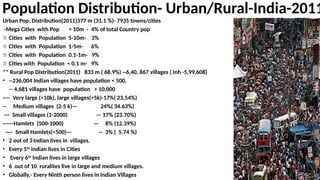
Population Distribution- Urban/Rural-India-2011
Urban Pop. Distribution(2011)377 m (31.1 %)- 7935 towns/cities
-Mega Cities with Pop > 10m - 4% of total Country pop
- Cities with Population 5-10m- 3%
- Cities with Population 1-5m- 6%
- Cities with Population 0.1-1m- 9%
- Cities with Population < 0.1 m- 9%
** Rural Pop Distribution(2011) 833 m ( 68.9%) --6,40, 867 villages ( Inh -5,99,608)
• --236,004 Indian villages have population < 500,
-- 4,681 villages have population > 10,000
---- Very large (>10k), large villages(>5k)-17%( 23.54%)
-- Medium villages (2-5 k)— 24%( 34.63%)
--- Small villages (1-2000) — 17% (23.70%)
------Hamlets (500-1000) — 8% (12.39%)
---- Small Hamlets(<500)— -- 3% ( 5.74 %)
• 2 out of 3Indian lives in villages.
• Every 5th
Indian lives in Cities
• Every 6th
Indian lives in large villages
• 6 out of 10 ruralites live in large and medium villages.
• Globally,- Every Ninth person lives in Indian Villages
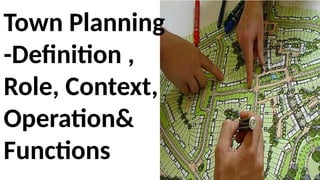
Town Planning
-Definition ,
Role, Context,
Operation&
Functions
TOWN PLANNING- Definition
-- Town planning defined differently by different experts - based on
focus, approach and understanding
-- Town Planning involves large number of subjects/ objects /
stakeholders/ issues/options, as defined below;
• as Art and science of planning human settlements to make them more
productive , effective, efficient, livable and sustainable besides providing
optimum quality of life to its residents.
• as Art and science of sub-dividing land; allocating use and defining what
could be built on to sub-divided land parcels,- based on larger goals of
physical, socio- economic development of the communities/ individuals, living
in human settlement
• as Art and science of ordering use of land, siting of buildings and defining
communication routes, to secure maximum degree of economy, convenience
and beauty
• Aristotle --A city should be built to give its residents security and happiness--
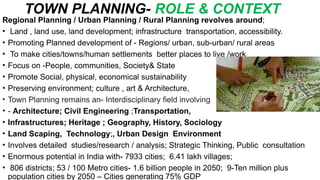
TOWN PLANNING- ROLE & CONTEXT
Regional Planning / Urban Planning / Rural Planning revolves around;
• Land , land use, land development; infrastructure transportation, accessibility.
• Promoting Planned development of - Regions/ urban, sub-urban/ rural areas
• To make cities/towns/human settlements better places to live /work
• Focus on -People, communities, Society& State
• Promote Social, physical, economical sustainability
• Preserving environment; culture , art & Architecture,
• Town Planning remains an- Interdisciplinary field involving
• - Architecture; Civil Engineering ;Transportation,
• Infrastructures; Heritage ; Geography, History, Sociology
• Land Scaping, Technology;, Urban Design Environment
• Involves detailed studies/research / analysis; Strategic Thinking, Public consultation
• Enormous potential in India with- 7933 cities; 6.41 lakh villages;
• 806 districts; 53 / 100 Metro cities- 1.6 billion people in 2050; 9-Ten million plus
population cities by 2050 – Cities generating 75% GDP
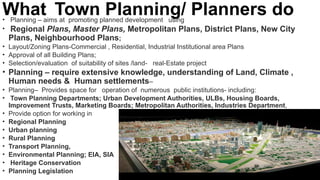
What Town Planning/ Planners do
• Planning – aims at promoting planned development using
• Regional Plans, Master Plans, Metropolitan Plans, District Plans, New City
Plans, Neighbourhood Plans;
• Layout/Zoning Plans-Commercial , Residential, Industrial Institutional area Plans
• Approval of all Building Plans;
• Selection/evaluation of suitability of sites /land- real-Estate project
• Planning – require extensive knowledge, understanding of Land, Climate ,
Human needs & Human settlements–
• Planning– Provides space for operation of numerous public institutions- including:
• Town Planning Departments; Urban Development Authorities, ULBs, Housing Boards,
Improvement Trusts, Marketing Boards; Metropolitan Authorities, Industries Department,
• Provide option for working in
• Regional Planning
• Urban planning
• Rural Planning
• Transport Planning,
• Environmental Planning; EIA, SIA
• Heritage Conservation
• Planning Legislation
TOWN PLANNING-Key Functions
Major functions performed by Town Planners/ Town Planning Departments include:
• Providing technical advice - on matters related to urban planning and development
• Assisting in selecting sites for setting up new towns/industrial areas / SEZ / institutions etc.
• Aiding, assisting , advising - state government/ development authorities/urban local bodies/industrial
corporations- in policy formulation / implementing programs related to planning of human settlements
• Identifying planning areas &- preparing regional plans / master plans /development plans / zonal /
zoning plans at region / settlement
• Prepare Building Bye Laws,
• Sanctioning building plans
• -- regulating construction on defined site.
• Co-ordinating activities of various stake holders involved in urban planning
• Preparing Traffic Operation /Transportation / Mobility Plans
• Ensuring planned development of human settlements
• Framing policies / programs for involving private sector in urban planning / infrastructure development
• Regulating development &checking haphazard development based on approved plans
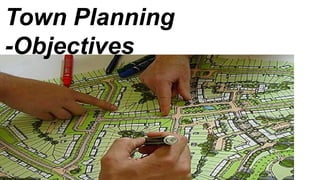
Town Planning
-Objectives
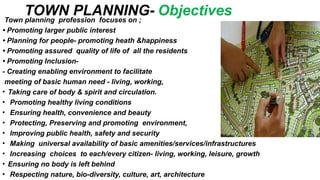
TOWN PLANNING- Objectives
Town planning profession focuses on ;
• Promoting larger public interest
• Planning for people- promoting heath &happiness
• Promoting assured quality of life of all the residents
• Promoting Inclusion-
- Creating enabling environment to facilitate
meeting of basic human need - living, working,
• Taking care of body & spirit and circulation.
• Promoting healthy living conditions
• Ensuring health, convenience and beauty
• Protecting, Preserving and promoting environment,
• Improving public health, safety and security
• Making universal availability of basic amenities/services/infrastructures
• Increasing choices to each/every citizen- living, working, leisure, growth
• Ensuring no body is left behind
• Respecting nature, bio-diversity, culture, art, architecture
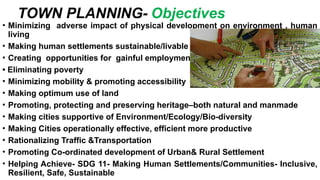
• Minimizing adverse impact of physical development on environment , human
living
• Making human settlements sustainable/livable
• Creating opportunities for gainful employment
• Eliminating poverty
• Minimizing mobility & promoting accessibility
• Making optimum use of land
• Promoting, protecting and preserving heritage–both natural and manmade
• Making cities supportive of Environment/Ecology/Bio-diversity
• Making Cities operationally effective, efficient more productive
• Rationalizing Traffic &Transportation
• Promoting Co-ordinated development of Urban& Rural Settlement
• Helping Achieve- SDG 11- Making Human Settlements/Communities- Inclusive,
Resilient, Safe, Sustainable
TOWN PLANNING- Objectives
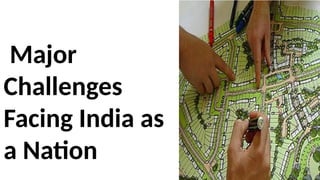
Major
Challenges
Facing India as
a Nation
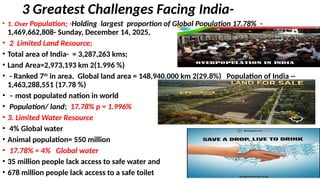
3 Greatest Challenges Facing India-
• 1. Over Population; -Holding largest proportion of Global Population 17.78% -
1,469,662,808- Sunday, December 14, 2025,
• 2 Limited Land Resource;
• Total area of India- = 3,287,263 kms;
• Land Area=2,973,193 km 2(1.996 %)
• - Ranked 7th
in area. Global land area = 148,940,000 km 2(29.8%) Population of India --
1,463,288,551 (17.78 %)
• – most populated nation in world
• Population/ land; 17.78% p = 1.996%
• 3. Limited Water Resource
• 4% Global water
• Animal population= 550 million
• 17.78% = 4% Global water
• 35 million people lack access to safe water and
• 678 million people lack access to a safe toilet
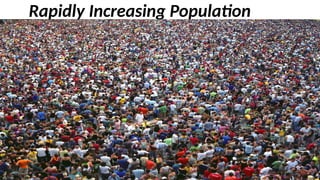
Rapidly Increasing Population
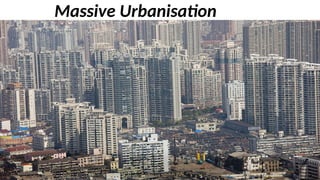
Massive Urbanisation
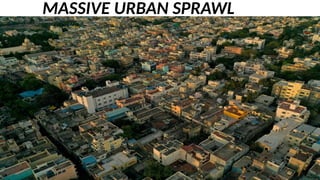
MASSIVE URBAN SPRAWL
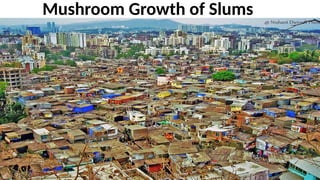
Mushroom Growth of Slums
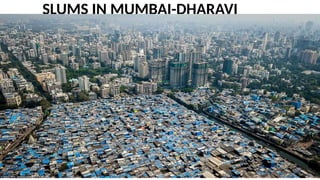
SLUMS IN MUMBAI-DHARAVI
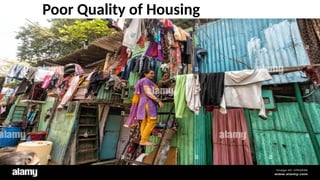
Poor Quality of Housing
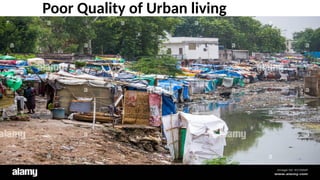
Poor Quality of Urban living
Factors causing Climate Change-
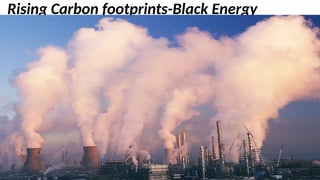
Rising Carbon footprints-Black Energy
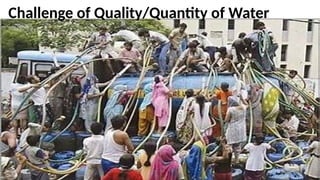
Challenge of Quality/Quantity of Water
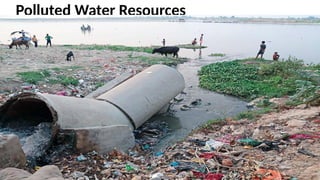
Polluted Water Resources
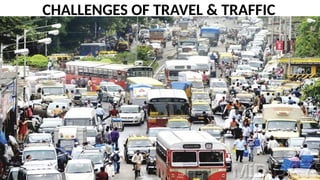
CHALLENGES OF TRAVEL & TRAFFIC
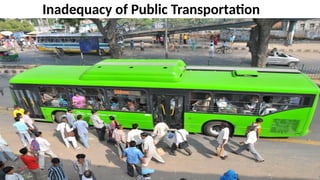
Inadequacy of Public Transportation
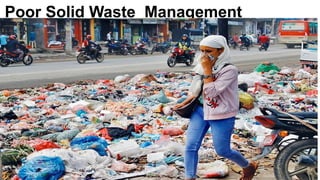
Poor Solid Waste Management
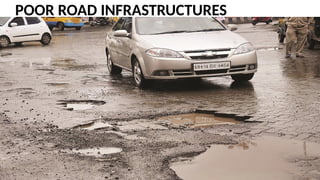
POOR ROAD INFRASTRUCTURES
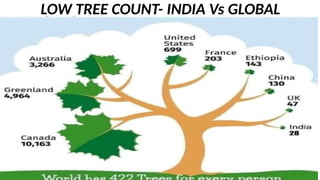
LOW TREE COUNT- INDIA Vs GLOBAL
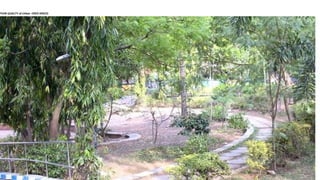
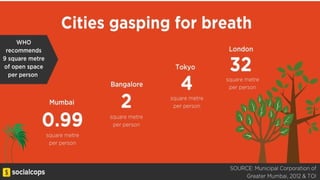
POOR QUALITY of-Urban OPEN SPACES
Open Spaces
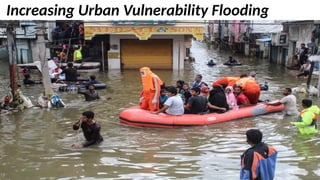
Increasing Urban Vulnerability Flooding
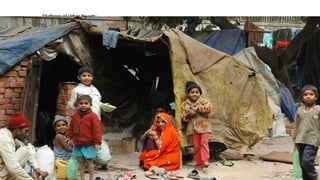
Challenge of Urban Poverty
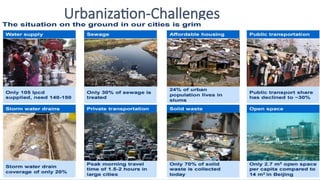
Urbanization-Challenges
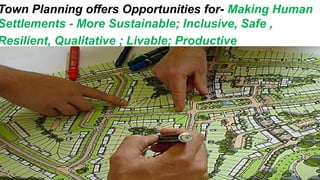
Town Planning offers Opportunities for- Making Human
Settlements - More Sustainable; Inclusive, Safe ,
Resilient, Qualitative ; Livable; Productive
TOWN PLANNING- Planning of human settlements
•
;Town planning involves/includes- Planning of Human Settlements based on;
• Carrying out detailed study of settlement- physical/ social
• Mapping historical perspective, growth/ development.
• Understanding basic fabric of the human settlements
• Identifying physical, demography; socio-economic features
• Mapping Specialized characteristics &past growth trends,
• Carrying out physical, social, economic, environmental studies of settlements
• Preparing land use mapping-planning areas, administrative boundaries, physical features,
• Mapping Morphology/topography, of built-up area, vacant areas, different land uses, slums,
• Identifying Industries, commercial nodes, institutions/institutional areas, parks/open spaces,
• Locating Amenities/facilities, protected/forest areas, road network, service network,
transportation nodes etc.
• Conducting Detailed Surveys/studies/analysis for-- ascertaining different activities – both in
quantity and quality.
• Identifying problems, issues, road-blocks in rational growth/development
• Carrying out SWOT analysis of human settlement,
TOWN PLANNING – Planning of Human settlements
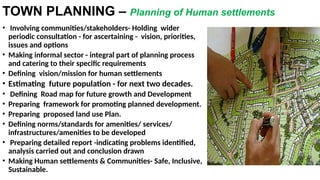
• Involving communities/stakeholders- Holding wider
periodic consultation - for ascertaining - vision, priorities,
issues and options
• Making informal sector - integral part of planning process
and catering to their specific requirements
• Defining vision/mission for human settlements
• Estimating future population - for next two decades.
• Defining Road map for future growth and Development
• Preparing framework for promoting planned development.
• Preparing proposed land use Plan.
• Defining norms/standards for amenities/ services/
infrastructures/amenities to be developed
• Preparing detailed report -indicating problems identified,
analysis carried out and conclusion drawn
• Making Human settlements & Communities- Safe, Inclusive,
Sustainable.
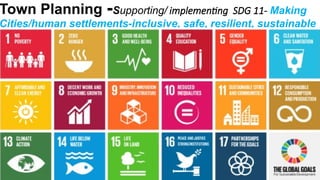
Town Planning -Supporting/ implementing SDG 11- Making
Cities/human settlements-inclusive, safe, resilient, sustainable
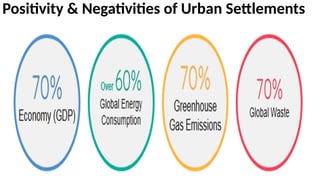
Positivity & Negativities of Urban Settlements
Need for Planned Development
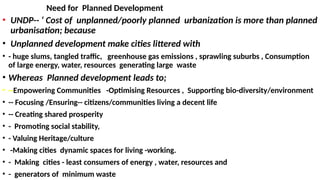
• UNDP-- ‘ Cost of unplanned/poorly planned urbanization is more than planned
urbanisation; because
• Unplanned development make cities littered with
• - huge slums, tangled traffic, greenhouse gas emissions , sprawl­
ing suburbs , Consumption
of large energy, water, resources generating large waste
• Whereas Planned development leads to;
• --Empowering Communities -Optimising Resources , Supporting bio-diversity/environment
• -- Focusing /Ensuring-- citi­
zens/communities living a decent life
• -- Creating shared prosperity
• - Promoting social stability,
• - Valuing Heritage/culture
• -Making cities dynamic spaces for living -working.
• - Making cities - least consumers of energy , water, resources and
• - generators of minimum waste
Need for Planned Development
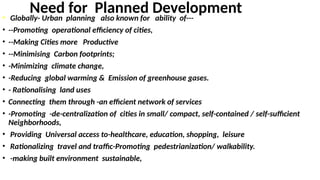
• Globally- Urban planning also known for ability of---
• --Promoting operational efficiency of cities,
• --Making Cities more Productive
• --Minimising Carbon footprints;
• -Minimizing climate change,
• -Reducing global warming & Emission of greenhouse gases.
• - Rationalising land uses
• Connecting them through -an efficient network of services
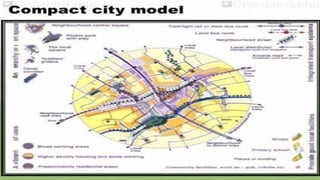
• -Promoting -de-centralization of cities in small/ compact, self-contained / self-sufficient
Neighborhoods,
• Providing Universal access to-healthcare, education, shopping, leisure
• Rationalizing travel and traffic-Promoting pedestrianization/ walkability.
• -making built environment sustainable,
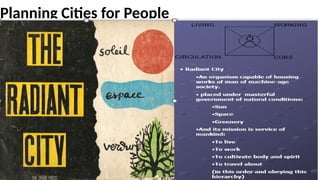
Planning Cities for People
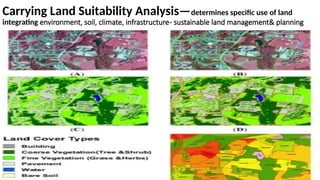
Carrying Land Suitability Analysis—determines specific use of land
integrating environment, soil, climate, infrastructure- sustainable land management& planning
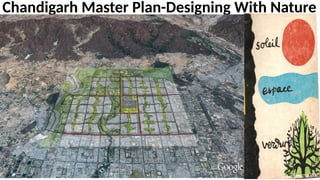
Chandigarh Master Plan-Designing With Nature
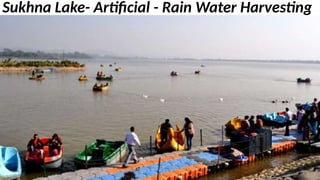
Sukhna Lake- Artificial - Rain Water Harvesting
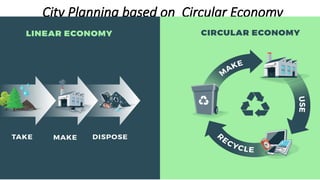
City Planning based on Circular Economy
TOWN PLANNING-Context –Land
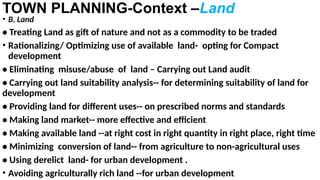
• B. Land
• Treating Land as gift of nature and not as a commodity to be traded
• Rationalizing/ Optimizing use of available land- opting for Compact
development
• Eliminating misuse/abuse of land – Carrying out Land audit
• Carrying out land suitability analysis-- for determining suitability of land for
development
• Providing land for different uses-- on prescribed norms and standards
• Making land market-- more effective and efficient
• Making available land --at right cost in right quantity in right place, right time
• Minimizing conversion of land-- from agriculture to non-agricultural uses
• Using derelict land- for urban development .
• Avoiding agriculturally rich land --for urban development
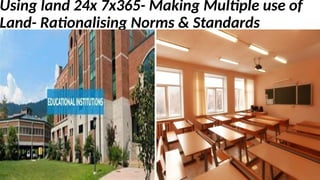
Using land 24x 7x365- Making Multiple use of
Land- Rationalising Norms & Standards
TOWN PLANNING- Traffic and Transportation
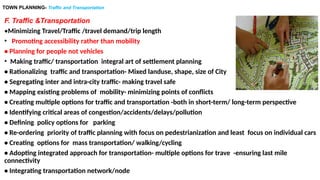
F. Traffic &Transportation
•Minimizing Travel/Traffic /travel demand/trip length
• Promoting accessibility rather than mobility
• Planning for people not vehicles
• Making traffic/ transportation integral art of settlement planning
• Rationalizing traffic and transportation- Mixed landuse, shape, size of City
• Segregating inter and intra-city traffic- making travel safe
• Mapping existing problems of mobility- minimizing points of conflicts
• Creating multiple options for traffic and transportation -both in short-term/ long-term perspective
• Identifying critical areas of congestion/accidents/delays/pollution
• Defining policy options for parking
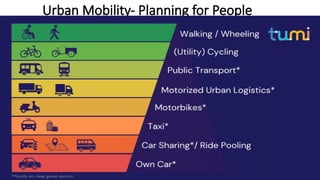
• Re-ordering priority of traffic planning with focus on pedestrianization and least focus on individual cars
• Creating options for mass transportation/ walking/cycling
• Adopting integrated approach for transportation- multiple options for trave -ensuring last mile
connectivity
• Integrating transportation network/node
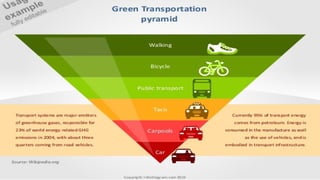
Defining Sustainable Transport
• Sustainable Transport --
• -- sometimes known as Green Transport
• -- form of transport that does not use / rely on dwindling
natural resources.
• -- relies on renewable /regenerated energy
• -- rather than fossil fuels that have a finite life expectancy
Urban Mobility- Planning for People
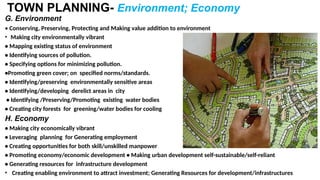
TOWN PLANNING- Environment; Economy
G. Environment
• Conserving, Preserving, Protecting and Making value addition to environment
• Making city environmentally vibrant
• Mapping existing status of environment
• Identifying sources of pollution.
• Specifying options for minimizing pollution.
•Promoting green cover; on specified norms/standards.
• Identifying/preserving environmentally sensitive areas
• Identifying/developing derelict areas in city
• Identifying /Preserving/Promoting existing water bodies
• Creating city forests for greening/water bodies for cooling
H. Economy
• Making city economically vibrant
• Leveraging planning for Generating employment
• Creating opportunities for both skill/unskilled manpower
• Promoting economy/economic development • Making urban development self-sustainable/self-reliant
• Generating resources for infrastructure development
• Creating enabling environment to attract investment; Generating Resources for development/infrastructures
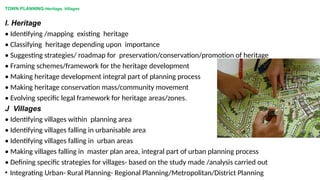
TOWN PLANNING-Heritage, Villages
I. Heritage
• Identifying /mapping existing heritage
• Classifying heritage depending upon importance
• Suggesting strategies/ roadmap for preservation/conservation/promotion of heritage
• Framing schemes/framework for the heritage development
• Making heritage development integral part of planning process
• Making heritage conservation mass/community movement
• Evolving specific legal framework for heritage areas/zones.
J Villages
• Identifying villages within planning area
• Identifying villages falling in urbanisable area
• Identifying villages falling in urban areas
• Making villages falling in master plan area, integral part of urban planning process
• Defining specific strategies for villages- based on the study made /analysis carried out
• Integrating Urban- Rural Planning- Regional Planning/Metropolitan/District Planning
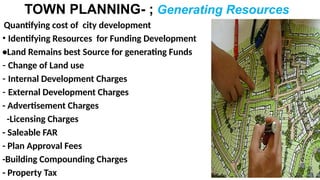
TOWN PLANNING- ; Generating Resources
Quantifying cost of city development
• Identifying Resources for Funding Development
•Land Remains best Source for generating Funds
- Change of Land use
- Internal Development Charges
- External Development Charges
- Advertisement Charges
-Licensing Charges
- Saleable FAR
- Plan Approval Fees
-Building Compounding Charges
- Property Tax
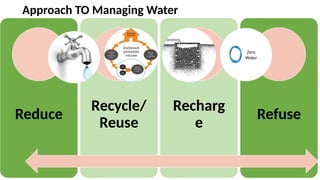
Approach TO Managing Water
Reduce
Recycle/
Reuse
Recharg
e
Refuse
Zero
Water
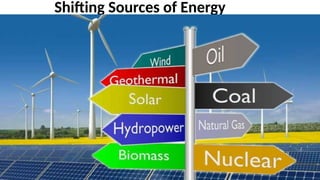
Shifting Sources of Energy
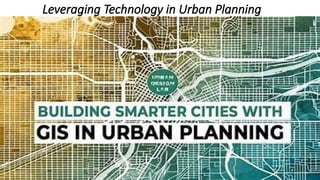
Leveraging Technology in Urban Planning
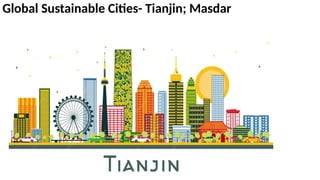
Global Sustainable Cities- Tianjin; Masdar
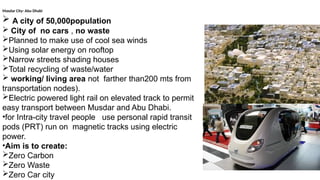
Masdar City- Abu Dhabi
 A city of 50,000population
 City of no cars , no waste
Planned to make use of cool sea winds
Using solar energy on rooftop
Narrow streets shading houses
Total recycling of waste/water
 working/ living area not farther than200 mts from
transportation nodes).
Electric powered light rail on elevated track to permit
easy transport between Musdar and Abu Dhabi.
•for Intra-city travel people use personal rapid transit
pods (PRT) run on magnetic tracks using electric
power.
•Aim is to create:
Zero Carbon
Zero Waste
Zero Car city
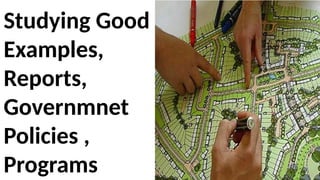
Studying Good
Examples,
Reports,
Governmnet
Policies ,
Programs
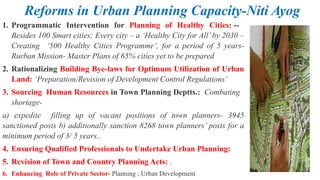
Reforms in Urban Planning Capacity-Niti Ayog
1. Programmatic Intervention for Planning of Healthy Cities: --
Besides 100 Smart cities; Every city – a ‘Healthy City for All’ by 2030 –
Creating ‘500 Healthy Cities Programme’, for a period of 5 years-
Rurban Mission- Master Plans of 65% cities yet to be prepared
2. Rationalizing Building Bye-laws for Optimum Utilization of Urban
Land: ‘Preparation/Revision of Development Control Regulations’
3. Sourcing Human Resources in Town Planning Deptts.: Combating
shortage-
a) expedite filling up of vacant positions of town planners- 3945
sanctioned posts b) additionally sanction 8268 town planners’ posts for a
minimum period of 3/ 5 years..
4. Ensuring Qualified Professionals to Undertake Urban Planning:
5. Revision of Town and Country Planning Acts: .
6. Enhancing Role of Private Sector- Planning ; Urban Development
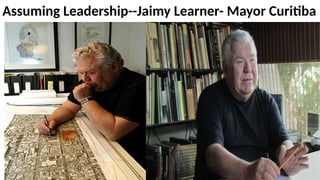
Assuming Leadership--Jaimy Learner- Mayor Curitiba
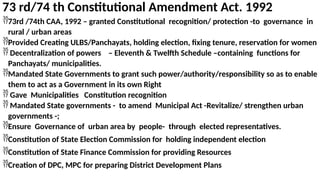
73 rd/74 th Constitutional Amendment Act. 1992
73rd /74th CAA, 1992 – granted Constitutional recognition/ protection -to governance in
rural / urban areas
Provided Creating ULBS/Panchayats, holding election, fixing tenure, reservation for women
 Decentralization of powers – Eleventh & Twelfth Schedule –containing functions for
Panchayats/ municipalities.
Mandated State Governments to grant such power/authority/responsibility so as to enable
them to act as a Government in its own Right
 Gave Municipalities Constitution recognition
 Mandated State governments - to amend Municipal Act -Revitalize/ strengthen urban
governments -;
Ensure Governance of urban area by people- through elected representatives.
Constitution of State Election Commission for holding independent election
Constitution of State Finance Commission for providing Resources
Creation of DPC, MPC for preparing District Development Plans
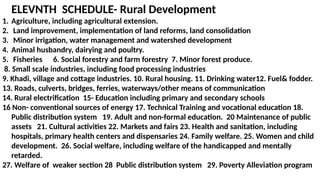
ELEVNTH SCHEDULE- Rural Development
1. Agriculture, including agricultural extension.
2. Land improvement, implementation of land reforms, land consolidation
3. Minor irrigation, water management and watershed development
4. Animal husbandry, dairying and poultry.
5. Fisheries 6. Social forestry and farm forestry 7. Minor forest produce.
8. Small scale industries, including food processing industries
9. Khadi, village and cottage industries. 10. Rural housing. 11. Drinking water12. Fuel& fodder.
13. Roads, culverts, bridges, ferries, waterways/other means of communication
14. Rural electrification 15- Education including primary and secondary schools
16 Non- conventional sources of energy 17. Technical Training and vocational education 18.
Public distribution system 19. Adult and non-formal education. 20 Maintenance of public
assets 21. Cultural activities 22. Markets and fairs 23. Health and sanitation, including
hospitals, primary health centers and dispensaries 24. Family welfare. 25. Women and child
development. 26. Social welfare, including welfare of the handicapped and mentally
retarded.
27. Welfare of weaker section 28 Public distribution system 29. Poverty Alleviation program
74 th CAA- Functions- 12th
Schedule
"1. Urban planning including town planning.
2. Regulation of land-use ,construction of buildings.
• 3. Planning for economic and social development. 4. Roads and bridges.
• 5. Water supply for domestic, industrial and commercial purposes.
• 6. Public health, sanitation conservancy and solid waste management. 7. Fire services.
• 8. Urban forestry, protection of environment /promotion of ecological aspects.
• 9. Safeguarding the interests of weaker sections of society, including the handicapped and
mentally retarded.10. Slum improvement and up-gradation. 11. Urban poverty alleviation.
• 12. Providing urban amenities /facilities parks, gardens, playgrounds.
• 13. Promotion of cultural, educational and aesthetic aspects.
• 14. Burials /burial grounds; cremations, cremation grounds/electric crematoriums.15. Cattle
pounds; prevention of cruelty to animals. 16. Vital statistics including registration of births
and deaths.
• 17. Public amenities including street lighting, parking lots, bus stops / public conveniences.
18. Regulation of slaughter houses and tanneries
Urban Mission-Launched By MOHUA- GOI
• Smart City Mission
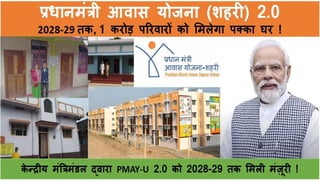
• Pradhan Mantri Awaas Yojna- Urban-
PMAY-U
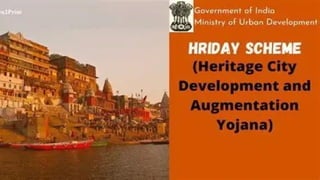
• Heritage City Development and
Augmentation Yojna- HRIDAY
• Swatch Bharat Yojna- SBY
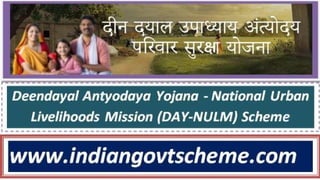
• Deen Dayal Anto-Uday-- National Urban
Livelihood Mission- DAY- NULM
• Atal Mission for Urban Re- Juvenation -
AMRUT
• Jawahar Lal Nehru Urban Renewal Mission
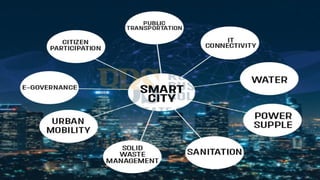
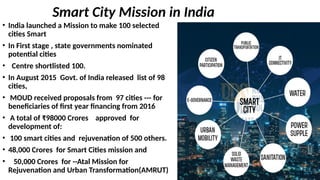
Smart City Mission in India
• India launched a Mission to make 100 selected
cities Smart
• In First stage , state governments nominated
potential cities
• Centre shortlisted 100.
• In August 2015 Govt. of India released list of 98
cities,
• MOUD received proposals from 97 cities --- for
beneficiaries of first year financing from 2016
• A total of ₹98000 Crores approved for
development of:
• 100 smart cities and rejuvenation of 500 others.
• 48,000 Crores for Smart Cities mission and
• 50,000 Crores for --Atal Mission for
Rejuvenation and Urban Transformation(AMRUT)
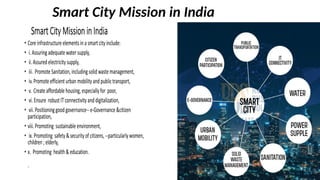
Smart City Mission in India
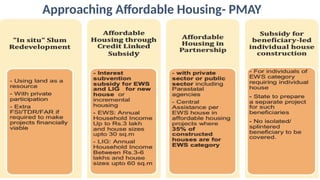
Approaching Affordable Housing- PMAY
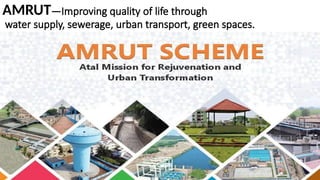
AMRUT—Improving quality of life through
water supply, sewerage, urban transport, green spaces.
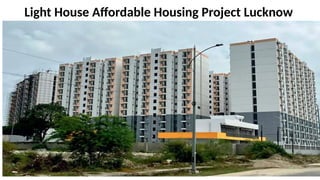
Light House Affordable Housing Project Lucknow
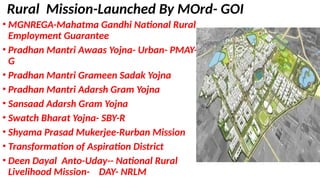
Rural Mission-Launched By MOrd- GOI
• MGNREGA-Mahatma Gandhi National Rural
Employment Guarantee
• Pradhan Mantri Awaas Yojna- Urban- PMAY-
G
• Pradhan Mantri Grameen Sadak Yojna
• Pradhan Mantri Adarsh Gram Yojna
• Sansaad Adarsh Gram Yojna
• Swatch Bharat Yojna- SBY-R
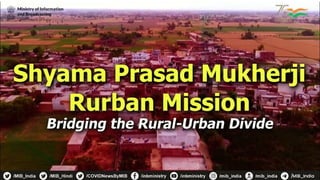
• Shyama Prasad Mukerjee-Rurban Mission
• Transformation of Aspiration District
• Deen Dayal Anto-Uday-- National Rural
Livelihood Mission- DAY- NRLM
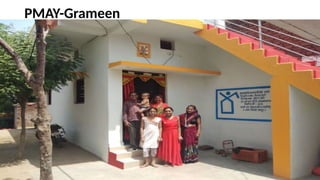
PMAY-Grameen
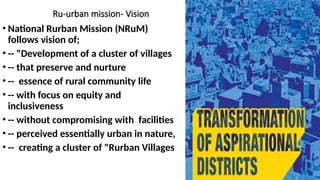
Ru-urban mission- Vision
• National Rurban Mission (NRuM)
follows vision of;
• -- "Development of a cluster of villages
• -- that preserve and nurture
• -- essence of rural community life
• -- with focus on equity and
inclusiveness
• -- without compromising with facilities
• -- perceived essentially urban in nature,
• -- creating a cluster of "Rurban Villages
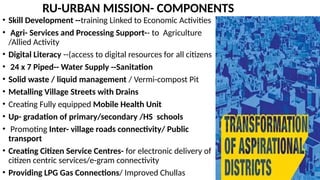
RU-URBAN MISSION- COMPONENTS
• Skill Development --training Linked to Economic Activities
• Agri- Services and Processing Support-- to Agriculture
/Allied Activity
• Digital Literacy --(access to digital resources for all citizens
• 24 x 7 Piped-- Water Supply --Sanitation
• Solid waste / liquid management / Vermi-compost Pit
• Metalling Village Streets with Drains
• Creating Fully equipped Mobile Health Unit
• Up- gradation of primary/secondary /HS schools
• Promoting Inter- village roads connectivity/ Public
transport
• Creating Citizen Service Centres- for electronic delivery of
citizen centric services/e-gram connectivity
• Providing LPG Gas Connections/ Improved Chullas
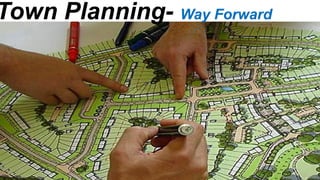
Town Planning- Way Forward
TOWN PLANNING- Opportunities
• Town Planning-as a profession- offers unlimited scope – in employment/
• Town Planning- only profession - looking at integrated physical, socio-economic
planned growth , development of human settlements.
• Role of Government agencies getting enlarged due to rapid urbanization-
• More cities & more development Authorities will require large manpower
trained in art and science of Town planning
• ULBs will need support of town planning professionals
• Development authorities/Improvement Trusts/Housing Board/Industrial
Development Corporations ; need wisdom of town planners for growth &
development
• Missions launched by GOI- PMAY, AMTUT, NuLM, Ru-Uban Miss Smart Cities
Mission, invariably need services of town planners for achieving desired goals
• Preparation/Revision of Regional Plans/Master Plans/Development plans need
services/expertise of planning profession- only 40% cities covered under Master
plans
• Professional Planners –can also work as trainers in capacity building for
Stakeholders, officials, elected representatives
TOWN PLANNING- Looking Forward
• All state training institutes- STI- includes/involve town planners as faculty
• RERA- offers options for being appointed as Members and staff positions
• Private sector/ Real estate companies --offers enormous opportunities of
employment and placement- due to large involvement in real estate sector
• Leading multinationals/national agencies engaged in planning, designing
and managing human settlements invariably need services of planners
• Growing field of Planning education- is increasing employment
opportunities in large number of planning schools opening in the country
• Undertaking Revision of legal framework/building bye-laws, development
controls- require services of urban planners
• Niti Ayog Report on - Reforms in Urban Planning Capacity buildings in
India- has already highlighted the growing shortage of professional
planners in the country- recommended filling of 3945 existing sanctioned
posts besides creating additional 8268 posts of town planners for a
minimum period of 3/ 5 years.- making in all 12213 posts
• Involving/focusing Town planning in Rural Planning –