Risks and Alternatives for Buying Gmail Accounts: PVA, Aged, Bulk Explained
Explore the risks of purchasing Gmail accounts and learn safer alternatives like legitimate account creation, business email systems, custom domains, and email aliases for secure and compliant email management.
Risks and Alternatives for Buying Gmail Accounts: PVA, Aged, Bulk Explained
1.
Top Sites toBuy Gmail Accounts (PVA,
Aged, Bulk Options)
The market for pre-existing email accounts is filled with terminology that can make questionable
services sound deceptively conventional. “PVA,” “aged,” “verified,” “bulk,” and “ready-to-use” are
common descriptors in listings for accounts that have already been created and configured.
▣If you want to more information just contact now-
➥24 Hours Reply/Contact
✅Telegram: @SmmTopPva
✅WhatsApp: +1 (334)549-5583
website :smmtoppva.com/product/buy-Old- Gmail-accounts/
▰▰▰▰▰▰▰▰▰▰▰▰▰▰▰▰▰▰▰▰▰▰▰▰▰▰▰
Yet purchasing batches of pre-existing Gmail accounts presents substantial security, ownership,
and platform-compliance concerns.
Gmail's current Terms of Service generally state that Gmail accounts are non-transferable. The
terms also place responsibility for activity conducted through an account on the account holder
and require users to safeguard account credentials. (legal.Gmail.com)
Accordingly, a responsible guide to Top Sites to Buy Gmail Accounts (PVA, Aged, Bulk
Options) should not present anonymous account vendors as trustworthy purchasing
recommendations. A polished marketplace, positive testimonials, or a “replacement guarantee”
does not establish that the seller has legitimate authority to transfer an account, that previous
recovery mechanisms have been removed, or that bulk accounts can legitimately be used for
the purchaser's intended purpose.
2.
A safer approachis to understand what these account categories mean, why they attract
buyers, what risks they entail, and which legitimate alternatives can provide the same
underlying functionality.
What Does PVA Mean?
PVA commonly stands for “phone-verified account.”
In marketplace terminology, a PVA account is generally advertised as having undergone phone-
number verification during registration or setup. Sellers may portray this as evidence that the
account is more trustworthy than an unverified account.
That inference is unreliable.
Phone verification establishes, at most, that a particular verification process occurred. It does
not prove that the account can legitimately be transferred to another person, that the original
registrant has relinquished every recovery mechanism, or that the account will remain in good
standing.
Verification is an authentication event, not a certificate of ownership.
This distinction becomes particularly important when an account is being sold in bulk.
What Is an Aged Gmail Account?
An aged account is generally an account that has existed for a comparatively long period.
Marketplace descriptions might advertise accounts that are months or years old and suggest
that their age makes them more valuable.
But chronological age is only one attribute.
An old account could have an unknown history, outdated recovery information, compromised
credentials, suspicious activity, or associations that the purchaser cannot independently
investigate.
A newly created account under legitimate ownership can therefore have a considerably cleaner
security posture than an old account acquired from an unknown intermediary.
Age should never be treated as synonymous with trust.
Why Do People Search for Bulk Accounts?
Bulk-account searches often arise from legitimate business requirements being conflated with
account acquisition.
For example, an organization may need multiple mailboxes for employees, customer service,
testing, administration, or separate business functions.
3.
The correct solutionis generally an organizational email system that allows authorized
administrators to create and manage mailboxes.
Purchasing a large collection of unrelated consumer accounts creates the opposite structure.
Instead of centralized control, there are numerous independent credentials. Instead of
standardized recovery, there may be dozens of unrelated recovery mechanisms. Instead of
clear ownership, there may be an opaque history involving unknown registrants.
More accounts do not necessarily mean more infrastructure.
Sometimes they mean more liabilities.
The Major Risks of Purchased Gmail
Accounts
1. Ownership Uncertainty
The first question should always be: who has the legitimate right to control the account?
A seller may possess a working password without possessing legitimate authority to transfer the
account.
That distinction is easy to overlook because a functional login creates an illusion of ownership.
A working key is not proof that the person holding it owns the building.
2. Recovery by a Previous User
An account may retain recovery information or historical authentication pathways associated
with its original user.
Even if a seller claims to have changed the password, future authentication challenges can
expose unresolved recovery dependencies.
Gmail provides recovery mechanisms specifically designed to help legitimate users regain
access to their accounts. (help.Gmail.com)
This creates an obvious complication for purchased accounts.
If the original user can recover the account, the purchaser's apparent control may be temporary.
3. Credential Exposure
4.
Bulk accounts mayhave passed through multiple people or automated systems before reaching
a buyer.
The purchaser may have no reliable way to determine how many parties have previously
possessed the credentials.
That makes confidentiality difficult to establish.
A password that has circulated through an unknown chain of custody should not automatically
be considered secure merely because it works.
4. Suspicious Historical Activity
An aged account may have been used for activities unrelated to its current purchaser.
The new user inherits the account's history whether they understand it or not.
This is one reason marketplace claims such as “clean history” should be treated cautiously. An
outside buyer usually has limited ability to verify the completeness of such a claim.
5. Security Challenges
Gmail can request additional verification when circumstances appear unusual.
Gmail's security guidance notes that unfamiliar devices, browsers, locations, VPNs, proxies, and
suspicious activity can contribute to additional verification requirements. (help.Gmail.com)
Consequently, an account advertised as “aged” or “trusted” is not guaranteed to remain
frictionless after changing hands.
A dramatic change in usage can itself become anomalous.
6. Platform-Policy Problems
Even if credentials function technically, the transaction may still conflict with the service's rules.
Gmail's current Terms of Service generally make accounts non-transferable. (legal.Gmail.com)
This is a fundamental consideration rather than a minor technical footnote.
7. Financial Fraud
The account market can also attract fraudulent sellers.
A vendor may accept payment and deliver nothing. Another may deliver credentials that fail
shortly afterward. A third may use the transaction to harvest additional credentials or payment
information.
5.
A professional-looking storefrontdoes not eliminate these possibilities.
8. Privacy Exposure
An email account can contain sensitive communications, contact lists, recovery information, and
references to other online services.
Buying an account means entering an environment whose previous privacy history may be
unknowable.
That is a significant concern.
Why 2FA Does Not Solve the Ownership
Problem
Two-factor authentication is an excellent security mechanism when properly configured by the
legitimate account holder.
It does not, however, establish that an account can be sold.
Suppose a seller advertises a Gmail account as “2FA enabled.” The buyer receives the
password and is told that the second factor is included.
Several questions immediately arise:
● Who controls the authentication device?
● Who controls the recovery phone?
● Is an authenticator application still registered elsewhere?
● Can the original user initiate account recovery?
● Were previous devices removed?
● Was the 2FA configuration legitimately established?
Gmail documents two-step verification and multiple authentication methods for account security.
(help.Gmail.com)
The security feature itself is not the problem.
The provenance of the account is.
Safer Alternative: Create Gmail Accounts
Legitimately
If the goal is to obtain Gmail Mail addresses, direct account creation is considerably more
straightforward.
6.
The legitimate userestablishes:
1. The account identity.
2. The password.
3. The recovery information.
4. The authentication methods.
5. The intended usage.
There is no previous owner to investigate.
There is no seller to trust.
There is no ambiguous transfer.
For ordinary personal email requirements, this is generally the cleanest model.
Safer Alternative: Use Business Email
Infrastructure
Organizations requiring multiple mailboxes should consider managed business email rather
than buying bulk consumer accounts.
A business email environment can provide:
● centralized administration;
● standardized security policies;
● controlled user provisioning;
● account recovery;
● employee lifecycle management;
● domain ownership;
● authentication configuration; and
● organizational continuity.
This architecture is particularly useful when dozens of addresses are required.
Instead of accumulating unrelated credentials, an organization creates a coherent system.
That is a much more defensible form of scalability.
Safer Alternative: Use a Custom Domain
A custom domain can solve the professional-identity problem that often motivates aged-account
purchases.
A company can establish addresses for:
7.
● sales;
● support;
●billing;
● administration;
● individual employees; and
● general inquiries.
The domain remains under organizational control.
If an employee leaves, the organization can manage the mailbox appropriately. If a vendor
disappears, the company does not lose its identity.
The difference is architectural rather than cosmetic.
Safer Alternative: Use Email Aliases
Not every use case requires dozens of independent inboxes.
Aliases can sometimes provide multiple addresses that route messages to an existing mailbox,
depending on the email provider and intended workflow.
This can be useful when an organization needs distinct addresses for departments, campaigns,
support functions, or public-facing contact points without creating an entirely separate account
for every address.
It reduces credential sprawl.
That alone can improve manageability.
Safer Alternative: Use Legitimate Testing
Infrastructure
Software developers and organizations sometimes need many email identities for testing.
That requirement should be solved with a controlled test environment rather than purchasing
arbitrary real-world accounts.
Test mailboxes, local mail systems, sandbox environments, and purpose-built testing services
can provide predictable addresses without introducing unknown account histories.
The advantage is reproducibility.
A test environment should behave according to known parameters rather than the mysterious
history of an account acquired from a marketplace.
8.
Safer Alternative: UseTransactional Email
Services
If the actual requirement is to send automated email, purchasing consumer accounts is usually
the wrong abstraction.
Transactional email services are designed for application-generated messages such as:
● password resets;
● account notifications;
● receipts;
● confirmations;
● alerts; and
● system messages.
They can provide appropriate sending infrastructure, authentication controls, monitoring, and
administrative tools.
The goal should be legitimate message delivery rather than disguising automated activity
behind a collection of unrelated consumer accounts.
Safer Alternative: Use Email-Marketing
Platforms
Organizations running newsletters or marketing campaigns should use systems designed for
those purposes.
Legitimate email-marketing platforms can provide subscriber management, consent workflows,
campaign tools, unsubscribe mechanisms, analytics, and sender authentication.
This is substantially safer than attempting to distribute marketing activity across purchased
consumer accounts.
A reputable sender identity is built through responsible practices.
It cannot simply be purchased as an account-age attribute.
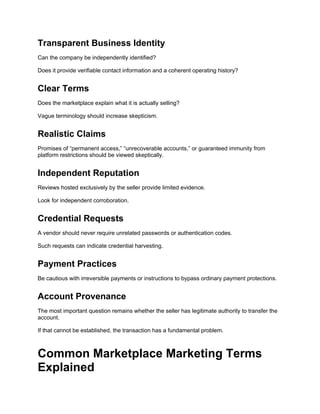
How to Evaluate an Account Marketplace
Without Buying
If researching an account vendor for analytical purposes, several indicators deserve attention.
9.
Transparent Business Identity
Canthe company be independently identified?
Does it provide verifiable contact information and a coherent operating history?
Clear Terms
Does the marketplace explain what it is actually selling?
Vague terminology should increase skepticism.
Realistic Claims
Promises of “permanent access,” “unrecoverable accounts,” or guaranteed immunity from
platform restrictions should be viewed skeptically.
Independent Reputation
Reviews hosted exclusively by the seller provide limited evidence.
Look for independent corroboration.
Credential Requests
A vendor should never require unrelated passwords or authentication codes.
Such requests can indicate credential harvesting.
Payment Practices
Be cautious with irreversible payments or instructions to bypass ordinary payment protections.
Account Provenance
The most important question remains whether the seller has legitimate authority to transfer the
account.
If that cannot be established, the transaction has a fundamental problem.
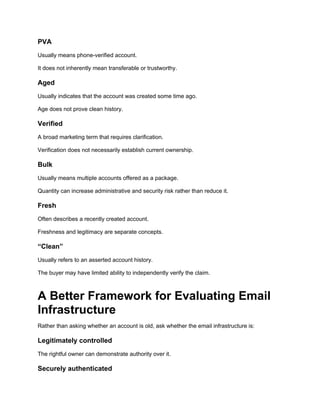
Common Marketplace Marketing Terms
Explained
10.
PVA
Usually means phone-verifiedaccount.
It does not inherently mean transferable or trustworthy.
Aged
Usually indicates that the account was created some time ago.
Age does not prove clean history.
Verified
A broad marketing term that requires clarification.
Verification does not necessarily establish current ownership.
Bulk
Usually means multiple accounts offered as a package.
Quantity can increase administrative and security risk rather than reduce it.
Fresh
Often describes a recently created account.
Freshness and legitimacy are separate concepts.
“Clean”
Usually refers to an asserted account history.
The buyer may have limited ability to independently verify the claim.
A Better Framework for Evaluating Email
Infrastructure
Rather than asking whether an account is old, ask whether the email infrastructure is:
Legitimately controlled
The rightful owner can demonstrate authority over it.
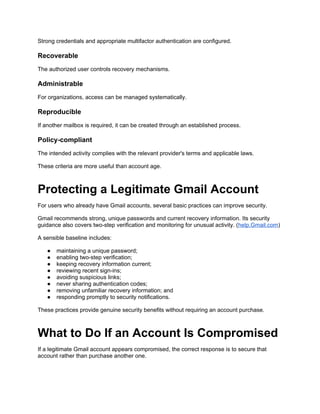
Securely authenticated
11.
Strong credentials andappropriate multifactor authentication are configured.
Recoverable
The authorized user controls recovery mechanisms.
Administrable
For organizations, access can be managed systematically.
Reproducible
If another mailbox is required, it can be created through an established process.
Policy-compliant
The intended activity complies with the relevant provider's terms and applicable laws.
These criteria are more useful than account age.
Protecting a Legitimate Gmail Account
For users who already have Gmail accounts, several basic practices can improve security.
Gmail recommends strong, unique passwords and current recovery information. Its security
guidance also covers two-step verification and monitoring for unusual activity. (help.Gmail.com)
A sensible baseline includes:
● maintaining a unique password;
● enabling two-step verification;
● keeping recovery information current;
● reviewing recent sign-ins;
● avoiding suspicious links;
● never sharing authentication codes;
● removing unfamiliar recovery information; and
● responding promptly to security notifications.
These practices provide genuine security benefits without requiring an account purchase.
What to Do If an Account Is Compromised
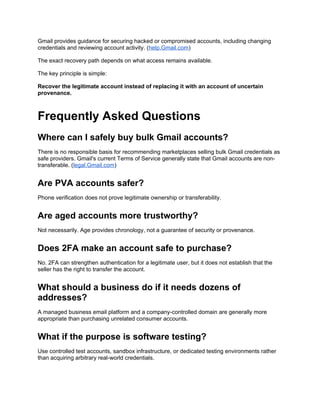
If a legitimate Gmail account appears compromised, the correct response is to secure that
account rather than purchase another one.
12.
Gmail provides guidancefor securing hacked or compromised accounts, including changing
credentials and reviewing account activity. (help.Gmail.com)
The exact recovery path depends on what access remains available.
The key principle is simple:
Recover the legitimate account instead of replacing it with an account of uncertain
provenance.
Frequently Asked Questions
Where can I safely buy bulk Gmail accounts?
There is no responsible basis for recommending marketplaces selling bulk Gmail credentials as
safe providers. Gmail's current Terms of Service generally state that Gmail accounts are non-
transferable. (legal.Gmail.com)
Are PVA accounts safer?
Phone verification does not prove legitimate ownership or transferability.
Are aged accounts more trustworthy?
Not necessarily. Age provides chronology, not a guarantee of security or provenance.
Does 2FA make an account safe to purchase?
No. 2FA can strengthen authentication for a legitimate user, but it does not establish that the
seller has the right to transfer the account.
What should a business do if it needs dozens of
addresses?
A managed business email platform and a company-controlled domain are generally more
appropriate than purchasing unrelated consumer accounts.
What if the purpose is software testing?
Use controlled test accounts, sandbox infrastructure, or dedicated testing environments rather
than acquiring arbitrary real-world credentials.
13.
What if thepurpose is automated email?
Use legitimate transactional or marketing email infrastructure designed for that function.
Final Takeaway
The phrase Top Sites to Buy Gmail Accounts (PVA, Aged, Bulk Options) suggests that the
challenge is finding a reputable marketplace.
The more fundamental issue is whether purchasing pre-existing Gmail credentials is an
appropriate way to obtain email infrastructure at all.
Gmail's current Terms of Service generally prohibit transferring accounts, while its security
documentation emphasizes legitimate account control, secure recovery information, strong
authentication, and protection against unauthorized access. (legal.Gmail.com)
For personal email, legitimate account creation is the cleaner route.
For businesses, managed email and custom domains provide stronger continuity.
For testing, controlled test environments are more reproducible.
For automated communication, transactional and marketing platforms are purpose-built for the
task.
And for security, 2FA, unique credentials, recovery controls, and activity monitoring matter far
more than an account's advertised age.
An aged credential may look like a shortcut.
A legitimate email system is infrastructure.