Retrieval-Augmented
Generation: Powering AI with
Real-World Knowledge
How RAG bridges the gap between static language models and the ever-evolving
complexity of real-world enterprise knowledge.
The Problem: The Static Knowledge
Gap
Large Language Models are trained on fixed datasets with a hard knowledge cut-off. Once
deployed, they have no awareness of new events, updated regulations, or proprietary enterprise
data — making them prone to hallucinations and factual obsolescence.
Hallucinations
Models confidently generate plausible-sounding but factually incorrect or
unverifiable answers, undermining user trust.
Factual Drift
In fast-moving fields like law, finance, and medicine, stale training data quickly
becomes a liability rather than an asset.
Private Data Blindspot
Proprietary enterprise knowledge — internal reports, contracts, policy documents
— is entirely invisible to a general-purpose LLM.
RAG Defined: The Bridge to Accuracy
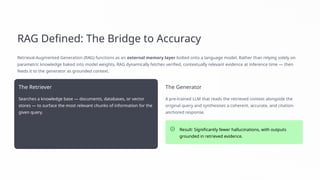
Retrieval-Augmented Generation (RAG) functions as an external memory layer bolted onto a language model. Rather than relying solely on
parametric knowledge baked into model weights, RAG dynamically fetches verified, contextually relevant evidence at inference time — then
feeds it to the generator as grounded context.
The Retriever
Searches a knowledge base — documents, databases, or vector
stores — to surface the most relevant chunks of information for the
given query.
The Generator
A pre-trained LLM that reads the retrieved context alongside the
original query and synthesises a coherent, accurate, and citation-
anchored response.
Result: Significantly fewer hallucinations, with outputs
grounded in retrieved evidence.
The RAG Pipeline: From Raw Data to Intelligence
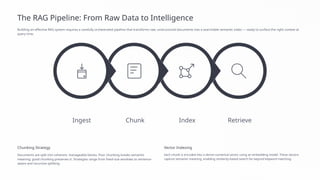
Building an effective RAG system requires a carefully orchestrated pipeline that transforms raw, unstructured documents into a searchable semantic index — ready to surface the right context at
query time.
Retrieve
Index
Chunk
Ingest
Chunking Strategy
Documents are split into coherent, manageable blocks. Poor chunking breaks semantic
meaning; good chunking preserves it. Strategies range from fixed-size windows to sentence-
aware and recursive splitting.
Vector Indexing
Each chunk is encoded into a dense numerical vector using an embedding model. These vectors
capture semantic meaning, enabling similarity-based search far beyond keyword matching.
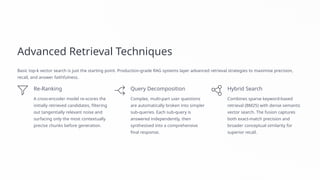
Advanced Retrieval Techniques
Basic top-k vector search is just the starting point. Production-grade RAG systems layer advanced retrieval strategies to maximise precision,
recall, and answer faithfulness.
Re-Ranking
A cross-encoder model re-scores the
initially retrieved candidates, filtering
out tangentially relevant noise and
surfacing only the most contextually
precise chunks before generation.
Query Decomposition
Complex, multi-part user questions
are automatically broken into simpler
sub-queries. Each sub-query is
answered independently, then
synthesised into a comprehensive
final response.
Hybrid Search
Combines sparse keyword-based
retrieval (BM25) with dense semantic
vector search. The fusion captures
both exact-match precision and
broader conceptual similarity for
superior recall.
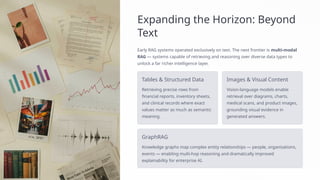
Expanding the Horizon: Beyond
Text
Early RAG systems operated exclusively on text. The next frontier is multi-modal
RAG — systems capable of retrieving and reasoning over diverse data types to
unlock a far richer intelligence layer.
Tables & Structured Data
Retrieving precise rows from
financial reports, inventory sheets,
and clinical records where exact
values matter as much as semantic
meaning.
Images & Visual Content
Vision-language models enable
retrieval over diagrams, charts,
medical scans, and product images,
grounding visual evidence in
generated answers.
GraphRAG
Knowledge graphs map complex entity relationships — people, organisations,
events — enabling multi-hop reasoning and dramatically improved
explainability for enterprise AI.
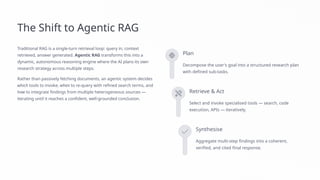
The Shift to Agentic RAG
Traditional RAG is a single-turn retrieval loop: query in, context
retrieved, answer generated. Agentic RAG transforms this into a
dynamic, autonomous reasoning engine where the AI plans its own
research strategy across multiple steps.
Rather than passively fetching documents, an agentic system decides
which tools to invoke, when to re-query with refined search terms, and
how to integrate findings from multiple heterogeneous sources —
iterating until it reaches a confident, well-grounded conclusion.
Plan
Decompose the user's goal into a structured research plan
with defined sub-tasks.
Retrieve & Act
Select and invoke specialised tools — search, code
execution, APIs — iteratively.
Synthesise
Aggregate multi-step findings into a coherent,
verified, and cited final response.
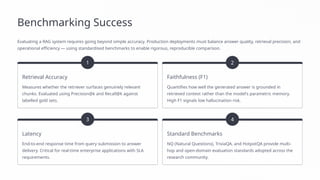
Benchmarking Success
Evaluating a RAG system requires going beyond simple accuracy. Production deployments must balance answer quality, retrieval precision, and
operational efficiency — using standardised benchmarks to enable rigorous, reproducible comparison.
1
Retrieval Accuracy
Measures whether the retriever surfaces genuinely relevant
chunks. Evaluated using Precision@k and Recall@k against
labelled gold sets.
2
Faithfulness (F1)
Quantifies how well the generated answer is grounded in
retrieved context rather than the model's parametric memory.
High F1 signals low hallucination risk.
3
Latency
End-to-end response time from query submission to answer
delivery. Critical for real-time enterprise applications with SLA
requirements.
4
Standard Benchmarks
NQ (Natural Questions), TriviaQA, and HotpotQA provide multi-
hop and open-domain evaluation standards adopted across the
research community.
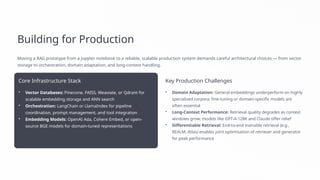
Building for Production
Moving a RAG prototype from a Jupyter notebook to a reliable, scalable production system demands careful architectural choices — from vector
storage to orchestration, domain adaptation, and long-context handling.
Core Infrastructure Stack
• Vector Databases: Pinecone, FAISS, Weaviate, or Qdrant for
scalable embedding storage and ANN search
• Orchestration: LangChain or LlamaIndex for pipeline
coordination, prompt management, and tool integration
• Embedding Models: OpenAI Ada, Cohere Embed, or open-
source BGE models for domain-tuned representations
Key Production Challenges
• Domain Adaptation: General embeddings underperform on highly
specialised corpora; fine-tuning or domain-specific models are
often essential
• Long-Context Performance: Retrieval quality degrades as context
windows grow; models like GPT-4-128K and Claude offer relief
• Differentiable Retrieval: End-to-end trainable retrieval (e.g.,
REALM, Atlas) enables joint optimisation of retriever and generator
for peak performance
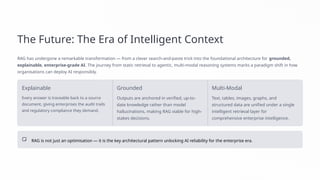
The Future: The Era of Intelligent Context
RAG has undergone a remarkable transformation — from a clever search-and-paste trick into the foundational architecture for grounded,
explainable, enterprise-grade AI. The journey from static retrieval to agentic, multi-modal reasoning systems marks a paradigm shift in how
organisations can deploy AI responsibly.
Explainable
Every answer is traceable back to a source
document, giving enterprises the audit trails
and regulatory compliance they demand.
Grounded
Outputs are anchored in verified, up-to-
date knowledge rather than model
hallucinations, making RAG viable for high-
stakes decisions.
Multi-Modal
Text, tables, images, graphs, and
structured data are unified under a single
intelligent retrieval layer for
comprehensive enterprise intelligence.
RAG is not just an optimisation — it is the key architectural pattern unlocking AI reliability for the enterprise era.