DIGITALISATION AND
COMPETITION
A Health System Perspective
Martin Wenzl
OECD Health Division
Workshop on Regulation and Competition in light of Digitalisation
31 January 2018
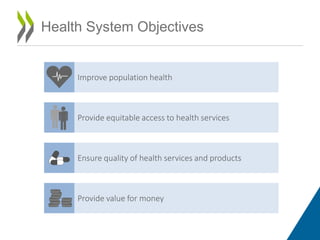
Health System Objectives
Provide equitable access to health services
Provide value for money
Ensure quality of health services and products
Improve population health
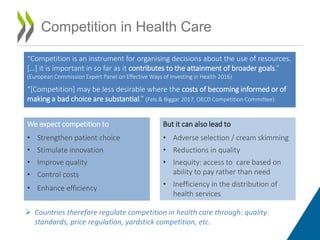
Competition in Health Care
We expect competition to
• Strengthen patient choice
• Stimulate innovation
• Improve quality
• Control costs
• Enhance efficiency
But it can also lead to
• Adverse selection / cream skimming
• Reductions in quality
• Inequity: access to care based on
ability to pay rather than need
• Inefficiency in the distribution of
health services
 Countries therefore regulate competition in health care through: quality
standards, price regulation, yardstick competition, etc.
“Competition is an instrument for organising decisions about the use of resources.
[…] it is important in so far as it contributes to the attainment of broader goals.”
(European Commission Expert Panel on Effective Ways of Investing in Health 2016)
“[Competition] may be less desirable where the costs of becoming informed or of
making a bad choice are substantial.” (Fels & Biggar 2017, OECD Competition Committee)
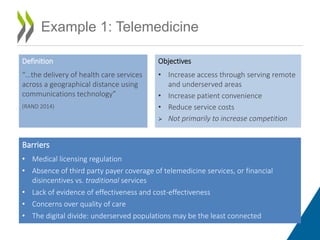
Example 1: Telemedicine
Definition
“…the delivery of health care services
across a geographical distance using
communications technology”
(RAND 2014)
Objectives
• Increase access through serving remote
and underserved areas
• Increase patient convenience
• Reduce service costs
 Not primarily to increase competition
Barriers
• Medical licensing regulation
• Absence of third party payer coverage of telemedicine services, or financial
disincentives vs. traditional services
• Lack of evidence of effectiveness and cost-effectiveness
• Concerns over quality of care
• The digital divide: underserved populations may be the least connected
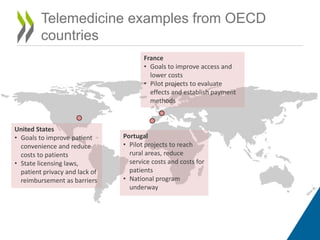
Telemedicine examples from OECD
countries
France
• Goals to improve access and
lower costs
• Pilot projects to evaluate
effects and establish payment
methods
United States
• Goals to improve patient
convenience and reduce
costs to patients
• State licensing laws,
patient privacy and lack of
reimbursement as barriers
Portugal
• Pilot projects to reach
rural areas, reduce
service costs and costs for
patients
• National program
underway
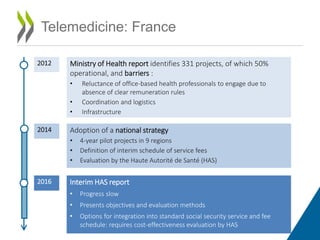
Telemedicine: France
2012
2016
2014
Ministry of Health report identifies 331 projects, of which 50%
operational, and barriers :
• Reluctance of office-based health professionals to engage due to
absence of clear remuneration rules
• Coordination and logistics
• Infrastructure
Adoption of a national strategy
• 4-year pilot projects in 9 regions
• Definition of interim schedule of service fees
• Evaluation by the Haute Autorité de Santé (HAS)
Interim HAS report
• Progress slow
• Presents objectives and evaluation methods
• Options for integration into standard social security service and fee
schedule: requires cost-effectiveness evaluation by HAS
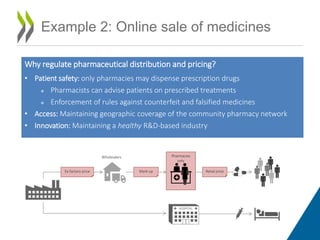
Example 2: Online sale of medicines
Why regulate pharmaceutical distribution and pricing?
• Patient safety: only pharmacies may dispense prescription drugs
 Pharmacists can advise patients on prescribed treatments
 Enforcement of rules against counterfeit and falsified medicines
• Access: Maintaining geographic coverage of the community pharmacy network
• Innovation: Maintaining a healthy R&D-based industry
Pharmacies
only
Ex-factory price Mark-up Retail price
Wholesalers
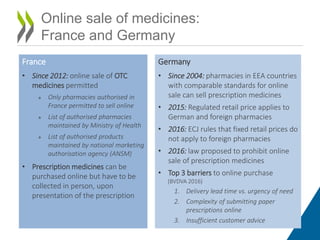
Online sale of medicines:
France and Germany
France
• Since 2012: online sale of OTC
medicines permitted
 Only pharmacies authorised in
France permitted to sell online
 List of authorised pharmacies
maintained by Ministry of Health
 List of authorised products
maintained by national marketing
authorisation agency (ANSM)
• Prescription medicines can be
purchased online but have to be
collected in person, upon
presentation of the prescription
Germany
• Since 2004: pharmacies in EEA countries
with comparable standards for online
sale can sell prescription medicines
• 2015: Regulated retail price applies to
German and foreign pharmacies
• 2016: ECJ rules that fixed retail prices do
not apply to foreign pharmacies
• 2016: law proposed to prohibit online
sale of prescription medicines
• Top 3 barriers to online purchase
(BVDVA 2016)
1. Delivery lead time vs. urgency of need
2. Complexity of submitting paper
prescriptions online
3. Insufficient customer advice
Staying in touch with the Health Division
Martin Wenzl martin.wenzl@oecd.org
@OECD_socialFollow us on Twitter
http://www.oecd.org/healthVisit our website