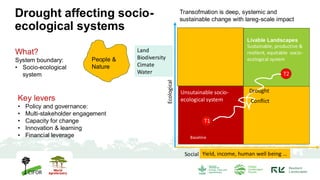
Drought affecting socio-
ecologicalsystems
What?
System boundary:
• Socio-ecological
system
People &
Nature
Social
Ecological
Land
Biodiversity
Cimate
Water
Yield, income, human well being …
Unsutainable socio-
ecological system
T1
Baseline
Livable Landscapes
Sustainable, productive &
resilient, equitable socio-
ecological system
T2
Key levers
• Policy and governance:
• Multi-stakeholder engagement
• Capacity for change
• Innovation & learning
• Financial leverage
Transofmation is deep, systemic and
sustainable change with lareg-scale impact
Drought
Conflict
4.
4
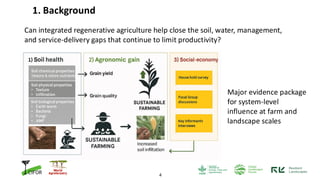
1. Background
Major evidencepackage
for system-level
influence at farm and
landscape scales
Can integrated regenerative agriculture help close the soil, water, management,
and service-delivery gaps that continue to limit productivity?
5.
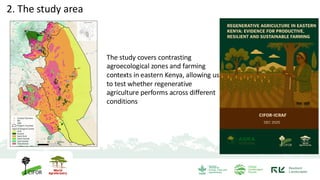
2. The studyarea
The study covers contrasting
agroecological zones and farming
contexts in eastern Kenya, allowing us
to test whether regenerative
agriculture performs across different
conditions
6.
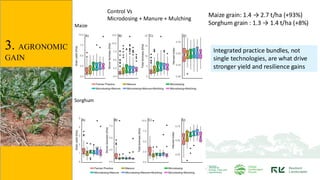
Integrated practice bundles,not
single technologies, are what drive
stronger yield and resilience gains
Maize
Sorghum
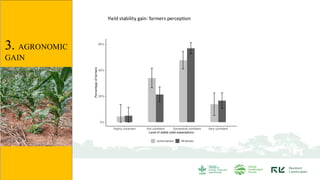
3. AGRONOMIC
GAIN
Maize grain: 1.4 → 2.7 t/ha (+93%)
Sorghum grain : 1.3 → 1.4 t/ha (+8%)
Control Vs
Microdosing + Manure + Mulching
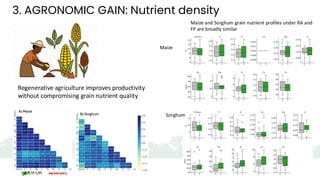
3. AGRONOMIC GAIN:Nutrient density
Maize
Sorghum
Maize and Sorghum grain nutrient profiles under RA and
FP are broadly similar
Regenerative agriculture improves productivity
without compromising grain nutrient quality
9.
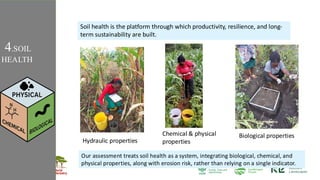
Hydraulic properties
Chemical &physical
properties
Biological properties
Our assessment treats soil health as a system, integrating biological, chemical, and
physical properties, along with erosion risk, rather than relying on a single indicator.
4.SOIL
HEALTH
Soil health is the platform through which productivity, resilience, and long-
term sustainability are built.
10.
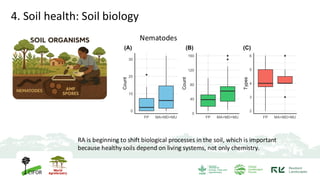
4. Soil health:Soil biology
RA is beginning to shift biological processes in the soil, which is important
because healthy soils depend on living systems, not only chemistry.
Nematodes
11.
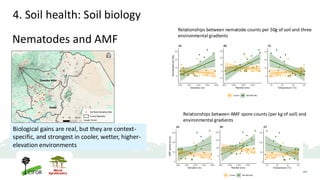
Nematodes and AMF
Relationshipsbetween AMF spore counts (per kg of soil) and
environmental gradients
Relationships between nematode counts per 50g of soil and three
environmental gradients
Biological gains are real, but they are context-
specific, and strongest in cooler, wetter, higher-
elevation environments
4. Soil health: Soil biology
12.
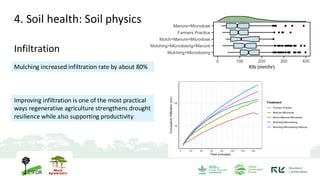
Infiltration
Improving infiltration isone of the most practical
ways regenerative agriculture strengthens drought
resilience while also supporting productivity
Mulching increased infiltration rate by about 80%
4. Soil health: Soil physics
13.
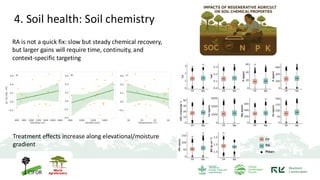
Treatment effects increasealong elevational/moisture
gradient
RA is not a quick fix: slow but steady chemical recovery,
but larger gains will require time, continuity, and
context-specific targeting
4. Soil health: Soil chemistry
14.
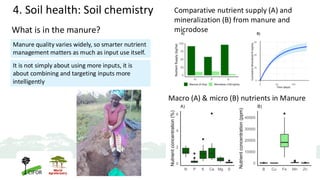
What is inthe manure?
Macro (A) & micro (B) nutrients in Manure
Comparative nutrient supply (A) and
mineralization (B) from manure and
microdose
Manure quality varies widely, so smarter nutrient
management matters as much as input use itself.
It is not simply about using more inputs, it is
about combining and targeting inputs more
intelligently
4. Soil health: Soil chemistry
15.
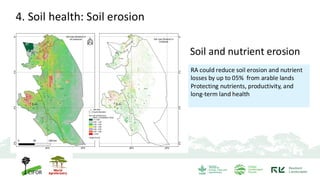
RA could reducesoil erosion and nutrient
losses by up to 05% from arable lands
Protecting nutrients, productivity, and
long-term land health
Soil and nutrient erosion
4. Soil health: Soil erosion
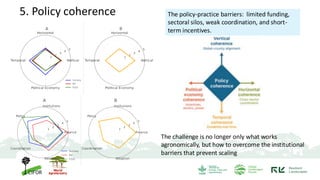
5. Policy coherenceThe policy-practice barriers: limited funding,
sectoral silos, weak coordination, and short-
term incentives.
The challenge is no longer only what works
agronomically, but how to overcome the institutional
barriers that prevent scaling
18.
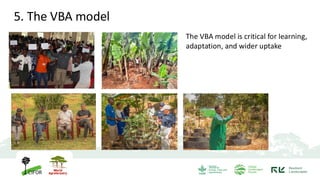
The VBA modelis critical for learning,
adaptation, and wider uptake
5. The VBA model
19.
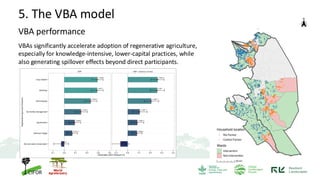
VBAs significantly accelerateadoption of regenerative agriculture,
especially for knowledge-intensive, lower-capital practices, while
also generating spillover effects beyond direct participants.
5. The VBA model
VBA performance
20.
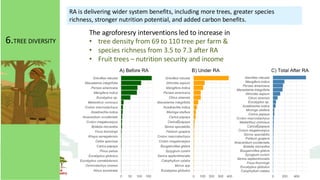
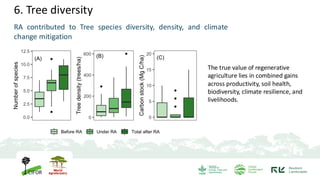
The agroforesry interventionsled to increase in
• tree density from 69 to 110 tree per farm &
• species richness from 3.5 to 7.3 after RA
• Fruit trees – nutrition security and income
RA is delivering wider system benefits, including more trees, greater species
richness, stronger nutrition potential, and added carbon benefits.
6.TREE DIVERSITY
21.
6. Tree diversity
RAcontributed to Tree species diversity, density, and climate
change mitigation
The true value of regenerative
agriculture lies in combined gains
across productivity, soil health,
biodiversity, climate resilience, and
livelihoods.
22.
Lessons learned
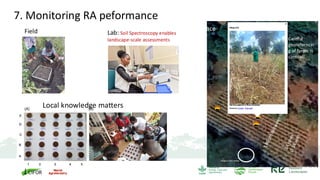
7. MonitoringRA peformance
Field Lab: Soil Spectroscopy enables
landscape-scale assessments
Space
Careful
georeferncin
g of farms is
ciritical!
TharakaNithi
Local knowledge matters