Pre-trial petitions ( Reciever, Amendment of Plaint, Discovery Inspection, Attachment before Judgment, Commissions, Rejection
of plaint)
Prepared by Showkat Hossain
• The Receiver is considered to be an officer of the court who
helps the court to protect and preserve the subject matter of
suit till the time the court decides the matter. Sometimes, the
court thinks, it is in the best interest of both the parties to
appoint a receiver who will be responsible for the
management of the subject matter. The subject matter is
generally a movable or immovable property.
• The Receiver is liable to take care of the property just as a
prudent man will take care of his own personal property. He
should follow the directions of the court or else his property
can be attached by the court to recover the amount which is
due to him.
• For example, in a dispute between A and B for an immovable property, if
the court thinks that it is in the best interest of both the parties that
possession should be taken from B and given to an independent person,
the court may appoint a receiver who can manage the property till the
time the suit is being decided. Such a receiver appointed by the court
would be responsible for the maintenance of the property. He can collect
the income accruing like rent or any other profits and utilize it to maintain
the property. After deducting the expenses incurred in maintenance from
the income received from the property, the receiver will have to submit
the remaining income, if any, in the court.
• He is not representative of either of the parties in the action, is uniformly
regarded as an officer of the court working in the interest of neither
plaintiff nor defendant but for the common benefit of all the parties.
What is the purpose of the appointment of a
receiver?
When a party in possession of the disputed property
exhausts the property or causes irreparable damages to
it, the whole object of the suit gets defeated because the
subject matter ceases to exist or its value gets affected.
Therefore, when the court is of the opinion that the
property in dispute must not go to either of the parties,
pendente lite, the court appoints a receiver who is
entrusted with the protection and preservation of such
property. It is a form of interim protection which the
court provides to the parties who makes the application
till the time the court adjudicates the matter.
How does the court decide whether to appoint a receiver or
not?
• Court has to keep the following principles in mind before appointing a receiver:
1. Appointment of a receiver is a discretionary power.
2. It is a protective relief to the plaintiff. The object is to protect and preserve the disputed property till the time the
suit is pending in the court.
3. A receiver should not be appointed unless the plaintiff shows prima facie that he has a strong case against the
defendant and it is more than likely that he will succeed in the suit. [ strong case, good title, reasonable good
possibility of ultimate success]
4. Appointment of a receiver is one of the hardest remedies as it deprives the defendant of his right to possession
before the final decree. Therefore, the court should not resort to it merely on the ground that it will do no harm.
There should be strong apprehension that there is a danger to the property or the plaintiff will be in worse of a
situation if the appointment of a receiver is delayed. [has a special equity in his favour and the property in the hands of the
defendant is in danger of being wasted.]
5. The court should appoint a receiver only when there is a possibility of wrong or injury. Also, if it is shown that the
subject matter is not in the possession of any of the parties and it is in the common interest of both the parties to
appoint a receiver for the protection and preservation of the property.
6. The court should look at the conduct of the party who makes the application for appointment of a receiver. The
party should come to the court with clean hands and their conduct should be such that they are not disentitled to
this equitable relief.
• Who can apply for the appointment of the receiver?
• Generally, a plaintiff files the application for appointment of a receiver
but defendants can also file such application. A third party is not allowed
to file the application but if he is interested in the protection and
preservation of the property, he can also make an application after
taking permission from the court.
• Who can be appointed as a receiver?
• A person who is independent, impartial and totally disinterested should
be appointed as a receiver. Such a person should not have any stake in
the disputed property. Generally, parties to the suit are not appointed as
receiver by the court. But in extraordinary circumstances, a party to suit
can be appointed as receiver.
• Suit for partition [ generally not but it will be ordered if there is prima
facie case of misappropriation.]
• Partnership suit
• Suit for possession [ generally not, But if the circumstances so
require
• Rent suit [In a suit for recovery of mesne profits, a receiver can
be appointed for collecting crops grown on the lands in
possession of the tenants.]
• https://www.waseeqanaveesi.com/2022/11/application-for-appoint
ment-of-receiver.html
Appointment of Receiver ( Section 44 of SR
Act)
• 44. The appointment of a receiver pending a suit is a matter
resting in the discretion of the Court.
• The mode and effect of his appointment, and his rights, powers,
duties and liabilities, are regulated by the Code of Civil
Procedure.
Appointment of receiver ( Order 40)
1) Where it appears to the Court to be just and convenient, the Court may by order−
(a) appoint a receiver of any property, whether before or after decree;
(b) remove any person from the possession or custody of the property;
(c) commit the same to the possession, custody or management of the receiver; and
(d) confer upon the receiver all such powers, as to bringing and defending suits and for the
realization, management, protection, preservation and improve-ment of the property, the
collection of the rents and profits thereof, the application and disposal of such rents and profits,
and the execution of documents as the owner himself has, or such of those powers as the Court
thinks fit.
(2) Nothing in this rule shall authorise the Court to remove from the possession or custody of
property any person whom any party to the suit has not a present right so to remove.
Amendment of plaint [ Order 6, rule 17]
• 17. The Court may at any stage of the proceedings allow either party to alter or amend his
pleadings in such manner and on such terms as may be just, and all such amendments shall
be made as may be necessary for the purpose of determining the real questions in
controversy between the parties .Provided that no application for amendment shall be
allowed after the trial has commenced, unless the Court is of opinion that in spite of due
diligence, the party could not have raised the matter before the commencement of trial,
Provided further that if an application for amendment is made after the trial has commenced
and the Court is of opinion that the application is made to delay the proceedings, the Court
shall make an order for the payment to the objector such cost by way of compensation as it
thinks fit.
Guiding principles
• Either party may amend their pleading
• At any stage of the suit, even at the appellate stage
• Only if the amendment is necessary to determine the actual controversy of
the parties
• Courts are in general liberal in granting amendment petitions
• there are two necessary conditions to be satisfied before granting
leave for amendment of pleadings:
1.This grant of leave should not leads to the injustice to other party.
2.This Amendment of pleadings is necessary for determining the
real question of controversy between parties.
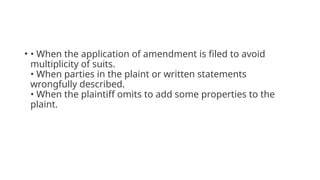
• • When the application of amendment is filed to avoid
multiplicity of suits.
• When parties in the plaint or written statements
wrongfully described.
• When the plaintiff omits to add some properties to the
plaint.
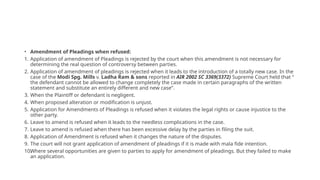
• Amendment of Pleadings when refused:
1. Application of amendment of Pleadings is rejected by the court when this amendment is not necessary for
determining the real question of controversy between parties.
2. Application of amendment of pleadings is rejected when it leads to the introduction of a totally new case. In the
case of the Modi Spg. Mills v. Ladha Ram & sons reported in AIR 2002 SC 3369(3372) Supreme Court held that “
the defendant cannot be allowed to change completely the case made in certain paragraphs of the written
statement and substitute an entirely different and new case”.
3. When the Plaintiff or defendant is negligent.
4. When proposed alteration or modification is unjust.
5. Application for Amendments of Pleadings is refused when it violates the legal rights or cause injustice to the
other party.
6. Leave to amend is refused when it leads to the needless complications in the case.
7. Leave to amend is refused when there has been excessive delay by the parties in filing the suit.
8. Application of Amendment is refused when it changes the nature of the disputes.
9. The court will not grant application of amendment of pleadings if it is made with mala fide intention.
10.
Where several opportunities are given to parties to apply for amendment of pleadings. But they failed to make
an application.
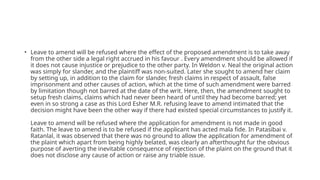
• Leave to amend will be refused where the effect of the proposed amendment is to take away
from the other side a legal right accrued in his favour . Every amendment should be allowed if
it does not cause injustice or prejudice to the other party. In Weldon v. Neal the original action
was simply for slander, and the plaintiff was non-suited. Later she sought to amend her claim
by setting up, in addition to the claim for slander, fresh claims in respect of assault, false
imprisonment and other causes of action, which at the time of such amendment were barred
by limitation though not barred at the date of the writ. Here, then, the amendment sought to
setup fresh claims, claims which had never been heard of until they had become barred; yet
even in so strong a case as this Lord Esher M.R. refusing leave to amend intimated that the
decision might have been the other way if there had existed special circumstances to justify it.
Leave to amend will be refused where the application for amendment is not made in good
faith. The leave to amend is to be refused if the applicant has acted mala fide. In Patasibai v.
Ratanlal, it was observed that there was no ground to allow the application for amendment of
the plaint which apart from being highly belated, was clearly an afterthought fur the obvious
purpose of averting the inevitable consequence of rejection of the plaint on the ground that it
does not disclose any cause of action or raise any triable issue.
• Law of limitations and date of applicability
• Amendment to delay the proceeding
• Step by Step procedure for filing an application for Amendment of Pleadings
• Step 1 – Firstly the Plaintiff or Defendant who wants to amend its pleadings can write an application
for the amendment of pleadings to the concerned civil court
• Step 2 – After drafting the application applicant needs to produce the application before the
concerned civil judge.
• Step 3 – He has to pay a required court fee under court fees Act, 1870.
• Step 4- Applicant needs to tell the purpose of the alteration in his application.
• Step 5 – Judge will read the application and if he thinks fit that this alteration or amendment is
necessary for the purpose of determining the real questions in controversy between the parties Than
he will grant permission for amendment for pleading.
• Step 6 – After getting the order from the court, the applicant needs to file new pleadings within the
prescribed time and if no time has been prescribed by the court then he needs to file it in 14 days
from the date of order.
• Step 7 – He also needs to give a copy of altered pleadings to the opposite party
• https://lawhelpbd.com/drafting/amendment-of-pleadings/
• Why Order 6 Rule 17 is been criticized?
• Application of the Amendments delays Justice. Arun Mohan, senior lawyer-author of the book called
“Justice, Courts, and delays” tells in his book that almost 80% of the application for the amendment is
filed with the sole objective of delaying the proceedings.
• One of the big challenges faced by the Indian courts is the backlog of the cases. Civil court is already
burdened with lot many cases and amendment of pleadings puts more burden on the civil courts
• Order 6 Rule 17 is the most misused law.
• It is a hindrance to speedy disposal of the matter
• It has more possibilities & chances of violation of legal rights of other side.
• Sometimes it is difficult to find the real question of controversy between parties
• The controversy between Amendment of proceedings and the Limitation is still not settled. In different
cases, there are different interpretations of this rule.
• Many applicants with the mala fide intention are filing the application for amendment. It is not easy
for the civil court to establish mala fide intention of the parties.