RCH literature review last RCH literature review last RCH literature review lastRCH literature review last.pptx
1.
ROLE OF WINDAND FEAR ON THE
DYNAMIC OF A PREY AND TWO
COMPETING PREDATORS
AUTHORS: RASHA ABDULHUSSEIN ALI & HIBA ABDULLAH IBRAHIM (UNIVERSITY OF
BAGHDAD)
JOURNAL: JOURNAL OF APPLIED MATHEMATICS, MAY 2025
PRESENTED BY: RASHA ABDULHUSSEIN ALI/PHD STUDENT
DATE: 9 SEPTEMPER 2025
2.
Literature Review
Conducting aliterature review not
only helps to build knowledge in a
particular topic or area of the study
but also helps to gain an
understanding of the existing research
and disputes relevant to the research
field.
2
3.
Objectives of theLiterature Review
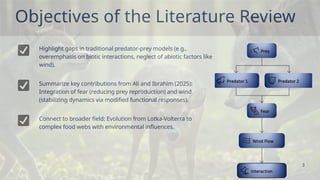
Highlight gaps in traditional predator-prey models (e.g.,
overemphasis on biotic interactions, neglect of abiotic factors like
wind).
Summarize key contributions from Ali and Ibrahim (2025):
Integration of fear (reducing prey reproduction) and wind
(stabilizing dynamics via modified functional responses).
Connect to broader field: Evolution from Lotka-Volterra to
complex food webs with environmental influences.
3
4.
Ecology is thescientific study of the earth’s living
systems and their interactions.
The term “ecology” was first used by German
zoologist Ernst Haeckel (1869)
WHAT IS
ECOLOGY
4
5.
• Mathematics playsa significant
role in the development of ecology.
5
• Mathematical modeling of
ecosystems deals with how
populations, communities, and
ecosystems change in space and
time.
• The first major use of mathematics
in ecology occurred in the early
1900s.
6.
The Lotka-Volterra
prey-predator
model
Alfred Lotka(1925) and Vito Volterra (1926)
describe the dynamics of ecological systems
in which two classes of populations interact,
one a predator and one its prey.
6
7.
The C.S. Holling
prey-predator
model
Canadianecologist C.S. Holling in the
1950s, extended the Lotka-Volterra model
by including density-dependent prey growth
and a functional response.
7
8.
MA, WANG &GAO (2023) MAGHOOL & NAJI (2022)
BAHLOOL, SATAR & IBRAHIM
(2020)
Two-species predator–prey system
with a classical Holling Type-II
functional response and cross-
diffusion terms.The saturating
predation rate introduces nonlinear
predator–prey coupling, which
interacts with cross-diffusion. and The
Holling-II term ensures that predation
pressure levels off at high prey
densities,
Modified Holling Type-II functional
response incorporating fear effects
and predator intraspecific
competition. The Holling-II form was
adapted so that attack rate decreases
when prey experience fear, effectively
lowering the functional response at
all prey densities. The saturation
effect of Holling-II interacts with fear
to produce bi-stability and stable line
equilibria.
Holling Type-II predator–prey model
extended with prey refuge, disease in
prey, and harvesting of both species. The
saturating predation rate interacts with
refuge to reduce effective prey
availability, lowering predator growth at
high prey densities. The interplay
between Holling-II saturation, refuge, and
harvesting can lead to complex dynamics,
including periodic oscillations and chaotic
attractors.
The Holling Type-II model
8
The Holling Type-II model describes predator-prey interactions with a saturating predation rate where
predators consume prey efficiently at moderate prey densities, reflecting realistic predator-prey dynamics
in ecosystems. It has been modified in various ways to account for different factors, such as
9.
• (Binzer A.,2013) the loss or addition of one species
can have cascading effects on others due to
interdependence and balance
• (Abbas & Naji, 2022) suggested a harvested food
web model under the influence of fear; they have
found that high levels of harvesting or fear cause
the extinction of one of the predators.
On the other hand, research has highlighted that the
competition between predators can have both direct
and indirect effects on prey populations, impacting their
growth and survival.
• Direct effects: Seen in Llibre & Xiao (2014) through
explicit predator–predator competition for prey,
altering survival and coexistence outcomes.
• Indirect effects: Highlighted in Mukherjee (2021) via
fear-mediated changes in prey behavior and
reproduction
Food webs illustrate
the complex
relationships
between species in
ecosystems in terms
of species, factors,
and competition.
9
Food
webs
10.
Fear effects
Boonstra etal, 1998 Zanette et al, 2011
their analysis of the
Snowshoe hare, it is found
that neither their high
population density nor poor
food level is the direct cause
of the decreasing
reproduction rate, rather it is
due to the high fear factor
driven by the predator.
experimentally showed that
fear of predation alone led to
a 40% reduction in the
number of offspring
reproduction of song
sparrows.
Wang et al. (2016)
showed that incorporating the
cost of fear into prey
reproduction can stabilize
predator-prey systems by
eliminating periodic
oscillations, particularly with
Holling Type II functional
responses.
investigates a three-species
food chain model
incorporating the
Beddington-DeAngelis
functional response,
Fear’s dual stabilizing and
destabilizing effects depend
on its intensity.
10
Ibrahim et al. (2020 ) Rahi et al, 2024
fear can lead to prey
extinction if not balanced by
refuge or additional food
sources. This highlights the
delicate interplay between
fear and other ecological
supports.
Several studies report that fear can stabilize predator-
prey systems.Conversely, some models show an opposite
effect.
11.
ABIOTIC
GAPS
Mathematical modeling ofecological systems involving
predator-prey interactions considers both biotic and
abiotic factors. Various theoretical studies have been
centrally focused on keeping in view the biotic factors.
Nevertheless, the role of abiotic factors in shaping an
ecosystem has been less thoroughly investigated.
11
12.
The impact ofwind flow
1 2 3
Barman &
Upadhyay,
(2023)
Barman, Kumar,
Roy & Alam,
(2022)
Panja, (2022)
The wind flow term plays a
crucial role in controlling
system dynamics, making
systems stable, and reducing
chaotic behaviors. whereby
they have been found that
seasonality causes chaos but
the wind leads to reduction.
introduced wind modifications
in the Holling type-Il functional
response and explored
complex dynamics under wind
conditions, demonstrating the
significant influence of wind on
system behaviors.
introduced a predator-prey
model under anti-predator
behavior and wind effects. It
has been found that the
influences of wind and anti-
predator behavior can stabilize
the system.
12
13.
The impact ofwind flow
4
Takyi, (2023)
proposed and examined the
dynamics of a predator-prey
system that incorporates wind
effects and prey refuge.
13