Ramadan and the Renewal of Tawheed: Purifying Belief and Worship
Explore Ramadan's spiritual goals including purification of faith, strengthening Tawheed, self-discipline, Qur'an connection, forgiveness, and building righteous character through comprehensive worship practices.
Ramadan and the Renewal of Tawheed: Purifying Belief and Worship
1.
ِدي ِح ْوَّتالُديِدْجَت َو ُانَضَمر
:
َع ُةَيِقْنَت
َانِتَداَبِع َو َانِتَديِق
RAMADAN AND THE RENEWAL OF TAWHEED:
PURIFYING OUR BELIEF AND WORSHIP
2.
MEET THE FACILITATOR
Dr.ABDUL RASHEED MUH’D QASIM
Deputy Imam Aonullah Mosque, Teachers Estate, Ogun State,
Nigeria
Founder Ma’had Qiraat Institute for Arabic and Islamic
Civilization
+234 - 8051700164, +234 - 7066867887
kazeemrasheed1440@gmail.com
3.
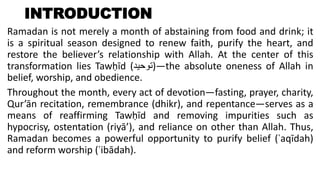
INTRODUCTION
Ramadan is notmerely a month of abstaining from food and drink; it
is a spiritual season designed to renew faith, purify the heart, and
restore the believer’s relationship with Allah. At the center of this
transformation lies Tawḥīd (—)توحيدthe absolute oneness of Allah in
belief, worship, and obedience.
Throughout the month, every act of devotion—fasting, prayer, charity,
Qur’ān recitation, remembrance (dhikr), and repentance—serves as a
means of reaffirming Tawḥīd and removing impurities such as
hypocrisy, ostentation (riyā’), and reliance on other than Allah. Thus,
Ramadan becomes a powerful opportunity to purify belief (ʿaqīdah)
and reform worship (ʿibādah).
4.
ِامَي ِ
الص ُةَّيِ
ض ْرَف
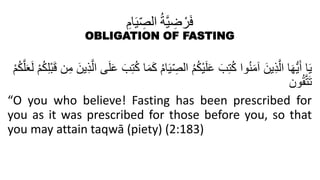
OBLIGATION OF FASTING
ُماَي ِ
الص ُمُكْيَلَع َبِتُك واُنَمآ َينِذَّال اَهُّيَأ اَي
ُكِلْبَق نِم َينِذَّال ىَلَع َبِتُك اَمَك
ْمُكَّلَعَل ْم
ونُقَّتَت
“O you who believe! Fasting has been prescribed for
you as it was prescribed for those before you, so that
you may attain taqwā (piety) (2:183)
5.
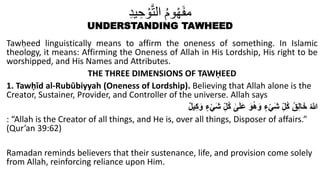
ِدي ِح ْوَّتالُموْهَفم
UNDERSTANDING TAWHEED
Tawḥeed linguistically means to affirm the oneness of something. In Islamic
theology, it means: Affirming the Oneness of Allah in His Lordship, His right to be
worshipped, and His Names and Attributes.
THE THREE DIMENSIONS OF TAWḤEED
1. Tawḥīd al-Rubūbiyyah (Oneness of Lordship). Believing that Allah alone is the
Creator, Sustainer, Provider, and Controller of the universe. Allah says
يلِكَو ٍءْيَش ُِلك ٰ
ىَلَع َوُهَو ٍءْيَش ُِلك ُقِلاَخ ُ ه
َّللا
: “Allah is the Creator of all things, and He is, over all things, Disposer of affairs.”
(Qur’an 39:62)
Ramadan reminds believers that their sustenance, life, and provision come solely
from Allah, reinforcing reliance upon Him.
6.
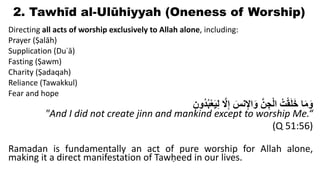
2. Tawhīd al-Ulūhiyyah(Oneness of Worship)
Directing all acts of worship exclusively to Allah alone, including:
Prayer (Ṣalāh)
Supplication (Duʿā)
Fasting (Ṣawm)
Charity (Ṣadaqah)
Reliance (Tawakkul)
Fear and hope
ُِوندُبْعَيِل ه
َّلِإ َ
نسِاإلَو هن ِجْلا ُتْقَلَخ اَمَو
"And I did not create jinn and mankind except to worship Me.“
(Q 51:56)
Ramadan is fundamentally an act of pure worship for Allah alone,
making it a direct manifestation of Tawḥeed in our lives.
7.
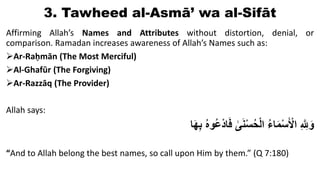
3. Tawheed al-Asmā’wa al-Sifāt
Affirming Allah’s Names and Attributes without distortion, denial, or
comparison. Ramadan increases awareness of Allah’s Names such as:
➢Ar-Raḥmān (The Most Merciful)
➢Al-Ghafūr (The Forgiving)
➢Ar-Razzāq (The Provider)
Allah says:
اَهِب ُهُوعْداَف ٰ
ىَنْسُحْلا ُءاَمْسَ ْ
اْل ِ ه ِ
ّلِلَو
“And to Allah belong the best names, so call upon Him by them.” (Q 7:180)
8.
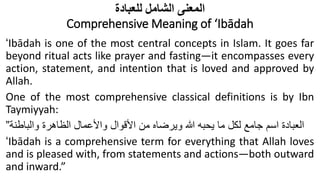
للعبادة الشامل المعنى
ComprehensiveMeaning of ‘Ibādah
‘Ibādah is one of the most central concepts in Islam. It goes far
beyond ritual acts like prayer and fasting—it encompasses every
action, statement, and intention that is loved and approved by
Allah.
One of the most comprehensive classical definitions is by Ibn
Taymiyyah:
العبادة
اسم
جامع
لكل
ما
يحبه
هللا
ويرضاه
من
األقوال
واألعمال
الظاهرة
والباطنة
”
‘Ibādah is a comprehensive term for everything that Allah loves
and is pleased with, from statements and actions—both outward
and inward.”
9.
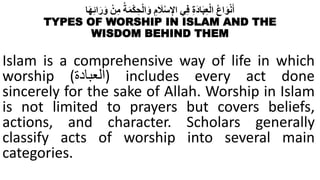
اَهِئاَرَو ْنِم ُةَمْكِحْلاَو ِم َ
َلْسِاإل يِف ِةَداَبِعْلا ُعاَوْنَأ
TYPES OF WORSHIP IN ISLAM AND THE
WISDOM BEHIND THEM
Islam is a comprehensive way of life in which
worship ()العبادة includes every act done
sincerely for the sake of Allah. Worship in Islam
is not limited to prayers but covers beliefs,
actions, and character. Scholars generally
classify acts of worship into several main
categories.
10.
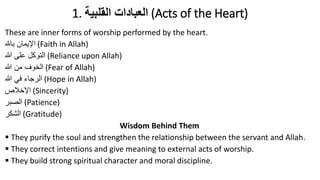
1. القلبية العبادات(Acts of the Heart)
These are inner forms of worship performed by the heart.
باهلل اإليمان (Faith in Allah)
هللا على التوكل (Reliance upon Allah)
هللا من الخوف (Fear of Allah)
هللا في الرجاء (Hope in Allah)
اإلخالص (Sincerity)
الصبر (Patience)
الشكر (Gratitude)
Wisdom Behind Them
▪ They purify the soul and strengthen the relationship between the servant and Allah.
▪ They correct intentions and give meaning to external acts of worship.
▪ They build strong spiritual character and moral discipline.
11.
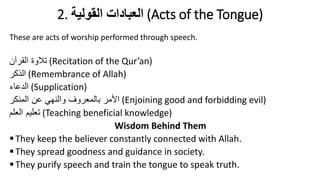
2. القولية العبادات(Acts of the Tongue)
These are acts of worship performed through speech.
القرآن تالوة (Recitation of the Qur’an)
الذكر (Remembrance of Allah)
الدعاء (Supplication)
المنكر عن والنهي بالمعروف األمر (Enjoining good and forbidding evil)
العلم تعليم (Teaching beneficial knowledge)
Wisdom Behind Them
▪They keep the believer constantly connected with Allah.
▪They spread goodness and guidance in society.
▪They purify speech and train the tongue to speak truth.
12.
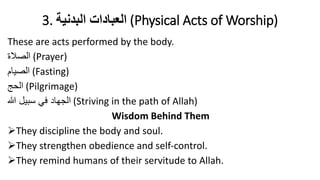
3. البدنية العبادات(Physical Acts of Worship)
These are acts performed by the body.
الصالة (Prayer)
الصيام (Fasting)
الحج (Pilgrimage)
هللا سبيل في الجهاد (Striving in the path of Allah)
Wisdom Behind Them
➢They discipline the body and soul.
➢They strengthen obedience and self-control.
➢They remind humans of their servitude to Allah.
13.
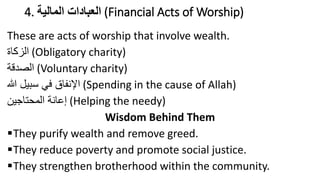
4. المالية العبادات(Financial Acts of Worship)
These are acts of worship that involve wealth.
الزكاة (Obligatory charity)
الصدقة (Voluntary charity)
هللا سبيل في اإلنفاق (Spending in the cause of Allah)
المحتاجين إعانة (Helping the needy)
Wisdom Behind Them
▪They purify wealth and remove greed.
▪They reduce poverty and promote social justice.
▪They strengthen brotherhood within the community.
14.
5. المركبة العبادات(Combined Acts of Worship)
These acts combine physical and financial elements.
الحج (Pilgrimage)
العمرة (Umrah)
Wisdom Behind Them
•They teach sacrifice, unity, and humility.
•They remind Muslims of the global unity of the
Ummah.
•They revive the legacy of the Prophets, especially
Ibrahim (السالم )عليه
15.
العبادة قبول شروط
CONDITIONSFOR ACCEPTANCE OF ‘IBĀDAH
For any act to be accepted, two essential conditions
must be fulfilled:
1. Ikhlāṣ اإلخالص Sincerity Done purely for Allah
alone
2. Ittibā‘ اتباع
السنة Done according to the teachings of
the Prophet Muhammad
16.
رمضان أهداف
THE GOALSOF RAMADAN
Ramadan is not only a month of fasting; it is a divine training period designed to
transform the believer spiritually, morally, and socially. The goals of Ramadan can
be understood from the Qur'an, the teachings of the Prophet ﷺ, and the wisdom
of Islamic scholars.
1. Attaining Taqwā (God-Consciousness)
This is the primary goal of Ramadan. Allah says
ِذَّال ىَلَع َبِتُك اَمَك ُماَي ِ
الص ُمُكْيَلَع َبِتُك واُنَمآ َينِذَّال اَهُّيَأ اَي
ونُقَّتَت ْمُكَّلَعَل ْمُكِلْبَق نِم َين
“O you who believe! Fasting is prescribed for you as it was prescribed for those
before you so that you may attain taqwā.” ( Q 2:183)
17.
2. Purification ofthe Soul
Ramadan cleanses the heart from spiritual diseases like
arrogance
envy
greed
hatred
hypocrisy
Then the believer becomes spiritually purified through:
fasting
dhikr
repentance
unconditional charity
18.
3. Strengthening Tawheed(Pure Monotheism)
Ramadan renews Muslim’s relationship with Allah alone.
It teaches:
➢Worship belongs only to Allah
➢Dependence on Allah alone
➢Sincerity in acts of worship
Every act in Ramadan—fasting, prayer, charity—is done
solely for Allah sake.
19.
4. Self-Discipline andControl
Fasting trains believers to control their desires. The Prophet ﷺ said:
يجهل وَّل يرفث فال ًاصائم أحدكم كان إذا
“When one of you is fasting, he should not behave in an obscene or
ignorant manner.” (Bukhari & Muslim)
Ramadan teaches control over:
food
drink
anger
desires
uncontrolled speech
20.
5. Strengthening theRelationship with the Qur'an
Ramadan is the month of the Qur’an. Allah says
ِ
اسَّنلِل ًىدُه ُآن ْرُقْال ِهيِف َل ِ
نزُأ يِذَّال َانَضَم َر ُرْهَش
“The month of Ramadan in which the Qur'an was revealed as guidance for
mankind.” (Q 2:185)
Goals related to the Qur'an:
➢recitation
➢reflection
➢memorization
➢living according to it
21.
6. Seeking ConstantForgiveness of Sins
Ramadan is a season of mercy and forgiveness. The Prophet ﷺ
said:
«
ذنبه من متقد ما له فرُغ اًبواحتسا اًنإيما رمضان صام من
»
“Whoever fasts Ramadan with faith and seeking reward will
have his past sins forgiven.” (Bukhari & Muslim)
Means of forgiveness:
▪fasting
▪night prayer (Tarāwīḥ)
▪Laylat al-Qadr
▪sincere repentance
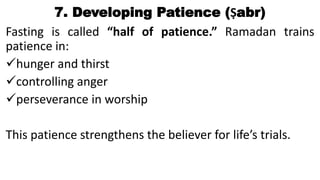
22.
7. Developing Patience(Ṣabr)
Fasting is called “half of patience.” Ramadan trains
patience in:
✓hunger and thirst
✓controlling anger
✓perseverance in worship
This patience strengthens the believer for life’s trials.
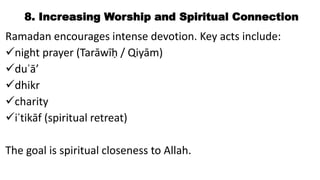
23.
8. Increasing Worshipand Spiritual Connection
Ramadan encourages intense devotion. Key acts include:
✓night prayer (Tarāwīḥ / Qiyām)
✓duʿā’
✓dhikr
✓charity
✓iʿtikāf (spiritual retreat)
The goal is spiritual closeness to Allah.
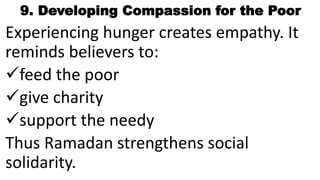
24.
9. Developing Compassionfor the Poor
Experiencing hunger creates empathy. It
reminds believers to:
✓feed the poor
✓give charity
✓support the needy
Thus Ramadan strengthens social
solidarity.
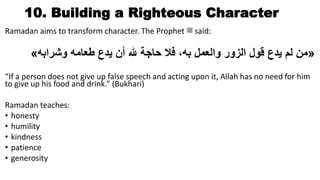
25.
10. Building aRighteous Character
Ramadan aims to transform character. The Prophet ﷺ said:
«
وشرابه طعامه يدع أن هلل حاجة فال ،به والعمل الزور قول يدع لم من
»
“If a person does not give up false speech and acting upon it, Allah has no need for him
to give up his food and drink.” (Bukhari)
Ramadan teaches:
• honesty
• humility
• kindness
• patience
• generosity
26.
11. Strengthening theMuslim Community
Ramadan brings unity through:
•congregational prayers
•communal ifṭār
•shared worship
•charity
It builds brotherhood and sisterhood in
Islam.
27.
12. Preparing theBeliever Lifelong
spiritual transformation
Ramadan is a spiritual training school. The goal is not
temporary change but lifelong transformation. A
successful Ramadan produces a believer who:
•prays regularly
•avoids sins
•reads Qur'an often
•maintains good character
28.
رمضان مع التوحيدتجديد استراتيجيات
STRATEGIES TO RENEW OUR TAWHEED THROUGH RAMADAN
الربوبية توحيد – Affirm Allah’s Lordship: Recognize Allah as the sole Creator,
Sustainer, and Provider.
اْللوهية توحيد – Worship Allah Alone: Direct all acts of worship to Allah without
partners.
والصفات اْلسماء توحيد – Affirm His Names & Attributes: Believe in Allah’s Names and
Attributes without distortion.
هللا على اَّلعتماد – Tawakkul (Reliance on Allah): Trust Allah in every matter of life.
والكبير الصغير الشرك ترك – Avoid Shirk: Avoid associating anything or anyone with
Allah.
29.
• اَّلستغفار –Seek Forgiveness: Regularly repent to cleanse the heart from sins.
• القلب مراقبة – Monitor the Heart: Be conscious of hidden forms of shirk and riyā’
(showing off).
• هللا خلق في التأمل – Reflect on Allah’s Creation: Deep reflection strengthens faith in His
oneness.
• هللا محبة – Love Allah: Place Allah’s love above worldly attachments.
• هللا في والرجاء الخوف – Fear and Hope in Allah: Balance between His mercy and His
justice.
• هللا مع الصدق – Be Honest with Allah: Be sincere in intentions and actions.
• الناس على اَّلعتماد تجنب – Avoid Relying on Creation: Place ultimate reliance only on
Allah.
30.
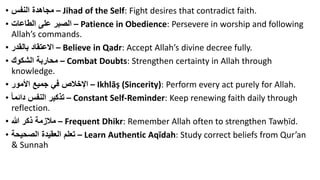
• النفس مجاهدة– Jihad of the Self: Fight desires that contradict faith.
• الطاعات على الصبر – Patience in Obedience: Persevere in worship and following
Allah’s commands.
• بالقدر اَّلعتقاد – Believe in Qadr: Accept Allah’s divine decree fully.
• الشكوك محاربة – Combat Doubts: Strengthen certainty in Allah through
knowledge.
• اْلمور جميع في اإلخالص – Ikhlāṣ (Sincerity): Perform every act purely for Allah.
• ًادائم النفس تذكير – Constant Self-Reminder: Keep renewing faith daily through
reflection.
• هللا ذكر مالزمة – Frequent Dhikr: Remember Allah often to strengthen Tawḥīd.
• الصحيحة العقيدة تعلم – Learn Authentic Aqīdah: Study correct beliefs from Qur’an
& Sunnah
31.
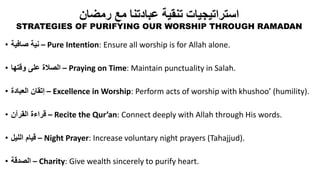
رمضان مع عبادتناتنقية استراتيجيات
STRATEGIES OF PURIFYING OUR WORSHIP THROUGH RAMADAN
• صافية نية – Pure Intention: Ensure all worship is for Allah alone.
• وقتها على الصالة – Praying on Time: Maintain punctuality in Salah.
• العبادة إتقان – Excellence in Worship: Perform acts of worship with khushoo’ (humility).
• القرآن قراءة – Recite the Qur’an: Connect deeply with Allah through His words.
• الليل قيام – Night Prayer: Increase voluntary night prayers (Tahajjud).
• الصدقة – Charity: Give wealth sincerely to purify heart.
32.
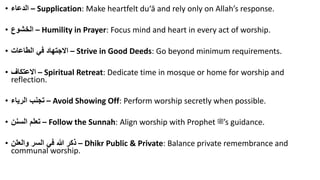
• الدعاء –Supplication: Make heartfelt du‘ā and rely only on Allah’s response.
• الخشوع – Humility in Prayer: Focus mind and heart in every act of worship.
• الطاعات في اَّلجتهاد – Strive in Good Deeds: Go beyond minimum requirements.
• اَّلعتكاف – Spiritual Retreat: Dedicate time in mosque or home for worship and
reflection.
• الرياء تجنب – Avoid Showing Off: Perform worship secretly when possible.
• السنن تعلم – Follow the Sunnah: Align worship with Prophet ’ﷺs guidance.
• والعلن السر في هللا ذكر – Dhikr Public & Private: Balance private remembrance and
communal worship.
33.
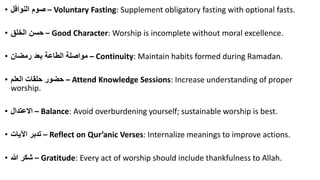
• النوافل صوم– Voluntary Fasting: Supplement obligatory fasting with optional fasts.
• الخلق حسن – Good Character: Worship is incomplete without moral excellence.
• رمضان بعد الطاعة مواصلة – Continuity: Maintain habits formed during Ramadan.
• العلم حلقات حضور – Attend Knowledge Sessions: Increase understanding of proper
worship.
• اَّلعتدال – Balance: Avoid overburdening yourself; sustainable worship is best.
• اآليات تدبر – Reflect on Qur’anic Verses: Internalize meanings to improve actions.
• هللا شكر – Gratitude: Every act of worship should include thankfulness to Allah.
34.
رمضان لنا تركهما
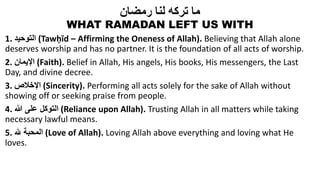
WHAT RAMADAN LEFT US WITH
1. التوحيد (Tawḥīd – Affirming the Oneness of Allah). Believing that Allah alone
deserves worship and has no partner. It is the foundation of all acts of worship.
2. اإليمان (Faith). Belief in Allah, His angels, His books, His messengers, the Last
Day, and divine decree.
3. اإلخالص (Sincerity). Performing all acts solely for the sake of Allah without
showing off or seeking praise from people.
4. هللا على التوكل (Reliance upon Allah). Trusting Allah in all matters while taking
necessary lawful means.
5. هلل المحبة (Love of Allah). Loving Allah above everything and loving what He
loves.
35.
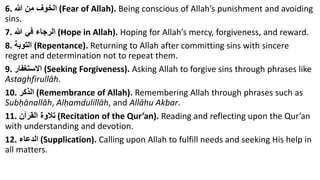
6. هللا منالخوف (Fear of Allah). Being conscious of Allah’s punishment and avoiding
sins.
7. هللا في الرجاء (Hope in Allah). Hoping for Allah’s mercy, forgiveness, and reward.
8. التوبة (Repentance). Returning to Allah after committing sins with sincere
regret and determination not to repeat them.
9. اَّلستغفار (Seeking Forgiveness). Asking Allah to forgive sins through phrases like
Astaghfirullāh.
10. الذكر (Remembrance of Allah). Remembering Allah through phrases such as
Subḥānallāh, Alḥamdulillāh, and Allāhu Akbar.
11. القرآن تالوة (Recitation of the Qur’an). Reading and reflecting upon the Qur’an
with understanding and devotion.
12. الدعاء (Supplication). Calling upon Allah to fulfill needs and seeking His help in
all matters.
36.
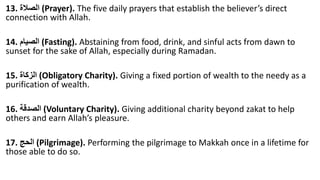
13. الصالة (Prayer).The five daily prayers that establish the believer’s direct
connection with Allah.
14. الصيام (Fasting). Abstaining from food, drink, and sinful acts from dawn to
sunset for the sake of Allah, especially during Ramadan.
15. الزكاة (Obligatory Charity). Giving a fixed portion of wealth to the needy as a
purification of wealth.
16. الصدقة (Voluntary Charity). Giving additional charity beyond zakat to help
others and earn Allah’s pleasure.
17. الحج (Pilgrimage). Performing the pilgrimage to Makkah once in a lifetime for
those able to do so.
37.
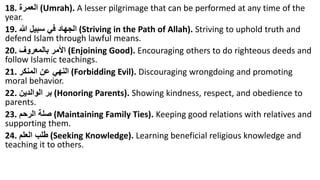
18. العمرة (Umrah).A lesser pilgrimage that can be performed at any time of the
year.
19. هللا سبيل في الجهاد (Striving in the Path of Allah). Striving to uphold truth and
defend Islam through lawful means.
20. بالمعروف اْلمر (Enjoining Good). Encouraging others to do righteous deeds and
follow Islamic teachings.
21. المنكر عن النهي (Forbidding Evil). Discouraging wrongdoing and promoting
moral behavior.
22. الوالدين بر (Honoring Parents). Showing kindness, respect, and obedience to
parents.
23. الرحم صلة (Maintaining Family Ties). Keeping good relations with relatives and
supporting them.
24. العلم طلب (Seeking Knowledge). Learning beneficial religious knowledge and
teaching it to others.
38.
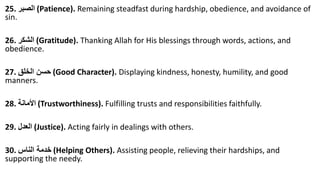
25. الصبر (Patience).Remaining steadfast during hardship, obedience, and avoidance of
sin.
26. الشكر (Gratitude). Thanking Allah for His blessings through words, actions, and
obedience.
27. الخلق حسن (Good Character). Displaying kindness, honesty, humility, and good
manners.
28. اْلمانة (Trustworthiness). Fulfilling trusts and responsibilities faithfully.
29. العدل (Justice). Acting fairly in dealings with others.
30. الناس خدمة (Helping Others). Assisting people, relieving their hardships, and
supporting the needy.
39.
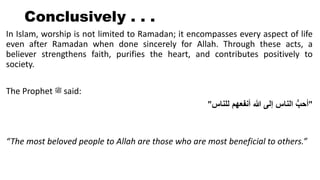
Conclusively . ..
In Islam, worship is not limited to Ramadan; it encompasses every aspect of life
even after Ramadan when done sincerely for Allah. Through these acts, a
believer strengthens faith, purifies the heart, and contributes positively to
society.
The Prophet ﷺ said:
"للناس أنفعهم هللا إلى الناس ُّ"أحب
“The most beloved people to Allah are those who are most beneficial to others.”