QUADRATIC
INEQUALITY
Objectives:
*Illustrates quadratic
inequalities
*Solves quadratic
inequalities.
•Review:
Ask the following questions:
1.) What is a quadratic equation?
2.) What is the standard form of a
quadratic equation?
3.) Give examples of a quadratic
equation.
Suppose we are going to change
the equal sign (=) of the
quadratic equation 𝒂𝒙𝟐
+ 𝒃𝒙 +
𝒄 = 𝟎 into >, this becomes 𝒂𝒙𝟐
+
𝒃𝒙 + 𝒄 > 𝟎. Is this still a quadratic
equation?
Why? What does an equation
mean?
5
A quadratic inequality is one that can be written
in one of the following standard forms:
A quadratic inequality is in standard form when
the inequality is set to zero (0).
5
Which of the following mathematical sentences
are quadratic inequalities?
a.) x2 + 9x +20 = 0
b.) 2t2 < 21- 9t
c.) r2 + 10r ≤ - 16
d.) 3w2 + 12w < 0
e.) 2s2 + 7s +5 ≥ 0
Steps in Solving a Quadratic Inequality
1.) Express the quadratic inequality as a quadratic equation in the
form of ax2 + bx + c = 0 and then solve for x
2.) Locate the numbers found in step one on a number line. They
serve as the boundary points. The number line will be divided into
regions.
3.) Choose one number from each region as a test point. Substitute
the test point to the original inequality.
4.) If the inequality holds true for the test point, then that region
belongs to the solution set, otherwise, it is not part of the solution
set of the inequality.
5.) Write the solution set as interval notation.
5
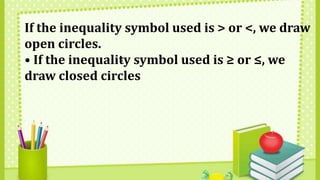
If the inequality symbol used is > or <, we draw
open circles.
• If the inequality symbol used is ≥ or ≤, we
draw closed circles
.
5
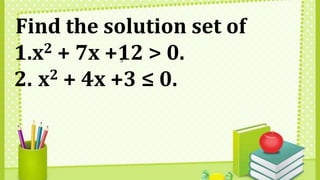
Find the solution set of
1.x2 + 7x +12 > 0.
2. x2 + 4x +3 ≤ 0.
5
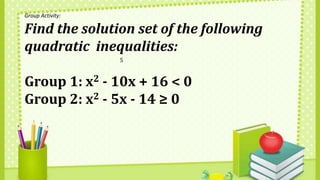
Group Activity:
Find the solution set of the following
quadratic inequalities:
Group 1: x2 - 10x + 16 < 0
Group 2: x2 - 5x - 14 ≥ 0
. I. Draw a if it is a quadratic inequality and draw a if
it is not:
1.) x2 + 3x > 2
2.) 2x2 - 5x – 12 = 0
3.) 7x2 < 28
4.) 9x2 = 4
5.) 5 ≥ x2 – x
6.) 2y2 + 1 ≤ 7y
7.) 4x + 4 ≥ 0
8.) 12 – 5m > -8
II.Find the solution set of x2 - x ≤ 20.