Objectives
At the endof the lesson, the students should be able to:
1. Define social influence, social perception, and social
interaction.
2. Differentiate the three concepts with real-life
examples.
3. Analyze how these dynamics affect relationships in
school, family, and community.
4. Demonstrate positive applications of social influence,
perception, and interaction through group activities.
3.
“Think of atime
when you changed
your decision
because of what
others said or did.
What happened?”
4.
Social Influence
: refersto the ways in which individuals change
their behavior, attitudes, or beliefs due to the
presence or actions of others.
Forms of Influence:
Conformity – adjusting behavior to align with group
standards.
Compliance – agreeing to a request even if one
privately disagrees.
Obedience – following orders from an authority figure.
5.
Social Perception
Definition:Social perception is the process of interpreting and understanding
other people’s behaviors, emotions, and intentions.
Key Aspects:
First Impressions – formed quickly and can strongly affect relationships.
Attribution – how we explain others’ behavior (internal causes like personality vs.
external causes like situation).
Stereotypes and Biases – shortcuts in perception that may lead to unfair judgments.
Example: Assuming a quiet classmate is unfriendly (internal attribution) when
in fact they may just be shy (external factor).
Importance: Accurate social perception fosters empathy, reduces conflict,
and builds healthier relationships.
6.
Social Interaction
Definition: Social interaction is the dynamic process in which
individuals act and react in relation to others. It is the
foundation of all social relationships.
Forms of Interaction:
Cooperation – working together toward a shared goal.
Competition – striving for a goal that only one can achieve.
Conflict – opposing actions or ideas leading to disagreements.
Accommodation and Compromise – adjusting to maintain harmony.
Example: Group projects in school, debates, family discussions,
or sports games.
Importance: Healthy interaction builds trust, develops
communication skills, and strengthens community bonds.
7.
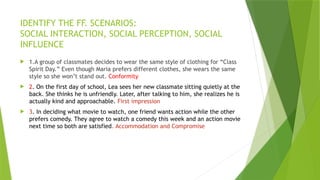
IDENTIFY THE FF.SCENARIOS:
SOCIAL INTERACTION, SOCIAL PERCEPTION, SOCIAL
INFLUENCE
1.A group of classmates decides to wear the same style of clothing for “Class
Spirit Day.” Even though Maria prefers different clothes, she wears the same
style so she won’t stand out. Conformity
2. On the first day of school, Lea sees her new classmate sitting quietly at the
back. She thinks he is unfriendly. Later, after talking to him, she realizes he is
actually kind and approachable. First impression
3. In deciding what movie to watch, one friend wants action while the other
prefers comedy. They agree to watch a comedy this week and an action movie
next time so both are satisfied. Accommodation and Compromise
8.
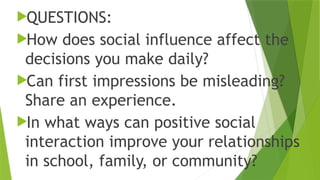
QUESTIONS:
How does socialinfluence affect the
decisions you make daily?
Can first impressions be misleading?
Share an experience.
In what ways can positive social
interaction improve your relationships
in school, family, or community?
9.
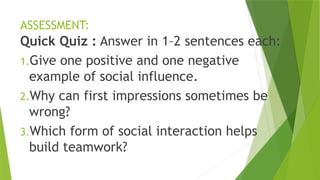
ASSESSMENT:
Quick Quiz :Answer in 1–2 sentences each:
1.Give one positive and one negative
example of social influence.
2.Why can first impressions sometimes be
wrong?
3.Which form of social interaction helps
build teamwork?