Separating the
Wheat from the Chaff

The Reality
of Proving
a Foodborne
Illness Case

William D. Marler, Esq.
The Chaff – Cases We Turn Away Every Day

 • Since 1993          •   Only a fraction of the victims
   Marler Clark has        who contact our office end
   represented             up being represented.
   thousands of        •   Who do we turn away?
   legitimate food
   illness victims
   in over 30 States.
   Settlements and
   Verdicts – total over
   $600,000,000.
Incubation Period

 • The time between
   ingestion of a
   foodborne pathogen
   and the onset of
   symptoms, are only
   ranges – and wide
   ones at that – they
   can still be used to
   identify a suspect
   food-poisoning
   claim.
Incubation Periods of
Common Foodborne Pathogens

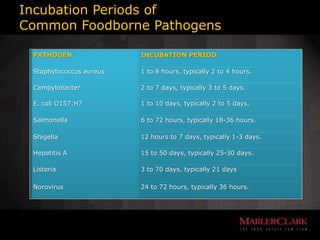
 PATHOGEN                INCUBATION PERIOD

 Staphylococcus aureus   1 to 8 hours, typically 2 to 4 hours.

 Campylobacter           2 to 7 days, typically 3 to 5 days.

 E. coli O157:H7         1 to 10 days, typically 2 to 5 days.

 Salmonella              6 to 72 hours, typically 18-36 hours.

 Shigella                12 hours to 7 days, typically 1-3 days.

 Hepatitis A             15 to 50 days, typically 25-30 days.

 Listeria                3 to 70 days, typically 21 days

 Norovirus               24 to 72 hours, typically 36 hours.
Within Hours of Eating


                     • After getting out of
                       church yesterday
                       morning, I stopped
                       at a restaurant to
                       grab a sandwich….
                       Within two hours of
                       eating that sandwich
                       I became very ill.
The Food Looked/Smelled/Tasted Funny

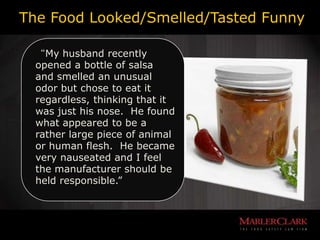
  “My husband recently
  opened a bottle of salsa
  and smelled an unusual
  odor but chose to eat it
  regardless, thinking that it
  was just his nose. He found
  what appeared to be a
  rather large piece of animal
  or human flesh. He became
  very nauseated and I feel
  the manufacturer should be
  held responsible.”
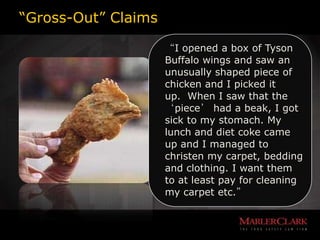
“Gross-Out” Claims

                     “I opened a box of Tyson
                     Buffalo wings and saw an
                     unusually shaped piece of
                     chicken and I picked it
                     up. When I saw that the
                     ‘piece’ had a beak, I got
                     sick to my stomach. My
                     lunch and diet coke came
                     up and I managed to
                     christen my carpet, bedding
                     and clothing. I want them
                     to at least pay for cleaning
                     my carpet etc.”
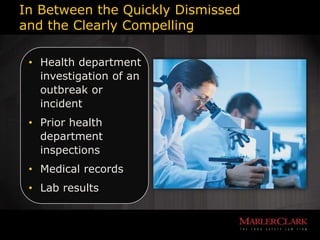
In Between the Quickly Dismissed
and the Clearly Compelling

 • Health department
   investigation of an
   outbreak or
   incident
 • Prior health
   department
   inspections
 • Medical records
 • Lab results
Health Department
Investigation of an Outbreak

• All states have agencies tasked with monitoring
  bacterial and viral illnesses associated with food
  consumption
• The scope of the investigation varies from case
  to case
• It is very difficult to dispute a health department-
  confirmed outbreak or even an isolated case.
• Health departments do not point the finger
  prematurely. Most epidemiologist will not confirm
  an outbreak without 95% confidence in a
  particular conclusion.
Can the Plaintiff Make a Case Without
Health Department Support?

• In cases in which the health department cannot
  rule out a source but also cannot identify it with
  95% certainty, it is possible for a plaintiff to make
  a claim for damages even without a health
  department’s confirmation of an outbreak.

• In these cases, reliable expert opinion or
  examination of the health department
  investigators themselves can establish the source
  of a plaintiff’s illness with sufficient certainty to
  meet the legal burden of proof.
Proving a Case Using Prior Health
Inspections/Violations

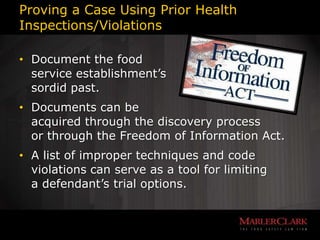
• Document the food
  service establishment’s
  sordid past.
• Documents can be
  acquired through the discovery process
  or through the Freedom of Information Act.
• A list of improper techniques and code
  violations can serve as a tool for limiting
  a defendant’s trial options.
Identifying the Improper Procedure
That Led to the Contamination of the Food

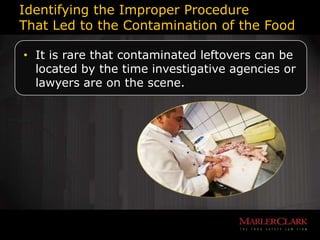
• It is rare that contaminated leftovers can be
  located by the time investigative agencies or
  lawyers are on the scene.
Improper Cooking Procedures

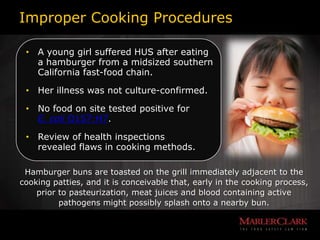
 • A young girl suffered HUS after eating
   a hamburger from a midsized southern
   California fast-food chain.

 • Her illness was not culture-confirmed.

 • No food on site tested positive for
   E. coli O157:H7.

 • Review of health inspections
   revealed flaws in cooking methods.

 Hamburger buns are toasted on the grill immediately adjacent to the
cooking patties, and it is conceivable that, early in the cooking process,
    prior to pasteurization, meat juices and blood containing active
          pathogens might possibly splash onto a nearby bun.
Improper Refrigeration

                                • A Chinese buffet-restaurant in
                                  Ohio was the suspected source
                                  of an E. coli O157:H7 outbreak.
                                • No contaminated leftover food
                                  was found.
                                • A number of ill patrons were
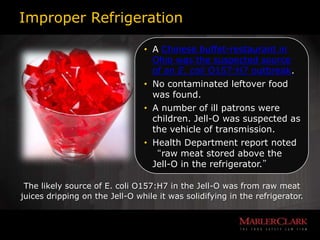
                                  children. Jell-O was suspected as
                                  the vehicle of transmission.
                                • Health Department report noted
                                  “raw meat stored above the
                                  Jell-O in the refrigerator.”

 The likely source of E. coli O157:H7 in the Jell-O was from raw meat
juices dripping on the Jell-O while it was solidifying in the refrigerator.
Improper Storage and Cooking Procedures

• Banquet-goers in
  southeastern
  Washington tested
  positive for Salmonella.

• Leftover food items
  had been discarded
  or tested negative.

• Restaurant had “pooled” dozens, if not hundreds,
  of raw eggs in a single bucket for storage
  overnight, then used them as a “wash” on a
  specialty dessert that was not cooked thoroughly.
Patterns of Poor Food-Handling Practices

• In a situation where
  defending the case
  from a liability
  standpoint is a
  less-than-certain
  undertaking, defense
  counsel may be wary
  of admission of
  evidence that will make
  the defendant look bad
  in the eyes of the jury.
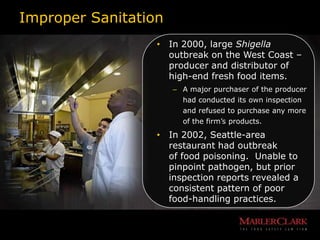
Improper Sanitation
                  • In 2000, large Shigella
                    outbreak on the West Coast –
                    producer and distributor of
                    high-end fresh food items.
                      – A major purchaser of the producer
                        had conducted its own inspection
                        and refused to purchase any more
                        of the firm’s products.
                  • In 2002, Seattle-area
                    restaurant had outbreak
                    of food poisoning. Unable to
                    pinpoint pathogen, but prior
                    inspection reports revealed a
                    consistent pattern of poor
                    food-handling practices.
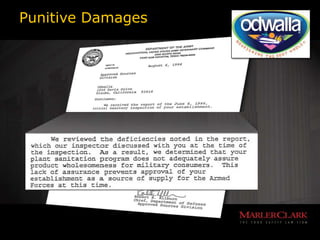
Punitive Damages
Proving a Case Using Medical Records

• Evidence of a possible
  foodborne illness
  source can sometimes
  be found in the
  person’s medical-
  treatment records,
  such as an emergency
  room notation of a
  suspected food or drink
  item, or a lab test
  result.
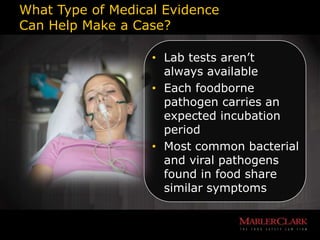
What Type of Medical Evidence
Can Help Make a Case?

                   • Lab tests aren’t
                     always available
                   • Each foodborne
                     pathogen carries an
                     expected incubation
                     period
                   • Most common bacterial
                     and viral pathogens
                     found in food share
                     similar symptoms
Proving a Case Using Lab Tests
 • Many states require reporting
   of tests for a number of
   pathogens, including;
    – E. coli O157:H7
    – Salmonella

    – Shigella

    – Listeria

    – Hepatitis A

    – Campylobacter

 • The process of obtaining the
   DNA fingerprint is called
   Pulse Field Gel
   Electrophoresis (PFGE).
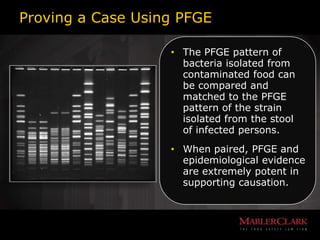
Proving a Case Using PFGE

                   • The PFGE pattern of
                     bacteria isolated from
                     contaminated food can
                     be compared and
                     matched to the PFGE
                     pattern of the strain
                     isolated from the stool
                     of infected persons.
                   • When paired, PFGE and
                     epidemiological evidence
                     are extremely potent in
                     supporting causation.
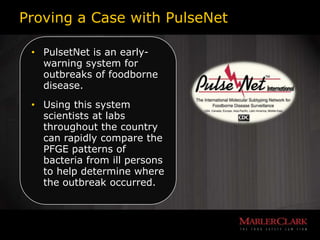
Proving a Case with PulseNet

 • PulsetNet is an early-
   warning system for
   outbreaks of foodborne
   disease.
 • Using this system
   scientists at labs
   throughout the country
   can rapidly compare the
   PFGE patterns of
   bacteria from ill persons
   to help determine where
   the outbreak occurred.
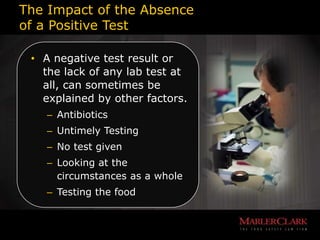
The Impact of the Absence
of a Positive Test

 • A negative test result or
   the lack of any lab test at
   all, can sometimes be
   explained by other factors.
   – Antibiotics
   – Untimely Testing
   – No test given
   – Looking at the
     circumstances as a whole
   – Testing the food
Legitimate Cases:
What Do They Look Like?

 • The Case of the
   Ammonia Chicken
   Tenders
 • The Case of the
   Restaurant with
   No Hot Water
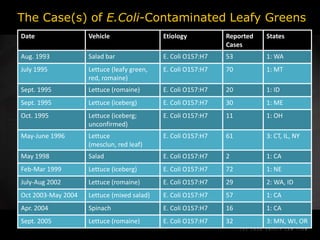
 • The Case(s)
   of E. coli-Contaminated
   Leafy Greens
The Case(s) of E.Coli-Contaminated Leafy Greens
Date                Vehicle                 Etiology          Reported   States
                                                              Cases
Aug. 1993           Salad bar               E. Coli O157:H7   53         1: WA
July 1995           Lettuce (leafy green,   E. Coli O157:H7   70         1: MT
                    red, romaine)
Sept. 1995          Lettuce (romaine)       E. Coli O157:H7   20         1: ID
Sept. 1995          Lettuce (iceberg)       E. Coli O157:H7   30         1: ME
Oct. 1995           Lettuce (iceberg;       E. Coli O157:H7   11         1: OH
                    unconfirmed)
May-June 1996       Lettuce                 E. Coli O157:H7   61         3: CT, IL, NY
                    (mesclun, red leaf)
May 1998            Salad                   E. Coli O157:H7   2          1: CA
Feb-Mar 1999        Lettuce (iceberg)       E. Coli O157:H7   72         1: NE
July-Aug 2002       Lettuce (romaine)       E. Coli O157:H7   29         2: WA, ID
Oct 2003-May 2004   Lettuce (mixed salad)   E. Coli O157:H7   57         1: CA
Apr. 2004           Spinach                 E. Coli O157:H7   16         1: CA
Sept. 2005          Lettuce (romaine)       E. Coli O157:H7   32         3: MN, WI, OR
Here We Go Again:
Another Dole E.coli O157:H7 Outbreak
 • The FDA and CDC found that
   spinach sold under several brand
   names had all come from the
   Natural Selection Foods processing
   center in San Juan Bautista, CA.
 • Further data narrowed the possible
   sources of outbreak down to Dole.
 • The FDA found that a bag of Dole
   baby spinach sold in
   Albuquerque, NM, contaminated
   with E. coli O157:H7, bore the same
   genetic marker as the outbreak
   strain.
 • Lab evidence traced the source of
   the contaminated spinach to one
   field. Pigs, water and cattle feces
   all tested positive to the same
   strain.
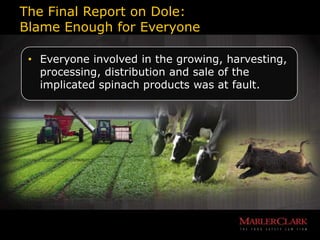
The Final Report on Dole:
Blame Enough for Everyone

 • Everyone involved in the growing, harvesting,
   processing, distribution and sale of the
   implicated spinach products was at fault.
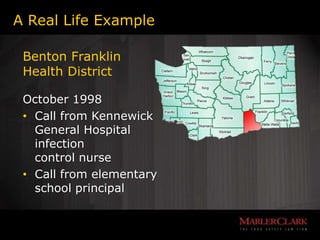
A Real Life Example

 Benton Franklin
 Health District

 October 1998
 • Call from Kennewick
   General Hospital
   infection
   control nurse
 • Call from elementary
   school principal
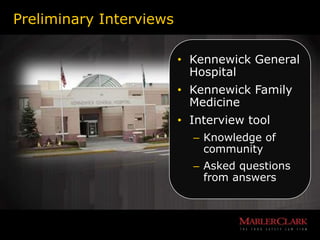
Preliminary Interviews

                         • Kennewick General
                           Hospital
                         • Kennewick Family
                           Medicine
                         • Interview tool
                           – Knowledge of
                             community
                           – Asked questions
                             from answers
Case Finding

 • Established communication with area
   laboratories, hospitals and physicians

 • Notified the Washington State Department
   of Health Epidemiology office

 • Established case definition early
   and narrowed later
Finley Schools

  • Finley
    School District
    – K-5
    – Middle School
    – High School
  • Rural area
    – Water supply
    – Irrigation water
    – Septic system
    – Buses
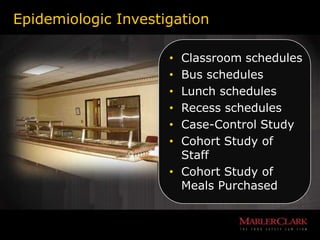
Epidemiologic Investigation

                     • Classroom schedules
                     • Bus schedules
                     • Lunch schedules
                     • Recess schedules
                     • Case-Control Study
                     • Cohort Study of
                       Staff
                     • Cohort Study of
                       Meals Purchased
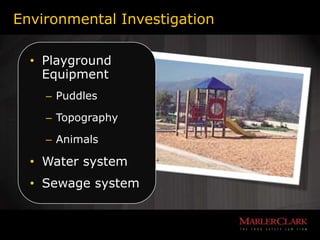
Environmental Investigation

  • Playground
    Equipment
    – Puddles

    – Topography

    – Animals

  • Water system
  • Sewage system
Environmental Investigation


                    • Hand Rails

                    • Dirty Can Opener

                    • Army Worms

                    • Stray dogs
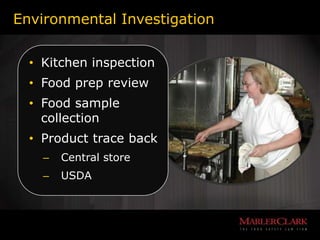
Environmental Investigation


  • Kitchen inspection
  • Food prep review
  • Food sample
    collection
  • Product trace back
    –   Central store
    –   USDA
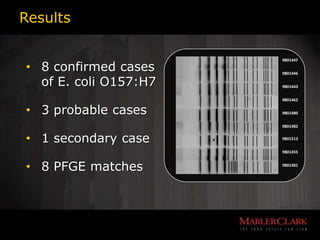
Results

                       9801447

• 8 confirmed cases    9801446

  of E. coli O157:H7   9801443

                       9801462

• 3 probable cases     9801480

                       9801482


• 1 secondary case     9801513

                       9801455


• 8 PFGE matches       9801481
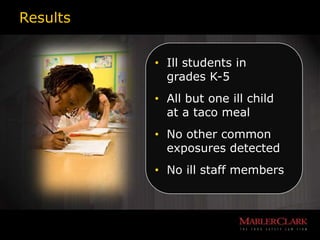
Results


          • Ill students in
            grades K-5
          • All but one ill child
            at a taco meal
          • No other common
            exposures detected
          • No ill staff members
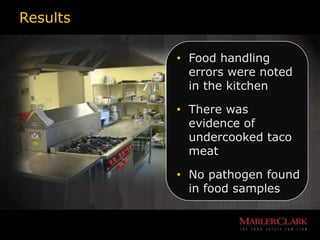
Results

          • Food handling
            errors were noted
            in the kitchen

          • There was
            evidence of
            undercooked taco
            meat

          • No pathogen found
            in food samples
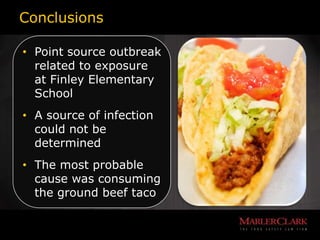
Conclusions

• Point source outbreak
  related to exposure
  at Finley Elementary
  School
• A source of infection
  could not be
  determined
• The most probable
  cause was consuming
  the ground beef taco
The Lawsuit

 • Eleven minor plaintiffs:
   10 primary cases, 1 secondary case

 • Parents also party to the lawsuit,
   individually and as guardians ad litem

 • Two defendants: Finley School District
   and Northern States Beef
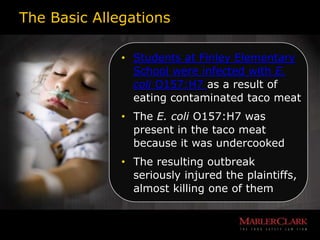
The Basic Allegations

              • Students at Finley Elementary
                School were infected with E.
                coli O157:H7 as a result of
                eating contaminated taco meat
              • The E. coli O157:H7 was
                present in the taco meat
                because it was undercooked
              • The resulting outbreak
                seriously injured the plaintiffs,
                almost killing one of them
At Trial: The Plaintiff’s Case

• The State and the BFHD
  conducted a fair and thorough
  investigation
• Final report issued by the
  WDOH concluded the taco
  meat was the most likely
  cause of the outbreak
• The conclusion reached as a
  result of the investigation was
  the correct one
More of The Plaintiff’s Case

  • There were serious deficiencies in the
    District’s foodservice operation
  • There were reasons to doubt the District’s
    explanation of how the taco meat was
    prepared
  • The law only requires a 51% probability
    to prove the outbreak’s cause-in-fact
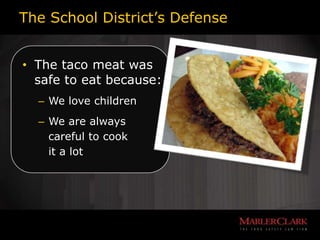
The School District’s Defense


• The taco meat was
  safe to eat because:
  – We love children
  – We are always
    careful to cook
    it a lot
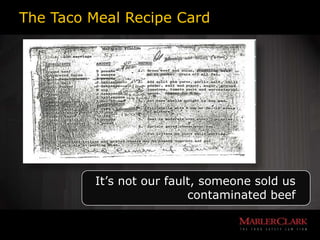
The Taco Meal Recipe Card


         It’s not our fault, someone sold us
                          contaminated beef
More of the School District’s Defense

• We’ve never poisoned
  anyone before
• The health departments
  botched the investigation
  and jumped to a hasty
  conclusion
• Something else caused
  the outbreak
What Will a Jury Think?
What Did This Jury Think?

                    • The investigation was
                      fair and thorough
                    • More probably than not,
                      undercooked taco meat
                      caused the children to
                      become ill
                    • The School District was
                      ultimately responsible
                      for ensuring the safety
                      of the food it sold to its
                      students
In The End
• After a six week trial,
  plaintiffs were awarded
  $4,750,000
• The District appealed
  the verdict on grounds
  that product liability
  law did not apply
• September 2003 the
  WA State Supreme
  Court dismissed the
  District’s case
• Final award -
  $6,068,612.85
Conclusion

  • Decision makers in the food industry must
    be prepared to quickly and accurately
    assess potential foodborne illness claims.

  • They must have an understanding of the
    epidemiological, microbiological, and
    environmental health issues at play.

  • Rash action to disregard or deny a claim
    could be damaging to the company and to
    the public.
Questions