BIOCHEMISTRY
Proteins part –II
Amino acid
D-pharm 2nd
year
E.R.20
Presented by
Pragati K. Mahajan
Ramtek
LEARNING OUTCOMES
• Definition
• General properties of amino acid
• classification of amino acids.
Pragati K. Mahajan
AMINO
ACIDS
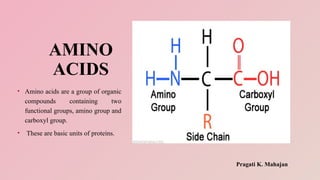
• Amino acids are a group of organic
compounds containing two
functional groups, amino group and
carboxyl group.
• These are basic units of proteins.
Pragati K. Mahajan
General properties of amino acid
• Amino acids are white crystalline solid substances
• They have a very high melting and boiling point.
• Amino acid can be sweet, tasteless or bitter
• Most of them are soluble in water and insoluble in organic solvents.
• On heating to high temperatures, they decompose.
• All amino acids (except glycine) are optically active.
• They are amphoteric in nature and act as both acids and bases due to two amine and carboxylic
groups present. They are called ampholytes or Zwitterion.
• At a certain pH known as the isoelectric point, an amino acid has no overall charge, since the
number of protonated ammonium groups (positive charges) and deprotonated carboxylate
groups (negative charges) are equal.
Pragati K. Mahajan
Classification Of
Amino Acid
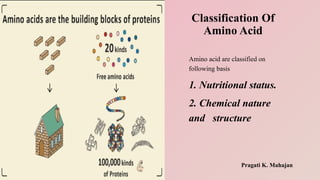
Amino acid are classified on
following basis
1. Nutritional status.
2. Chemical nature
and structure
Pragati K. Mahajan
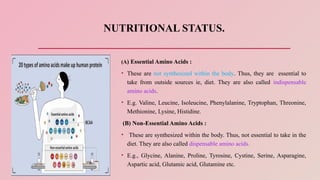
NUTRITIONAL STATUS.
(A) Essential Amino Acids :
• These are not synthesized within the body. Thus, they are essential to
take from outside sources ie, diet. They are also called indispensable
amino acids.
• E.g. Valine, Leucine, Isoleucine, Phenylalanine, Tryptophan, Threonine,
Methionine, Lysine, Histidine.
(B) Non-Essential Amino Acids :
• These are synthesized within the body. Thus, not essential to take in the
diet. They are also called dispensable amino acids.
• E.g., Glycine, Alanine, Proline, Tyrosine, Cystine, Serine, Asparagine,
Aspartic acid, Glutamic acid, Glutamine etc.
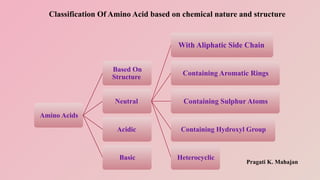
Amino Acids
Based On
Structure
Neutral
With Aliphatic Side Chain
Containing Aromatic Rings
Containing Sulphur Atoms
Containing Hydroxyl Group
Heterocyclic
Acidic
Basic
Classification Of Amino Acid based on chemical nature and structure
Pragati K. Mahajan
Classification Of Amino Acid based on chemical nature and structure
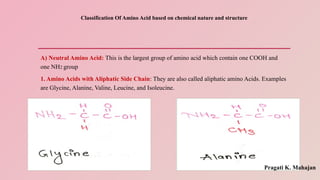
A) Neutral Amino Acid: This is the largest group of amino acid which contain one COOH and
one NH2 group
1. Amino Acids with Aliphatic Side Chain: They are also called aliphatic amino Acids. Examples
are Glycine, Alanine, Valine, Leucine, and Isoleucine.
Pragati K. Mahajan
Classification Of Amino Acid based on chemical nature and structure
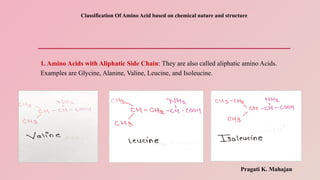
1. Amino Acids with Aliphatic Side Chain: They are also called aliphatic amino Acids.
Examples are Glycine, Alanine, Valine, Leucine, and Isoleucine.
Pragati K. Mahajan
Classification Of Amino Acid based on chemical nature and structure
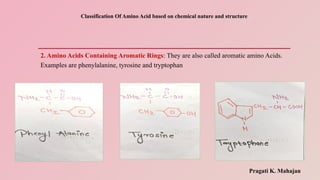
2. Amino Acids Containing Aromatic Rings: They are also called aromatic amino Acids.
Examples are phenylalanine, tyrosine and tryptophan
Pragati K. Mahajan
Classification Of Amino Acid based on chemical nature and structure
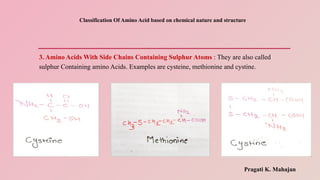
3. Amino Acids With Side Chains Containing Sulphur Atoms : They are also called
sulphur Containing amino Acids. Examples are cysteine, methionine and cystine.
Pragati K. Mahajan
Classification Of Amino Acid based on chemical nature and structure
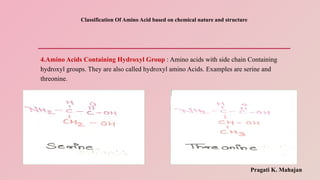
4.Amino Acids Containing Hydroxyl Group : Amino acids with side chain Containing
hydroxyl groups. They are also called hydroxyl amino Acids. Examples are serine and
threonine.
Pragati K. Mahajan
Classification Of Amino Acid based on chemical nature and structure
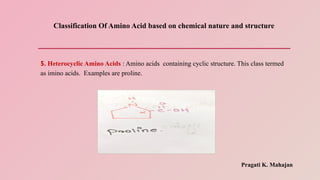
5. Heterocyclic Amino Acids : Amino acids containing cyclic structure. This class termed
as imino acids. Examples are proline.
Pragati K. Mahajan
Classification Of Amino Acid based on chemical nature and structure
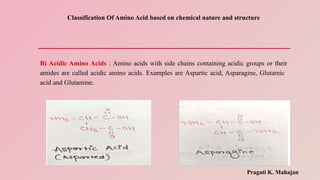
B) Acidic Amino Acids : Amino acids with side chains containing acidic groups or their
amides are called acidic amino acids. Examples are Aspartic acid, Asparagine, Glutamic
acid and Glutamine.
Pragati K. Mahajan
Classification Of Amino Acid based on chemical nature and structure
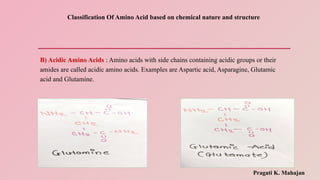
B) Acidic Amino Acids : Amino acids with side chains containing acidic groups or their
amides are called acidic amino acids. Examples are Aspartic acid, Asparagine, Glutamic
acid and Glutamine.
Pragati K. Mahajan
Classification Of Amino Acid based on chemical nature and structure
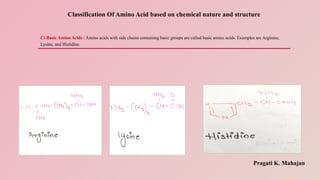
C) Basic Amino Acids : Amino acids with side chains containing basic groups are called basic amino acids. Examples are Arginine,
Lysine, and Histidine.
Pragati K. Mahajan
THANK YOU