Mariano-da-Silva et al. Int. J. Agron. Agri. Res.
International Journal of Agronomy and Agricultural Research
ISSN: 2223-7054 (Print); 2225-3610 (Online) | IJAAR |
Website: https://www.innspub.net
Email: info@innspub.net
RESEARCH PAPER
Vol. 28, Issue: 6, 2026
OPEN ACCESS
Protective effects of exogenous L-proline on germination and early seedling
development of soybean under osmotic stress
Samuel Mariano-da-Silva1, Rafael Dal Bosco Ducatti*2,3, André Luiz Radünz1,
Marco Aurélio Tamontin1, Siumar Pedro Tironi1, Vanderlei Smaniotto4
1Federal University of Fronteira Sul. Chapecó, SC, Brazil
2Dugan Agribusiness LTDA. Chapecó, SC, Brazil
3Kelpia do Brasil. Luís Eduardo Magalhães, BA, Brazil
4Federal University of Fronteira Sul. Erechim, RS, Brazil
DOI: https://dx.doi.org/10.12692/ijaar/28.6.1-8
ARTICLE INFORMATION ABSTRACT
RESEARCH PAPER
Vol. 28, Issue: 6, p. 1-8, 2026
Int. J. Agron. Agri. Res.
Mariano-da-Silva et al.
ACCEPTED: 03 June, 2026
PUBLISHED: 09 June, 2026
Corresponding author:
Rafael Dal Bosco Ducatti
Email: r.ducatti@dugan.com.br
Copyright © by the Authors. This article is
an open access article and distributed
under the terms and conditions of the
Creative Commons Attribution 4.0
(CC BY 4.0) license.
Salinity is a major abiotic stress limiting soybean germination and seedling
establishment by impairing water uptake, metabolism, and early growth. Exogenous
application of L-proline has emerged as a potential strategy to improve plant
tolerance to saline conditions. Soybean seeds (GH 5933 IPRO) were treated with
four concentrations of L-proline (0, 0.04, 0.08, and 0.12 g kg⁻¹ seed) and subjected
to four osmotic potentials (0.0, −0.3, −0.6, and −0.9 MPa) induced by NaCl.
Germination, seed vigor, seedling growth, and dry matter accumulation were
evaluated in a completely randomized factorial design. Salinity significantly reduced
seed vigor from approximately 92% under non-saline conditions to about 45% at
−0.9 MPa, while the percentage of normal seedlings declined from approximately
95% to 47%. Application of 0.12 g kg⁻¹ L-proline increased seed vigor under severe
stress to approximately 74% and improved the percentage of normal seedlings to
about 75%, compared with untreated seeds. The proportion of hard and dead seeds
under severe salinity decreased from approximately 50% in untreated seeds to about
17% following L-proline treatment. Root length increased from 3.6 to 4.5 cm,
whereas shoot length increased from 1.9 to 2.4 cm with increasing L-proline
concentration. Dry matter accumulation also increased, reaching approximately 0.31
g seedling⁻¹ at the highest L-proline dose under non-saline conditions, while
biomass losses under saline stress were partially alleviated. These findings
demonstrate that exogenous L-proline enhances osmotic adjustment, improves
germination and seedling vigor, stimulates early growth, and reduces seed mortality
under salt stress, highlighting its potential as a sustainable strategy for improving
soybean establishment in saline environments.
Key words: Glycine max, Osmotic adjustment, Plant vigor, Saline stress, Seed germination
International Journal of Agronomy and Agricultural Research
ISSN: 2223-7054 (Print); 2225-3610 (Online) | IJAAR |
Vol. 28, Issue: 6, p. 1-8, 2026
Website: https://innspub.net
2 Mariano-da-Silva et al. Int. J. Agron. Agri. Res.
INTRODUCTION
Soybean (Glycine max L. Merr.) is one of the most
important agricultural crops worldwide due to its high
protein and oil content and its broad utilization in food,
feed, and biofuel production (Hartman et al., 2011). Brazil
is currently the world’s largest soybean producer; however,
several production regions are increasingly exposed to
abiotic stresses such as drought and soil salinity, which
significantly impair crop establishment and productivity
(CONAB, 2025; IBGE, 2025). Moreover, climate change is
expected to intensify the frequency and severity of these
environmental constraints, reinforcing the need for
effective strategies to enhance crop tolerance and ensure
sustainable agricultural production (Zhang et al., 2022).
Among abiotic stresses, salinity is considered one of the
primary factors limiting seed germination and seedling
establishment. Elevated salt concentrations reduce soil
osmotic potential, thereby restricting water uptake and
impairing the metabolic processes required for
germination. Additionally, excessive accumulation of
salts induces ionic toxicity, nutritional imbalance,
oxidative stress, and disruption of cellular homeostasis
(Hosseinifard et al., 2022; Hasanuzzaman et al., 2018).
In soybean, salt stress negatively affects germination rate,
seed vigor, seedling growth, photosynthetic activity, and
biomass accumulation, ultimately reducing crop
productivity (Medina et al., 2023). Likewise, drought
stress compromises several physiological and
biochemical processes, including membrane stability,
stomatal conductance, and nutrient transport,
particularly during the early stages of plant development
(Zhou et al., 2023).
Because seed germination and seedling establishment
represent highly sensitive phases of the plant life cycle, the
development of strategies capable of improving stress
tolerance during these stages is essential. In this context,
seed treatment with biostimulants and osmoprotective
compounds has emerged as a promising and sustainable
approach for mitigating the negative effects of such abiotic
stresses (Moukhtari et al., 2020). Among these
compounds, L-proline has attracted considerable scientific
interest because of its multifunctional role in plant stress
tolerance mechanisms.
Proline is a compatible osmolyte naturally accumulated in
plants under adverse environmental conditions and is
closely associated with tolerance to salinity, drought,
temperature extremes, and oxidative stress (Szabados and
Savouré, 2010; Trovato et al., 2019). Beyond its role in
osmotic adjustment, proline contributes to the
stabilization of proteins and cellular membranes,
protection of the photosynthetic apparatus, maintenance
of cellular redox balance, and scavenging of reactive
oxygen species (ROS) (Liang et al., 2013; Sharma et al.,
2011). Furthermore, proline metabolism is strongly linked
to stress-responsive signaling pathways and the regulation
of genes involved in plant adaptation to adverse
environmental conditions (Verslues and Sharma, 2010).
Recent studies have demonstrated that exogenous
application of proline can substantially improve plant
tolerance to abiotic stresses (Hosseinifard et al., 2022;
Mariano-da-Silva et al., 2025a; Mariano-da-Silva et al.,
2025b; Medina et al., 2023; Moukhtari et al., 2020; Zhou
et al., 2023). Collectively, these findings highlight the
potential of L-proline as an environmentally friendly and
sustainable alternative for mitigating stress-induced
damage during early plant development.
Therefore, the present study evaluated the effects of seed
treatment with exogenous L-proline on the physiological
performance of soybean seeds subjected to salt stress.
Specifically, the study investigated whether L-proline could
improve seed vigor, germination, seedling growth, and
biomass accumulation under saline conditions, while
mitigating the detrimental effects of salinity during
seedling establishment.
MATERIALS AND METHODS
The experiment was conducted at the Seed and Grain
Laboratory of the Federal University of Fronteira Sul,
Chapecó campus. Soybean seeds of the cultivar GH 5933
IPRO (Golden Harvest, 2025) were obtained from a
commercial production field as farm-saved seeds and had
not received any prior treatment.
A completely randomized factorial design was adopted,
with four replications and two experimental factors
(Pimentel-Gomes, 2000). The first factor consisted of
four osmotic potentials (0.0, -0.3, -0.6, and -0.9 MPa),
International Journal of Agronomy and Agricultural Research
ISSN: 2223-7054 (Print); 2225-3610 (Online) | IJAAR |
Vol. 28, Issue: 6, p. 1-8, 2026
Website: https://innspub.net
3 Mariano-da-Silva et al. Int. J. Agron. Agri. Res.
while the second factor comprised four L-proline
concentrations (0, 0.04, 0.08, and 0.12 g kg-1 seed).
Seeds were separated into four batches of 800 g and
stored in transparent plastic bags. Each batch received an
aqueous solution containing the respective L-proline
concentration. After solution application, air was injected
into the bags, which were vigorously shaken to ensure
uniform coating of the seeds. Subsequently, the seeds
were dried under shade at 25 ± 2°C for 24 h (Marcos
Filho, 2015).
Salinity stress was simulated using sodium chloride
(NaCl) solutions prepared according to the calibration
curve proposed by Braccini et al. (1996), generating
osmotic potentials of 0.0, -0.3, -0.6, and -0.9 MPa. Based
on the classification of Ayub et al. (2020), these osmotic
potentials correspond respectively to non-saline, low-
salinity, moderately saline, and highly saline soils,
considering that soils with electrical conductivity above 4
mmhos cm-1 are classified as saline.
Each L-proline-treated seed lot was subdivided into four
sublots of 200 g. Seeds were distributed on eight sheets
of Germitest paper, with 50 seeds per sheet. The papers
were moistened with NaCl solution in a volume
equivalent to three times the dry weight of the paper. The
sheets were then rolled and maintained in a germination
chamber under constant temperature (25 ± 1°C) and
photoperiod conditions (Brasil, 2009; Sá et al., 2011).
Germination was evaluated on the fifth and eighth days
after sowing, and results were expressed as percentages
(Brasil, 2009; Sá et al., 2011). On the eighth day, shoot
and primary root lengths were measured using a
millimeter ruler, and results were expressed in
centimeters. Dry matter accumulation was determined
separately for shoots and roots of normal seedlings. Plant
material was weighed, transferred to paper bags, and
dried in a forced-air oven at 80 ± 2°C for 24 h (Sá et al.,
2011). After cooling at room temperature, samples were
reweighed, and dry matter content was expressed in
grams.
Data were subjected to analysis of variance (F-test, p ≤
0.05). Regression analyses were performed at a 95%
confidence level to evaluate the effects of osmotic
potential and L-proline concentrations. Linear and
quadratic models were selected based on orthogonal
polynomial regression criteria (Pimentel-Gomes, 2000;
Souza, 1998).
RESULTS AND DISCUSSION
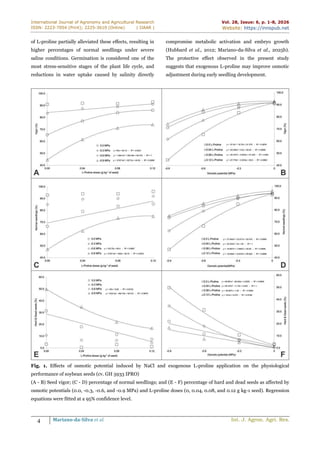
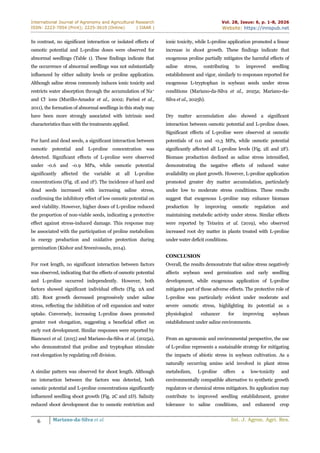
The analysis of variance (F-test) revealed a significant
interaction between osmotic potential and L-proline
concentration for seed vigor, indicating that the response
of soybean seeds to L-proline depended on the intensity
of saline stress. Partitioning of the interaction showed
significant effects of L-proline within the osmotic
potentials of -0.3, -0.6, and -0.9 MPa, while osmotic
potential significantly affected vigor at all tested L-
proline concentrations (Fig. 1A and 1B).
The regression analyses demonstrated that seed vigor
progressively declined as osmotic potential decreased,
confirming the detrimental effects of saline stress on
soybean seed performance. However, increasing
concentrations of L-proline mitigated these reductions,
particularly under moderate and severe stress conditions.
These results reinforce the role of L-proline as an
important osmoprotective compound capable of
stabilizing cellular metabolism under adverse
environmental conditions. According to Szabados and
Savouré (2010), proline acts in osmotic adjustment,
membrane stabilization, and protection against oxidative
damage. In addition, proline metabolism contributes to
the oxidative pentose phosphate pathway by generating
cytosolic NADPH, an essential reducing agent for stress
defense mechanisms (Signorelli, 2016).
For the variable normal seedlings, a significant
interaction was also detected between osmotic
potential and L-proline doses. The partitioning
analysis indicated significant effects of L-proline at
osmotic potentials of -0.6 and -0.9 MPa, while osmotic
potential affected seedling formation across all L-
proline levels (Fig. 1C and 1D).
The results indicate that saline stress severely impaired
seed germination and seedling establishment, especially
at lower osmotic potentials. Nevertheless, the application
International Journal of Agronomy and Agricultural Research
ISSN: 2223-7054 (Print); 2225-3610 (Online) | IJAAR |
Vol. 28, Issue: 6, p. 1-8, 2026
Website: https://innspub.net
4 Mariano-da-Silva et al. Int. J. Agron. Agri. Res.
of L-proline partially alleviated these effects, resulting in
higher percentages of normal seedlings under severe
saline conditions. Germination is considered one of the
most stress-sensitive stages of the plant life cycle, and
reductions in water uptake caused by salinity directly
compromise metabolic activation and embryo growth
(Hubbard et al., 2012; Mariano-da-Silva et al., 2025b).
The protective effect observed in the present study
suggests that exogenous L-proline may improve osmotic
adjustment during early seedling development.
Fig. 1. Effects of osmotic potential induced by NaCl and exogenous L-proline application on the physiological
performance of soybean seeds (cv. GH 5933 IPRO)
(A - B) Seed vigor; (C - D) percentage of normal seedlings; and (E - F) percentage of hard and dead seeds as affected by
osmotic potentials (0.0, -0.3, -0.6, and -0.9 MPa) and L-proline doses (0, 0.04, 0.08, and 0.12 g kg-1 seed). Regression
equations were fitted at a 95% confidence level.
International Journal of Agronomy and Agricultural Research
ISSN: 2223-7054 (Print); 2225-3610 (Online) | IJAAR |
Vol. 28, Issue: 6, p. 1-8, 2026
Website: https://innspub.net
5 Mariano-da-Silva et al. Int. J. Agron. Agri. Res.
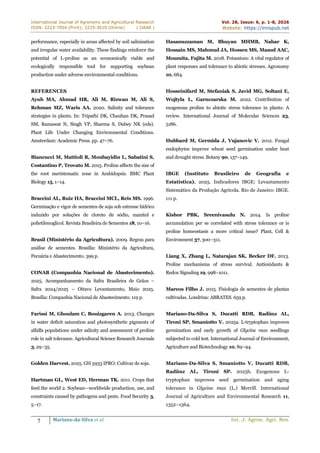
Table 1. Mean percentage of germination (% abnormal seedlings) of Glycine max seeds, treated with different doses of
L-proline and subject to salt stress
Osmotic potential
(MPa)
L-proline doses (g kg-1 of seeds)
0.0g 0.04g 0.08g 0.12g
0.0 3.75 5.50 3.00 2.75
-0.3 4.25 3.75 3.50 3.50
-0.6 2.00 3.00 5.00 7.00
-0.9 3.25 2.75 4.50 8.25
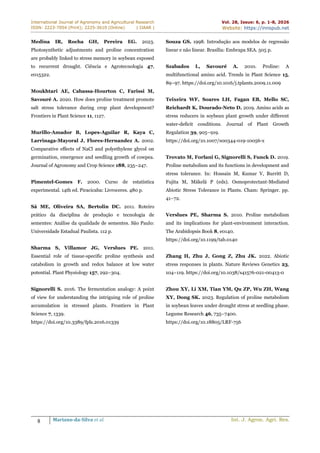
Fig. 2. Effects of osmotic potential induced by NaCl and exogenous L-proline application on soybean seedling growth
and biomass accumulation
(A - B) Root length; (C - D) shoot length; and (E - F) dry matter accumulation of soybean seedlings (cv. GH 5933 IPRO)
subjected to osmotic potentials of 0.0, -0.3, -0.6, and -0.9 MPa and treated with L-proline doses of 0, 0.04, 0.08, and
0.12 g kg-1 seed. Regression equations were fitted at a 95% confidence level.
International Journal of Agronomy and Agricultural Research
ISSN: 2223-7054 (Print); 2225-3610 (Online) | IJAAR |
Vol. 28, Issue: 6, p. 1-8, 2026
Website: https://innspub.net
6 Mariano-da-Silva et al. Int. J. Agron. Agri. Res.
In contrast, no significant interaction or isolated effects of
osmotic potential and L-proline doses were observed for
abnormal seedlings (Table 1). These findings indicate that
the occurrence of abnormal seedlings was not substantially
influenced by either salinity levels or proline application.
Although saline stress commonly induces ionic toxicity and
restricts water absorption through the accumulation of Na+
and Cl- ions (Murillo-Amador et al., 2002; Farissi et al.,
2011), the formation of abnormal seedlings in this study may
have been more strongly associated with intrinsic seed
characteristics than with the treatments applied.
For hard and dead seeds, a significant interaction between
osmotic potential and L-proline concentration was
detected. Significant effects of L-proline were observed
under -0.6 and -0.9 MPa, while osmotic potential
significantly affected the variable at all L-proline
concentrations (Fig. 1E and 1F). The incidence of hard and
dead seeds increased with increasing saline stress,
confirming the inhibitory effect of low osmotic potential on
seed viability. However, higher doses of L-proline reduced
the proportion of non-viable seeds, indicating a protective
effect against stress-induced damage. This response may
be associated with the participation of proline metabolism
in energy production and oxidative protection during
germination (Kishor and Sreenivasulu, 2014).
For root length, no significant interaction between factors
was observed, indicating that the effects of osmotic potential
and L-proline occurred independently. However, both
factors showed significant individual effects (Fig. 2A and
2B). Root growth decreased progressively under saline
stress, reflecting the inhibition of cell expansion and water
uptake. Conversely, increasing L-proline doses promoted
greater root elongation, suggesting a beneficial effect on
early root development. Similar responses were reported by
Biancucci et al. (2015) and Mariano-da-Silva et al. (2025a),
who demonstrated that proline and tryptophan stimulate
root elongation by regulating cell division.
A similar pattern was observed for shoot length. Although
no interaction between the factors was detected, both
osmotic potential and L-proline concentrations significantly
influenced seedling shoot growth (Fig. 2C and 2D). Salinity
reduced shoot development due to osmotic restriction and
ionic toxicity, while L-proline application promoted a linear
increase in shoot growth. These findings indicate that
exogenous proline partially mitigates the harmful effects of
saline stress, contributing to improved seedling
establishment and vigor, similarly to responses reported for
exogenous L-tryptophan in soybean seeds under stress
conditions (Mariano-da-Silva et al., 2025a; Mariano-da-
Silva et al., 2025b).
Dry matter accumulation also showed a significant
interaction between osmotic potential and L-proline doses.
Significant effects of L-proline were observed at osmotic
potentials of 0.0 and -0.3 MPa, while osmotic potential
significantly affected all L-proline levels (Fig. 2E and 2F).
Biomass production declined as saline stress intensified,
demonstrating the negative effects of reduced water
availability on plant growth. However, L-proline application
promoted greater dry matter accumulation, particularly
under low to moderate stress conditions. These results
suggest that exogenous L-proline may enhance biomass
production by improving osmotic regulation and
maintaining metabolic activity under stress. Similar effects
were reported by Teixeira et al. (2019), who observed
increased root dry matter in plants treated with L-proline
under water deficit conditions.
CONCLUSION
Overall, the results demonstrate that saline stress negatively
affects soybean seed germination and early seedling
development, while exogenous application of L-proline
mitigates part of these adverse effects. The protective role of
L-proline was particularly evident under moderate and
severe osmotic stress, highlighting its potential as a
physiological enhancer for improving soybean
establishment under saline environments.
From an agronomic and environmental perspective, the use
of L-proline represents a sustainable strategy for mitigating
the impacts of abiotic stress in soybean cultivation. As a
naturally occurring amino acid involved in plant stress
metabolism, L-proline offers a low-toxicity and
environmentally compatible alternative to synthetic growth
regulators or chemical stress mitigators. Its application may
contribute to improved seedling establishment, greater
tolerance to saline conditions, and enhanced crop
International Journal of Agronomy and Agricultural Research
ISSN: 2223-7054 (Print); 2225-3610 (Online) | IJAAR |
Vol. 28, Issue: 6, p. 1-8, 2026
Website: https://innspub.net
7 Mariano-da-Silva et al. Int. J. Agron. Agri. Res.
performance, especially in areas affected by soil salinization
and irregular water availability. These findings reinforce the
potential of L-proline as an economically viable and
ecologically responsible tool for supporting soybean
production under adverse environmental conditions.
REFERENCES
Ayub MA, Ahmad HR, Ali M, Rizwan M, Ali S,
Rehman MZ, Waris AA. 2020. Salinity and tolerance
strategies in plants. In: Tripathi DK, Chauhan DK, Prasad
SM, Ramawat N, Singh VP, Sharma S, Dubey NK (eds).
Plant Life Under Changing Environmental Conditions.
Amsterdam: Academic Press. pp. 47–76.
Biancucci M, Mattioli R, Moubayidin L, Sabatini S,
Costantino P, Trovato M. 2015. Proline affects the size of
the root meristematic zone in Arabidopsis. BMC Plant
Biology 15, 1–14.
Braccini AL, Ruiz HA, Braccini MCL, Reis MS. 1996.
Germinação e vigor de sementes de soja sob estresse hídrico
induzido por soluções de cloreto de sódio, manitol e
polietilenoglicol. Revista Brasileira de Sementes 18, 10–16.
Brasil (Ministério da Agricultura). 2009. Regras para
análise de sementes. Brasília: Ministério da Agricultura,
Pecuária e Abastecimento. 399 p.
CONAB (Companhia Nacional de Abastecimento).
2025. Acompanhamento da Safra Brasileira de Grãos –
Safra 2024/2025 – Oitavo Levantamento, Maio 2025.
Brasília: Companhia Nacional de Abastecimento. 119 p.
Farissi M, Ghoulam C, Bouizgaren A. 2013. Changes
in water deficit saturation and photosynthetic pigments of
alfalfa populations under salinity and assessment of proline
role in salt tolerance. Agricultural Science Research Journals
3, 29–35.
Golden Harvest. 2025. GH 5933 IPRO: Cultivar de soja.
Hartman GL, West ED, Herman TK. 2011. Crops that
feed the world 2. Soybean—worldwide production, use, and
constraints caused by pathogens and pests. Food Security 3,
5–17.
Hasanuzzaman M, Bhuyan MHMB, Nahar K,
Hossain MS, Mahmud JA, Hossen MS, Masud AAC,
Moumita, Fujita M. 2018. Potassium: A vital regulator of
plant responses and tolerance to abiotic stresses. Agronomy
10, 684.
Hosseinifard M, Stefaniak S, Javid MG, Soltani E,
Wojtyla L, Garnczarska M. 2022. Contribution of
exogenous proline to abiotic stress tolerance in plants: A
review. International Journal of Molecular Sciences 23,
5186.
Hubbard M, Germida J, Vujanovic V. 2012. Fungal
endophytes improve wheat seed germination under heat
and drought stress. Botany 90, 137–149.
IBGE (Instituto Brasileiro de Geografia e
Estatística). 2025. Indicadores IBGE: Levantamento
Sistemático da Produção Agrícola. Rio de Janeiro: IBGE.
111 p.
Kishor PBK, Sreenivasulu N. 2014. Is proline
accumulation per se correlated with stress tolerance or is
proline homeostasis a more critical issue? Plant, Cell &
Environment 37, 300–311.
Liang X, Zhang L, Natarajan SK, Becker DF. 2013.
Proline mechanisms of stress survival. Antioxidants &
Redox Signaling 19, 998–1011.
Marcos Filho J. 2015. Fisiologia de sementes de plantas
cultivadas. Londrina: ABRATES. 659 p.
Mariano-Da-Silva S, Ducatti RDB, Radünz AL,
Tironi SP, Smaniotto V. 2025a. L-tryptophan improves
germination and early growth of Glycine max seedlings
subjected to cold test. International Journal of Environment,
Agriculture and Biotechnology 10, 89–94.
Mariano-Da-Silva S, Smaniotto V, Ducatti RDB,
Radünz AL, Tironi SP. 2025b. Exogenous L-
tryptophan improves seed germination and aging
tolerance in Glycine max (L.) Merrill. International
Journal of Agriculture and Environmental Research 11,
1352–1364.
International Journal of Agronomy and Agricultural Research
ISSN: 2223-7054 (Print); 2225-3610 (Online) | IJAAR |
Vol. 28, Issue: 6, p. 1-8, 2026
Website: https://innspub.net
8 Mariano-da-Silva et al. Int. J. Agron. Agri. Res.
Medina IR, Rocha GH, Pereira EG. 2023.
Photosynthetic adjustments and proline concentration
are probably linked to stress memory in soybean exposed
to recurrent drought. Ciência e Agrotecnologia 47,
e015322.
Moukhtari AE, Cabassa-Hourton C, Farissi M,
Savouré A. 2020. How does proline treatment promote
salt stress tolerance during crop plant development?
Frontiers in Plant Science 11, 1127.
Murillo-Amador B, Lopes-Aguilar R, Kaya C,
Larrinaga-Mayoral J, Flores-Hernandez A. 2002.
Comparative effects of NaCl and polyethylene glycol on
germination, emergence and seedling growth of cowpea.
Journal of Agronomy and Crop Science 188, 235–247.
Pimentel-Gomes F. 2000. Curso de estatística
experimental. 14th ed. Piracicaba: Livroceres. 480 p.
Sá ME, Oliveira SA, Bertolin DC. 2011. Roteiro
prático da disciplina de produção e tecnologia de
sementes: Análise da qualidade de sementes. São Paulo:
Universidade Estadual Paulista. 112 p.
Sharma S, Villamor JG, Verslues PE. 2011.
Essential role of tissue-specific proline synthesis and
catabolism in growth and redox balance at low water
potential. Plant Physiology 157, 292–304.
Signorelli S. 2016. The fermentation analogy: A point
of view for understanding the intriguing role of proline
accumulation in stressed plants. Frontiers in Plant
Science 7, 1339.
https://doi.org/10.3389/fpls.2016.01339
Souza GS. 1998. Introdução aos modelos de regressão
linear e não linear. Brasília: Embrapa SEA. 505 p.
Szabados L, Savouré A. 2010. Proline: A
multifunctional amino acid. Trends in Plant Science 15,
89–97. https://doi.org/10.1016/j.tplants.2009.11.009
Teixeira WF, Soares LH, Fagan EB, Mello SC,
Reichardt K, Dourado-Neto D. 2019. Amino acids as
stress reducers in soybean plant growth under different
water-deficit conditions. Journal of Plant Growth
Regulation 39, 905–919.
https://doi.org/10.1007/s00344-019-10056-x
Trovato M, Forlani G, Signorelli S, Funck D. 2019.
Proline metabolism and its functions in development and
stress tolerance. In: Hossain M, Kumar V, Burritt D,
Fujita M, Mäkelä P (eds). Osmoprotectant-Mediated
Abiotic Stress Tolerance in Plants. Cham: Springer. pp.
41–72.
Verslues PE, Sharma S. 2010. Proline metabolism
and its implications for plant-environment interaction.
The Arabidopsis Book 8, e0140.
https://doi.org/10.1199/tab.0140
Zhang H, Zhu J, Gong Z, Zhu JK. 2022. Abiotic
stress responses in plants. Nature Reviews Genetics 23,
104–119. https://doi.org/10.1038/s41576-021-00413-0
Zhou XY, Li XM, Tian YM, Qu ZP, Wu ZH, Wang
XY, Dong SK. 2023. Regulation of proline metabolism
in soybean leaves under drought stress at seedling phase.
Legume Research 46, 735–7400.
https://doi.org/10.18805/LRF-756