2
PROFESSOR JAYASHANKAR TELANGANA STATE
AGRICULTURAL UNIVERSITY.
COLLEGE OF AGRICULTURE, RAJENDRANAGAR, HYDERABAD
Major Advisor:
Dr. N. Jemimah
Scientist, Entomology
AINP on Pesticide
Residues,
Rajendranagar,
PJTSAU
Course in-charge:
Dr. P. Swarna Sree ,
Professor
Department of
Entomology,
PJTSAU, Hyderabad.
Recent trends in pest
management strategies under
protected cultivation in India
Masters Seminar
Department of Entomology, PJTSAU, Rajendra Nagar
Kishore S.M
RAM/2021-59
M.Sc. 2nd Year(Entomology)
4
SEMINAR
OUTLINE
Introduction
Pest
Management
Conclusion &
Discussion
Suitable crops
How different
from field?
Different pests under
protected cultivation
Monitoring approaches
Physical approaches
Biological approaches
Chemical approaches
Integrated approaches
5
INTRODUCTION
6
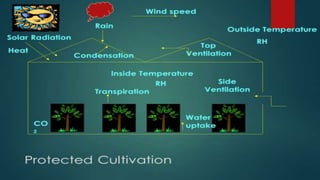
PROTECTED CULTIVATION
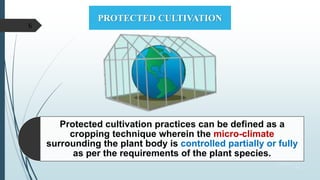
Protected cultivation practices can be defined as a
cropping technique wherein the micro-climate
surrounding the plant body is controlled partially or fully
as per the requirements of the plant species.
1/29/2024 11:21
AM
7
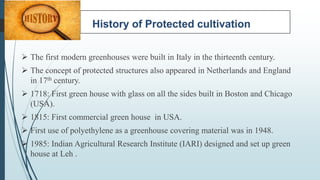
 The first modern greenhouses were built in Italy in the thirteenth century.
 The concept of protected structures also appeared in Netherlands and England
in 17th century.
 1718: First green house with glass on all the sides built in Boston and Chicago
(USA).
 1815: First commercial green house in USA.
 First use of polyethylene as a greenhouse covering material was in 1948.
 1985: Indian Agricultural Research Institute (IARI) designed and set up green
house at Leh .
8
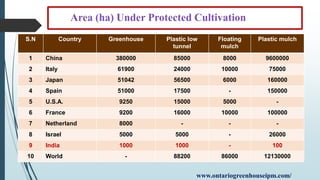
S.N Country Greenhouse Plastic low
tunnel
Floating
mulch
Plastic mulch
1 China 380000 85000 8000 9600000
2 Italy 61900 24000 10000 75000
3 Japan 51042 56500 6000 160000
4 Spain 51000 17500 - 150000
5 U.S.A. 9250 15000 5000 -
6 France 9200 16000 10000 100000
7 Netherland 8000 - - -
8 Israel 5000 5000 - 26000
9 India 1000 1000 - 100
10 World - 88200 86000 12130000
www.ontariogreenhouseipm.com/
.
10
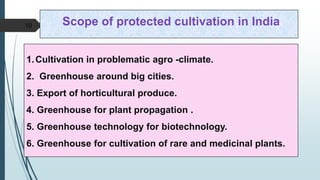
1.Cultivation in problematic agro -climate.
2. Greenhouse around big cities.
3. Export of horticultural produce.
4. Greenhouse for plant propagation .
5. Greenhouse technology for biotechnology.
6. Greenhouse for cultivation of rare and medicinal plants.
11
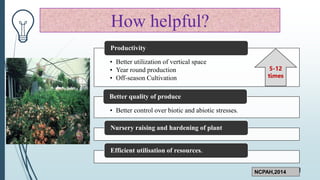
• Better utilization of vertical space
• Year round production
• Off-season Cultivation
Productivity
• Better control over biotic and abiotic stresses.
Better quality of produce
Nursery raising and hardening of plant
Efficient utilisation of resources.
How helpful?
5-12
times
NCPAH,2014
12
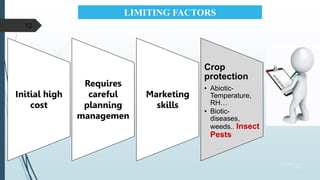
Initial high
cost
Requires
careful
planning
managemen
Marketing
skills
Crop
protection
• Abiotic-
Temperature,
RH…
• Biotic-
diseases,
weeds.. Insect
Pests
LIMITING FACTORS
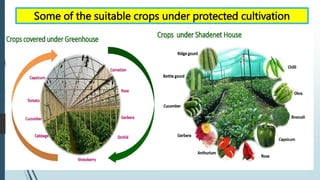
Some of the suitable crops under protected cultivation
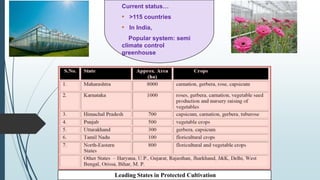
Current status…
• >115 countries
• In India,
Popular system: semi
climate control
greenhouse
Leading States in Protected Cultivation
How different from field condition?....
Structure itself will be helpful in
excluding the pests.
Environmental factors can be
manipulated.
Provides primary protection from
wind, rain..
15
Pro
1/29/2024 11:21
AM
16
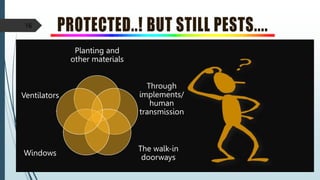
Planting and
other materials
Through
implements/
human
transmission
The walk-in
doorways
Windows
Ventilators
How different from field condition?....
Provides favourable conditions.
Less number of natural enemies.
═►More rapidly and with greater severity
than outdoors.
If Neglected = 100% loss
17
Con
18
PEST MANAGEMENT
What to manage?
20 Pest ID is critical…
 For implementing the appropriate
management tactics..
 Misidentifying may misleads to
inappropriate management practices…
TYPES OF PESTS FOUND IN PROTECTED CULTIVATION
With changing horticultural practices new
pests like thrips , scales, whiteflies, mites,
borers, caterpillars, slugs, nematodes etc. are
emerging not only under open conditions but
also under protected cultivation.
SLUGS
INSECTS
MITES
NEMATODE
S
WEEDS
PATHOGEN
S
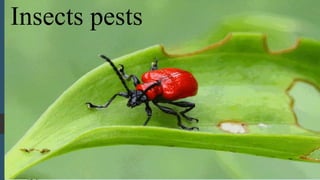
Insects pests
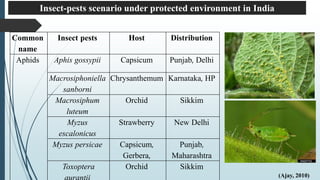
Insect-pests scenario under protected environment in India
(Ajay, 2010)
Common
name
Insect pests Host Distribution
Aphids Aphis gossypii Capsicum Punjab, Delhi
Macrosiphoniella
sanborni
Chrysanthemum Karnataka, HP
Macrosiphum
luteum
Orchid Sikkim
Myzus
escalonicus
Strawberry New Delhi
Myzus persicae Capsicum,
Gerbera,
Punjab,
Maharashtra
Toxoptera Orchid Sikkim
24
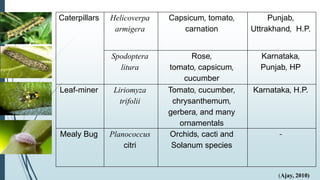
Caterpillars Helicoverpa
armigera
Capsicum, tomato,
carnation
Punjab,
Uttrakhand, H.P.
Spodoptera
litura
Rose,
tomato, capsicum,
cucumber
Karnataka,
Punjab, HP
Leaf-miner Liriomyza
trifolii
Tomato, cucumber,
chrysanthemum,
gerbera, and many
ornamentals
Karnataka, H.P.
Mealy Bug Planococcus
citri
Orchids, cacti and
Solanum species
-
(Ajay, 2010)
25
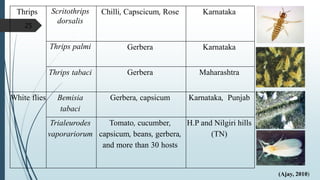
Thrips Scritothrips
dorsalis
Chilli, Capscicum, Rose Karnataka
Thrips palmi Gerbera Karnataka
Thrips tabaci Gerbera Maharashtra
White flies Bemisia
tabaci
Gerbera, capsicum Karnataka, Punjab
Trialeurodes
vaporariorum
Tomato, cucumber,
capsicum, beans, gerbera,
and more than 30 hosts
H.P and Nilgiri hills
(TN)
(Ajay, 2010)
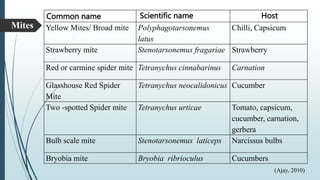
Common name Scientific name Host
Yellow Mites/ Broad mite Polyphagotarsonemus
latus
Chilli, Capsicum
Strawberry mite Stenotarsonemus fragariae Strawberry
Red or carmine spider mite Tetranychus cinnabarinus Carnation
Glasshouse Red Spider
Mite
Tetranychus neocalidonicus Cucumber
Two -spotted Spider mite Tetranychus urticae Tomato, capsicum,
cucumber, carnation,
gerbera
Bulb scale mite Stenotarsonemus laticeps Narcissus bulbs
Bryobia mite Bryobia ribrioculus Cucumbers
Mites
(Ajay, 2010)
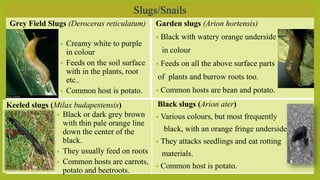
Grey Field Slugs (Deroceras reticulatum)
• Creamy white to purple
in colour
• Feeds on the soil surface
with in the plants, root
etc..
• Common host is potato.
Garden slugs (Arion hortensis)
• Black with watery orange underside
in colour
• Feeds on all the above surface parts
of plants and burrow roots too.
• Common hosts are bean and potato.
Keeled slugs (Milax budapestensis)
• Black or dark grey brown
with thin pale orange line
down the center of the
black.
• They usually feed on roots
• Common hosts are carrots,
potato and beetroots.
Black slugs (Arion ater)
• Various colours, but most frequently
black, with an orange fringe underside
• They attacks seedlings and eat rotting
materials.
• Common host is potato.
Slugs/Snails
27
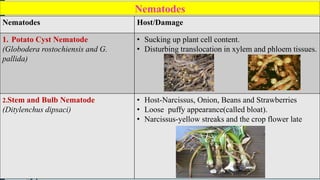
Nematodes Host/Damage
1. Potato Cyst Nematode
(Globodera rostochiensis and G.
pallida)
• Sucking up plant cell content.
• Disturbing translocation in xylem and phloem tissues.
2.Stem and Bulb Nematode
(Ditylenchus dipsaci)
• Host-Narcissus, Onion, Beans and Strawberries
• Loose puffy appearance(called bloat).
• Narcissus-yellow streaks and the crop flower late
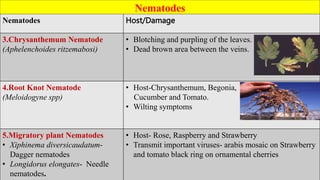
Nematodes
Nematodes Host/Damage
3.Chrysanthemum Nematode
(Aphelenchoides ritzemabosi)
• Blotching and purpling of the leaves.
• Dead brown area between the veins.
4.Root Knot Nematode
(Meloidogyne spp)
• Host-Chrysanthemum, Begonia,
Cucumber and Tomato.
• Wilting symptoms
5.Migratory plant Nematodes
• Xiphinema diversicaudatum-
Dagger nematodes
• Longidorus elongates- Needle
nematodes.
• Host- Rose, Raspberry and Strawberry
• Transmit important viruses- arabis mosaic on Strawberry
and tomato black ring on ornamental cherries
Nematodes
 Multiple generations - up to 20/year.
 Less of natural enemies to reduce populations.
 Almost unlimited food supply.
 Constant environmental conditions.
 Some life stages are not susceptible to treatment.
 Major insecticide and miticide resistance.
WHEN TO MANAGE?
31
Scouting
By visual
Use of hand lens
32
Saha et al. (2015)
Scout pest populations before starting:
 What are your pests?
 Where are your problems? Hot spots?
 When do they occur?
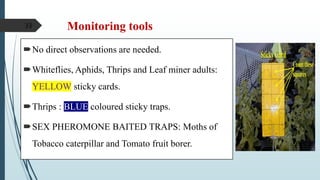
No direct observations are needed.
Whiteflies, Aphids, Thrips and Leaf miner adults:
YELLOW sticky cards.
Thrips : BLUE coloured sticky traps.
SEX PHEROMONE BAITED TRAPS: Moths of
Tobacco caterpillar and Tomato fruit borer.
33
Sticky yellow trap cards
Monitoring tools
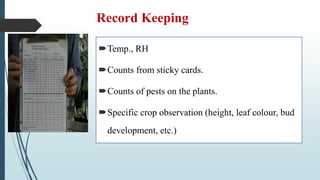
Record Keeping
Temp., RH
Counts from sticky cards.
Counts of pests on the plants.
Specific crop observation (height, leaf colour, bud
development, etc.)
35 HOW TO MANAGE?
INTEGRATED
APPROACH
 NON CHEMICAL
 PHYSICAL
 BIOLOGICAL
 CHEMICAL
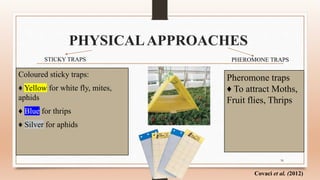
Coloured sticky traps:
♦ Yellow for white fly, mites,
aphids
♦ Blue for thrips
♦ Silver for aphids
PHYSICALAPPROACHES
Pheromone traps
♦ To attract Moths,
Fruit flies, Thrips
STICKY TRAPS PHEROMONE TRAPS
36
Covaci et al. (2012)
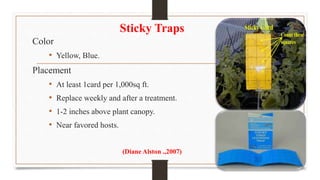
Sticky Traps
Color
• Yellow, Blue.
Placement
• At least 1card per 1,000sq ft.
• Replace weekly and after a treatment.
• 1-2 inches above plant canopy.
• Near favored hosts.
(Diane Alston .,2007)
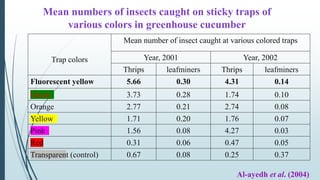
Mean numbers of insects caught on sticky traps of
various colors in greenhouse cucumber
Trap colors
Mean number of insect caught at various colored traps
Year, 2001 Year, 2002
Thrips leafminers Thrips leafminers
Fluorescent yellow 5.66 0.30 4.31 0.14
Green 3.73 0.28 1.74 0.10
Orange 2.77 0.21 2.74 0.08
Yellow 1.71 0.20 1.76 0.07
Pink 1.56 0.08 4.27 0.03
Red 0.31 0.06 0.47 0.05
Transparent (control) 0.67 0.08 0.25 0.37
Al-ayedh et al. (2004)
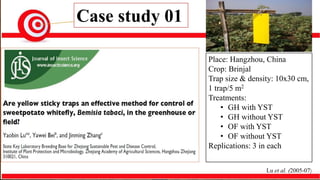
Case study 01
1/29/2024 11:21 AM 39
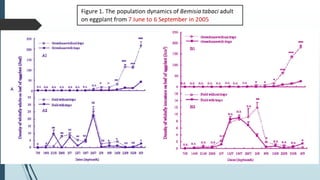
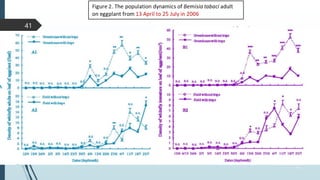
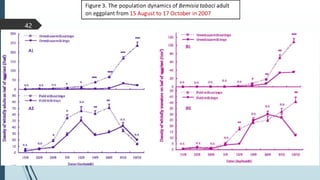
Place: Hangzhou, China
Crop: Brinjal
Trap size & density: 10x30 cm,
1 trap/5 m2
Treatments:
• GH with YST
• GH without YST
• OF with YST
• OF without YST
Replications: 3 in each
Lu et al. (2005-07)
41
42
NATURAL ENEMIES ENTOMOPATHOGENS
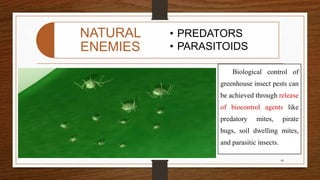
Biological control of
greenhouse insect pests can
be achieved through release
of biocontrol agents like
predatory mites, pirate
bugs, soil dwelling mites,
and parasitic insects.
44
NATURAL
ENEMIES
• PREDATORS
• PARASITOIDS
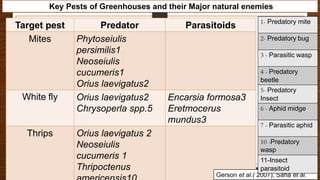
Key Pests of Greenhouses and their Major natural enemies
Target pest Predator Parasitoids
Mites Phytoseiulis
persimilis1
Neoseiulis
cucumeris1
Orius laevigatus2
White fly Orius laevigatus2
Chrysoperla spp.5
Encarsia formosa3
Eretmocerus
mundus3
Thrips Orius laevigatus 2
Neoseiulis
cucumeris 1
Thripoctenus
Gerson et al.( 2007), Saha et al.
45
1- Predatory mite
2- Predatory bug
3 - Parasitic wasp
4 - Predatory
beetle
5- Predatory
Insect
6 - Aphid midge
7 - Parasitic aphid
10 -Predatory
wasp
11-Insect
parasitoid
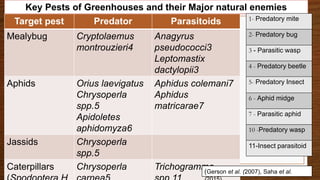
Key Pests of Greenhouses and their Major natural enemies
Target pest Predator Parasitoids
Mealybug Cryptolaemus
montrouzieri4
Anagyrus
pseudococci3
Leptomastix
dactylopii3
Aphids Orius laevigatus
Chrysoperla
spp.5
Apidoletes
aphidomyza6
Aphidus colemani7
Aphidus
matricarae7
Jassids Chrysoperla
spp.5
Caterpillars Chrysoperla Trichogramma
1- Predatory mite
2- Predatory bug
3 - Parasitic wasp
4 - Predatory beetle
5- Predatory Insect
6 - Aphid midge
7 - Parasitic aphid
10 -Predatory wasp
11-Insect parasitoid
(Gerson et al. (2007), Saha et al.
ENTOMOPATHOGENS
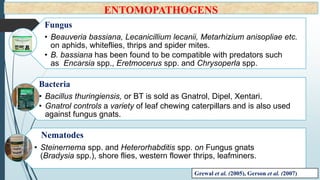
Fungus
• Beauveria bassiana, Lecanicillium lecanii, Metarhizium anisopliae etc.
on aphids, whiteflies, thrips and spider mites.
• B. bassiana has been found to be compatible with predators such
as Encarsia spp., Eretmocerus spp. and Chrysoperla spp.
Bacteria
• Bacillus thuringiensis, or BT is sold as Gnatrol, Dipel, Xentari.
• Gnatrol controls a variety of leaf chewing caterpillars and is also used
against fungus gnats.
Nematodes
• Steinernema spp. and Heterorhabditis spp. on Fungus gnats
(Bradysia spp.), shore flies, western flower thrips, leafminers.
Grewal et al. (2005), Gerson et al. (2007)
1/29/2024 11:21 AM 48
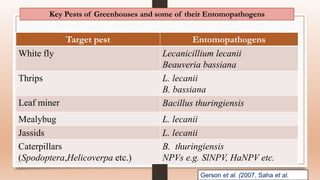
Target pest Entomopathogens
White fly Lecanicillium lecanii
Beauveria bassiana
Thrips L. lecanii
B. bassiana
Leaf miner Bacillus thuringiensis
Mealybug L. lecanii
Jassids L. lecanii
Caterpillars
(Spodoptera,Helicoverpa etc.)
B. thuringiensis
NPVs e.g. SlNPV, HaNPV etc.
Gerson et al. (2007, Saha et al.
Key Pests of Greenhouses and some of their Entomopathogens
LESS TOXIC:
BIORATIONALS
TOXIC:
CHEMICAL PESTICIDES
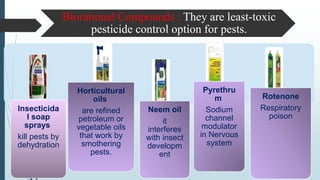
Bio rational Pesticides
Insecticida
l soap
sprays
kill pests by
dehydration
Horticultural
oils
are refined
petroleum or
vegetable oils
that work by
smothering
pests.
Neem oil
it
interferes
with insect
developm
ent
Pyrethru
m
Sodium
channel
modulator
in Nervous
system
Rotenone
Respiratory
poison
Biorational Compounds : They are least-toxic
pesticide control option for pests.
Saha et al. (2015)
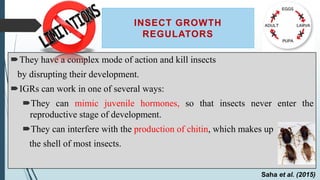
They have a complex mode of action and kill insects
by disrupting their development.
IGRs can work in one of several ways:
They can mimic juvenile hormones, so that insects never enter the
reproductive stage of development.
They can interfere with the production of chitin, which makes up
the shell of most insects.
INSECT GROWTH
REGULATORS
Chemical pest control refers to the use of
chemicals that kill the pests. These
chemicals are called pesticides.
Easier use
Readily available
provides a quick means of killing pests
efficiency
Cost effectiveness
It’s the most popular,
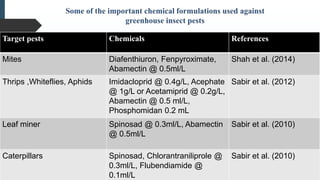
Target pests Chemicals References
Mites Diafenthiuron, Fenpyroximate,
Abamectin @ 0.5ml/L
Shah et al. (2014)
Thrips ,Whiteflies, Aphids Imidacloprid @ 0.4g/L, Acephate
@ 1g/L or Acetamiprid @ 0.2g/L,
Abamectin @ 0.5 ml/L,
Phosphomidan 0.2 mL
Sabir et al. (2012)
Leaf miner Spinosad @ 0.3ml/L, Abamectin
@ 0.5ml/L
Sabir et al. (2010)
Caterpillars Spinosad, Chlorantraniliprole @
0.3ml/L, Flubendiamide @
0.1ml/L
Sabir et al. (2010)
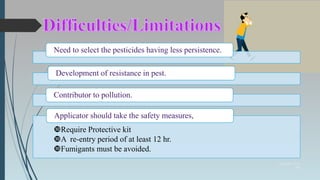
Need to select the pesticides having less persistence.
Development of resistance in pest.
Contributor to pollution.
Require Protective kit
A re-entry period of at least 12 hr.
Fumigants must be avoided.
Applicator should take the safety measures,
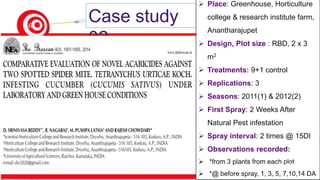
Case study
02
 Place: Greenhouse, Horticulture
college & research institute farm,
Anantharajupet
 Design, Plot size : RBD, 2 x 3
m2
 Treatments: 9+1 control
 Replications: 3
 Seasons: 2011(1) & 2012(2)
 First Spray: 2 Weeks After
Natural Pest infestation
 Spray interval: 2 times @ 15DI
 Observations recorded:
 *from 3 plants from each plot
 *@ before spray, 1, 3, 5, 7,10,14 DA
1/29/2024 11:21
AM
56
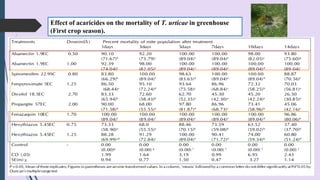
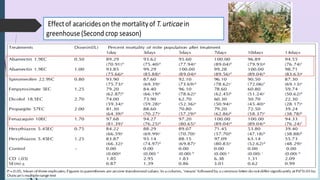
Effect of acaricides on the mortality of T. urticae in greenhouse
(First crop season).
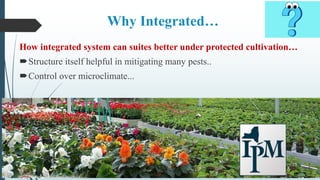
Why Integrated…
How integrated system can suites better under protected cultivation…
Structure itself helpful in mitigating many pests..
Control over microclimate...
1/29/2024 11:21
AM
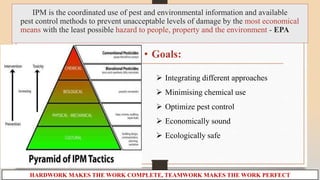
IPM is the coordinated use of pest and environmental information and available
pest control methods to prevent unacceptable levels of damage by the most economical
means with the least possible hazard to people, property and the environment - EPA
• Goals:
 Integrating different approaches
 Minimising chemical use
 Optimize pest control
 Economically sound
 Ecologically safe
HARDWORK MAKES THE WORK COMPLETE, TEAMWORK MAKES THE WORK PERFECT
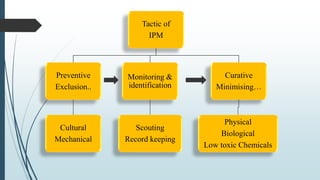
Tactic of
IPM
Preventive
Exclusion..
Cultural
Mechanical
Monitoring &
identification
Scouting
Record keeping
Curative
Minimising…
Physical
Biological
Low toxic Chemicals
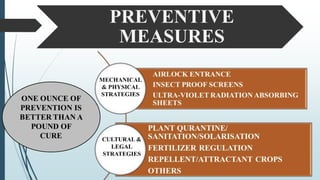
PREVENTIVE
MEASURES
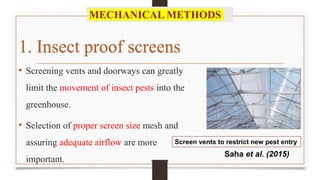
• Screening vents and doorways can greatly
limit the movement of insect pests into the
greenhouse.
• Selection of proper screen size mesh and
assuring adequate airflow are more
important.
64
MECHANICAL METHODS
Saha et al. (2015)
Screen vents to restrict new pest entry
1. Insect proof screens
1/29/2024
11:21 AM
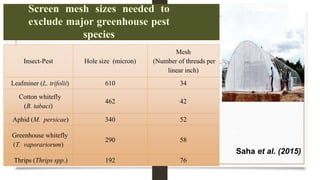
Insect-Pest Hole size (micron)
Mesh
(Number of threads per
linear inch)
Leafminer (L. trifolii) 610 34
Cotton whitefly
(B. tabaci)
462 42
Aphid (M. persicae) 340 52
Greenhouse whitefly
(T. vaporariorum)
290 58
Thrips (Thrips spp.) 192 76
Saha et al. (2015)
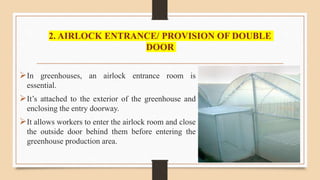
In greenhouses, an airlock entrance room is
essential.
It’s attached to the exterior of the greenhouse and
enclosing the entry doorway.
It allows workers to enter the airlock room and close
the outside door behind them before entering the
greenhouse production area.
2. AIRLOCK ENTRANCE/ PROVISION OF DOUBLE
DOOR
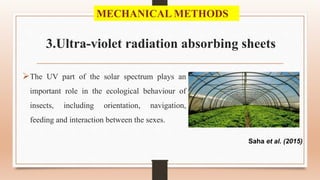
3.Ultra-violet radiation absorbing sheets
The UV part of the solar spectrum plays an
important role in the ecological behaviour of
insects, including orientation, navigation,
feeding and interaction between the sexes.
Saha et al. (2015)
MECHANICAL METHODS
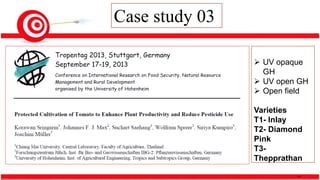
Case study 03
68
68
 UV opaque
GH
 UV open GH
 Open field
Varieties
T1- Inlay
T2- Diamond
Pink
T3-
Thepprathan
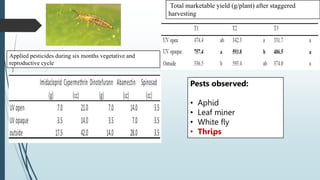
Total marketable yield (g/plant) after staggered
harvesting
Applied pesticides during six months vegetative and
reproductive cycle
Pests observed:
• Spider mite
• Aphid
• Leaf miner
• White fly
• Thrips
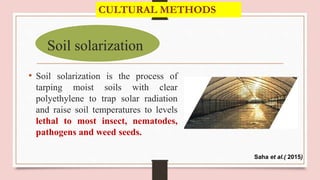
Soil solarization
• Soil solarization is the process of
tarping moist soils with clear
polyethylene to trap solar radiation
and raise soil temperatures to levels
lethal to most insect, nematodes,
pathogens and weed seeds.
Saha et al.( 2015)
CULTURAL METHODS
Plant Quarantine &
Sanitation
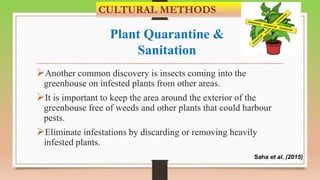
Another common discovery is insects coming into the
greenhouse on infested plants from other areas.
It is important to keep the area around the exterior of the
greenhouse free of weeds and other plants that could harbour
pests.
Eliminate infestations by discarding or removing heavily
infested plants.
Saha et al. (2015)
CULTURAL METHODS
Balanced use of fertilizer
Fertilization schedules based on balanced use of nutrients
should be followed.
Nitrogen should be applied only as needed for optimal growth.
Application of potassium at desired levels has been found to
reduce the incidence of insect-pests.
CULTURAL METHODS
Use of Natural Insect Repellent, Attractant/Trap crops
Repellents-
Spearmint repels aphids
Strong-smelling herbs like rosemary, thyme, and wormwood
– repels moths and flies.
A pot of mint repels cabbage white butterflies.
Neem plants are another safe way to deter insects.
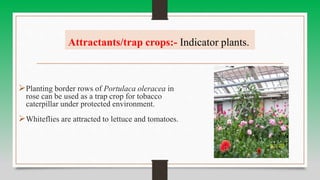
Planting border rows of Portulaca oleracea in
rose can be used as a trap crop for tobacco
caterpillar under protected environment.
Whiteflies are attracted to lettuce and tomatoes.
Attractants/trap crops:- Indicator plants.
75
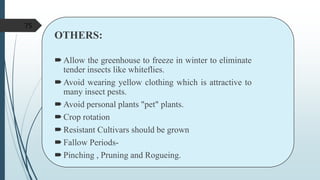
OTHERS:
Allow the greenhouse to freeze in winter to eliminate
tender insects like whiteflies.
Avoid wearing yellow clothing which is attractive to
many insect pests.
Avoid personal plants "pet" plants.
Crop rotation
Resistant Cultivars should be grown
Fallow Periods-
Pinching , Pruning and Rogueing.
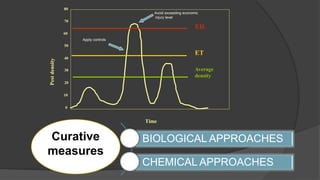
EIL
ET
Average
density
Time
80
70
60
50
40
30
20
10
0
Apply controls
Avoid exceeding economic
injury level
BIOLOGICAL APPROACHES
CHEMICAL APPROACHES
Curative
measures
SELECTION OF CURATIVE MEASURES
While selecting the combination we must be careful.
Preferably least toxic chemicals should be used
E.g.
Flonicamid, Methoxyfenozide were suitable with predators like Orius
laevigatus and Amblyseius swirskii. ( Colomer et al., 2011).
Spinosad with some predatory mites (Rahman et al., 2010).
Sabir et al. (2011)
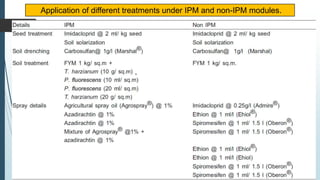
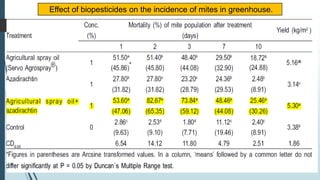
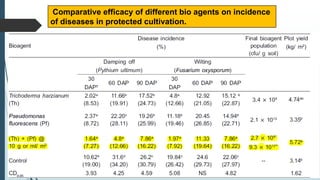
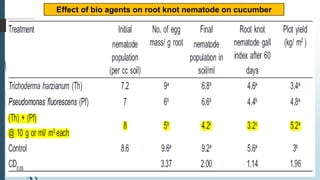
CASE STUDY 04
1/29/2024 11:21
AM
Application of different treatments under IPM and non-IPM modules.
1/29/2024 11:21
AM
80
Effect of biopesticides on the incidence of mites in greenhouse.
1/29/2024 11:21
AM
Comparative efficacy of different bio agents on incidence
of diseases in protected cultivation.
1/29/2024 11:21
AM
Effect of bio agents on root knot nematode on cucumber
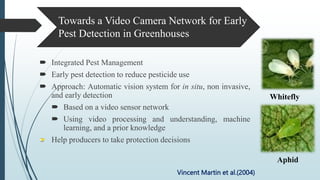
Towards a Video Camera Network for Early
Pest Detection in Greenhouses
 Integrated Pest Management
 Early pest detection to reduce pesticide use
 Approach: Automatic vision system for in situ, non invasive,
and early detection
 Based on a video sensor network
 Using video processing and understanding, machine
learning, and a prior knowledge
Help producers to take protection decisions
Whitefly
Aphid
Vincent Martin et al.(2004)
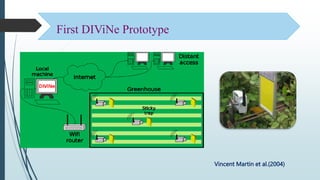
First DIViNe Prototype
Vincent Martin et al.(2004)
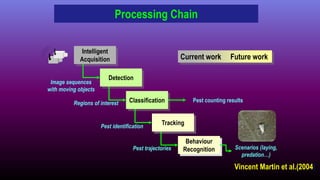
Intelligent
Acquisition
Detection
Classification
Tracking
Behaviour
Recognition
Regions of interest
Pest identification
Pest trajectories Scenarios (laying,
predation…)
Image sequences
with moving objects
Pest counting results
Current work Future work
Processing Chain
Vincent Martin et al.(2004)
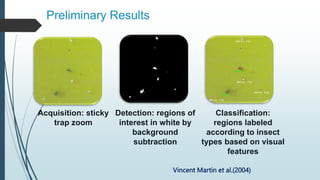
Preliminary Results
Acquisition: sticky
trap zoom
Detection: regions of
interest in white by
background
subtraction
Classification:
regions labeled
according to insect
types based on visual
features
Vincent Martin et al.(2004)
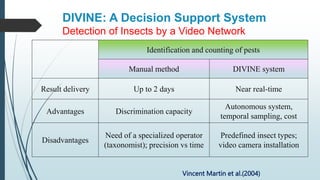
DIVINE: A Decision Support System
Detection of Insects by a Video Network
Identification and counting of pests
Manual method DIVINE system
Result delivery Up to 2 days Near real-time
Advantages Discrimination capacity
Autonomous system,
temporal sampling, cost
Disadvantages
Need of a specialized operator
(taxonomist); precision vs time
Predefined insect types;
video camera installation
Vincent Martin et al.(2004)
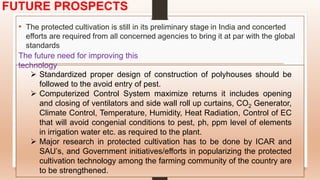
FUTURE PROSPECTS
• The protected cultivation is still in its preliminary stage in India and concerted
efforts are required from all concerned agencies to bring it at par with the global
standards
The future need for improving this
technology
 Standardized proper design of construction of polyhouses should be
followed to the avoid entry of pest.
 Computerized Control System maximize returns it includes opening
and closing of ventilators and side wall roll up curtains, CO2 Generator,
Climate Control, Temperature, Humidity, Heat Radiation, Control of EC
that will avoid congenial conditions to pest, ph, ppm level of elements
in irrigation water etc. as required to the plant.
 Major research in protected cultivation has to be done by ICAR and
SAU’s, and Government initiatives/efforts in popularizing the protected
cultivation technology among the farming community of the country are
to be strengthened.
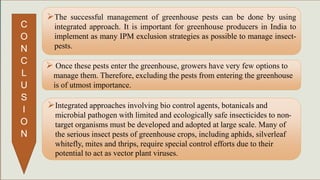
The successful management of greenhouse pests can be done by using
integrated approach. It is important for greenhouse producers in India to
implement as many IPM exclusion strategies as possible to manage insect-
pests.
 Once these pests enter the greenhouse, growers have very few options to
manage them. Therefore, excluding the pests from entering the greenhouse
is of utmost importance.
Integrated approaches involving bio control agents, botanicals and
microbial pathogen with limited and ecologically safe insecticides to non-
target organisms must be developed and adopted at large scale. Many of
the serious insect pests of greenhouse crops, including aphids, silverleaf
whitefly, mites and thrips, require special control efforts due to their
potential to act as vector plant viruses.
C
O
N
C
L
U
S
I
O
N
1/29/2024 11:21 AM 90
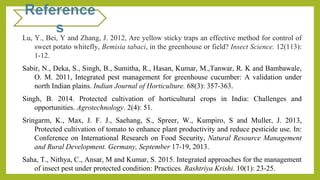
Lu, Y., Bei, Y and Zhang, J. 2012, Are yellow sticky traps an effective method for control of
sweet potato whitefly, Bemisia tabaci, in the greenhouse or field? Insect Science. 12(113):
1-12.
Sabir, N., Deka, S., Singh, B., Sumitha, R., Hasan, Kumar, M.,Tanwar, R. K and Bambawale,
O. M. 2011, Integrated pest management for greenhouse cucumber: A validation under
north Indian plains. Indian Journal of Horticulture. 68(3): 357-363.
Singh, B. 2014. Protected cultivation of horticultural crops in India: Challenges and
opportunities. Agrotechnology. 2(4): 51.
Sringarm, K., Max, J. F. J., Saehang, S., Spreer, W., Kumpiro, S and Muller, J. 2013,
Protected cultivation of tomato to enhance plant productivity and reduce pesticide use. In:
Conference on International Research on Food Security, Natural Resource Management
and Rural Development. Germany, September 17-19, 2013.
Saha, T., Nithya, C., Ansar, M and Kumar, S. 2015. Integrated approaches for the management
of insect pest under protected condition: Practices. Rashtriya Krishi. 10(1): 23-25.
1/29/2024 11:21 AM 91
Arthurs, S. P., Aristizábal, L. F and Avery, P. B. 2013, Evaluation of entomopathogenic
fungi against chilli thrips, Scirtothrips dorsalis. Insect Science. 13(31): 1-16.
Gerson, U and Weintraub, P. G. 2007, Mites for the control of pests in protected
Cultivation. Pest Management Sciences. 63: 658-676.
Colomer, I., Aguado, P., Medina, P., Heredia, R. S., Fereres, A., Belda, J. E and Vinuela, E.
2011, Field trial measuring the compatibility of methoxyfenozide and flonicamid with
Orius laevigatus (Fieber) and Amblyseius swirskii in a commercial pepper greenhouse.
Pest Management Sciences. 67: 1237-1244.
Cabello, T., Gallego, J. R., Fernandez, F. J., Gamez, M., Vila, E., Pino, M. D and
Hernandez, E. 2010 Biological Control Strategies for the South American Tomato Moth
(Lepidoptera: Gelechiidae) in Greenhouse Tomatoes. Journal of Economic Entomology.
105(6): 2085-2096.
1/29/2024 11:21 AM 92
Rahman, T., Spafford, H and Broughton, S. 2010, Single versus multiple releases of
predatory mites combined with spinosad for the management of western flower thrips in
strawberry. Crop Protection. 30: 468-475.
Nandini, R. S., Giraddi, S., Mantur, M., Patil, K., Mallapur, C. P and Ashalatha, K. V. 2012.
Population dynamics and extent damage of pests of Capsicum under protected
cultivation, Karnataka, Journal of Agriculture Sciences. 25:150-151.
Jagdish EJ., Purnima AP. 2011 Evaluation of selective botanicals and entomopathogens
against Scirtothrips dorsalis Hood under polyhouse conditions on rose. Journal of
Biopesticides. 4(1):81-85.
1/29/2024 11:21 AM 93