Leadership	role	in	promoting	diversity	
and	non-discriminating	workplaces
Prof.	Uduak [Udy]	Archibong	MBE
Professor	of	Diversity;Director,	Centre	for	Inclusion	and	DiversityStrategic	
Advisor	for	Equality,	Diversity	and	Inclusion
University	of	Bradford,	UK
International	conference „Integration Challenges in	a	Radicalizing World“
29	– 30	November	2016,	Tallinn,	 Estonia
Leadership role in
promoting diversity
and non-
discriminating
workplaces
Uduak [Udy] Archibong MBE
Professor of Diversity
Director, Centre for Inclusion and Diversity
Strategic Advisor for Equality, Diversity and
Inclusion
23 December, 20163 © Udy Archibong University of Bradford 2016
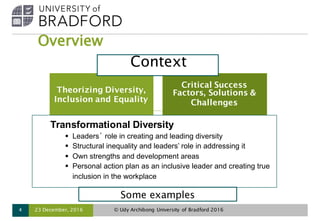
Theorizing Diversity,
Inclusion and Equality
Critical Success
Factors, Solutions &
Challenges
23 December, 20164
Overview
Context
Transformational Diversity
§ Leaders role in creating and leading diversity
§ Structural inequality and leaders’ role in addressing it
§ Own strengths and development areas
§ Personal action plan as an inclusive leader and creating true
inclusion in the workplace
© Udy Archibong University of Bradford 2016
Some examples
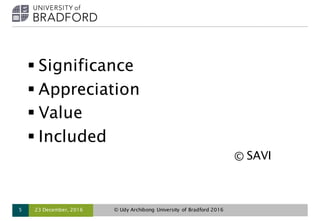
§ Significance
§ Appreciation
§ Value
§ Included
©
23 December, 20165 © Udy Archibong University of Bradford 2016
SAVI
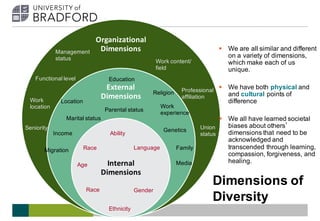
Organizational	
Dimensions
External	
Dimensions
Internal	
Dimensions
Race Gender
Ethnicity
Ability
Language
Age
Race
Income
Parental status
Work
experience
Religion
Location
Migration
Genetics
Media
Family
Marital status
EducationFunctional level
Work content/
field
Professional
affiliation
Work
location
Seniority Union
status
Management
status
§ We are all similar and different
on a variety of dimensions,
which make each of us
unique.
§ We have both physical and
and cultural points of
difference
§ We all have learned societal
biases about others
dimensions that need to be
acknowledged and
transcended through learning,
compassion, forgiveness, and
healing.
Dimensions of
Diversity
Diversity - A collective mixture characterised by differences and
similarities that are applied in pursuit of organisational
objectives Roosevelt Thomas 1999
Diversity Management - A process of planning for, organising,
directing, and supporting these collective mixtures in a way
that adds a measurable difference to organisational
performance Hubbard 1999
• All the ways we differ
• The individuality or uniqueness of people, distinguished by
visible and non-visible characteristics
• Sharing and valuing differences, acknowledging, respecting
and accommodating differences
23 December, 20167 © Udy Archibong University of Bradford 2016
§ Diversity is the mix
§ Inclusion is getting the mix to work well together
§ Equality - Systems and processes which ensure that
mix can participate and has the opportunity to fulfil
their potential; Backed by legislation
§ Structural equality requires more than Being Nice
§ Cultural competence – a set of competences and
skills that individuals and organisations can use to
create a truly inclusive environment that values
diversity
23 December, 20168 © Udy Archibong University of Bradford 2016
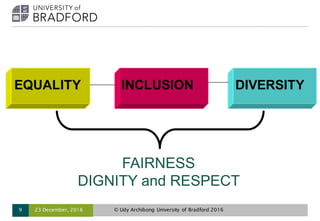
FAIRNESS
DIGNITY and RESPECT
EQUALITY INCLUSION DIVERSITY
23 December, 20169 © Udy Archibong University of Bradford 2016
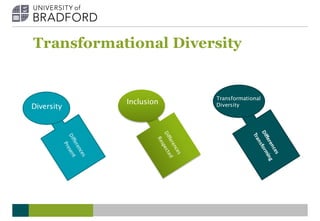
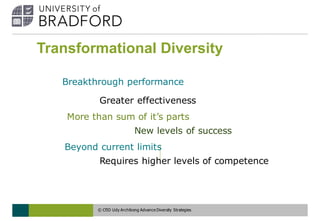
Transformational Diversity
Inclusion
Diversity
Inclusion
Transformational
Diversity
Transformational Diversity
Breakthrough performance
© CfID Udy Archibong Advance Diversity Strategies
Greater effectiveness
More than sum of it’s parts
New levels of success
Beyond current limits
Requires higher levels of competence
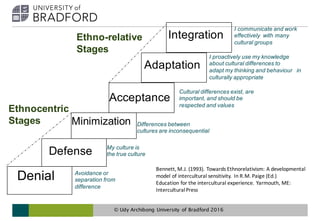
Integration
Adaptation
Acceptance
Minimization
Defense
Denial Avoidance or
separation from
difference
My culture is
the true culture
Differences between
cultures are inconsequential
Cultural differences exist, are
important, and should be
respected and values
I proactively use my knowledge
about cultural differences to
adapt my thinking and behaviour in
culturally appropriate
I communicate and work
effectively with many
cultural groups
Ethnocentric
Stages
Ethno-relative
Stages
© Udy Archibong University of Bradford 2016
Bennett,	M.J.	(1993).	Towards	Ethnorelativism:	A	developmental	
model	of	intercultural	sensitivity.	In	R.M.	Paige	(Ed.)	
Education	for	the	intercultural	experience.	Yarmouth,	ME:	
Intercultural	Press
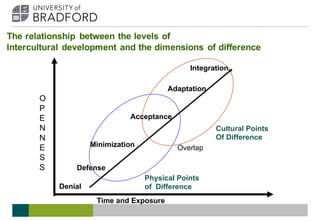
Denial
Defense
Acceptance
Adaptation
Cultural Points
Of Difference
Physical Points
of Difference
Overlap
Time and Exposure
O
P
E
N
N
E
S
S
The relationship between the levels of
Intercultural development and the dimensions of difference
Minimization
Integration
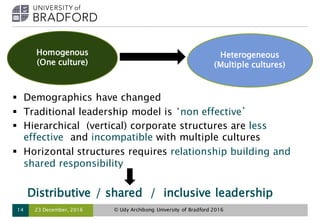
§ Demographics have changed
§ Traditional leadership model is non effective
§ Hierarchical (vertical) corporate structures are less
effective and incompatible with multiple cultures
§ Horizontal structures requires relationship building and
shared responsibility
Distributive / shared / inclusive leadership
Homogenous
(One culture)
Heterogeneous
(Multiple cultures)
23 December, 201614 © Udy Archibong University of Bradford 2016
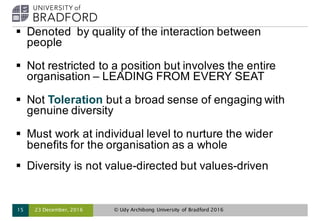
§ Denoted by quality of the interaction between
people
§ Not restricted to a position but involves the entire
organisation – LEADING FROM EVERY SEAT
§ Not Toleration but a broad sense of engaging with
genuine diversity
§ Must work at individual level to nurture the wider
benefits for the organisation as a whole
§ Diversity is not value-directed but values-driven
23 December, 201615 © Udy Archibong University of Bradford 2016
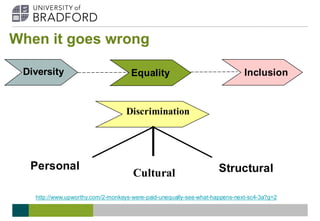
InclusionDiversity
Discrimination
Personal
Cultural Structural
Equality
http://www.upworthy.com/2-monkeys-were-paid-unequally-see-what-happens-next-sc4-3a?g=2
When it goes wrong
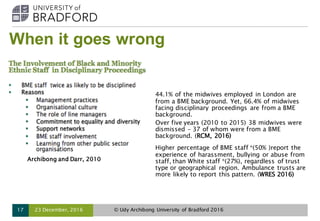
44.1% of the midwives employed in London are
from a BME background. Yet, 66.4% of midwives
facing disciplinary proceedings are from a BME
background.
Over five years (2010 to 2015) 38 midwives were
dismissed - 37 of whom were from a BME
background. (RCM, 2016)
Higher percentage of BME staff *(50% )report the
experience of harassment, bullying or abuse from
staff, than White staff *(27%), regardless of trust
type or geographical region. Ambulance trusts are
more likely to report this pattern. (WRES 2016)
When it goes wrong
23 December, 201617 © Udy Archibong University of Bradford 2016
Archibong and Darr, 2010
23 December, 201618 © Udy Archibong University of Bradford 2016
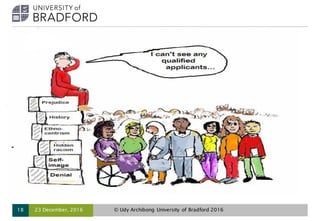
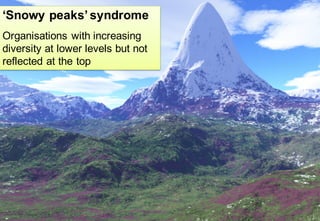
‘Snowy peaks’ syndrome
Organisations with increasing
diversity at lower levels but not
reflected at the top
Inclusive Leadership
A comprehensive management process that addresses
the organisation s infrastructures to create an
environment that enables all members of a workforce to
be productive, without advantaging or disadvantaging
anyone
Inclusive leadership has 2 components
§ As an individual – setting a tone for diversity
§ As a power in the infrastructure – eliminating structural
inequality
23 December, 201620 © Udy Archibong University of Bradford 2016
A leadership style which embraces,
encourages and taps into the creativity
and ideas which come about in non
homogeneous groups
Opportunity Now - http://diversity.bitc.org.uk/
23 December, 201621 © Udy Archibong University of Bradford 2016
23 December, 201622 © Udy Archibong University of Bradford 2015
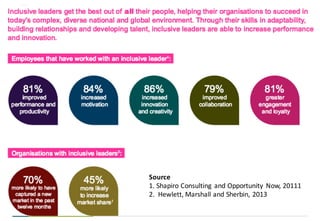
Source
1.	Shapiro	Consulting	 and	Opportunity	 Now,	20111
2.		Hewlett,	Marshall	and	Sherbin,	2013
Inclusive Leadership Gap
• Core competencies are rare in organisations
• 66% employees say there are less than 50% of
leaders that are inclusive
• In the 21st century, inclusive capabilities must
become synonymous with excellent
management and leadership
23 December, 2016 POWERPOINT PRESENTATION TEMPLATE GREEN23
A leadership style which embraces,
encourages and taps into the creativity
and ideas which come about in non
homogeneous groups
Opportunity Now - http://diversity.bitc.org.uk/
23 December, 201624 © Udy Archibong University of Bradford 2016
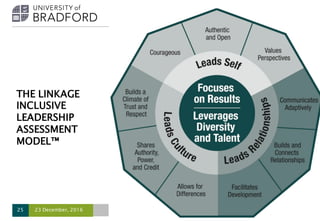
23 December, 2016 POWERPOINT PRESENTATION TEMPLATE GREEN25
THE LINKAGE
INCLUSIVE
LEADERSHIP
ASSESSMENT
MODEL™
© CfID Udy Archibong Advance Diversity Strategies
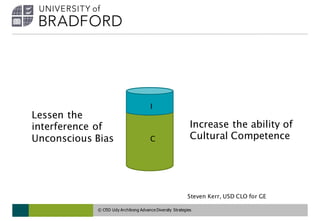
C
I
Steven Kerr, USD CLO for GE
Lessen the
interference of
Unconscious Bias
Increase the ability of
Cultural Competence
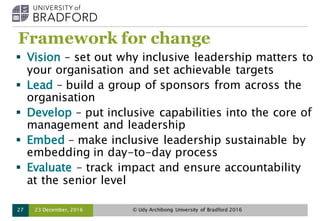
Framework for change
§ Vision – set out why inclusive leadership matters to
your organisation and set achievable targets
§ Lead – build a group of sponsors from across the
organisation
§ Develop – put inclusive capabilities into the core of
management and leadership
§ Embed – make inclusive leadership sustainable by
embedding in day-to-day process
§ Evaluate – track impact and ensure accountability
at the senior level
23 December, 201627 23 December, 201627 © Udy Archibong University of Bradford 2016
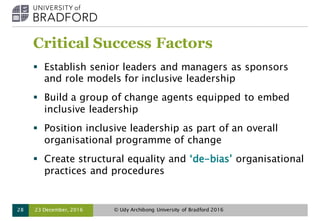
Critical Success Factors
§ Establish senior leaders and managers as sponsors
and role models for inclusive leadership
§ Build a group of change agents equipped to embed
inclusive leadership
§ Position inclusive leadership as part of an overall
organisational programme of change
§ Create structural equality and ‘de-bias’ organisational
practices and procedures
23 December, 201628 23 December, 201628 © Udy Archibong University of Bradford 2016
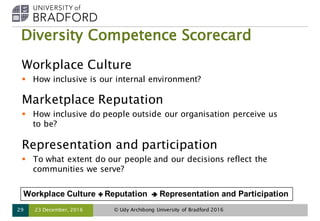
Workplace Culture Ì Reputation â Representation and Participation
Workplace Culture
§ How inclusive is our internal environment?
Marketplace Reputation
§ How inclusive do people outside our organisation perceive us
to be?
Representation and participation
§ To what extent do our people and our decisions reflect the
communities we serve?
Diversity Competence Scorecard
23 December, 201629 © Udy Archibong University of Bradford 2016
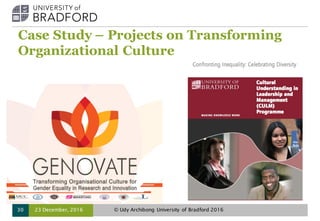
Case Study – Projects on Transforming
Organizational Culture
23 December, 201630 23 December, 201630 © Udy Archibong University of Bradford 2016
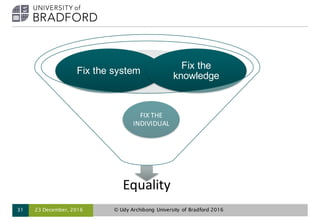
Equality
FIX	THE	
INDIVIDUAL
Fix the system
Fix the
knowledge
23 December, 201631 © Udy Archibong University of Bradford 2016
We never said it would be easy!
“The usual business case states a set of benefits, and
defines the tasks to realise the benefits. Diversity
turns this model on its head. In order to bring the
benefits of diversity to the enterprise, we must first
examine and if necessary change the behaviours of
our leaders.”
B Kandola 2010 (The value of difference)
23 December, 201632 © Udy Archibong University of Bradford 2016
And more…
23 December, 2016 POWERPOINT PRESENTATION TEMPLATE GREEN33
§ Intersection of diversity and inclusion - A shift from
diverse to inclusive organisational practices
§ Moving diversity from a transactional issue to a
business issue - Diversity not simply human
resource but about business practices
§ Action beyond legislation
§ Measurement critical to success
§ Tapping into engagement
§ Simple, clear message
Not about making a small group of people special but making
the entire workforce engaged
Great leadership is at the heart of great business and great
organisations. It is also at the heart of creating cultures
which are not only diverse, but cultures which leverage that
difference for competitive advantage
§ Develop people
§ Value individuals
§ Champion diversity
§ Promote strategic diversity focus
Become an Inclusive Leader
23 December, 201634 © Udy Archibong University of Bradford 2016
35
Contact information
Uduak Archibong
Email: u.e.archibong@bradford.ac.uk
Skype: udy.archibong
Twitter: @uduakarchibong1
23 December, 201635 © Udy Archibong University of Bradford 2016
Presentationgiven at	International	conference
Integration Challenges in	a	Radicalising World
29	– 30	November	2016	in	Tallinn,	Estonia
For	more	conference	materials	and	presentations
please	visit www.misakonverents.ee