Small Scale Industries
Definition
Characteristics
Importance
Advantages of running an SSI

A few definitions..
  • Small scale undertakings - Engaged in manufacturing,
    processing or preservation of goods; investment in plant and
    machinery up to Rs. 1 crore
  • Tiny enterprises - Investment in plant and machinery up to
    Rs. 25 Lakh
  • Small scale service/business enterprise - Investment in fixed
    assets up to Rs.25 Lakh (excluding plant and machinery)
  • Women enterprises- Small scale units with financial holding
    of minimum 51% by one or more women entrepreneurs
  • Artisans, village and cottage industries – Artisans and small
    industrial activities in villages/towns with population of max.
    50,000; utilising locally available natural resources;
    individual credit requirement up to Rs.50,000/-
Characteristics of a SSI
  • Small capital investment
  • Generates employment, generally around 10 employees
  • Located in rural and semi urban areas
  • Generally a sole proprietorship business
  • Funding from the entrepreneur’s personal funds
  • Exploitation of human resources (Women and child labour)
  • Organising and management skills are often neglected
  • Financial discipline is weak
  • Encourages entrepreneurial growth
  • Balanced regional development is ensured
Importance of SSI
  • Labour intensive
  • Ensure an equal distribution of income and wealth
  • Act as a link to large scale
  • Act as a training ground for entrepreneurs
  • Mobilize resources and services
  • Give rise to capital formation
  • Has a huge export potential
  • Are extremely innovative and productive
Advantages of running a SSI
  • Most do not need high level of technology and are labour
    intensive and hence do not need huge start up or working
    capital
  • SSI projects can be undertaken in a short time frame
  • Use of abundant local natural resources is possible
  • Small scale enterprises can be linked to large businesses
    which help in their growth and progress
  • Able to generate local and permanent employment
  • Have a short gestation period

PROCEDURES FOR SMALL SCALE INDUSTRIAL LICENSING

License
    According to economics license means:-
      A government-issued permission to engage in an activity or to operate
      a business.
Criteria For SSI in India
    Industry employing less than 100 workers.
    Having fixed assets of less than Rs 10 lakhs need not obtain any
      license.
      (Subject to the condition that the unit is not owned, controlled or
      subsidiary of any other industrial undertaking)
    Small scale units have to conform to the rules and regulations
      prescribed by state or local authority under the Factories Act.
The Industries (Development and Regulation) Act, 1951
   Section ١٠ refers to the requirement of registration of existing
     industrial units.
   Section ١١ refers to the requirement of licensing of new industrial
     undertakings.
   Section ١١A deals with licences for the production of new articles.
   Section ١٣ refers, inter alia to the requirement of licensing for effecting
     substantial expansion.
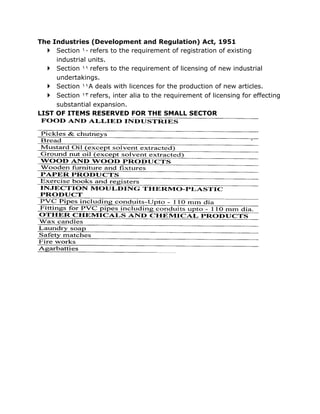
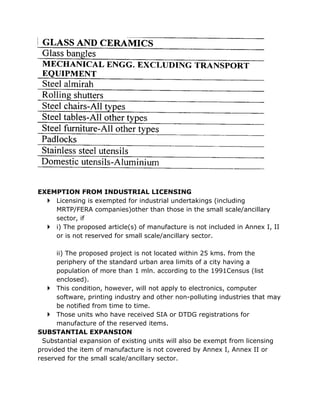
LIST OF ITEMS RESERVED FOR THE SMALL SECTOR
EXEMPTION FROM INDUSTRIAL LICENSING
   Licensing is exempted for industrial undertakings (including
    MRTP/FERA companies)other than those in the small scale/ancillary
    sector, if
   i) The proposed article(s) of manufacture is not included in Annex I, II
    or is not reserved for small scale/ancillary sector.

      ii) The proposed project is not located within 25 kms. from the
      periphery of the standard urban area limits of a city having a
      population of more than 1 mln. according to the 1991Census (list
      enclosed).
    This condition, however, will not apply to electronics, computer
      software, printing industry and other non-polluting industries that may
      be notified from time to time.
    Those units who have received SIA or DTDG registrations for
      manufacture of the reserved items.
SUBSTANTIAL EXPANSION
 Substantial expansion of existing units will also be exempt from licensing
provided the item of manufacture is not covered by Annex I, Annex II or
reserved for the small scale/ancillary sector.
Manufacture of New Article
   Existing units will be permitted to manufacture any new article without
     additional investment if the article is not otherwise subjected to
     compulsory licensing
   This facility would be available notwithstanding any location
     conditions.
FILING OF MEMORANDA
   In respect of new projects for manufacture of articles not covered by
     compulsory licensing or their substantial expansions the only
     requirement would be that the industrial undertaking shall file a
     memorandum in prescribed form to the Secretariat for Industrial
     Approvals (SIA) in the Ministry of Industry.
   Such a memorandum will also have to be filed by those industrial
     undertakings to be engaged in non-scheduled industries i.e. those not
     covered under the I(D&R) Act.
   The memorandum will be accompanied by a crossed demand draft of
     Rs. 1000/- in favor of the Pay and Accounts Officer, Department of
     Industrial Development, Ministry of Industry, Nirman Bhavan, New
     Delhi - 110011.
   The receipt of the memorandum will be acknowledged by the SIA and
     a reference number will be given. Industrial undertakings should quote
     this reference number in all future correspondence, if any, with the
     SIA
REGISTRATION OF SSI
   Small Scale and ancillary units (i.e. undertaking with investment in
     plant and machinery of less than Rs. 6.0 million and Rs. 7.5 million
     respectively) should seek registration with the Director of Industries of
     the concerned State Government.
Registering Your SSI Unit
  • The main purpose of Registration is to maintain statistics and maintain
     a roll of such units for the purposes of providing incentives and
     support services.

    States have generally adopted the uniform registration procedures as
    per the guidelines. However, there may be some modifications done by
    States. It must be noted that small industries is basically a state
    subject. States use the same registration scheme for implementing
    their own policies. It is possible that some states may have a 'SIDO
    registration scheme' and a 'State registration scheme'.
Benefits of Registering
   The regime of incentives offered by the Centre generally contains the
    following:

       - Credit prescription (Priority sector lending), differential rates of
       interest etc.

       - Excise Exemption Scheme
        - Exemption under Direct Tax Laws.

       - Statutory support such as reservation and the Interest on Delayed
       Payments Act.
      States/UTs have their own package of facilities and incentives for small
       scale. They relate to:
        Development of industrial estates
        Tax subsidies
        Power tariff subsidies
        Capital investment subsidies &
        Other support.
      Both the Centre and the State, whether under law or otherwise, target
       their incentives and support packages generally to units registered
       with them.
Objectives of The Registration Scheme
- To enumerate and maintain a roll of small industries to which the package
of incentives and support are targeted.
-To provide a certificate enabling the units to avail statutory benefits mainly
in terms of protection.
 - To serve the purpose of collection of statistics.
 - To create nodal centres at the Centre, State and District levels to promote
SSI.

Features of The Scheme
- DIC is the primary registering centre
- Registration is voluntary and not compulsory.
- Two types of registration is done in all States.
  I. Provisional registration certificate
 II. Permanent registration certificate , after commencement of production
 - PRC is normally valid for 5 years and permanent registration is given in
perpetuity

Provisional Registration Certificate (PRC)
- This is given for the pre-operative period and enables the units to obtain
the term loans and working capital from financial institutions/banks under
priority sector lending.
 - Obtain facilities for accommodation, land, other approvals etc.
 - Obtain various necessary NOCs and clearances from regulatory bodies
such as Pollution Control Board, Labour Regulations etc.

Permanent Registration Certificate
  • Enables the unit to get the following incentives/concessions:
     - Excise exemptions
     - Income-Tax exemption and Sales Tax exemption as per State Govt.
    Policy.
     - Incentives and concessions in power tariff etc.
     - Price and purchase preference for goods produced.
     - Availability of raw material depending on existing policy.
Procedure For Registration
  • Features of the present procedures are as follows:
      - A unit can apply for PRC for any item that does not require industrial
      license which means items listed in Schedule-III and items not listed
      in Schedule-I or Schedule-II of the licencing Exemption Notification.
      Units employing less than 50/100 workers with/without power can
      apply for registration even for those items included in Schedule-II.
      - Unit applies for PRC in prescribed application form. No field enquiry
      is done and PRC is issued.
      - PRC is valid for five years. If the entrepreneur is unable to set up
     the unit in this period, he can apply afresh at the end of five years
     period.
      - Once the unit commences production, it has to apply for permanent
     registration on the prescribed form.
  • The following form basis of evaluation:
      - The unit has obtained all necessary clearances whether statutory or
     administrative. e.g. drug license under drug control order, NOC from
     Pollution Control Board, if required etc.
      - Unit does not violate any locational restrictions in force, at the time
     of evaluation.
      - Value of plant and machinery is within prescribed limits.
      - Unit is not owned, controlled or subsidiary of any other industrial
     undertaking as per notification.

De-Registration
  • A Small Scale Unit can violate the regulations in the following ways
    which will make it liable for de-registration:
     - It crosses the investment limits.
     - It starts manufacturing any new item or items that require an
    industrial license or other kind of statutory license.
     - It does not satisfy the condition of being owned, controlled or being
    a subsidiary of any other industrial undertaking.