Problems with Level Measurement in High Density
Pulp Stock
Level Measurement in Pulp Stock has posed problems for a wide range of level
measurement technologies.In most pulp mills this is the most challenging application
on site.
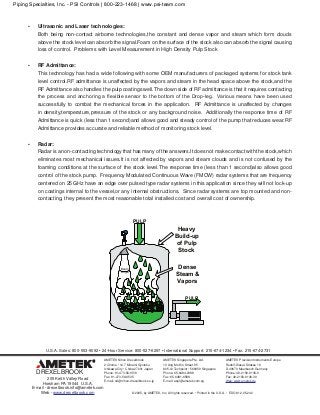
The environment in the high-density pulp tank is very corrosive to most common metals
and the clouds of dense steam vapors that rise from the stock and foaming surface of
the level are a constant source of signal loss for many non-contact technologies.
Due to the size of the vessel and density of the stock,mechanical devices are typically
short lived.Stock coatings that form on all interior surfaces add additional mechanical
stress and the pulp coating deposits can adversely affect accurate level measurement
performance.
One of the challenges of a level measurement device is to control the level in the stock
tank,thereby helping to control the average pulp density by controlling the speed of the
pump.The response time of the level measurement system is critical in controlling the
pump speed and reducing pump oscillations and surges that will eventually reduce the
life of the pump.Too slow of a response from the level instrument will allow the level
to rise above it ’s optimum density level and cause excessive loading and wear on the
pump.
Challenges of Level Measurement Technologies:
•	 Pressure and differential pressure:
	 The variations in pulp density makes any level technology that is based on pressure totally
inadequate, although pressure devices can still be found,with the power and signal wires cut,on
pulp stock tanks. Pressure devices for this application are typically used with a seal fluid to reduce
the corrosive nature of this measurement.The response times of the “fill fluid ” systems tend to
reduce the reaction time to level changes and this eventually causes pump wear.
•	 Nuclear devices:
	 Although nuclear systems are non-intrusive and eliminate most of the application problems, they are
affected by a slow response time to level changes and this does not solve the problem of controlling
density and pump wear.Nuclear systems have additional negatives when price and source disposal
are factored.
Pulp & Paper Plants Application
420-22-053
Piping Specialties, Inc. - PSI Controls | 800-223-1468 | www.psi-team.com
AMETEK Nihon Drexelbrook	 AMETEK Singapore Pte. Ltd.	 AMETEK Precision Instruments Europe
2 Chome • 12-7 Minami Gyotoku	 10 Ang Mo Kio Street 65	 Rudolf-Diesel-Strasse 16	
Ichikawa City • Chiba 27201 Japan	 #05-12 Techpoint • 569059 Singapore	 D-40670 Meerbusch Germany	
Phone: 81-473-56-6513	 Phone: 65-6484-2388	 Phone: 49-2159-9136-0	
Fax: 81-473-56-6535	 Fax: 65-6481-6588	 Fax: 49-2159-9136-39
E-mail: nd@nihon-drexelbrook.co.jp	 E-mail: aspl@ametek.com.sg	 Web: www.ametek.de
U.S.A. Sales: 800-553-9092 • 24-Hour Service: 800-527-6297 • International Support: 215-674-1234 • Fax: 215-674-2731
DREXELBROOK
205 Keith Valley Road
Horsham PA 19044 U.S.A.
E-mail - drexelbrook.info@ametek.com
Web - www.drexelbrook.com ©2005, by AMETEK, Inc. All rights reserved. • Printed in the U.S.A. • EDO# 12-05-242
•	 Ultrasonic and Laser technologies:
	 Both being non-contact airborne technologies,the constant and dense vapor and steam which form clouds
above the stock level can absorb the signal.Foam on the surface of the stock also can absorb the signal causing
loss of control. Problems with Level Measurement in High Density Pulp Stock
•	 RF Admittance:
	 This technology has had a wide following with some OEM manufacturers of packaged systems for stock tank
level control.RF admittance is unaffected by the vapors and steam in the head space above the stock,and the
RF Admittance also handles the pulp coatings well.The down side of RF admittance is that it requires contacting
the process and anchoring a flexible sensor to the bottom of the Drop-leg. Various means have been used
successfully to combat the mechanical forces in the application. RF Admittance is unaffected by changes
in density,temperature,pressure of the stock or any background noise. Additionally the response time of RF
Admittance is quick (less than 1 second)and allows good and steady control of the pump that reduces wear.RF
Admittance provides accurate and reliable method of monitoring stock level.
•	 Radar:
	 Radar is a non-contacting technology that has many of the answers.It does not make contact with the stock,which
eliminates most mechanical issues.It is not affected by vapors and steam clouds and is not confused by the
foaming conditions at the surface of the stock level.The response time (less than 1 second)also allows good
control of the stock pump. Frequency Modulated Continuous Wave (FMCW) radar systems that are frequency
centered on 25GHz have an edge over pulsed type radar systems in this application since they will not lock-up
on coatings internal to the vessel,or any internal obstructions. Since radar systems are top mounted and non-
contacting, they present the most reasonable total installed cost and overall cost of ownership.
Beam
Angle
PULP
PULP
Dense
Steam &
Vapors
Heavy
Build-up
of Pulp
Stock
Piping Specialties, Inc. - PSI Controls | 800-223-1468 | www.psi-team.com