INTRODUCTION
Cancer isa group of more than
100 different diseases that are
characterized by uncontrolled
cellular growth, local tissue
invasion, and distant
metastases
3.
INTRODUCTION
Many tumorand patient specific factors
must be considered in the decision-
making process for an individual patient.
We will discuss the basic principles of
cancer growth and treatment
Treatment with drugs is the main focus
of the pharmacist
4.
ETIOLOGY OF CANCER
Carcinogenesis
… A cancer, is thought to develop from a cell
in which the normal mechanisms for
control of growth and proliferation are
altered.
… Current evidence supports the concept of
carcinogenesis as a multistage process that
is genetically regulated
5.
ETIOLOGY OF CANCER
Carcinogenesis
… The first step in this process is initiation,
which requires exposure of normal cells to
carcinogenic substances.
… Substances that may act as carcinogens or
initiators include chemical, physical, and
biologic agents
6.
ETIOLOGY OF CANCER
Geneticand Molecular Basis of Cancer
Two major classes of genes are involved
in carcinogenesis: oncogenes and tumor
suppressor genes
7.
ETIOLOGY OF CANCER
Oncogenes
Oncogenes develop from normal genes,
called protooncogenes, and may have
important roles in all phases of
carcinogenesis.
Protooncogenes are present in all cells and
are essential regulators of normal cellular
functions, including the cell cycle.
8.
ETIOLOGY OF CANCER
Oncogenes
Genetic alteration of the protooncogene
activates the oncogene.
These may be caused by carcinogenics
or viruses (somatic mutations), or may
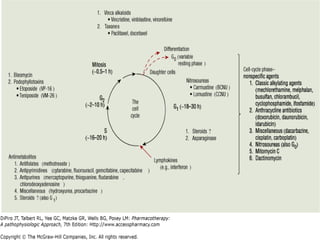
be inherited
9.
ETIOLOGY OF CANCER
Oncogenes
The result is dysregulation of normal cell
growth and proliferation, which imparts a
distinct growth advantage to the cell and
increases the probability of neoplastic
transformation
10.
ETIOLOGY OF CANCER
tumorsuppressor
tumor suppressor genes regulate and inhibit
inappropriate cellular growth and
proliferation.
Gene loss or mutation results in loss of
control over normal cell growth.
11.
ETIOLOGY OF CANCER
tumorsuppressor
Two common examples of tumor suppressor
genes are the retinoblastoma and p53 genes.
Mutation of p53 is one of the most common
genetic changes associated with cancer, and
is estimated to occur in half of all
malignancies.
12.
Pathology of cancer:tumor origin
Tumors may arise from any of four basic
tissue types
…epithelial tissue,
…connective tissue (i.e., muscle, bone,
and cartilage)
…Lymphoid tissue
…nerve tissue
13.
Pathology of cancer:tumor origin
Malignant cells are divided into those of
epithelial origin or the other tissue types.
Carcinomas are malignant growths arising
from epithelial cells.
sarcomas are malignant growths of muscle
or connective tissue.
Adenocarcinoma is a malignant tumor
arising from glandular tissue.
14.
Tumor characteristics
invadeand destroy the surrounding tissue.
The cells are genetically unstable
loss of normal cell architecture results in cells
that are atypical of their origin.
lose the ability to perform their usual
functions.
metastasize, and consequently, recurrences
are common after removal or destruction of
the primary tumor.
15.
Invasion and metastasis
Metastasis is the spread of neoplastic cells from
the primary tumor site to distant sites.
many patients have detectable metastatic
disease at diagnosis.
Once clinically evident distant metastases are
present, cancers are seldom curable
microscopic cancer metastases
16.
Invasion and metastasis
two primary pathways of metastasis
hematogenous and lymphatic.
Not all of the shed cancer cells result in a
metastatic lesion.
The "seed" must first find the appropriate
"soil," or an environment suitable for growth
17.
Metastasis
This processis illustrated in the diverse
patterns of metastasis that are
characteristic of individual types of cancer
E.g. colorectal cancer metastasizes to the
liver and prostrates cancer to the bone
18.
Metastasis
Used torefer to solid tumor only
The concept of tumor spread is not relevant to
hematological malignancies because cancer
cells circulate in the blood early in the course
of the disease
19.
Metastasis
30% ofpatients will have metastatic tumor >
1 cm at the time of diagnosis
Another 30% will have microscopic metastases
that are too small to be detected (the proof is
they have cancer recurrence even when the 1ry
tumor has been removed or destroyed)
20.
Diagnosis
The presentingsigns and symptoms of cancer
vary widely and depend on the type of cancer
The presentation in adults may include any
of cancer's seven warning signs as well as
pain or loss of appetite
21.
Diagnosis
The warningsigns of cancer in children are
different, and reflect the types of tumors more
common in this patient population.
The definitive diagnosis of cancer relies on a
sample of the tissue or cells suspected of
malignancy and pathologic assessment.
22.
Staging and workup
tumors should be staged to determine the
extent of disease before any definitive
treatment is initiated.
Staging provides information on prognosis
and guides treatment selection.
After treatment, the staging is usually
repeated to evaluate the effectiveness.
23.
Staging and workup
Some cancers produce tumor markers
Often nonspecific,
more useful for monitoring response and
detecting recurrence than as diagnostic tools.
24.
Clinically detectable cancer
Doublingtime (DT)
… the time it takes a tumor mass to double in
size
Wide variability in doubling times for various
cancers
Solid tumors are usually longer
Average DT for most solid time is 2-3 months
Breast cancer has an AVG DT of 100 days
There is a wide variation of growth rate even
among tumors of the same type
25.
Clinically detectable cancer
A tumor mass cannot be detected by physical
examination or radiological studies until it is
at least 1 cm in diameter.
Tumors of deep internal organs e.g. colon,
escape detection until they are much larger
A 1 cm mass weighs about 1 gram and
contains about 1 billion (1x10⁹
) cells
26.
Clinically detectable cancer
It requires about 30 DT for a tumor to grow
from 1 cell to 1 billion cells
This process takes 5-7 years at the average
rate of growth of solid tumors
It takes only an additional 10 DT for this 1
gram mass to be 1 kg
A tumor of a mass of 1-2 kg is considered
lethal
27.
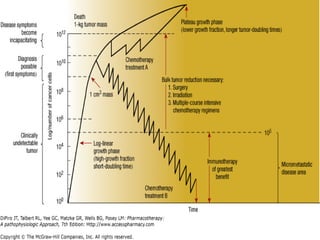
Gompertazin growth curve
Gompertazin growth curve demonstrates
the theoretical pattern of tumor growth
…Tumor growth may be slow very early
in the tumor's development, since the
tumor cells may have to over come
immunological defense mechanisms of the
host
29.
Gompertazin growth curve
The % of actively dividing cells is called
the growth fraction.
The growth fraction decreases as the
tumor mass increases in size and the
doubling time increases in length.
30.
Goals of cancertreatment
1- Primary goal
Cure the patient
Render him clinically and pathologically free
of disease and return their life expectancy to
that of healthy individuals of the same age
and sex.
Current therapies do not offer cures for all
patients
31.
Goals of cancertreatment
2- The best alternative goal
To prolong survival while maintaining the
patient's functional status and quality of
life.
3- The 3rd goal
Relive symptoms such as pain for patients
in whom the likehood of cure or prolonged
survival is very low
32.
Modalities of cancertreatment
The Major Modalities
Surgery
Radiation
Chemotherapy
Biological therapy
33.
Modalities of cancertreatment
The most appropriate type of therapy for each
individual patient is determined by
Type and extent of tumor involvement
Treatment goals
Performance status
Age
Concomitant disease
Many patient receive 2 or 3 of these modalities
together
34.
I-Surgery
The oldestcancer treatment
The most invasive method
Requires patient be able to tolerate physical
challenges of surgery
Was only method that could produce cures
Still provides the best chance of cure for most
patients with solid tumors.
35.
I-Surgery
Uses
…Treat theprimary cancer
…To remove isolated metastatic masses
…To make other methods of treatment
possible e.g. providing access for
chemotherapy delivery (implanted
infusion pumps)
36.
I-SURGERY
Diagnosis andStaging
Reconstruct anatomical defects to improve
function, cosmetic appearance, and quality of
life
Prevention
… Permitting the removal of precancerous lesions
such as abnormal moles or colon polyps.
I-SURGERY
Debulking
…Reduce the sizeof the tumor even though
the entire tumor cannot be resected
1ry to relive pain or other symptoms
Increase effectiveness of radiation or
chemotherapy
39.
I-SURGERY
Surgical removal ofa source of hormone
…A form of hormonal therapy
…Used in to treat tumors whose growth
depends on those hormones
…Most common type: removal of testes in
prostate cancer and removal of ovaries in
breast cancer.
40.
II- Radiation
Itis the destruction of cancer cells by ionizing
radiation
A component of treatment for ½-2/3 of all
patients with cancer
Radiation is usually generated by machines
outside the patient (external beam radiation)
41.
II- Radiation
Lesscommonly radiation sources are placed
close to the body surface or within the body
cavity (brachy-therapy)
Sometimes radiation sources are implanted
into or around cancerous tissue (interstitial
brachytherapy)
42.
II- Radiation
Usuallyadministered in small doses over
several weeks (fractionating)
fractionating permits the administration of
levels of radiation sufficient to kill tumor
cells while allowing normal surrounding
tissue to recover from damage
43.
II- Radiation
Side Effects
Radiation can never be directed only at tumor and
normal cells and tissue are also damaged
The most sensitive tissues are those that undergo
continuous cell renewal such as the skin, hair , GI
mucosa, bone marrow, reproductive tissue, and sweat
glands
In slowly growing tissue such as lungs, effects of
radiation is seen much later
44.
II- RADIATION
Side effects:
the ability to produce a cure with radiation
will depend on the capacity of normal tissues
surrounding the tumor to withstand the toxic
effects
… if the normal tissue are very sensitive, the
range of radiation doses used may be
limited
45.
II- Radiation
Radiocurability:ability to cure by radiation
Depends on
… The size and location of the tumor
… Type of tumor
… Tumor’s radiosensitivity
Curative radiation is limited to localized
tumors like surgery
46.
II- Radiation
Uses
Curativefor localized tumors
Total body radiation to prepare for bone
marrow transplant , but highly toxic
As supplement to surgery
To destroy micro metasitasis
47.
II- Radiation
Uses
Palliatively
…the most common used is to relive pain
caused by skeletal bone metastases
… such as seizures associated with brain
metastases
… spinal cord compression caused by growth
of tumors on the spine
48.
III-CHEMOTHERAPY
refers tothe use of conventional cytotoxic
drugs in addition to hormonal and
endocrine therapy.
Originally started in 1941, when
Goodman and Gilman first administered
nitrogen mustard to patients with
lymphoma
49.
III-CHEMOTHERAPY
Now thereare > 50 conventional
cytotoxic agents and > 15 hormonal
agents for cancer treatment
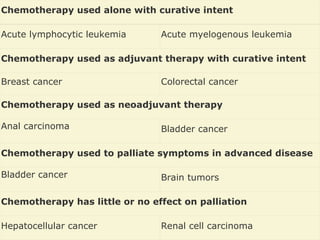
Chemotherapy used alonewith curative intent
Acute lymphocytic leukemia Acute myelogenous leukemia
Chemotherapy used as adjuvant therapy with curative intent
Breast cancer Colorectal cancer
Chemotherapy used as neoadjuvant therapy
Anal carcinoma Bladder cancer
Chemotherapy used to palliate symptoms in advanced disease
Bladder cancer Brain tumors
Chemotherapy has little or no effect on palliation
Hepatocellular cancer Renal cell carcinoma
52.
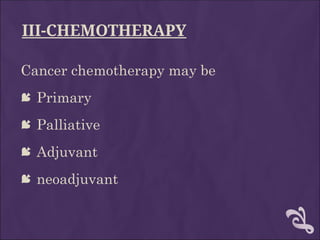
Adjuvant therapy
Toeradicate any residual micro metastases and
prevent them from growing into clinically evident
disease.
Usually systemic cytotoxic drugs, hormones, or
biological agents after the 1ry solid tumor mass has
been eliminated with surgery or radiation.
It also can be administered after the 1ry disease has
been eliminated by antineoplastic drugs
53.
Neoadjuvant therapy
… Aless conventional form
… Systemic chemo or biological therapy is given before
surgery to debulk the tumor, reducing the extent and
disfigurement of surgery
…may play a double role because may also eradicate
micro metastases.
…Practically useful in head, neck, and bone tumors
…Hormones may be used for the management of locally
advanced prostate cancer
54.
Tumor burden
acertain % of cancer cells will be killed
with each course of chemotherapy.
According to this hypothesis, the tumor
burden will never reach zero.
Tumors consisting of less than 104
cells
are believed to be small enough for
elimination by host factors, including
immunologic mechanisms.
55.
Tumor proliferation
Bothcancer cells and normal cells
reproduce in a series of steps known as
the cell cycle
DNA synthesis occurs in S phase.
%of cells in the S phase is an indicator
of the rate of tumor-cell proliferation.
Tumors with a high percentage of S-
phase cells are aggressively growing
57.
Tumor proliferation
Mostnormal human cells exist in the
G0 phase
Most cancer cells are not sensitive to
the effects of chemotherapy when they
are in this stage
58.
Tumor proliferation
Manyanticancer drugs target
rapidly proliferating cells
Agents with major activity in a
particular phase of the cell cycle are
known as cell-cycle phase-specific
agents.
…may also be active to a lesser
extent in other phases of the cycle.
59.
Tumor proliferation
Cell-cyclephase-nonspecific agents are
those with significant activity in
multiple phases.
In many cases, the cytotoxic effects of a
drug may result from interactions with
other intracellular activities and are
not related to specific cell-cycle events.
60.
Tumor proliferation
Bygiving phase-specific agents as a
continuous infusion or in multiple
repeated fractions, clinicians can
theoretically target more cells as they
progress into the drug-sensitive phase.
Thus cell-cycle phase-specific agents
are also termed schedule dependent.
61.
Tumor proliferation
cell-cyclephase-nonspecific drugs are
active in many phases, and
consequently are not schedule
dependent.
…The activity depends on the dose, and
these drugs are termed dose
dependent
62.
III-CHEMOTHERAPY
Uses
A-Limited in caseof primary localized
cancer, since only a few solid tumors are
sensitive enough to be treated with
drugs alone.
B-chemotherapy is the main treatment in
disseminated cancer, because drugs go
almost everywhere in the body
63.
III-CHEMOTHERAPY
C-Chemotherapy can beused in other clinical
situations in addition to other methods to
make them more effective
debulking of tumor so the surgical removal is
less extensive.
Radiosensitizers: Fluorouracil, doxorubicin
and cisplatin increase the effects of radiation
therapy. They are given before or during
radiation.
64.
IV-ENDOCRINE THERAPY
Optionfor management of cancers
from tissues whose growth is under
gonadal hormonal control, especially
breast, prostate, and endometrial
cancers
These cancers may regress if the
"feeding" hormone is eliminated or
antagonized.
65.
IV-ENDOCRINE THERAPY
Majororgan system toxicity is
uncommon from hormonal treatment,
making it the least toxic of systemic
anticancer therapies.
IV-ENDOCRINE THERAPY
Corticosteroids
…Playimportant role in managing
hematological malignancies
…Also in supportive care of patient with cancer
Corticosteroids are lymphocytotoxic
Useful in malignancies in which lymph tissue
are involved such as lymphocyetic leukemia,
lymphoma
68.
IV-ENDOCRINE THERAPY
Hormonereceptor tests measures the amount
of hormone receptors in cancer tissue.
Hormones (such as estrogen and
progesterone) can attach to these receptors.
If the test is positive, it is indicating that the
hormone is probably helping the cancer cells
to grow.
69.
V- BIOLOGICAL THERAPY
Theimmune system is an effective antitumor
defense
Malignant cells occasionally arise in healthy bodies
as a result of mutations but Not all these cells give
rise to clinically evident cancer
There are rare cases of spontaneous remission from
metastatic cancer
An intact immune system can identify malignant
cells and destroy them without negative effects on
normal cells.
70.
V- BIOLOGICAL THERAPY
any therapeutic alteration in the relationship
between the patient and the tumor( except
direct killing of the tumor) that improves the
patient’s ability to reject the tumor
the use of immune system therapies such as
interferons, interleukins, tumor vaccines, and
antibody and gene therapy to treat cancer.
71.
V- BIOLOGICAL THERAPY
Biologicaltherapies boost the immune system,
either directly or indirectly by
making cancer cells more recognizable by the
immune system, and more susceptible to
destruction
boosting the killing power of immune system
cells
changing the way cancer cells grow, so that they
act more like healthy cells
72.
V- BIOLOGICAL THERAPY
Biologicaltherapies boost the immune system, either
directly or indirectly, by
stopping the process that changes a normal cell into
a cancerous cell
enhancing the body's ability to repair or replace
normal cells damaged or destroyed by other forms of
cancer treatment, such as chemotherapy or radiation
preventing cancer cells from spreading to other parts
of the body
73.
V- BIOLOGICAL THERAPY
Whatare the different types of biological
therapies?
1-Nonspecific immunomodulating agents:
Drugs that stimulate the immune system,
causing it to produce more cytokines and
antibodies to help fight cancer and
infections in the body.
74.
V- BIOLOGICAL THERAPY
2-Biologicalresponse modifiers (BRMs):
They change the way the body's defenses interact
with cancer cells.
boost the body's ability to fight the disease.
direct the immune system's disease fighting powers
to disease cells.
strengthen a weakened immune system.
75.
V- BIOLOGICAL THERAPY
1-Interferons(IFN)
A type of BRM that naturally occurs in the body.
They have been shown to improve the way a cancer
patient's immune system acts against cancer cells.
… INFs may work directly on cancer cells to slow their growth,
… they may cause cancer cells to change into cells with more
normal behavior.
Some INFs may also stimulate natural killer cells, T
cells, and macrophages.
76.
V- BIOLOGICAL THERAPY
2-Interleukins(IL): (Aldesleukin)
…Proteins (cytokines) that occur naturally
in the body
…stimulate the growth and activity of
immune cells, such as lymphocytes, which
work to destroy cancer cells
77.
V- BIOLOGICAL THERAPY
3-MonoclonalAntibodies (MoABs)
MoABs consist of immunoglobulin sequences that
are known to recognize a specific antigen or protein
on the surface of cells.
Two main classes of MoABs are used in the
treatment of cancer
… unconjugated or naked MoABs
… immunoconjugates, MoABs conjugated to a toxin
(immunotoxin), chemotherapy agent, or
radioactive particle (radioimmunoconjugate).
78.
V- BIOLOGICAL THERAPY
The first MoABs used in humans were murine,
but most of the MoABs used today are
chimeric, humanized, or fully human.
Hypersensitivity and infusion-related
reactions, with or without the development of
human antimouse antibodies (HAMAs), are
generally greatest with murine antibodies and
least with humanized antibodies
79.
V- BIOLOGICAL THERAPY
mechanismsby which MoABs may induce death
of cancer cells.
Unconjugated MoABs that target antigens
on the cell surface of cancer cells may
directly mediate cell killing
antibody binding may result in the
transmission of signals that induce
apoptosis, or programmed cell death in the
targeted cell.
80.
V- BIOLOGICAL THERAPY
immunoconjugates deliver a chemotherapy
drug or radioactive particle to the site of
disease.
Once bound to target antigens, the
chemotherapy drug conjugated to the MoAB
is internalized by the target cell and kills
tumor cells through traditional mechanisms
of action.
81.
V- BIOLOGICAL THERAPY
MoABs have been developed that target the
underlying mechanism of cell growth and
proliferation
… Targeting the HER pathway is currently
used to treat a variety of solid tumor
malignancies
… Epidermal growth factor receptor (EGFR)
Angiogenesis inhibitors for
cancertreatment
What is angiogenesis?
The formation of new blood vessels is a process
controlled by certain chemicals produced in the body.
may help in normal wound healing.
becomes unregulated in several malignancies and can
lead to tumor growth, invasion, and metastasis
Angiogenesis provides cancer cells with oxygen and
nutrients.
84.
Angiogenesis inhibitors for
cancertreatment
This process is regulated by pro- and
antiangiogenic growth factors.
The best studied of the proangiogenic factors
is VEGF, whose elevated levels have been
associated with a poor prognosis and an
increased risk of metastases in a variety of
malignancies
85.
Angiogenesis inhibitors for
cancertreatment
Drugs can interfere with angiogenesis by
targeting vascular growth factors
the production and control of the endothelial
cells that make up the vessel linings.
Most drugs are cytostatic rather than
cytotoxic,
86.
VI- angiogenesis inhibitorsfor
cancer treatment
What are angiogenesis inhibitors and how do
they work?
A chemical that interferes with the signals to form
new blood vessels
May prevent the growth of cancer by blocking the
formation of new blood vessels.
In some animal case studies, angiogenesis inhibitors
have caused cancer to shrink and resolve completely.
87.
Combination chemotherapy
administrationof multiple agents to
overcome factors for decreased patient
response
Drugs that possess minimally overlapping
mechanisms of action and toxicities are
combined
Combination of chemotherpay with bioligical
therapy
88.
Administration of chemotherapy
a WBC count 3,000/mm3
or an ANC of 1,500/mm3
and
a platelet count of 100,000/mm3
are usually required
prior to administering chemotherapy.
assess renal and hepatic function, especially for
agents eliminated via those routes.
Chemotherapy dosed based on body surface area
… BSA used as an estimate of cardiac output and
subsequent distribution to the liver and kidneys
… The most common methods used to determine
BSA are the Mosteller and DuBois formulas
89.
EVALUATION OF RESPONSE
Objective categories of response
World Health Organization response criteria
was updated in 2000 and are now termed the
RECIST (Response Evaluation Criteria in
Solid Tumors)
90.
EVALUATION OF RESPONSE
1-completeresponse or remission (CR)
the complete disappearance of all clinical evidence of
the tumor for ≥ 1 Mo
the return to normal performance status (Physical
function)
2-partial response (PR):
> 30% decrease of measurable tumor, with no new
areas of cancer
no evidence of tumor progression for ≥ 1 Mo
91.
EVALUATION OF RESPONSE
3-diseaseprogression (treatment failure):
increase of measurable tumor by > 20%
appearance of new lesions
Tumor-induced death
4- stable disease:
measurable tumor that does not meet the criteria for
CR, PR, or disease progression
the tumor mass does not increase or decrease in size
by > 25%
92.
EVALUATION OF RESPONSE
5-clinical benefit response
patients who have clinical benefit as measured by
decreases in pain or analgesic consumption, or
improved quality of life or performance status.
6-Overall objective response rates f
calculated by adding the CR and partial response
rates
93.
EVALUATION OF RESPONSE
diseases such as leukemias and multiple myeloma
responses are measured by
… elimination of abnormal cells (e.g., return to
normal hematology parameters and normal
bone marrow in leukemia)
… return of tumor markers to normal levels (e.g.,
normal serum protein electrophoresis in
multiple myeloma)
… improved function of affected organs (e.g.,
improved renal function after obstructive
uropathy).
94.
EVALUATION OF RESPONSE
diseases such as leukemias and multiple myeloma
responses are measured by
… Measuring cytogenetic responses is increasingly
common in patients with known cytogenetic
abnormalities and absence of complete cytogenetic
responses may predict disease relapse
in chronic myelogenous leukemia, the
Philadelphia chromosome can be detected by
PCR,
Patients without evidence of the Philadelphia
chromosome are classified as a complete
cytogenetic response.
95.
EVALUATION OF RESPONSE
Survivalend points
Overall survival
… the gold standard but increasing emphasis
is being placed on other survival end points
that consider quality of life.
96.
EVALUATION OF RESPONSE
survivalend points
disease-free survival
… Measure the time the patient "survives"
free of disease
progression-free survival
… measure the time the patient is free of
progression
The relationship betweendose and
response
Dose is believed to be a critical factor in
determining response for many types of cancers.
Dose intensity
… the dose delivered to the patient over a
specified period of time. Determined by
… the dose per course
… the interval between doses
… and the total cumulative dose.
99.
The relationship betweendose and
response
The delivery of optimal dose intensity is
often compromised by the toxicities of the
oncologic drugs.
Treatment cycles are commonly delayed
because of inadequate recovery from drug
toxicity, especially myelosuppression.
Subsequent doses of chemotherapy are often
reduced to prevent or reduce the severity of
these toxicities.
100.
The relationship betweendose and
response
The impact on patient outcome is reduced
rates of response and survival
The development of drug- and toxicity-
specific chemoprotective agents has
facilitated application of dose-intensity
principles