INTRODUCTION
Bus is anelectrically conducting path
along which data is transmitted inside
any digital electronic device.
Bus may be in the form of wires, copper
tracks on a PCB or microscopic trails on
the surface of a silicon chip.
5.
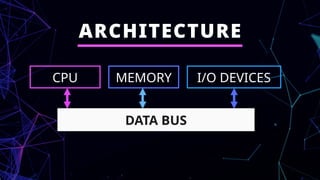
System Bus isa pathway composed of
cables and connectors used to carry
data between the computer
microprocessor and the main
memory.
S Y S T E M B U S
In other words it is considered as
the communication path between
the major components of any
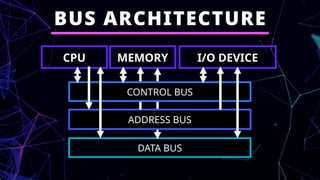
computer. It is made up of three
buses.
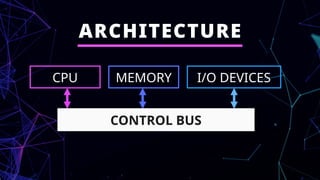
The control busis a communication
pathway in a computer's architecture
that carries control signals between
the CPU and other components, such
as memory and input/output devices.
C O N T R O L B U S
These signals coordinate and manage
the operations of the system,
ensuring that data is transferred
correctly and that processes occur in
the right sequence.
C O NT R O L B U S
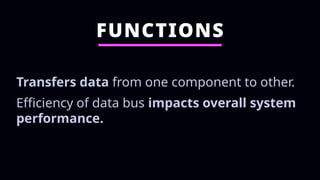
Data bus is a type of system bus
responsible for carrying data and
instructions to and from memory as
well as peripheral devices.
D ATA B U S
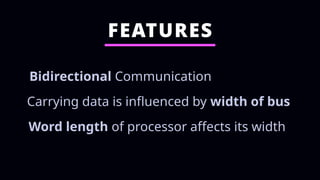
It consists of a set of wire, each
capable of transferring one bit of
data at a time.
C O NT R O L B U S
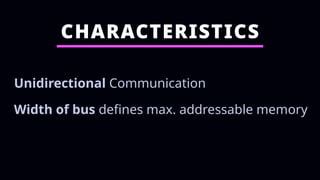
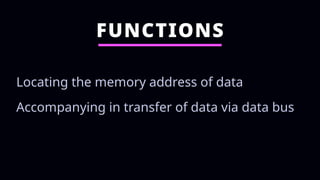
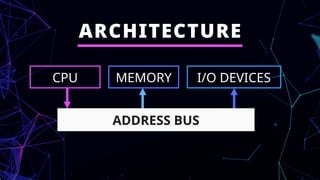
The address bus is a set of wires or
lines used to transmit addresses from
the CPU to memory and input/output
devices. It determines where data
should be read from or written to
within the system.
A D D R E S S B U S