European Patients’ Academy
on Therapeutic Innovation
Non-clinical development
European Patients’ Academy
on Therapeutic Innovation
 Once a lead molecule (candidate compound) is
identified, non-clinical development begins. Non-clinical
studies seek to answer the following questions:
 Does it work? (Efficacy assessment)
 How can it be delivered and how does the body react? (ADME
profiling)
 Is it safe? (Toxicology/safety, pharmacology assessment)
 Is the manufacturing process viable and controllable? (CMC
activities)
 Non-clinical development studies and activities
continue throughout the life-cycle of the product.
2
Objectives of non-clinical
development
European Patients’ Academy
on Therapeutic Innovation
 The non-clinical development of a medicine is complex
and regulatory-driven.
 The non-clinical development phase primarily aims to
 identify which candidate compound has the greatest probability
of success
 assess its safety, and
 build a solid scientific foundation before transition to the clinical
development phase, i.e. Phase I (first-in-human)
3
Non-clinical developement definition
and background
European Patients’ Academy
on Therapeutic Innovation
 During the non-clinical development phase:
 the intellectual property rights of the candidate compound are
registered (patented), and
 availability of the medicinal product for clinical trials is prepared
- synthesis and production of an appropriate amount of
medicine for pre-clinical and clinical testing
Background activities during non-
clinical development
European Patients’ Academy
on Therapeutic Innovation
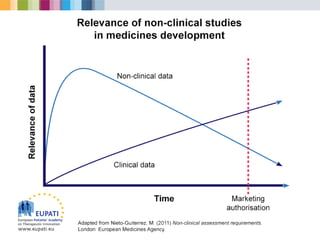
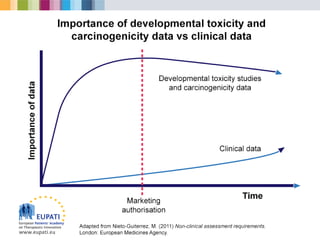
 Information obtained in non-clinical studies is needed in
specific situations for decisions:
 on clinical trials,
 on marketing authorization applications, and
 on post-marketing or monitoring studies.
 Non-clinical information is also used
 to determine first-in-human doses of the compound (based on
pharmacology and toxicology data)
 in clinical studies specific on heart function, and
 in safety monitoring in different systems (liver, central nervous
system, renal, etc.)
5
Why are non-clinical studies
needed?
European Patients’ Academy
on Therapeutic Innovation
European Patients’ Academy
on Therapeutic Innovation
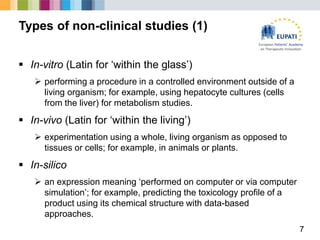
 In-vitro (Latin for ‘within the glass’)
 performing a procedure in a controlled environment outside of a
living organism; for example, using hepatocyte cultures (cells
from the liver) for metabolism studies.
 In-vivo (Latin for ‘within the living’)
 experimentation using a whole, living organism as opposed to
tissues or cells; for example, in animals or plants.
 In-silico
 an expression meaning ‘performed on computer or via computer
simulation’; for example, predicting the toxicology profile of a
product using its chemical structure with data-based
approaches.
7
Types of non-clinical studies (1)
European Patients’ Academy
on Therapeutic Innovation
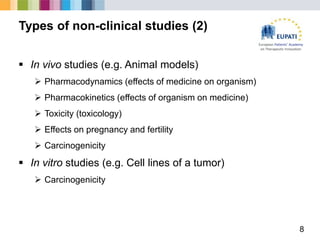
 In vivo studies (e.g. Animal models)
 Pharmacodynamics (effects of medicine on organism)
 Pharmacokinetics (effects of organism on medicine)
 Toxicity (toxicology)
 Effects on pregnancy and fertility
 Carcinogenicity
 In vitro studies (e.g. Cell lines of a tumor)
 Carcinogenicity
8
Types of non-clinical studies (2)
European Patients’ Academy
on Therapeutic Innovation
 In Silico (e.g. Computer models)
 Pharmacogenomics
 Effects on biomarkers
 Development of the compound
9
Types of non-clinical studies (3)
European Patients’ Academy
on Therapeutic Innovation
 Pharmacodynamics studies
 Aim to study how the medicine acts on the body (mode of action
(MOA)). Includes gathering information on the pharmacology of
the medicine (the study of specific effects on organs, for instance
the heart).
 Pharmacokinetic studies
 Aim to study the effects of the body on the medicine
 ADME: A (absorption), D (distribution), M (metabolism), E
(excretion)
 Toxicokinetics of the medicine – is the product toxic?
10
Types of non-clinical studies (4)
European Patients’ Academy
on Therapeutic Innovation
 Toxicology studies aim to address the toxicity of the
compound in different scenarios:
 Single-dose toxicity
 Repeated-dose toxicity
 Genotoxicity (will the product alter the genetic profile, interfering
with DNA or chromosomes?)
 Carcinogenicity (will the product cause cancer?)
 Development and reproductive toxicity (DART)
11
Types of non-clinical studies (4)
European Patients’ Academy
on Therapeutic Innovation
 Before non-clinical studies can begin, an adequate
amount of the active ingredient (AI) must be produced.
 Non-clinical studies usually require quantities of the AI in
milligrams or grams; later stages of the development process will
require a scale-up process to produce kilograms of the AI
 In order for studies to meet Good Laboratory Practice
(GLP) guidelines, the batches of AI must be qualified and
produced according to Good Manufacturing Practice
(GMP) guidelines.
 Chemistry, Manufacturing, Control (CMC) are key
aspects during non-clinical development.
12
Development of the compound for its
use in development (1)
European Patients’ Academy
on Therapeutic Innovation
 Formulation for non-clinical development studies
 Determining the dosing system and method of application of the
active ingredient based on product properties and type of animal
model.
 Detailed physico-chemical characterisation
 Stability testing and impurity analysis
 Development and validation of methods to quantify the
active substance in body fluids (e.g. blood, plasma,
urine) in pharmacokinetic and toxicokinetic studies
 Development of a prototype for the clinical formulation
13
Key CMC steps during non-clinical
development
European Patients’ Academy
on Therapeutic Innovation
 Discovery of target organ toxicity
 For example, if a compound is hepatotoxic (toxic for the liver) in
an animal
 Identification of poor pharmacokinetic properties
 For example, if a product is poorly absorbed, if it accumulates, or
if it generates toxic metabolites.
 ADME studies are performed to optimize selection of successful
product candidates
14
Non-clinical outcomes that can halt
development
European Patients’ Academy
on Therapeutic Innovation
 On ethical grounds, the Declaration of Helsinki states the
acceptability of using animals as models of risk
assessment for man when these models can mimic
human diseases.
 Questions that must be addressed:
 How relevant are non-clinical (animal) models for the human
situation?
 Were the non-clinical signs and pathologies sufficiently studied
within the context of the proposed human use of the novel
medicine?
15
Use of animals in medicines
research & development (1)
European Patients’ Academy
on Therapeutic Innovation
 How to align expectations from animal information to the
information provided by clinical studies in healthy
volunteers and patients?
 Can alternative tests be used?
 Further resources regarding the importance of animal
testing:
 http://www.animalresearchcures.org/
 http://www.animalethics.org.au/legislation/international
 Experience of patients: http://www.smh.com.au/world/i-would-
have-been-dead-at-nine-caterina-simonsen-in-hospital-after-
backlash-over-defence-of-animal-testing-20131230-hv75n.html
16
Use of animals in medicines
research & development (2)
European Patients’ Academy
on Therapeutic Innovation
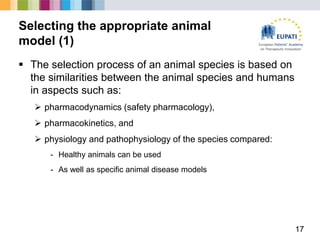
 The selection process of an animal species is based on
the similarities between the animal species and humans
in aspects such as:
 pharmacodynamics (safety pharmacology),
 pharmacokinetics, and
 physiology and pathophysiology of the species compared:
- Healthy animals can be used
- As well as specific animal disease models
17
Selecting the appropriate animal
model (1)
European Patients’ Academy
on Therapeutic Innovation
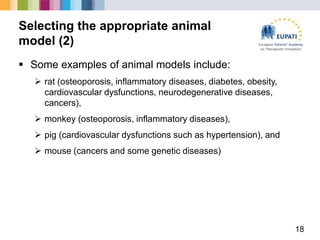
 Some examples of animal models include:
 rat (osteoporosis, inflammatory diseases, diabetes, obesity,
cardiovascular dysfunctions, neurodegenerative diseases,
cancers),
 monkey (osteoporosis, inflammatory diseases),
 pig (cardiovascular dysfunctions such as hypertension), and
 mouse (cancers and some genetic diseases)
18
Selecting the appropriate animal
model (2)
European Patients’ Academy
on Therapeutic Innovation
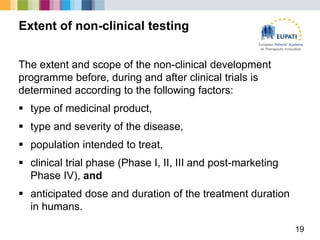
The extent and scope of the non-clinical development
programme before, during and after clinical trials is
determined according to the following factors:
 type of medicinal product,
 type and severity of the disease,
 population intended to treat,
 clinical trial phase (Phase I, II, III and post-marketing
Phase IV), and
 anticipated dose and duration of the treatment duration
in humans.
19
Extent of non-clinical testing
European Patients’ Academy
on Therapeutic Innovation
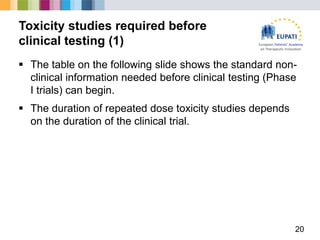
 The table on the following slide shows the standard non-
clinical information needed before clinical testing (Phase
I trials) can begin.
 The duration of repeated dose toxicity studies depends
on the duration of the clinical trial.
20
Toxicity studies required before
clinical testing (1)
European Patients’ Academy
on Therapeutic Innovation
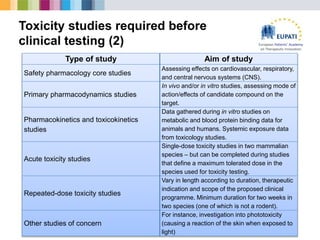
Toxicity studies required before
clinical testing (2)
Type of study Aim of study
Safety pharmacology core studies
Assessing effects on cardiovascular, respiratory,
and central nervous systems (CNS).
Primary pharmacodynamics studies
In vivo and/or in vitro studies, assessing mode of
action/effects of candidate compound on the
target.
Pharmacokinetics and toxicokinetics
studies
Data gathered during in vitro studies on
metabolic and blood protein binding data for
animals and humans. Systemic exposure data
from toxicology studies.
Acute toxicity studies
Single-dose toxicity studies in two mammalian
species – but can be completed during studies
that define a maximum tolerated dose in the
species used for toxicity testing.
Repeated-dose toxicity studies
Vary in length according to duration, therapeutic
indication and scope of the proposed clinical
programme. Minimum duration for two weeks in
two species (one of which is not a rodent).
Other studies of concern
For instance, investigation into phototoxicity
(causing a reaction of the skin when exposed to
light)
European Patients’ Academy
on Therapeutic Innovation
European Patients’ Academy
on Therapeutic Innovation
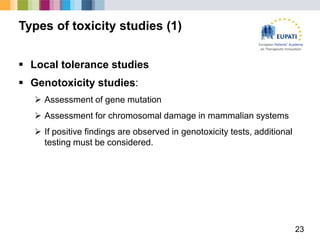
 Local tolerance studies
 Genotoxicity studies:
 Assessment of gene mutation
 Assessment for chromosomal damage in mammalian systems
 If positive findings are observed in genotoxicity tests, additional
testing must be considered.
23
Types of toxicity studies (1)
European Patients’ Academy
on Therapeutic Innovation
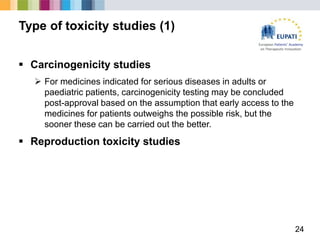
 Carcinogenicity studies
 For medicines indicated for serious diseases in adults or
paediatric patients, carcinogenicity testing may be concluded
post-approval based on the assumption that early access to the
medicines for patients outweighs the possible risk, but the
sooner these can be carried out the better.
 Reproduction toxicity studies
24
Type of toxicity studies (1)
European Patients’ Academy
on Therapeutic Innovation
 Some important factors to consider when the first-in-
human dose is established include:
 All relevant nonclinical data
- pharmacological dose response studies,
- pharmacological/toxicological profile, and
- pharmacokinetics studies
 Particular aspects of the candidate compound, and
 Clinical Study design
25
How to choose the first-in-human
dose (1)
European Patients’ Academy
on Therapeutic Innovation
 The No Observed Adverse Effect Level (NOAEL) is most
important
 NOAEL level is the level of exposure at which there is no
significant increase in the frequency or severity of any adverse
effects.
 In the case of many biotechnology-derived medicines
(biological medicines), and when risk factors have been
identified, the first human dose is established using the
Minimal-Anticipated-Biological-Effect-Level (MABEL).
26
How to choose the first-in-human
dose (2)