Data Cleaning
in R Made
Simple
Data cleaning.
The process of identifying, correcting, or removing inaccurate raw data
for downstream purposes.
Or, more colloquially, an unglamorous yet wholely necessary first step
towards an analysis-ready dataset.
Data cleaning may not be the sexiest task in a data scientist’s day but
never underestimate its ability to make or break a statistically-driven
project.
Data Cleaning
in R
Data Cleaning is the process to transform
raw data into consistent data that can be
easily analyzed.
It is aimed at filtering the content of
statistical statements based on the data as
well as their reliability.
Moreover, it influences the statistical
statements based on the data and improves
your data quality and overall productivity.
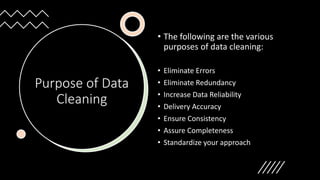
Purpose of Data
Cleaning
• The following are the various
purposes of data cleaning:
• Eliminate Errors
• Eliminate Redundancy
• Increase Data Reliability
• Delivery Accuracy
• Ensure Consistency
• Assure Completeness
• Standardize your approach
Overview of a typical
data analysis chain
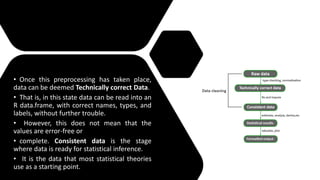
• This section represents an overview of a
typical data analysis.
• Each rectangle in the figure represents
data in a certain state while each arrow
represents the activities needed to get
from one state to the other.
• The first state (Raw data) is the data as it
comes in. Raw data may lack headers,
contain wrong data types, wrong
category labels, unknown or unexpected
character encoding, and so on.
• Once this preprocessing has taken place,
data can be deemed Technically correct Data.
• That is, in this state data can be read into an
R data.frame, with correct names, types, and
labels, without further trouble.
• However, this does not mean that the
values are error-free or
• complete. Consistent data is the stage
where data is ready for statistical inference.
• It is the data that most statistical theories
use as a starting point.
How to clean
data in R
• Here, this involves various steps, as from the
initial raw data have to move toward the
consistent and highly efficient data which is
ready to me implement as per the
requirements and produces the highly
precise and accurate statistical results.
• The steps vary from data to data as in this
case the user should be aware of the date
he/she is using for the results.
• As there are many characteristics and
common symptoms of messy data which
totally depend on the data used by the user
for analysis.
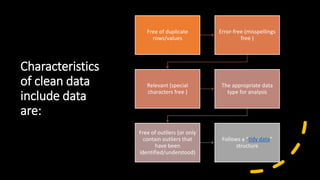
Characteristics
of clean data
include data
are:
Free of duplicate
rows/values
Error-free (misspellings
free )
Relevant (special
characters free )
The appropriate data
type for analysis
Free of outliers (or only
contain outliers that
have been
identified/understood)
Follows a “tidy data”
structure
Presentation 1.pptx