Welcome to
Today’s
Webinar!
Thursday, May 1, 2025
CORPORATE PARTNERS
PLATINUM
GOLD
www.PackagingTechnologyAndResearch .com
CREATED FOR :
Spring 2025
Chemicals of Concern
Pragmatic Risk
Assessment and
Mitigation for
Pragmatic risk assessment and mitigation for CoCs in packaging - by Dr. Claire Sand - 3
Chemicals of
Concern in Packaging
ABOUT
PTR
Dr. Claire Sand thinks “all packaging all the
time”
Claire’s enables a more sustainable food system with science & value chain innovations
• 35+ years of food packaging experience
• Ranks innovative packaging science and value chain solutions to extend shelf life
• Generates implementation roadmaps and aligns business cases
• IFT Fellow, Riester-Davis-Brody life-time achievement in food packaging award
recipient
• Doctorate in Food Science and Nutrition at the University of Minnesota
• MS and BS in Packaging at Michigan State University
Owner Columnist Current Leadership & Editorial Boards Awards
Executive Boards
Editorial Reviewer National
Board
Science Foundation
Editorial Board
Riester-Davis-Brody
IFT
Food Packaging
Lifetime
Achievement Award
Fellow
Pragmatic risk assessment and mitigation for CoCs in packaging - by Dr. Claire Sand - 2
Let’s Connect!
Emily Smith, Project Manager
at Civil & Environmental
Consultants, Inc
• Office: 866.312.2024 x 2620
• Mobile: 508.272.3833
• Email: easmith@cecinc.com
Chemicals of
Concern
• Over 12 years of professional experience in the engineering
and consulting industry
• Specializes in environmental services including remediation,
environmental assessments, and drinking water protection
• Extensive experience with emerging contaminants
of concerns including
• Microplastics
• PFAS
• High-risk threats to sources of drinking
water
• BS in Chemical Engineering at the University of New
Hampshire
ABOUT CIVIL & ENVIRONMENTAL CONSULT
ANTS, INC
Emily Smith – Project
Manager
Pragmatic risk assessment and mitigation for CoCs in packaging - by Dr. Claire Sand - 5
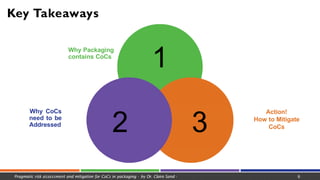
1
Pragmatic risk assessment and mitigation for CoCs in packaging - by Dr. Claire Sand - 6
3
2
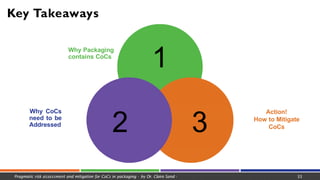
Key Takeaways
Why Packaging
contains CoCs
Why CoCs
need to be
Addressed
Action!
How to Mitigate
CoCs
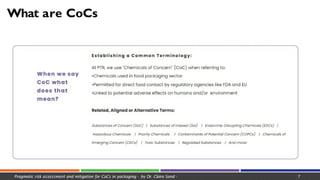
What are CoCs
Pragmatic risk assessment and mitigation for CoCs in packaging - by Dr. Claire Sand - 7
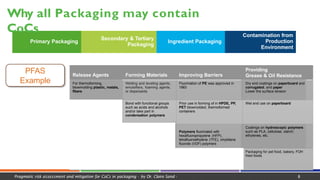
Primary Packaging
Secondary & Tertiary
Packaging
Ingredient Packaging
Contamination from
Production
Environment
Why all Packaging may contain
CoCs
Release Agents Forming Materials Improving Barriers
Providing
Grease & Oil Resistance
For thermoforming,
blowmolding plastic, metals,
fibers
Wetting and leveling agents,
emulsifiers, foaming agents,
or dispersants
Fluorination of PE was approved in
1983
Dry end coatings on paperboard and
corrugated, and paper
Lower the surface tension
Bond with functional groups
such as acids and alcohols
and/or take part in
condensation polymers
Prior use in forming of in HPDE, PP,
PET blowmolded, thermoformed
containers
Wet end use on paperboard
Polymers fluorinated with
hexafluoropropylene (HFP),
tetrafluoroethylene (TFE), vinylidene
fluoride (VDF) polymers
Coatings on hydroscopic polymers
such as PLA, cellulose, starch,
ethylenes, etc.
Packaging for pet food, bakery, FOH
fried foods
PFAS
Example
Pragmatic risk assessment and mitigation for CoCs in packaging - by Dr. Claire Sand - 8
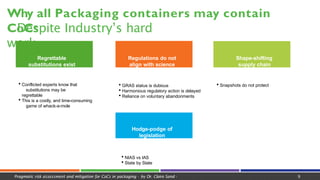
Why all Packaging containers may contain
CoCs
Pragmatic risk assessment and mitigation for CoCs in packaging - by Dr. Claire Sand - 9
- Despite Industry’s hard
work
Regrettable
substitutions exist
Regulations do not
align with science
Hodge-podge of
legislation
 Conflicted experts know that
substitutions may be
regrettable
 This is a costly, and time-consuming
game of whack-a-mole
 GRAS status is dubious
 Harmonious regulatory action is delayed
 Reliance on voluntary abandonments
Shape-shifting
supply chain
 Snapshots do not protect
 NIAS vs IAS
 State by State
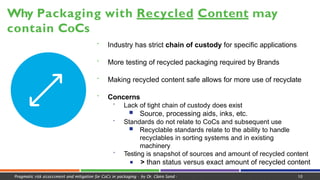
 Industry has strict chain of custody for specific applications
 More testing of recycled packaging required by Brands
 Making recycled content safe allows for more use of recyclate
 Concerns
 Lack of tight chain of custody does exist
■ Source, processing aids, inks, etc.
 Standards do not relate to CoCs and subsequent use
■ Recyclable standards relate to the ability to handle
recyclables in sorting systems and in existing
machinery
 Testing is snapshot of sources and amount of recycled content
■ > than status versus exact amount of recycled content
Why Packaging with Recycled Content may
contain CoCs
Pragmatic risk assessment and mitigation for CoCs in packaging - by Dr. Claire Sand - 10
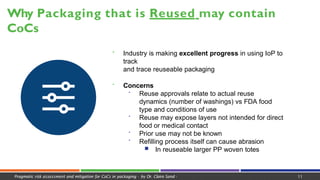
Why Packaging that is Reused may contain
CoCs
 Industry is making excellent progress in using IoP to
track
and trace reuseable packaging
 Concerns
 Reuse approvals relate to actual reuse
dynamics (number of washings) vs FDA food
type and conditions of use
 Reuse may expose layers not intended for direct
food or medical contact
 Prior use may not be known
 Refilling process itself can cause abrasion
■ In reuseable larger PP woven totes
Pragmatic risk assessment and mitigation for CoCs in packaging - by Dr. Claire Sand - 11
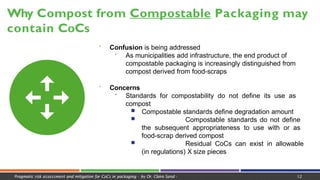
 Confusion is being addressed
 As municipalities add infrastructure, the end product of
compostable packaging is increasingly distinguished from
compost derived from food-scraps
 Concerns
 Standards for compostability do not define its use as
compost
■ Compostable standards define degradation amount
■ Compostable standards do not define
the subsequent appropriateness to use with or as
food-scrap derived compost
■ Residual CoCs can exist in allowable
(in regulations) X size pieces
Why Compost from Compostable Packaging may
contain CoCs
Pragmatic risk assessment and mitigation for CoCs in packaging - by Dr. Claire Sand - 12
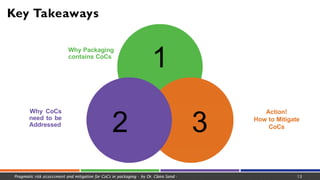
1
Pragmatic risk assessment and mitigation for CoCs in packaging - by Dr. Claire Sand - 13
3
2
Why Packaging
contains CoCs
Why CoCs
need to be
Addressed
Action!
How to Mitigate
CoCs
Key Takeaways
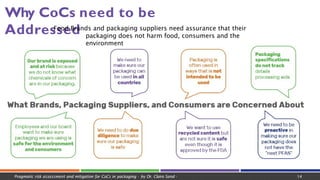
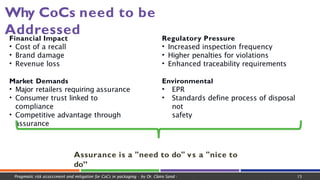
Why CoCs need to be
Addressed
Food Brands and packaging suppliers need assurance that their
packaging does not harm food, consumers and the
environment
Pragmatic risk assessment and mitigation for CoCs in packaging - by Dr. Claire Sand - 14
Financial Impact
• Cost of a recall
• Brand damage
• Revenue loss
Market Demands
• Major retailers requiring assurance
• Consumer trust linked to
compliance
• Competitive advantage through
assurance
Regulatory Pressure
• Increased inspection frequency
• Higher penalties for violations
• Enhanced traceability requirements
Environmental
• EPR
• Standards define process of disposal
not
safety
Assurance is a "need to do" vs a "nice to
do”
Why CoCs need to be
Addressed
Pragmatic risk assessment and mitigation for CoCs in packaging - by Dr. Claire Sand - 15
1
Pragmatic risk assessment and mitigation for CoCs in packaging - by Dr. Claire Sand - 16
3
2
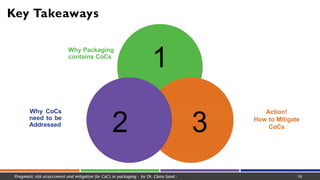
Why Packaging
contains CoCs
Why CoCs
need to be
Addressed
Action!
How to Mitigate
CoCs
Key Takeaways
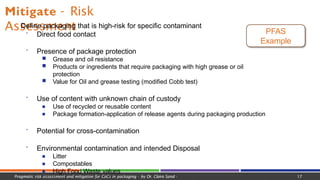
Mitigate - Risk
Assessment
 Define packaging that is high-risk for specific contaminant
 Direct food contact
 Presence of package protection
■ Grease and oil resistance
■ Products or ingredients that require packaging with high grease or oil
protection
■ Value for Oil and grease testing (modified Cobb test)
 Use of content with unknown chain of custody
■ Use of recycled or reusable content
■ Package formation-application of release agents during packaging production
 Potential for cross-contamination
 Environmental contamination and intended Disposal
■ Litter
■ Compostables
■ High Food Waste values
PFAS
Example
Pragmatic risk assessment and mitigation for CoCs in packaging - by Dr. Claire Sand - 17
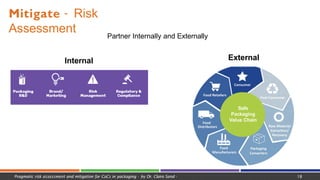
Partner Internally and Externally
Safe
Packaging
Value Chain
Internal
Pragmatic risk assessment and mitigation for CoCs in packaging - by Dr. Claire Sand - 18
External
Mitigate - Risk
Assessment
Mitigate - Risk Assessment - Client
Work Chemicals of
Concern
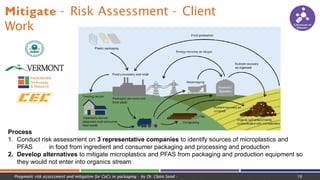
Process
1. Conduct risk assessment on 3 representative companies to identify sources of microplastics and
PFAS in food from ingredient and consumer packaging and processing and production
2. Develop alternatives to mitigate microplastics and PFAS from packaging and production equipment so
they would not enter into organics stream
Pragmatic risk assessment and mitigation for CoCs in packaging - by Dr. Claire Sand - 19
Mitigate - Client Work - Risk
Assessment
Results
• Identified >75 sources of microplastics and PFAS from
packaging and production equipment
• Provided >50 solutions to mitigate microplastics and
PFAS
from packaging and production equipment
• Shared results from representative brands to provide direction for
other food processing and packaging operations to identify sources
and mitigate microplastics and PFAS from packaging and
production equipment
Chemicals of
Concern
Pragmatic risk assessment and mitigation for CoCs in packaging - by Dr. Claire Sand - 20
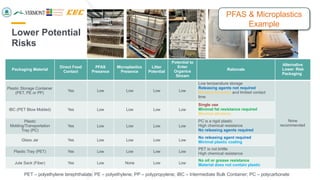
Lower Potential
Risks
PET – polyethylene terephthalate; PE – polyethylene; PP – polypropylene; IBC – Intermediate Bulk Container; PC – polycarbonate
Packaging Material
Direct Food
Contact
PFAS
Presence
Microplastics
Presence
Litter
Potential
Potential to
Enter
Organics
Stream
Rationale
Alternative
Lower Risk
Packaging
Plastic Storage Container
(PET, PE or PP)
Yes Low Low Low Low
Low temperature storage
Releasing agents not required
Minimal abrasion and limited contact
time
None
recommended
IBC (PET Blow Molded) Yes Low Low Low Low
Single use
Minimal fat resistance required
Minimal abrasion
Plastic
Molding/Transportation
Tray (PC)
Yes Low Low Low Low
PC is a rigid plastic
High chemical resistance
No releasing agents required
Glass Jar Yes Low Low Low Low
No releasing agent required
Minimal plastic coating
Plastic Tray (PET) Yes Low Low Low Low
PET is not brittle
High chemical resistance
Jute Sack (Fiber) Yes Low None Low Low
No oil or grease resistance
Material does not contain plastic
PFAS & Microplastics
Example
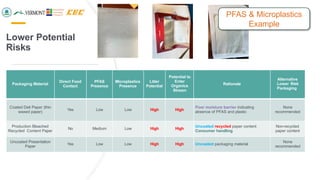
Lower Potential
Risks
Packaging Material
Direct Food
Contact
PFAS
Presence
Microplastics
Presence
Litter
Potential
Potential to
Enter
Organics
Stream
Rationale
Alternative
Lower Risk
Packaging
Coated Deli Paper (thin
waxed paper)
Yes Low Low High High
Poor moisture barrier indicating
absence of PFAS and plastic
None
recommended
Production Bleached
Recycled Content Paper
No Medium Low High High
Uncoated recycled paper content
Consumer handling
Non-recycled
paper content
Uncoated Presentation
Paper
Yes Low Low High High Uncoated packaging material
None
recommended
PFAS & Microplastics
Example
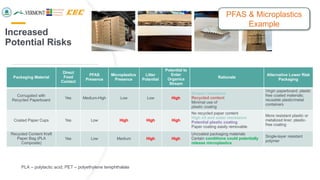
Increased
Potential Risks
PLA – polylactic acid; PET – polyethylene terephthalate
Packaging Material
Direct
Food
Contact
PFAS
Presence
Microplastics
Presence
Litter
Potential
Potential to
Enter
Organics
Stream
Rationale
Alternative Lower Risk
Packaging
Corrugated with
Recycled Paperboard
Yes Medium-High Low Low High
Grease resistance
Recycled content
Minimal use of
plastic coating
Virgin paperboard; plastic
free coated materials;
reusable plastic/metal
containers
Coated Paper Cups Yes Low High High High
No recycled paper content
High oil and water resistance
Potential plastic coating
Paper coating easily removable
More resistant plastic or
metalized liner; plastic-
free coating
Recycled Content Kraft
Paper Bag (PLA
Composite)
Yes Low Medium High High
Uncoated packaging materials
Certain conditions could potentially
release microplastics
Single-layer resistant
polymer
PFAS & Microplastics
Example
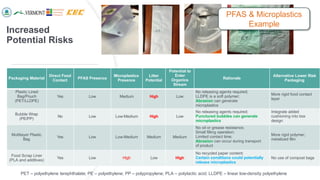
PET – polyethylene terephthalate; PE – polyethylene; PP – polypropylene; PLA – polylactic acid; LLDPE – linear low-density polyethylene
Increased
Potential Risks
Packaging Material
Direct Food
Contact
PFAS Presence
Microplastics
Presence
Litter
Potential
Potential to
Enter
Organics
Stream
Rationale
Alternative Lower Risk
Packaging
Plastic Lined
Bag/Pouch
(PET/LLDPE)
Yes Low Medium High Low
No releasing agents required;
LLDPE is a soft polymer;
Abrasion can generate
microplastics
More rigid food contact
layer
Bubble Wrap
(PE/PP)
No Low Low-Medium High Low
No releasing agents required;
Punctured bubbles can generate
microplastics
Integrate added
cushioning into box
design
Multilayer Plastic
Bag
Yes Low Low-Medium Medium Medium
No oil or grease resistance;
Small filling operation;
Limited contact time;
Abrasion can occur during transport
of product
More rigid polymer;
metalized film
Food Scrap Liner
(PLA and additives)
Yes Low High Low High
No recycled paper content;
Certain conditions could potentially
release microplastics
No use of compost bags
PFAS & Microplastics
Example
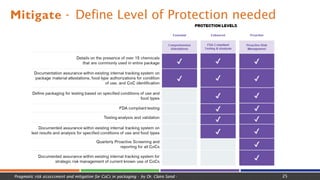
Mitigate - Define Level of Protection needed
25
Pragmatic risk assessment and mitigation for CoCs in packaging - by Dr. Claire Sand -
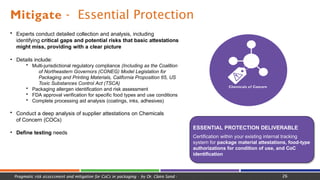
Mitigate - Essential Protection
Chemicals of Concern
• Experts conduct detailed collection and analysis, including
identifying critical gaps and potential risks that basic attestations
might miss, providing with a clear picture
• Details include:
• Multi-jurisdictional regulatory compliance (Including as the Coalition
of Northeastern Governors (CONEG) Model Legislation for
Packaging and Printing Materials, California Proposition 65, US
Toxic Substances Control Act (TSCA)
• Packaging allergen identification and risk assessment
• FDA approval verification for specific food types and use conditions
• Complete processing aid analysis (coatings, inks, adhesives)
• Conduct a deep analysis of supplier attestations on Chemicals
of Concern (COCs)
• Define testing needs
ESSENTIAL PROTECTION DELIVERABLE
Certification within your existing internal tracking
system for package material attestations, food-type
authorizations for condition of use, and CoC
identification
26
Pragmatic risk assessment and mitigation for CoCs in packaging - by Dr. Claire Sand -
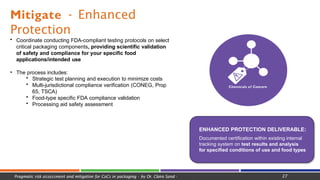
Mitigate - Enhanced
Protection
Chemicals of Concern
ENHANCED PROTECTION DELIVERABLE:
Documented certification within existing internal
tracking system on test results and analysis
for specified conditions of use and food types
27
Pragmatic risk assessment and mitigation for CoCs in packaging - by Dr. Claire Sand -
• Coordinate conducting FDA-compliant testing protocols on select
critical packaging components, providing scientific validation
of safety and compliance for your specific food
applications/intended use
• The process includes:
• Strategic test planning and execution to minimize costs
• Multi-jurisdictional compliance verification (CONEG, Prop
65, TSCA)
• Food-type specific FDA compliance validation
• Processing aid safety assessment
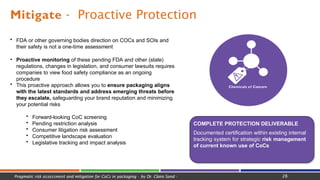
Mitigate - Proactive Protection
Chemicals of Concern
COMPLETE PROTECTION DELIVERABLE
Documented certification within existing internal
tracking system for strategic risk management
of current known use of CoCs
28
Pragmatic risk assessment and mitigation for CoCs in packaging - by Dr. Claire Sand -
• FDA or other governing bodies direction on COCs and SOIs and
their safety is not a one-time assessment
• Proactive monitoring of these pending FDA and other (state)
regulations, changes in legislation, and consumer lawsuits requires
companies to view food safety compliance as an ongoing
procedure
• This proactive approach allows you to ensure packaging aligns
with the latest standards and address emerging threats before
they escalate, safeguarding your brand reputation and minimizing
your potential risks
• Forward-looking CoC screening
• Pending restriction analysis
• Consumer litigation risk assessment
• Competitive landscape evaluation
• Legislative tracking and impact analysis
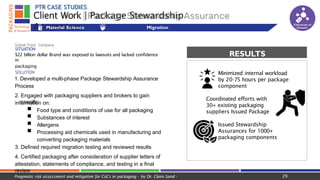
SITUATION
$22 billion dollar Brand was exposed to lawsuits and lacked confidence
in
packaging
SOLUTION
1. Developed a multi-phase Package Stewardship Assurance
Process
2. Engaged with packaging suppliers and brokers to gain
specific
information on:
 Food type and conditions of use for all packaging
 Substances of interest
 Allergens
 Processing aid chemicals used in manufacturing and
converting packaging materials
3. Defined required migration testing and reviewed results
4. Certified packaging after consideration of supplier letters of
attestation, statements of compliance, and testing in a final
review
Client Work | Package Stewardship
Assurance
PTR CASE STUDIES
Minimized internal workload
by 20-75 hours per package
component
Coordinated efforts with
30+ existing packaging
suppliers Issued Package
Issued Stewardship
Assurances for 1000+
packaging components
RESULTS
Chemicals of
Concern
Material Science Migration
Complexities
Global Food Company
29
Pragmatic risk assessment and mitigation for CoCs in packaging - by Dr. Claire Sand -
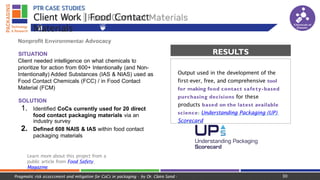
PTR CASE STUDIES
Nonprofit Environmental Advocacy
SITUATION
Client needed intelligence on what chemicals to
prioritize for action from 600+ Intentionally (and Non-
Intentionally) Added Substances (IAS & NIAS) used as
Food Contact Chemicals (FCC) / in Food Contact
Material (FCM)
SOLUTION
1. Identified CoCs currently used for 20 direct
food contact packaging materials via an
industry survey
2. Defined 608 NAIS & IAS within food contact
packaging materials
Learn more about this project from a
public article from Food Safety
Magazine
Client Work | Food Contact
Materials
Material Science Migration Complexities
Output used in the development of the
first-ever, free, and comprehensive tool
for making food contact safety-based
purchasing decisions for these
products based on the latest available
science: Understanding Packaging (UP)
Scorecard
RESULTS
Chemicals of
Concern
30
Pragmatic risk assessment and mitigation for CoCs in packaging - by Dr. Claire Sand -
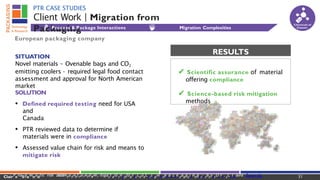
Client Work | Migration from
Packaging
PTR CASE STUDIES
European packaging company
SITUATION
Novel materials – Ovenable bags and CO2
emitting coolers - required legal food contact
assessment and approval for North American
market
SOLUTION
• Defined required testing need for USA
and
Canada
• PTR reviewed data to determine if
materials were in compliance
• Assessed value chain for risk and means to
mitigate risk
✔ Scientific assurance of material
offering compliance
✔ Science-based risk mitigation
methods
RESULTS
Process & Package Interactions Migration Complexities
Chemicals of
Concern
31
ClairPeraSgamnadtic risk a
s
s
e
s
s
m6e1
2n.
8t0a7n.
5d3
4m1 itigactlaioirne@fopracCkoaCgisngintecphancokloaggyianngdr-esbeyarDcrh..cColmaire SPaancdk
a
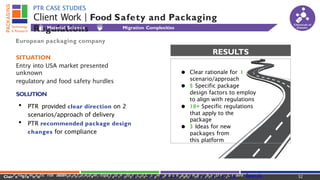
● Clear rationale for 1
scenario/approach
● 5 Specific package
design factors to employ
to align with regulations
● 10+ Specific regulations
that apply to the
package
● 3 Ideas for new
packages from
this platform
RESULTS
Client Work | Food Safety and Packaging
Regulations
PTR CASE STUDIES
European packaging company
SITUATION
Entry into USA market presented
unknown
regulatory and food safety hurdles
SOLUTION
• PTR provided clear direction on 2
scenarios/approach of delivery
• PTR recommended package design
changes for compliance
Material Science Migration Complexities
Chemicals of
Concern
32
ClairPeraSgamnadtic risk a
s
s
e
s
s
m6e1
2n.
8t0a7n.
5d3
4m1 itigactlaioirne@fopracCkoaCgisngintecphancokloaggyianngdr-esbeyarDcrh..cColmaire SPaancdk
a
1
Pragmatic risk assessment and mitigation for CoCs in packaging - by Dr. Claire Sand - 33
3
2
Why Packaging
contains CoCs
Why CoCs
need to be
Addressed
Action!
How to Mitigate
CoCs
Key Takeaways
Dr. Claire Sand
Founder & Owner
Thank
you
Reach out to connect for
a virtual coffee
Pragmatic risk assessment and mitigation for CoCs in packaging - by Dr. Claire Sand - 34