Potential Scope, Advantages, and Challenges of RAS and Bio-floc Technology in Indian Fish Farming
Brief on Recirculating Aquaculture Systems and Bio-floc Technology's role, benefits, challenges, and future strategies, schemes supporting RAS&Bio-floc technologies in sustainable fish farming within India's aquaculture sector.
Potential Scope, Advantages, and Challenges of RAS and Bio-floc Technology in Indian Fish Farming
1.
1
Potential Scope, Advantages,and Challenges of Recirculating Aquaculture Systems
(RAS) and Bio-floc Technology (BFT) in Fish Farming in the Indian Scenario
By B. Bhaskar, (Fisheries)
1. Introduction
Global population is exponentially increased over 8 billion, another side climate change,
natural disasters, anthropogenic drivers impact also significantly raised over the years in agri-
aqua production system, resulted in desertification, However this unproductive land also can
be utilized for aquaculture including for promotion of RAS & Biofloc technology.
2. Strength of Indian Fisheries Sector:
India’s fisheries and aquaculture sector has rapidly evolved into a 198 lakh metric tonne
powerhouse during 2025-26 (Dept. of Fisheries, GOI, 2026).
Global Standing: India contributes roughly 9% of the world's aquatic animals and holds the
globally 1st
in inland fisheries, 2nd
rank in Aquaculture production.
Record Exports and Trade India exported 19,72,018 metric tonnes (MT) of seafood valued
at ₹73,890.46 crore (USD 8.46 billion) during FY 2025–26, registering an all-time high in both
volume and value despite challenging global market conditions
Global Reach: India exports over 350 seafood products to >130 countries, with aquaculture
comprising 62% of the export value
3. RAS& Bio-flocs:
Global aquaculture must expand to meet rising protein demands sustainably. Traditional open-
pond systems face strict limitations due to heavy land use, water scarcity, and environmental
runoff risks. Modern producers lean heavily on Recirculating Aquaculture Systems (RAS) and
Biofloc Technology (BFT) to maximize yield while conserving natural resources. Recirculating
Aquaculture Systems (RAS) and Biofloc Technology (BFT) represent two highly intensive, controlled,
and sustainable methods of aquaculture. While RAS relies on mechanical and biological filtration, BFT
utilizes beneficial bacteria suspended in the water to convert waste into natural feed
RAS comes equipped with an external filter that removes bacteria that produce
nitrogen, as well as larger solids from the tank system. Most RAS also include ultraviolet lamps
that sterilize the water so that no unwanted bacteria will infect your fish. Unfortunately,
recirculating aquaculture systems tend to be more expensive than Biofloc. Biofloc systems use
an extensive microbial community to remove unwanted chemicals and compounds from your
tank's water. The only external filtration component for Biofloc is used to remove larger waste
particles from the system. The Biofloc system is less expensive than RAS because there is less
technical equipment involved. Recent research and developments in indoor Litopenaeus
vannamei farming indicates that combining technologies—specifically using Biofloc
Technology (BFT) for nurseries followed by Recirculating Aquaculture Systems (RAS) for
grow-out—yields superior performance. BFT excels in early stages with higher survival rates,
while RAS offers better water quality management and higher final yields in grow-out,
balancing growth, cost, and system robustness.
2.
2
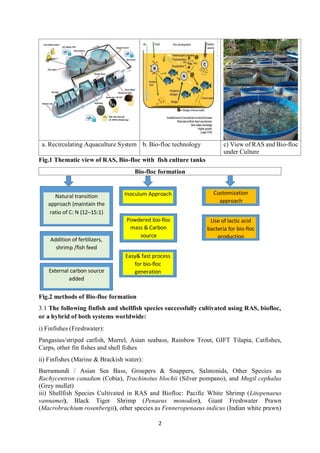
a. Recirculating AquacultureSystem b. Bio-floc technology c) View of RAS and Bio-floc
under Culture
Fig.1 Thematic view of RAS, Bio-floc with fish culture tanks
Bio-floc formation
Fig.2 methods of Bio-floc formation
3.1 The following finfish and shellfish species successfully cultivated using RAS, biofloc,
or a hybrid of both systems worldwide:
i) Finfishes (Freshwater):
Pangasius/striped catfish, Murrel, Asian seabass, Rainbow Trout, GIFT Tilapia, Catfishes,
Carps, other fin fishes and shell fishes
ii) Finfishes (Marine & Brackish water):
Barramundi / Asian Sea Bass, Groupers & Snappers, Salmonids, Other Species as
Rachycentron canadum (Cobia), Trachinotus blochii (Silver pompano), and Mugil cephalus
(Grey mullet)
iii) Shellfish Species Cultivated in RAS and Biofloc: Pacific White Shrimp (Litopenaeus
vannamei), Black Tiger Shrimp (Penaeus monodon), Giant Freshwater Prawn
(Macrobrachium rosenbergii), other species as Fenneropenaeus indicus (Indian white prawn)
Natural transition
approach (maintain the
ratio of C: N (12–15:1)
Inoculum Approach Customization
approach
Addition of fertilizers,
shrimp /fish feed
Powdered bio-floc
mass & Carbon
source
Use of lactic acid
bacteria for bio-floc
production
External carbon source
added
Easy& fast process
for bio-floc
generation
3.
3
and various mudcrab species like Scylla serrata are sometimes raised in biofloc-based nursing
stages. Bivalves Species as Crassostrea gigas (Pacific oysters) and Mytilus edulis (Blue
mussels) are grown in specialized marine RAS environments, mostly for seed production and
sustainable shellfish farming
3.2 Ideal water quality parameters for successful RAS and bio-floc technology:
1) Dissolved oxygen (DO) >Above of 5.0 mg L−1 (ideal) and at least 60% of saturation.
2) Temperature 28-30° C
3) pH 6.8-8
4) Salinity: depends on cultured species
5) TAN &Nitrite <1 mg L−1 (ideal)
6) Nitrate 0.5–20 mg L−1
7) Orthophosphate: 0.5–20 mg L−1
8) Alkalinity More than 100 mg L−1
9) Settling solids (SS): Ideal: 5–15 mL L−1(shrimp), 5–20 (tilapia fingerlings) and 20–50 mL
L−1(juveniles and adult tilapia)
10) Total suspended solids (TSS): <500 mg L−1
Table1. System Suitability Comparison
Feature
Recirculating Aquaculture
Systems (RAS)
Biofloc Technology (BFT)
Primary Species Fit
Carnivorous, herbivorous, and
omnivorous finfish
Omnivorous/detritivorous shrimp and
tilapia
Water Clarity
Crystal clear
(mechanical/biological filtration)
Turbid (high suspended
solids/microbial mass)
Capital Investment
Very High (requires specialized
infrastructure)
Moderate (requires heavy aeration
and carbon input)
Dietary
Supplementation
100% reliant on formulated feeds
Animals eat both feed and the live
biofloc
Table2. Realistic Production Expectations at existing fish species seed availability
Parameter Bio-floc Technology (BFT)
Recirculating Aquaculture System
(RAS)
Primary Suitability
Shrimp (L. vannamei), Tilapia,
Catfish and few other fin fishes
and shell fish species
Barramundi/Asian seabass, Shrimp,
GIFT Tilapia, Pangasius, cold water
trouts, Salmonids, few other
finfishes and shell fish species
Realistic Density 10 – 30 kg per m³ 40 – 80 kg per m³
Capital Investment Low to Moderate Extremely High
Operational Costs
Moderate (High
carbohydrate/pumping cost)
High (Continuous mechanical
filtration/UV)
Water Quality Risk High Nitrite/TSS spikes
Rapid Ammonia spikes on filter
failure
4. Challenges:
Climate change, disasters, overpopulation, associated pollution, lack of adequate land and
water resources, the risk of spreading diseases, lack of alternatives for the complete
4.
4
replacement of antibiotics,antimicrobial resistance (AMR), and water quality-related
environmental degradation are significant challenges. Additionally, high post-harvest losses,
high input costs, lack of adequate support at the state level, and lengthy processes for licenses
and electricity supply connections contribute to delays. Furthermore, many Biofloc and
Recirculating Aquaculture System (RAS) units fail because producers lack the necessary
support and technical expertise in daily microbial management. Accumulating sludge at the
bottom of the tank turns anaerobic, releasing fatal doses of hydrogen sulfide and methane,
which leads to unstable water quality, oxygen crashes, and disease outbreaks. High electrical
dependence and mechanical breakdowns also frequently may cause catastrophic and sudden
stock-economic losses
5. Advantages of RAS and Bio floc technologies: This technologies are well suited as
proved worldwide commercial aquafarming, in land resources limited, water scare/dry
areas and urban areas
Way forward to overcome Challenges and Achieve Realistic Production in Bio-flocs and
RAS units:
1. Implement Advanced Solids and Sludge Management
Incorporate Clarifiers, Compartmentalised Design, Central Drainage, Precision
Biology and Carbon Tracking, Automate C:N Ratios, Deploy Pure Heterotrophic
Probiotics, Maintain Buffer Alkalinity
2. Optimize Infrastructure for High Density:
a) Redundant Aeration & Automation
b) Incorporate Multi-Phase Nurseries: Instead of stocking post-larvae directly into
large grow-out units, leverage Biofloc as a highly nutritious, biosecure intermediate
nursery phase. Move stronger, larger juveniles into RAS units later to optimize feed
conversion ratios (FCR).
c) Employ Smart IoT Monitoring: Utilize digital sensors to monitor dissolved oxygen
(DO), temperature, and pH levels continuously. Catching a drop in DO early protects
gill health and preserves historical growth curves.
3. Optimize Water Quality & Solid Management:
a) Install Settling Cones/Clarifiers: Continually remove heavy suspended solids
mechanically before they break down into toxic waste.
b) Rigorous Aeration: Utilize bottom aeration (such as radial diffusers) to ensure
constant turbulent mixing. This suspends the bio-floc, preventing the creation of
dangerous anaerobic zones on the tank floor
c) Real-time Monitoring: Adopt low-cost IoT sensors to monitor and control
parameters like dissolved oxygen, pH, and ammonia to prevent environmental
crashes.
4. Enhance Biological & Feed Management
a) Strict C:N Ratio Control: Use measured, inexpensive carbon sources like molasses
or tapioca flour alongside high-quality commercial feeds to foster healthy,
nitrogen-consuming heterotrophic bacteria
b) Probiotics: Introduce premium, targeted probiotics (e.g., Bacillus strains) to
outcompete harmful bacteria and boost the innate immune response of your
shrimp and fish.
5.
5
5. Improve SystemDesign & Biosecurity
a) Backup Power Systems: Invest in automatic power backups (such as diesel
generators) and battery-powered aeration to prevent stock death during grid
failures.
b) Compartmentalize Operations: Do not stock a massive single-unit volume without
a backup. Set up smaller, independent, compartmentalized tanks to prevent a
disease outbreak in one section from wiping out the entire farm.
6. Strengthen Financial & Market Viability
a) Target the Right Species: Focus on species that command a high market price per
kilogram (e.g., Pacific Whiteleg Shrimp / L. vannamei, Tilapia, or Barramundi) to
justify the intensive energy and operational costs.
b) Leverage Government Support: Check with local agricultural and fisheries
departments for capital subsidies or soft loans tailored to intensive aquaculture
adoption.
6. Unit Costs under various schemes promoted RAS & bio-flocs units
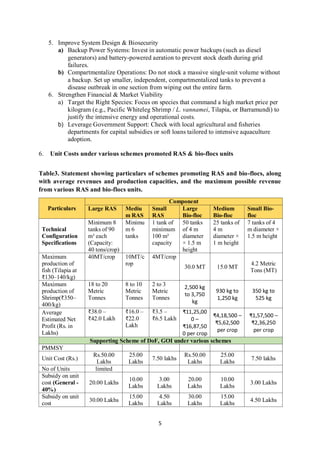
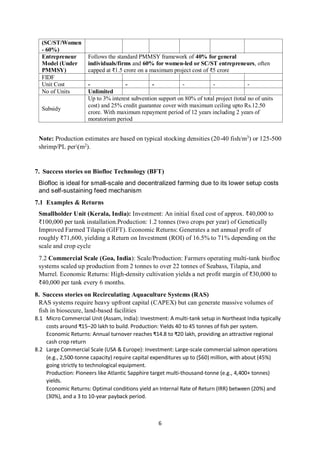
Table3. Statement showing particulars of schemes promoting RAS and bio-flocs, along
with average revenues and production capacities, and the maximum possible revenue
from various RAS and bio-flocs units.
Particulars
Component
Large RAS Mediu
m RAS
Small
RAS
Large
Bio-floc
Medium
Bio-floc
Small Bio-
floc
Technical
Configuration
Specifications
Minimum 8
tanks of 90
m³ each
(Capacity:
40 tons/crop)
Minimu
m 6
tanks
1 tank of
minimum
100 m³
capacity
50 tanks
of 4 m
diameter
× 1.5 m
height
25 tanks of
4 m
diameter ×
1 m height
7 tanks of 4
m diameter ×
1.5 m height
Maximum
production of
fish (Tilapia at
₹130–140/kg)
40MT/crop 10MT/c
rop
4MT/crop
30.0 MT 15.0 MT
4.2 Metric
Tons (MT)
Maximum
production of
Shrimp(₹350–
400/kg)
18 to 20
Metric
Tonnes
8 to 10
Metric
Tonnes
2 to 3
Metric
Tonnes
2,500 kg
to 3,750
kg
930 kg to
1,250 kg
350 kg to
525 kg
Average
Estimated Net
Profit (Rs. in
Lakhs)
₹38.0 –
₹42.0 Lakh
₹16.0 –
₹22.0
Lakh
₹3.5 –
₹6.5 Lakh
₹11,25,00
0 –
₹16,87,50
0 per crop
₹4,18,500 –
₹5,62,500
per crop
₹1,57,500 –
₹2,36,250
per crop
Supporting Scheme of DoF, GOI under various schemes
PMMSY
Unit Cost (Rs.)
Rs.50.00
Lakhs
25.00
Lakhs
7.50 lakhs
Rs.50.00
Lakhs
25.00
Lakhs
7.50 lakhs
No of Units limited
Subsidy on unit
cost (General -
40%)
20.00 Lakhs
10.00
Lakhs
3.00
Lakhs
20.00
Lakhs
10.00
Lakhs
3.00 Lakhs
Subsidy on unit
cost
30.00 Lakhs
15.00
Lakhs
4.50
Lakhs
30.00
Lakhs
15.00
Lakhs
4.50 Lakhs
6.
6
(SC/ST/Women
- 60%)
Entrepreneur
Model (Under
PMMSY)
Followsthe standard PMMSY framework of 40% for general
individuals/firms and 60% for women-led or SC/ST entrepreneurs, often
capped at ₹1.5 crore on a maximum project cost of ₹5 crore
FIDF
Unit Cost - - - - - -
No of Units Unlimited
Subsidy
Up to 3% interest subvention support on 80% of total project (total no of units
cost) and 25% credit guarantee cover with maximum ceiling upto Rs.12.50
crore. With maximum repayment period of 12 years including 2 years of
moratorium period
Note: Production estimates are based on typical stocking densities (20-40 fish/m3
) or 125-500
shrimp/PL per(m2
).
7. Success stories on Biofloc Technology (BFT)
Biofloc is ideal for small-scale and decentralized farming due to its lower setup costs
and self-sustaining feed mechanism
7.1 Examples & Returns
Smallholder Unit (Kerala, India): Investment: An initial fixed cost of approx. ₹40,000 to
₹100,000 per tank installation.Production: 1.2 tonnes (two crops per year) of Genetically
Improved Farmed Tilapia (GIFT). Economic Returns: Generates a net annual profit of
roughly ₹71,600, yielding a Return on Investment (ROI) of 16.5% to 71% depending on the
scale and crop cycle
7.2 Commercial Scale (Goa, India): Scale/Production: Farmers operating multi-tank biofloc
systems scaled up production from 2 tonnes to over 22 tonnes of Seabass, Tilapia, and
Murrel. Economic Returns: High-density cultivation yields a net profit margin of ₹30,000 to
₹40,000 per tank every 6 months.
8. Success stories on Recirculating Aquaculture Systems (RAS)
RAS systems require heavy upfront capital (CAPEX) but can generate massive volumes of
fish in biosecure, land-based facilities
8.1 Micro Commercial Unit (Assam, India): Investment: A multi-tank setup in Northeast India typically
costs around ₹15–20 lakh to build. Production: Yields 40 to 45 tonnes of fish per system.
Economic Returns: Annual turnover reaches ₹14.8 to ₹20 lakh, providing an attractive regional
cash crop return
8.2 Large Commercial Scale (USA & Europe): Investment: Large-scale commercial salmon operations
(e.g., 2,500-tonne capacity) require capital expenditures up to ($60) million, with about (45%)
going strictly to technological equipment.
Production: Pioneers like Atlantic Sapphire target multi-thousand-tonne (e.g., 4,400+ tonnes)
yields.
Economic Returns: Optimal conditions yield an Internal Rate of Return (IRR) between (20%) and
(30%), and a 3 to 10-year payback period.