Postharvest Physiological Changes and Structural Characteristics of Fruits, Vegetables, and Cut Flowers
Explores the structure and postharvest physiological changes of fruits, vegetables, and cut flowers, focusing on respiration, transpiration, ethylene effects, and factors influencing shelf life and quality.
Postharvest Physiological Changes and Structural Characteristics of Fruits, Vegetables, and Cut Flowers
1.
Structure of fruits,vegetables and cut flowers related to
physiological changes after harvest
Umesh Timilsina
Assistant Professor
Department of Horticulture
CNRM, Bardibas, Mahottari
Agriculture and Forestry University
3.
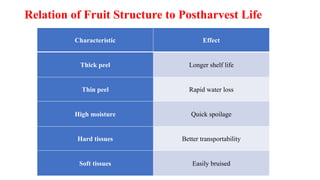
Relation of FruitStructure to Postharvest Life
Characteristic Effect
Thick peel Longer shelf life
Thin peel Rapid water loss
High moisture Quick spoilage
Hard tissues Better transportability
Soft tissues Easily bruised
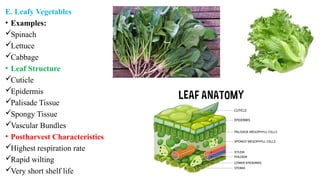
E. Leafy Vegetables
•Examples:
Spinach
Lettuce
Cabbage
• Leaf Structure
Cuticle
Epidermis
Palisade Tissue
Spongy Tissue
Vascular Bundles
• Postharvest Characteristics
Highest respiration rate
Rapid wilting
Very short shelf life
10.
F. Flower Vegetables
•Examples:
Cauliflower
Broccoli
• Structure
Immature flower buds attached to stalk.
• Postharvest Characteristics
Highly perishable
Sensitive to ethylene
Rapid yellowing
11.
G. Fruit Vegetables
•Examples:
Tomato
Brinjal
Chilli
Cucumber
• Structure similar to fruits.
12.
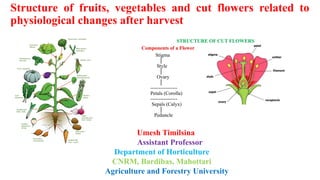
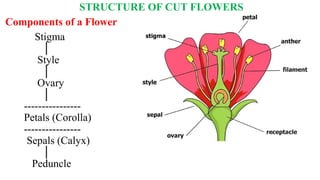
STRUCTURE OF CUTFLOWERS
Components of a Flower
Stigma
│
Style
│
Ovary
│
----------------
Petals (Corolla)
----------------
Sepals (Calyx)
│
Peduncle
13.
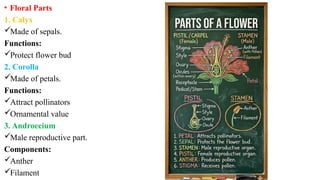
• Floral Parts
1.Calyx
Made of sepals.
Functions:
Protect flower bud
2. Corolla
Made of petals.
Functions:
Attract pollinators
Ornamental value
3. Androecium
Male reproductive part.
Components:
Anther
Filament
14.
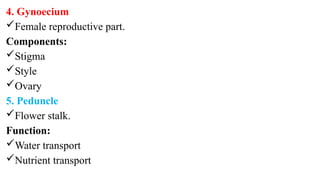
4. Gynoecium
Female reproductivepart.
Components:
Stigma
Style
Ovary
5. Peduncle
Flower stalk.
Function:
Water transport
Nutrient transport
15.
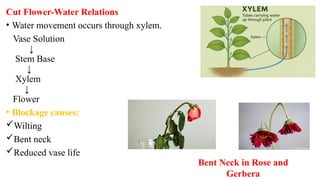
Cut Flower-Water Relations
•Water movement occurs through xylem.
Vase Solution
↓
Stem Base
↓
Xylem
↓
Flower
• Blockage causes:
Wilting
Bent neck
Reduced vase life
Bent Neck in Rose and
Gerbera
16.
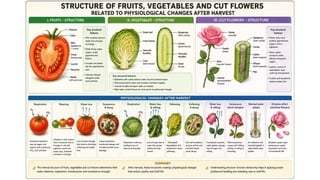
PHYSIOLOGICAL CHANGES AFTERHARVEST
• After harvest, produce remains alive.
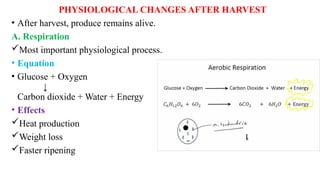
A. Respiration
Most important physiological process.
• Equation
• Glucose + Oxygen
↓
Carbon dioxide + Water + Energy
• Effects
Heat production
Weight loss
Faster ripening
17.
B. Transpiration
Loss ofwater from produce.
Effects
Wilting
Shriveling
Loss of freshness
C. Ethylene Production
Natural ripening hormone.
Functions
Ripening
Degreening
Senescence
18.
D. Ripening
Changes include:
•Physical
Softening
Color development
• Chemical
Starch → Sugar
Acid reduction
E. Senescence
Final deterioration stage.
Symptoms:
Yellowing
Tissue breakdown
Flower fading
19.
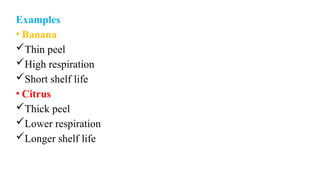
STRUCTURAL FACTORS AFFECTINGSTORAGE LIFE
1. Cuticle Thickness
• Thicker cuticle:
Less water loss
Longer shelf life
• Examples:
Citrus
Pumpkin
2. Surface Area
High surface area:
Higher transpiration
• Examples:
Spinach
Coriander
20.
3. Stomata
Large numberof stomata:
Greater water loss
4. Tissue Firmness
Firm tissues:
Longer storage
• Examples:
• Apple
• Citrus
Soft tissues:
Short storage
• Examples:
Strawberry
Papaya
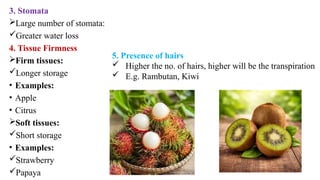
5. Presence of hairs
Higher the no. of hairs, higher will be the transpiration
E.g. Rambutan, Kiwi
21.
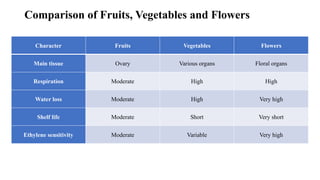
Comparison of Fruits,Vegetables and Flowers
Character Fruits Vegetables Flowers
Main tissue Ovary Various organs Floral organs
Respiration Moderate High High
Water loss Moderate High Very high
Shelf life Moderate Short Very short
Ethylene sensitivity Moderate Variable Very high