Postharvest Entomology and Insect Pest Control in Horticultural Produce
Covers insect pests affecting harvested produce, field protective measures, cold treatment, fumigation, irradiation, and integrated pest management to maintain quality and meet quarantine standards.
Postharvest Entomology and Insect Pest Control in Horticultural Produce
1.
Unit 8. PostharvestEntomology and Control of insect pests in
harvested produce: Protective measures in the field to control
insect pests, Cold treatment, Fumigations and Irradiation of
harvested produce for the control of different insect pests
Prepared by
Umesh Timilsina
Assistant Professor
CNRM, Bardibas
Agriculture and Forestry University
2.
Post-harvest Entomology
• Post-harvestentomology is the branch of entomology that deals with the study
of insect pests that infest horticultural produce after harvest during handling,
storage, transportation, and marketing.
• These insect pests cause quantitative and qualitative losses by feeding on fruits,
vegetables, flowers, bulbs, tubers, and stored produce.
• Effective post-harvest pest management is essential to maintain product quality,
reduce economic losses, and satisfy domestic and international quarantine
requirements.
3.
Importance of Post-harvestEntomology
• Reduces quantitative and qualitative losses.
• Maintains nutritional and market quality.
• Prevents contamination of produce.
• Extends storage life.
• Meets export quarantine standards.
• Increases farmers' income.
• Reduces post-harvest losses.
4.
Types of InsectPests Affecting Harvested Produce
A. Field-to-Storage Pests
• These insects infest crops in the field and continue damaging produce during storage.
• Examples:
Fruit flies
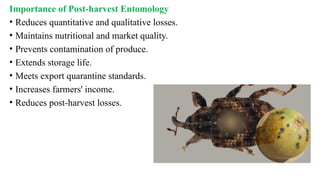
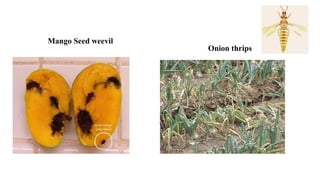
Mango seed weevil
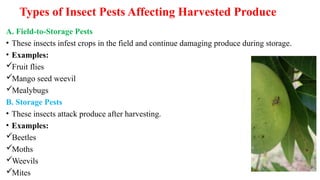
Mealybugs
B. Storage Pests
• These insects attack produce after harvesting.
• Examples:
Beetles
Moths
Weevils
Mites
Nature of DamageCaused by Insect Pests
• Feeding holes
• Internal tunneling
• Fruit rotting
• Contamination with insect excreta
• Weight loss
• Reduction in nutritional quality
• Reduced seed viability
• Premature ripening
• Secondary fungal and bacterial infections
• Loss of export quality
11.
A. Protective Measuresin the Field to
Control Insect Pests
• Field management is the first step in
preventing post-harvest insect infestation.
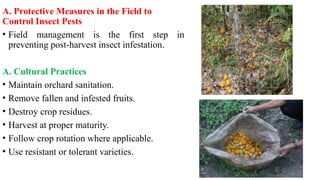
A. Cultural Practices
• Maintain orchard sanitation.
• Remove fallen and infested fruits.
• Destroy crop residues.
• Harvest at proper maturity.
• Follow crop rotation where applicable.
• Use resistant or tolerant varieties.
12.
B. Mechanical Control
•Collect and destroy infested fruits
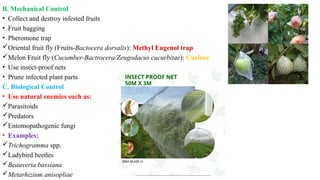
• Fruit bagging
• Pheromone trap
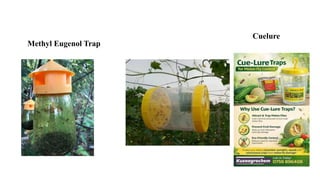
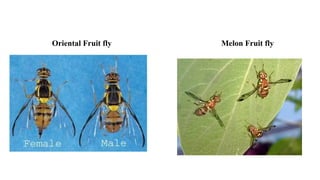
Oriental fruit fly (Fruits-Bactocera dorsalis): Methyl Eugenol trap
Melon Fruit fly (Cucumber-Bactrocera/Zeugodacus cucurbitae): Cuelure
• Use insect-proof nets
• Prune infected plant parts
C. Biological Control
• Use natural enemies such as:
Parasitoids
Predators
Entomopathogenic fungi
• Examples:
Trichogramma spp.
Ladybird beetles
Beauveria bassiana
Metarhizium anisopliae
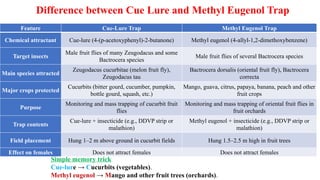
Difference between CueLure and Methyl Eugenol Trap
Feature Cue-Lure Trap Methyl Eugenol Trap
Chemical attractant Cue-lure (4-(p-acetoxyphenyl)-2-butanone) Methyl eugenol (4-allyl-1,2-dimethoxybenzene)
Target insects
Male fruit flies of many Zeugodacus and some
Bactrocera species
Male fruit flies of several Bactrocera species
Main species attracted
Zeugodacus cucurbitae (melon fruit fly),
Zeugodacus tau
Bactrocera dorsalis (oriental fruit fly), Bactrocera
correcta
Major crops protected
Cucurbits (bitter gourd, cucumber, pumpkin,
bottle gourd, squash, etc.)
Mango, guava, citrus, papaya, banana, peach and other
fruit crops
Purpose
Monitoring and mass trapping of cucurbit fruit
flies
Monitoring and mass trapping of oriental fruit flies in
fruit orchards
Trap contents
Cue-lure + insecticide (e.g., DDVP strip or
malathion)
Methyl eugenol + insecticide (e.g., DDVP strip or
malathion)
Field placement Hung 1–2 m above ground in cucurbit fields Hung 1.5–2.5 m high in fruit trees
Effect on females Does not attract females Does not attract females
Simple memory trick
Cue-lure → Cucurbits (vegetables).
Methyl eugenol → Mango and other fruit trees (orchards).
15.
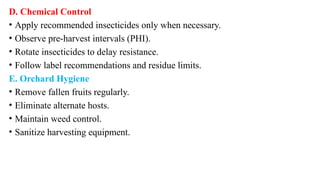
D. Chemical Control
•Apply recommended insecticides only when necessary.
• Observe pre-harvest intervals (PHI).
• Rotate insecticides to delay resistance.
• Follow label recommendations and residue limits.
E. Orchard Hygiene
• Remove fallen fruits regularly.
• Eliminate alternate hosts.
• Maintain weed control.
• Sanitize harvesting equipment.
16.
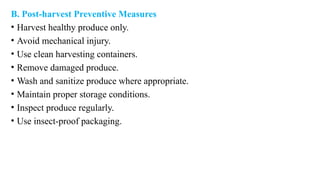
B. Post-harvest PreventiveMeasures
• Harvest healthy produce only.
• Avoid mechanical injury.
• Use clean harvesting containers.
• Remove damaged produce.
• Wash and sanitize produce where appropriate.
• Maintain proper storage conditions.
• Inspect produce regularly.
• Use insect-proof packaging.
17.
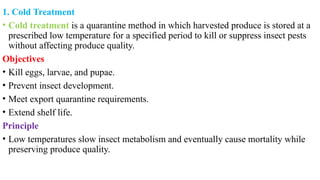
1. Cold Treatment
•Cold treatment is a quarantine method in which harvested produce is stored at a
prescribed low temperature for a specified period to kill or suppress insect pests
without affecting produce quality.
Objectives
• Kill eggs, larvae, and pupae.
• Prevent insect development.
• Meet export quarantine requirements.
• Extend shelf life.
Principle
• Low temperatures slow insect metabolism and eventually cause mortality while
preserving produce quality.
18.
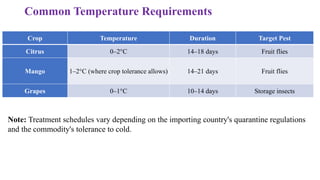
Common Temperature Requirements
CropTemperature Duration Target Pest
Citrus 0–2°C 14–18 days Fruit flies
Mango 1–2°C (where crop tolerance allows) 14–21 days Fruit flies
Grapes 0–1°C 10–14 days Storage insects
Note: Treatment schedules vary depending on the importing country's quarantine regulations
and the commodity's tolerance to cold.
19.
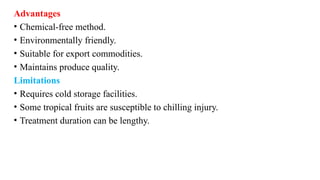
Advantages
• Chemical-free method.
•Environmentally friendly.
• Suitable for export commodities.
• Maintains produce quality.
Limitations
• Requires cold storage facilities.
• Some tropical fruits are susceptible to chilling injury.
• Treatment duration can be lengthy.
20.
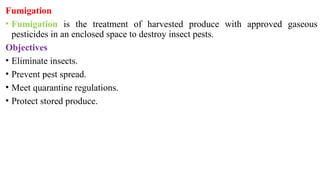
Fumigation
• Fumigation isthe treatment of harvested produce with approved gaseous
pesticides in an enclosed space to destroy insect pests.
Objectives
• Eliminate insects.
• Prevent pest spread.
• Meet quarantine regulations.
• Protect stored produce.
21.
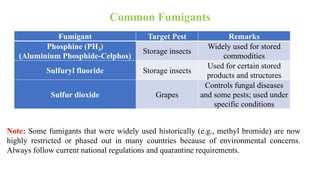
Common Fumigants
Fumigant TargetPest Remarks
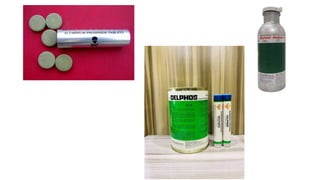
Phosphine (PH )
₃
(Aluminium Phosphide-Celphos)
Storage insects
Widely used for stored
commodities
Sulfuryl fluoride Storage insects
Used for certain stored
products and structures
Sulfur dioxide Grapes
Controls fungal diseases
and some pests; used under
specific conditions
Note: Some fumigants that were widely used historically (e.g., methyl bromide) are now
highly restricted or phased out in many countries because of environmental concerns.
Always follow current national regulations and quarantine requirements.
23.
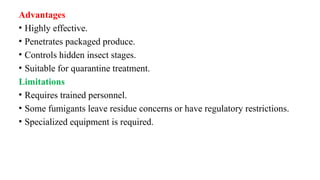
Advantages
• Highly effective.
•Penetrates packaged produce.
• Controls hidden insect stages.
• Suitable for quarantine treatment.
Limitations
• Requires trained personnel.
• Some fumigants leave residue concerns or have regulatory restrictions.
• Specialized equipment is required.
24.
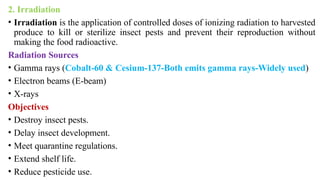
2. Irradiation
• Irradiationis the application of controlled doses of ionizing radiation to harvested
produce to kill or sterilize insect pests and prevent their reproduction without
making the food radioactive.
Radiation Sources
• Gamma rays (Cobalt-60 & Cesium-137-Both emits gamma rays-Widely used)
• Electron beams (E-beam)
• X-rays
Objectives
• Destroy insect pests.
• Delay insect development.
• Meet quarantine regulations.
• Extend shelf life.
• Reduce pesticide use.
25.
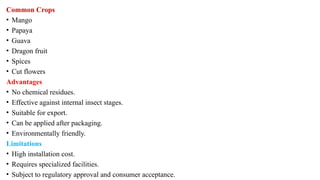
Common Crops
• Mango
•Papaya
• Guava
• Dragon fruit
• Spices
• Cut flowers
Advantages
• No chemical residues.
• Effective against internal insect stages.
• Suitable for export.
• Can be applied after packaging.
• Environmentally friendly.
Limitations
• High installation cost.
• Requires specialized facilities.
• Subject to regulatory approval and consumer acceptance.
26.
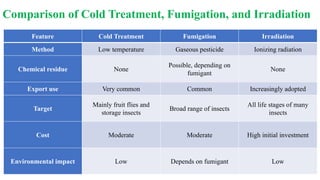
Comparison of ColdTreatment, Fumigation, and Irradiation
Feature Cold Treatment Fumigation Irradiation
Method Low temperature Gaseous pesticide Ionizing radiation
Chemical residue None
Possible, depending on
fumigant
None
Export use Very common Common Increasingly adopted
Target
Mainly fruit flies and
storage insects
Broad range of insects
All life stages of many
insects
Cost Moderate Moderate High initial investment
Environmental impact Low Depends on fumigant Low
27.
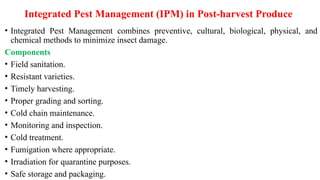
Integrated Pest Management(IPM) in Post-harvest Produce
• Integrated Pest Management combines preventive, cultural, biological, physical, and
chemical methods to minimize insect damage.
Components
• Field sanitation.
• Resistant varieties.
• Timely harvesting.
• Proper grading and sorting.
• Cold chain maintenance.
• Monitoring and inspection.
• Cold treatment.
• Fumigation where appropriate.
• Irradiation for quarantine purposes.
• Safe storage and packaging.
28.
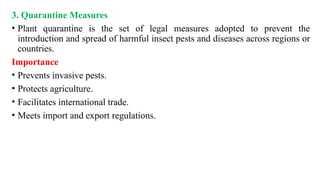
3. Quarantine Measures
•Plant quarantine is the set of legal measures adopted to prevent the
introduction and spread of harmful insect pests and diseases across regions or
countries.
Importance
• Prevents invasive pests.
• Protects agriculture.
• Facilitates international trade.
• Meets import and export regulations.
29.
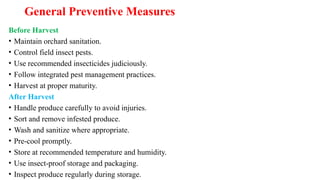
General Preventive Measures
BeforeHarvest
• Maintain orchard sanitation.
• Control field insect pests.
• Use recommended insecticides judiciously.
• Follow integrated pest management practices.
• Harvest at proper maturity.
After Harvest
• Handle produce carefully to avoid injuries.
• Sort and remove infested produce.
• Wash and sanitize where appropriate.
• Pre-cool promptly.
• Store at recommended temperature and humidity.
• Use insect-proof storage and packaging.
• Inspect produce regularly during storage.
30.
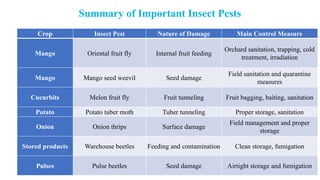
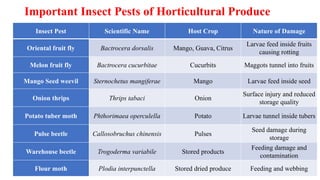
Summary of ImportantInsect Pests
Crop Insect Pest Nature of Damage Main Control Measure
Mango Oriental fruit fly Internal fruit feeding
Orchard sanitation, trapping, cold
treatment, irradiation
Mango Mango seed weevil Seed damage
Field sanitation and quarantine
measures
Cucurbits Melon fruit fly Fruit tunneling Fruit bagging, baiting, sanitation
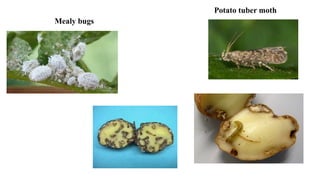
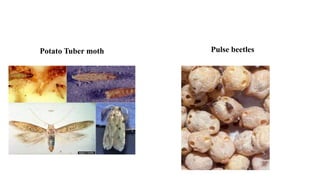
Potato Potato tuber moth Tuber tunneling Proper storage, sanitation
Onion Onion thrips Surface damage
Field management and proper
storage
Stored products Warehouse beetles Feeding and contamination Clean storage, fumigation
Pulses Pulse beetles Seed damage Airtight storage and fumigation
31.
Key Points
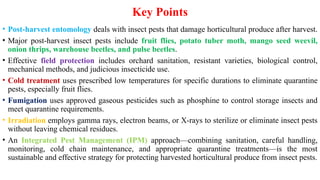
• Post-harvestentomology deals with insect pests that damage horticultural produce after harvest.
• Major post-harvest insect pests include fruit flies, potato tuber moth, mango seed weevil,
onion thrips, warehouse beetles, and pulse beetles.
• Effective field protection includes orchard sanitation, resistant varieties, biological control,
mechanical methods, and judicious insecticide use.
• Cold treatment uses prescribed low temperatures for specific durations to eliminate quarantine
pests, especially fruit flies.
• Fumigation uses approved gaseous pesticides such as phosphine to control storage insects and
meet quarantine requirements.
• Irradiation employs gamma rays, electron beams, or X-rays to sterilize or eliminate insect pests
without leaving chemical residues.
• An Integrated Pest Management (IPM) approach—combining sanitation, careful handling,
monitoring, cold chain maintenance, and appropriate quarantine treatments—is the most
sustainable and effective strategy for protecting harvested horticultural produce from insect pests.
 Most read
 Most read
 Most read