Post-Harvest Management of Horticultural Crops: Reducing Losses and Enhancing Food Security
Overview of post-harvest techniques, loss reduction, economic benefits, and the status of horticultural crop management in Nepal to improve shelf life, quality, and marketability.
Short Introduction
Name: UmeshTimilsina
Designation: Assistant Professor
Address: Changunarayan-8, Bhaktapur
Bachelor: IAAS, Lamjung Campus (2010-2014)
Masters: AFU, Rampur (2014-2016)
PhD: AFU (Running)
Experience:
Assistant Lecturer: 4.5 years (PU-GPCAR)
Assistant Professor: 4.5 years (AFU)
3.
Introduction
Post-harvest horticulturerefers to the handling, storage,
processing, and marketing of horticultural crops after they
have been harvested.
It plays a crucial role in maintaining the quality, extending
shelf life, and reducing losses of fruits, vegetables, flowers,
and other perishable plant products.
Horticultural produce are highly perishable commodities due
to high moisture content and higher metabolic activities.
Spoilage occur due to Physical factors, biochemical factors
and entomological factors i.e. microbial attack, auto-
oxidation and insect pest attack
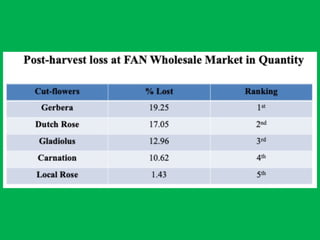
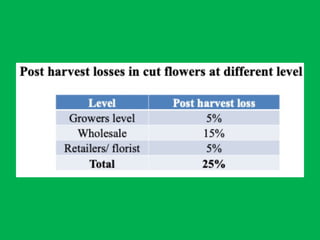
As a result, about 25-30% of the production is lost after
harvest (loss of about 15-20% in non- perishable and 20-30%
in perishables)
4.
Contd…
The roleof Postharvest Horticulture is important
for:
Reduction of post harvest losses of fruits and
vegetables and to make them available for longer
period in the market.
Minimize losses of horticultural crops and their
products between production and consumption
Reduction of postharvest losses:
Increases food availability to the growing
human population,
Decreases the area needed for production and
Conserves natural resources
5.
PHT canbe defined as methods and techniques
applied to increase the shelf – life and retain
quality and safety of fresh or processed
horticultural produce after harvest.
PHT deals about all the practices that are done after
the harvest of the produce till consumption.
The practices which are done to minimize the food
loss after harvest.
Contd…
6.
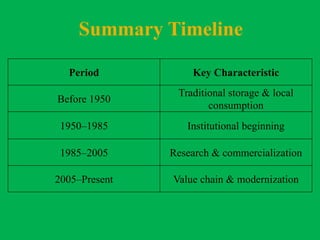
Summary Timeline
Period KeyCharacteristic
Before 1950
Traditional storage & local
consumption
1950–1985 Institutional beginning
1985–2005 Research & commercialization
2005–Present Value chain & modernization
8.
Status of Postharvest horticulture in Nepal
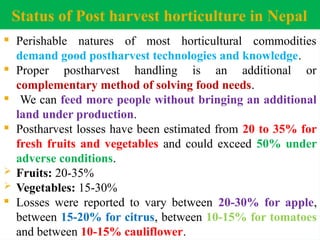
Perishable natures of most horticultural commodities
demand good postharvest technologies and knowledge.
Proper postharvest handling is an additional or
complementary method of solving food needs.
We can feed more people without bringing an additional
land under production.
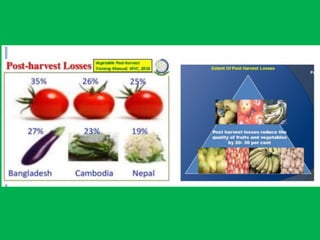
Postharvest losses have been estimated from 20 to 35% for
fresh fruits and vegetables and could exceed 50% under
adverse conditions.
Fruits: 20-35%
Vegetables: 15-30%
Losses were reported to vary between 20-30% for apple,
between 15-20% for citrus, between 10-15% for tomatoes
and between 10-15% cauliflower.
9.
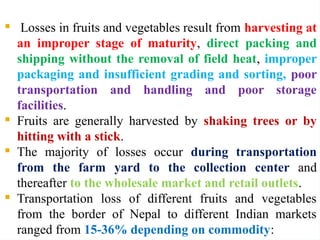
Losses infruits and vegetables result from harvesting at
an improper stage of maturity, direct packing and
shipping without the removal of field heat, improper
packaging and insufficient grading and sorting, poor
transportation and handling and poor storage
facilities.
Fruits are generally harvested by shaking trees or by
hitting with a stick.
The majority of losses occur during transportation
from the farm yard to the collection center and
thereafter to the wholesale market and retail outlets.
Transportation loss of different fruits and vegetables
from the border of Nepal to different Indian markets
ranged from 15-36% depending on commodity:
10.
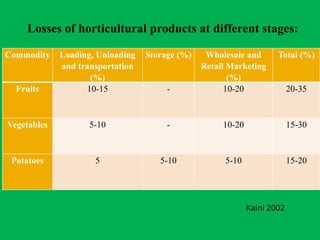
Commodity Loading, Unloading
andtransportation
(%)
Storage (%) Wholesale and
Retail Marketing
(%)
Total (%)
Fruits 10-15 - 10-20 20-35
Vegetables 5-10 - 10-20 15-30
Potatoes 5 5-10 5-10 15-20
Losses of horticultural products at different stages:
Kaini 2002
11.
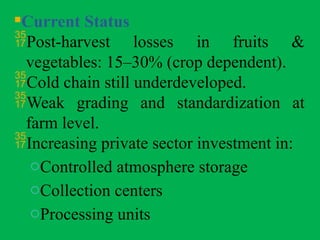
Current Status
Post-harvest lossesin fruits &
vegetables: 15–30% (crop dependent).
Cold chain still underdeveloped.
Weak grading and standardization at
farm level.
Increasing private sector investment in:
oControlled atmosphere storage
oCollection centers
oProcessing units
15.
Importance of PostHarvest Technology
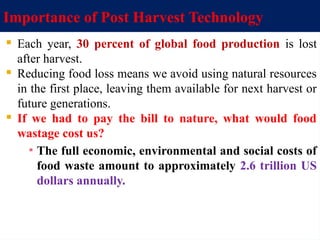
Each year, 30 percent of global food production is lost
after harvest.
Reducing food loss means we avoid using natural resources
in the first place, leaving them available for next harvest or
future generations.
If we had to pay the bill to nature, what would food
wastage cost us?
▪ The full economic, environmental and social costs of
food waste amount to approximately 2.6 trillion US
dollars annually.
16.
Importance of Post-harvesttechnology
1. Increased food supply
PHM of produce include proper handling, packaging,
storage, transportation and marketing, which can
increase shelf-life and reduce the overall spoilage
PHM possess modern technologies like refrigerated
storage, controlled and modified storage, and
irradiation, which also increase the shelf-life of
produce appreciably.
PHM can save the produced food from spoilage for
consumption and thereby help in increasing the food
supply.
17.
2. Offseason availability
All most all commodities are seasonal in nature.
During production period, there is surplus
products in the market
But during other season, there is scarcity of the
produce.
By storage technology, we can make them surplus
in offseason also.
3. Higher price
Higher price of horticultural commodities during
offseason
Contd…
18.
4. Nutritional Securityand Better health
Several essential nutrition are required for human
health
Fruits and vegetables are the rich source of
vitamins, minerals, antioxidants and fibers
All round availability
PHM saves several minerals and vitamins from
being lost, and thus PHM is the only solution for
nutritional security of growing population of the
country
Contd…
19.
5. Employment Generation
PHMactivities such as harvesting, sorting, grading, and
packaging can provide gainful employment to unskilled
and skilled people.
Processing of surplus and cull fruits and vegetables also
generate employment.
6. Value Addition and product diversification
Surplus and cull fruits and vegetables can be processed
into several value added products.
PHM and processing can add value to the fresh as well
processed products and the producer or farmer can get
good return of his produce.
Contd…
20.
7. Export Earning
Sanitary and Phyto Sanitary (SPS) excellence is essential
for marketing in international market.
PH helps to ensure SPS.
It is mainly because of good post harvest management
practices, quality maintenance throughout the marketing
channel and basic infrastructure of export.
Post-harvest horticulture is a key driver of export
earnings, enabling countries to maximize the value of
their agricultural produce, reduce losses, and maintain
high-quality standards.
By adopting advanced post-harvest technologies, countries
can enhance their global competitiveness, strengthen their
economies, and create sustainable livelihoods for millions
involved in the horticultural value chain.
21.
8. Rural Industrializations
Postharvest management and processing is
essential for horticultural industry
PHM can take care of all possible wastage during
distributional channel
Development of processing industry and
packaging house units in the rural areas will help
in rural industrialization as well.
Contd…
22.
9. Resource saving
▪used water for irrigation and increased water
scarcity
▪ cleared forests and eroded land
▪ Input saving
10. Garbage disposal and environment protection
If food loss is minimum there will be less problem
of garbage disposal.
wasted food still:
▪ caused greenhouse gas emissions and climate
change and pollution
Contd…
23.
11. Economic Benefit
20-50% loss of commodities during Post harvest
We can save thousands tons of fruits and vegetables by
preventing loss
Reduction of loss is more economical rather than to
increase in production
It is difficult to increase 10% yield but it is easy to
reduce 10% loss
Supply of fruits and vegetables can be significantly
increased without bringing additional land and other
inputs for production
Contd…
24.
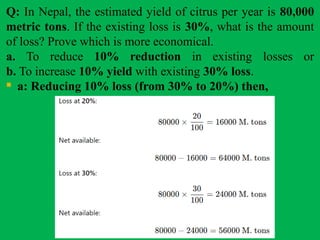
Q: In Nepal,the estimated yield of citrus per year is 80,000
metric tons. If the existing loss is 30%, what is the amount
of loss? Prove which is more economical.
a. To reduce 10% reduction in existing losses or
b. To increase 10% yield with existing 30% loss.
a: Reducing 10% loss (from 30% to 20%) then,
25.
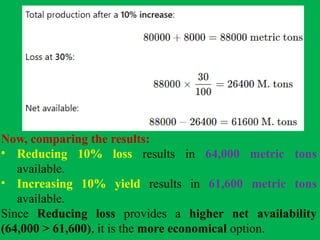
Now, comparing theresults:
• Reducing 10% loss results in 64,000 metric tons
available.
• Increasing 10% yield results in 61,600 metric tons
available.
Since Reducing loss provides a higher net availability
(64,000 > 61,600), it is the more economical option.
26.
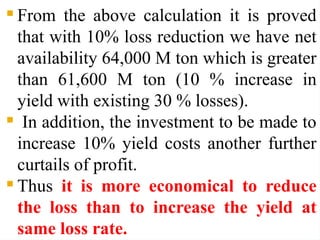
From theabove calculation it is proved
that with 10% loss reduction we have net
availability 64,000 M ton which is greater
than 61,600 M ton (10 % increase in
yield with existing 30 % losses).
In addition, the investment to be made to
increase 10% yield costs another further
curtails of profit.
Thus it is more economical to reduce
the loss than to increase the yield at
same loss rate.
27.
Main factors responsiblefor
loss
Harvesting of immature or over mature products
Traditional and faulty harvesting techniques
Exposure of products to sun after harvest
Rough handling of the products
Dumping of products on heap at collection centers
Minimum sorting/grading of damaged products at
the selling and collection centers
Mishandling during packaging
Use of improper packages during transportation
from collection centers to wholesale markets
Use of ordinary trucks and buses for transportation
28.
Rough roadconditions
Rough handling during loading and unloading
Use of ordinary rooms for storing the fruits and
vegetables at the wholesale market and retail market
Display of fruits and vegetables on the open ground
during selling at wholesale and retail markets
Contd…
29.
What can bedone?
Reducing food loss by raising awareness in
every actor of value chain
Investing in improved post-harvest
infrastructures
Food that is about to be wasted on the market
can timely redirected to other sector
Research on different aspects of PH
Extension of proven practices
30.
One of themain issue
There is always abundance of produce at the
production site but scarcity at the consumption place
Grower’s sale their produce at the lowest minimum
price due to fear of spoilage
Middleman in the market takes heavy share, which
increases the price of commodity many times
Consumer purchases the same commodities at a very
high price in the cities.
Training to growers in PHM activities can overcome
this situation
Hence, growers will get a good price for their produce
and consumers will have to pay a reasonable low price
31.
National issues andProblems in reduction of
post harvest losses in Nepal
Small and scattered production pockets
Lack of co-ordination between research and
extension system
Inadequate postharvest technologies and storage
facilities
Inadequate technical personnel on postharvest
technology
Inadequate attention of government agencies
Lack of private sector involvement
Infrastructure development
32.
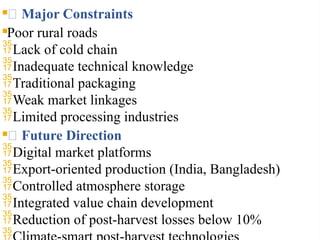
🔎 Major Constraints
Poorrural roads
Lack of cold chain
Inadequate technical knowledge
Traditional packaging
Weak market linkages
Limited processing industries
🌱 Future Direction
Digital market platforms
Export-oriented production (India, Bangladesh)
Controlled atmosphere storage
Integrated value chain development
Reduction of post-harvest losses below 10%
34.
Thank You
Zero foodloss and Zero
hunger is the main aim of Post
Harvest Horticulture
35.
Assignment-1
1. Describe thescope, importance and constraints
of Postharvest horticulture in Nepal.
2. Write down the status of postharvest
horticulture in Nepal.
3. Justify with example that “Reduction of loss is
more economical rather than to increase in
production.”


 Most read