Post-Harvest Diseases and Their Prevention in Horticultural Crops
Overview of post-harvest diseases, causes, classification, major diseases in fruits, vegetables, ornamentals, and preventive measures including treatments and integrated management.
Post-Harvest Diseases and Their Prevention in Horticultural Crops
1.
Post harvest diseasesand their Preventive measures
Prepared by
Umesh Timilsina
Assistant Professor
CNRM, Bardibas
Agriculture and Forestry University
2.
Post harvest Disease
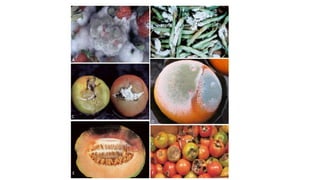
•Post-harvest diseases are one of the major causes of quantitative and qualitative
losses in horticultural crops after harvesting.
• These diseases develop during harvesting, handling, transportation, storage, and
marketing, reducing shelf life and market value.
• It is estimated that 20–40% of fruits and vegetables are lost globally due to
post-harvest diseases, with losses being even higher in developing countries due
to inadequate storage and handling facilities.
• A post-harvest disease is any disease that develops after harvest during handling,
storage, transportation, or marketing and causes deterioration in the quality and
quantity of horticultural produce.
Causes of Post-harvestDiseases
• Mechanical injuries during harvesting and handling
• Infection by fungi, bacteria, or yeasts
• High temperature
• High relative humidity
• Poor sanitation
• Improper storage
• Insect damage
• Delayed cooling
• Contaminated packaging materials
• Poor ventilation
5.
Classification of Post-harvestDiseases
A. Based on Nature of Infection
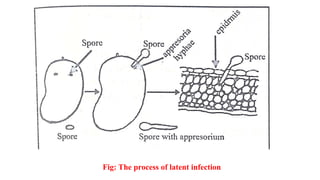
1. Latent (Quiescent) Infection
• A latent infection occurs when the pathogen
infects the crop before harvest but remains
dormant until the fruit ripens or storage
conditions become favorable.
Characteristics
• Infection occurs in the field.
• Symptoms appear after harvest.
• Common in climacteric fruits.
Examples
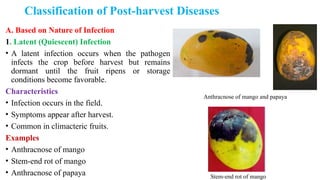
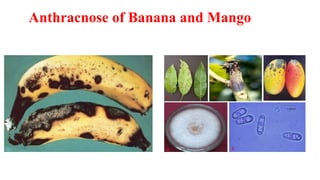
• Anthracnose of mango
• Stem-end rot of mango
• Anthracnose of papaya
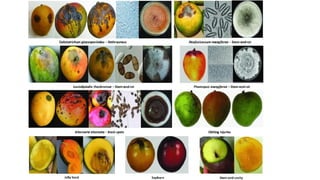
Anthracnose of mango and papaya
Stem-end rot of mango
2. Wound Infection
•Infection occurs through mechanical injuries (cuts, bruises, cracks, punctures, or abrasions)
produced during harvesting and handling or by insect injury.
• Wounds need not be large for infection to take place and in many cases may be microscopic
in size.
Characteristics
• Requires wounds for pathogen entry.
• Common during transportation and storage.
• Progresses rapidly under high humidity.
Examples
• Common postharvest diseases resulting from wound infections include Blue and Green
mould (caused by Penicillium spp.) and transit rot (caused by Rhizopus stolonifer).
• Bacteria such as –Erwinia carotovora (soft rot) are also common wound invaders.
• In potato, Erwinia (soft rot) infection occurs at harvest but rotting occurs later in storage.
9.
3. Natural OpeningInfection
• The pathogen enters through natural openings such as stomata, lenticels, stem ends, or
blossom ends.
Examples
• Stem-end rot
• Bacterial soft rot
4. Out rightly visible disease before harvest
• Usually the pathogenic microorganisms are abundant in plant debris, soil and the
environment.
• During rain or the wind, these propagating structures are transported to the fruits and
various plant organs.
• When they got favorable environment, they produce lesions, canker, scab, necrotic
spots etc.
• Often fruit trees have chronic infected lesions which is the source of infection for many
post harvest diseases.
• Eg. Canker, Scab etc.
10.
Classification Based onCausal Organism
A. Fungal Diseases
• Fungi are the most important cause of post-harvest losses.
Common Fungi
• Colletotrichum spp.
• Botrytis cinerea
• Penicillium spp.
• Rhizopus stolonifer
• Alternaria spp.
• Aspergillus spp.
• Fusarium spp.
• Lasiodiplodia theobromae
11.
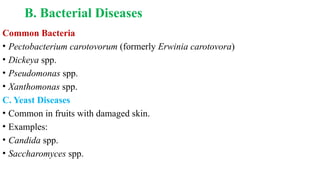
B. Bacterial Diseases
CommonBacteria
• Pectobacterium carotovorum (formerly Erwinia carotovora)
• Dickeya spp.
• Pseudomonas spp.
• Xanthomonas spp.
C. Yeast Diseases
• Common in fruits with damaged skin.
• Examples:
• Candida spp.
• Saccharomyces spp.
12.
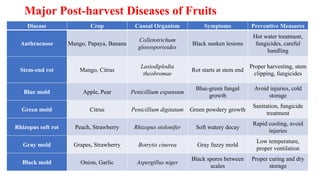
Major Post-harvest Diseasesof Fruits
Disease Crop Causal Organism Symptoms Preventive Measures
Anthracnose Mango, Papaya, Banana
Colletotrichum
gloeosporioides
Black sunken lesions
Hot water treatment,
fungicides, careful
handling
Stem-end rot Mango, Citrus
Lasiodiplodia
theobromae
Rot starts at stem end
Proper harvesting, stem
clipping, fungicides
Blue mold Apple, Pear Penicillium expansum
Blue-green fungal
growth
Avoid injuries, cold
storage
Green mold Citrus Penicillium digitatum Green powdery growth
Sanitation, fungicide
treatment
Rhizopus soft rot Peach, Strawberry Rhizopus stolonifer Soft watery decay
Rapid cooling, avoid
injuries
Gray mold Grapes, Strawberry Botrytis cinerea Gray fuzzy mold
Low temperature,
proper ventilation
Black mold Onion, Garlic Aspergillus niger
Black spores between
scales
Proper curing and dry
storage
14.
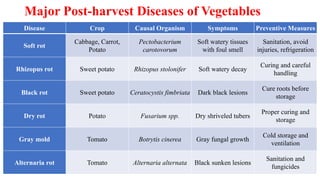
Major Post-harvest Diseasesof Vegetables
Disease Crop Causal Organism Symptoms Preventive Measures
Soft rot
Cabbage, Carrot,
Potato
Pectobacterium
carotovorum
Soft watery tissues
with foul smell
Sanitation, avoid
injuries, refrigeration
Rhizopus rot Sweet potato Rhizopus stolonifer Soft watery decay
Curing and careful
handling
Black rot Sweet potato Ceratocystis fimbriata Dark black lesions
Cure roots before
storage
Dry rot Potato Fusarium spp. Dry shriveled tubers
Proper curing and
storage
Gray mold Tomato Botrytis cinerea Gray fungal growth
Cold storage and
ventilation
Alternaria rot Tomato Alternaria alternata Black sunken lesions
Sanitation and
fungicides
16.
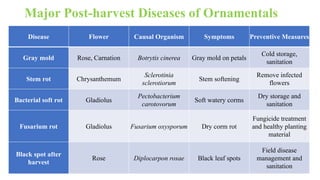
Major Post-harvest Diseasesof Ornamentals
Disease Flower Causal Organism Symptoms Preventive Measures
Gray mold Rose, Carnation Botrytis cinerea Gray mold on petals
Cold storage,
sanitation
Stem rot Chrysanthemum
Sclerotinia
sclerotiorum
Stem softening
Remove infected
flowers
Bacterial soft rot Gladiolus
Pectobacterium
carotovorum
Soft watery corms
Dry storage and
sanitation
Fusarium rot Gladiolus Fusarium oxysporum Dry corm rot
Fungicide treatment
and healthy planting
material
Black spot after
harvest
Rose Diplocarpon rosae Black leaf spots
Field disease
management and
sanitation
17.
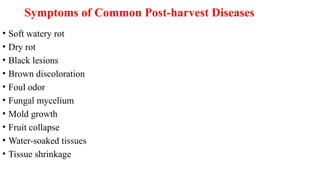
Symptoms of CommonPost-harvest Diseases
• Soft watery rot
• Dry rot
• Black lesions
• Brown discoloration
• Foul odor
• Fungal mycelium
• Mold growth
• Fruit collapse
• Water-soaked tissues
• Tissue shrinkage
18.
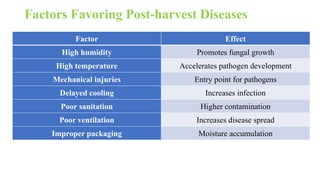
Factors Favoring Post-harvestDiseases
Factor Effect
High humidity Promotes fungal growth
High temperature Accelerates pathogen development
Mechanical injuries Entry point for pathogens
Delayed cooling Increases infection
Poor sanitation Higher contamination
Poor ventilation Increases disease spread
Improper packaging Moisture accumulation
19.
Preventive Measures ofPost harvest Diseases
A. Pre-harvest Measures
• Use disease-free planting materials.
• Grow resistant or tolerant varieties where available.
• Follow balanced fertilization.
• Maintain proper irrigation and drainage.
• Control insects and field diseases.
• Apply recommended fungicides when necessary.
• Harvest at propr maturity.
20.
B. Harvesting Measures
•Harvest during cool hours.
• Avoid bruising and cuts.
• Use clean harvesting tools.
• Remove diseased produce.
• Use clean harvesting containers.
C. Packing House Measures
• Wash produce with clean, sanitized water.
• Disinfect equipment and containers.
• Grade and sort carefully.
• Remove infected produce immediately.
• Use clean packaging materials.
21.
B. Post-harvest Treatments
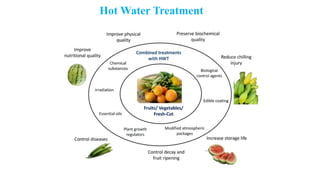
1.Hot Water Treatment
Thermal death point of pathogen: 50-55°C for 5-10 min
Effective for Anthracnose and stem end rot of mango.
Fungicidal treatment+ hot water- effective.
• Commonly used for mango, papaya, and citrus.
2. Fungicide Treatment
Most of the fungicide ineffective- pathogens are deep seated.
Deep seated- Systemic fungicide- strong penetrating power- Benomyl, Benlate,
Thiobendazole, Topsin M-45, Imazalil, Prochloraz, Fludioxonil
3. Biological Control
Beneficialmicroorganisms:
Bacillus subtilis
Pseudomonas fluorescens
Trichoderma harzianum
Candida oleophila
4. Edible Coatings
Chitosan
Aloe vera gel
Carnauba wax
Beeswax
• These coatings reduce moisture loss and slow disease development.
24.
5. Controlled Atmosphere(CA) Storage
• Low oxygen (O )
₂
• Increased/Elevated carbon dioxide (CO )
₂
Benefits:
• Slows pathogen growth.
• Reduces respiration.
• Extends shelf life.
6. Refrigeration or low temperature treatment
• Delays ripening, suppress rapid growth, development, reproduction and
multiplication of pathogens.
25.
7. Modified AtmospherePackaging (MAP)
• Maintains favorable gas composition around the produce.
• Delays disease development and ripening.
8. Use of vegetable oils/Plant extract
Garlic extract which contains Allicin (antibiotic) can be used for the control of
pathogenic fungi and bacteria.
Garlic, Sesamum oil and ginger extract significantly reduce the post harvest
diseases in banana (Timilsina, et al., 2017).
9. Wrapping and bagging
Prevents sporulation of individual fruits or bunches.
Wrapping bunches of banana and grapes with paper of plastic prevents disease as
well as uniform fruit development.
Apple, pear etc. fruits can be wrapped individually by paper bags.
26.
Integrated Management ofPost-harvest Diseases
• Harvest healthy produce.
• Prevent mechanical injuries.
• Maintain strict sanitation.
• Pre-cool immediately after harvest.
• Store at recommended temperature and humidity.
• Use fungicides or biological agents where appropriate.
• Maintain the cold chain during storage and transportation.
• Monitor produce regularly and remove infected items promptly.
 Most read
 Most read
 Most read