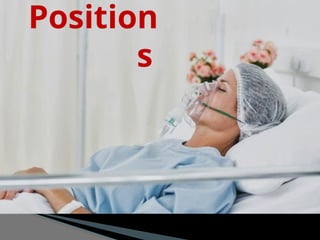
Positioning defined asplacing the person
in such a way to perform therapeutic
interventions to promote the health of an
individual.
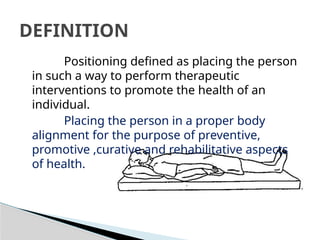
Placing the person in a proper body
alignment for the purpose of preventive,
promotive ,curative and rehabilitative aspects
of health.
DEFINITION
3.
To providecomfort to the patient
To relieve pressure on various aspects
To improve circulation
To prevent formation of deformity
To carry out investigations
To perform surgical and medical investigations
To prevent pressure sores
To provide proper body alignment
To conduct delivery / labor
To carryout nursing interventions
Purpose
4.
Maintain goodbody mechanics
Obtain assistance as required
Ensure the mattress is firm and level of bed is
at working height
Ensure that sheets are clean and dry
Avoid placing a body part directly over another
to prevent pressure
Plan a regular position changes schedule for
the patient for 24 hours
Ensure patient comfort
Wash hands before and after procedure
Principles
5.
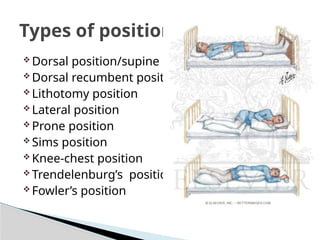
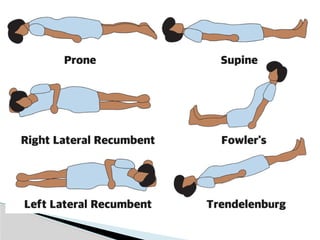
Dorsal position/supineposition
Dorsal recumbent position
Lithotomy position
Lateral position
Prone position
Sims position
Knee-chest position
Trendelenburg’s position
Fowler’s position
Types of positions
6.
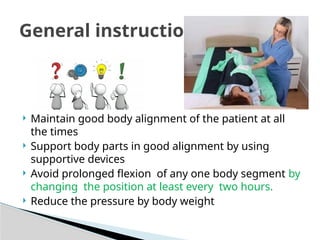
Maintain goodbody alignment of the patient at all
the times
Support body parts in good alignment by using
supportive devices
Avoid prolonged flexion of any one body segment by
changing the position at least every two hours.
Reduce the pressure by body weight
General instructions
7.
Check
Patients generalcondition
Physician order
Assess self care ability
Arrange the comfort devices near the bed side
Identify the deformed extremity (support the
immobilize area during positioning)
Identify the rationale before positioning
Preliminary assessment
8.
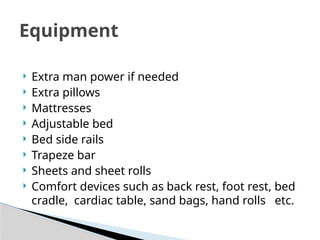
Extra manpower if needed
Extra pillows
Mattresses
Adjustable bed
Bed side rails
Trapeze bar
Sheets and sheet rolls
Comfort devices such as back rest, foot rest, bed
cradle, cardiac table, sand bags, hand rolls etc.
Equipment
9.
Explain theprocedure to the patients
Provide privacy
Arrange the articles and manpower
Untie the bed sheet
Turn/lift/ambulate gently
Place and support with extra pillows under pressure
points
Special care taken at pressure areas
Cover the patient with top sheet
Hand washing
Record the time, position and condition of the skin
Procedure
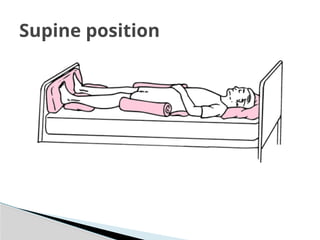
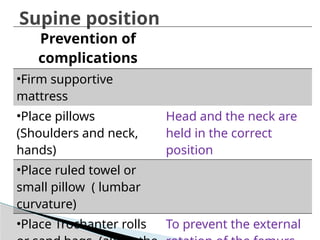
The patients lieson his back with his head
and shoulders are slightly elevated.
Supine position
Comfort devices
needed
• Pillows
• Trochanter rolls
• Hand rolls or arm
splints
• Foot board
Uses
Comfortable position
Examination of head,
neck, chest, abdomen
and extremities
Surgery of anterior part
of the body
Complications
• Flexion contractures
• Foot drop
13.
Supine position
Prevention of
complications
•Firmsupportive
mattress
•Place pillows
(Shoulders and neck,
hands)
Head and the neck are
held in the correct
position
•Place ruled towel or
small pillow ( lumbar
curvature)
•Place Trochanter rolls To prevent the external
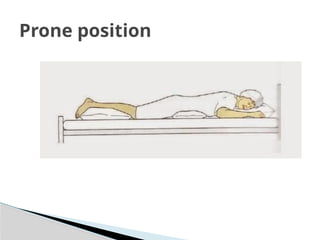
A patientlies flat on abdomen.
Head turned to one side
Hands held in comfortable position
Comfort devices
Pillow may be placed under the head
Place a small cushion under the patient
between the end of the rib cage and upper
abdomen
Prone position
16.
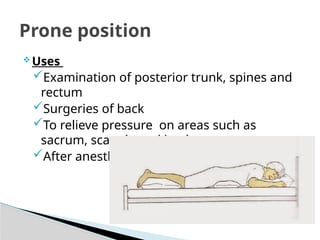
Uses
Examination ofposterior trunk, spines and
rectum
Surgeries of back
To relieve pressure on areas such as
sacrum, scapula and heel
After anesthesia to prevent aspiration
Prone position
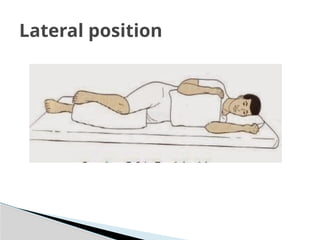
Side lying position
Patientlies on left side
Major portion of body weight on the
dependent hip and shoulders
Uses
Comfortable position
Relieve pressure on bony prominences
Used for enema, insertion of suppositories
and for checking rectal temperature
Lateral position
19.
Prevention of
complications
•Place pillowunder
head and neck
To prevent lateral
flexion of neck
•Place pillow under
upper arm, lower arm
should be flexed
•Place hand wrist splint
•Use one or two pillows
as needed to support
Lateral position
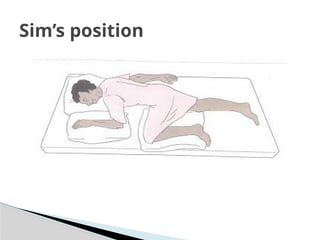
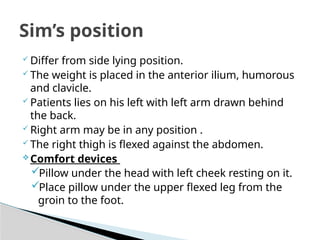
Differ fromside lying position.
The weight is placed in the anterior ilium, humorous
and clavicle.
Patients lies on his left with left arm drawn behind
the back.
Right arm may be in any position .
The right thigh is flexed against the abdomen.
Comfort devices
Pillow under the head with left cheek resting on it.
Place pillow under the upper flexed leg from the
groin to the foot.
Sim’s position
22.
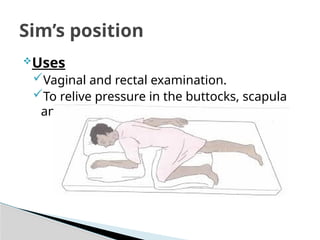
Uses
Vaginal and rectalexamination.
To relive pressure in the buttocks, scapula
and heels.
Sim’s position
23.
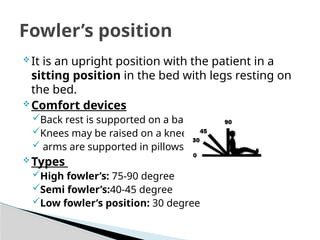
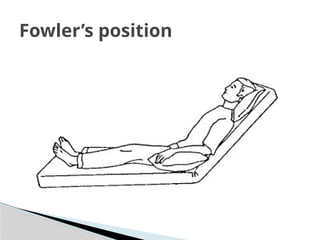
It isan upright position with the patient in a
sitting position in the bed with legs resting on
the bed.
Comfort devices
Back rest is supported on a back rest
Knees may be raised on a knee pillow
arms are supported in pillows
Types
High fowler’s: 75-90 degree
Semi fowler’s:40-45 degree
Low fowler’s position: 30 degree
Fowler’s position
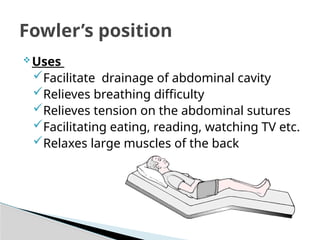
Uses
Facilitate drainage ofabdominal cavity
Relieves breathing difficulty
Relieves tension on the abdominal sutures
Facilitating eating, reading, watching TV etc.
Relaxes large muscles of the back
Fowler’s position
26.
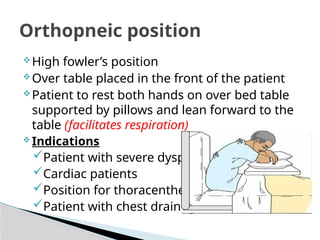
High fowler’s position
Overtable placed in the front of the patient
Patient to rest both hands on over bed table
supported by pillows and lean forward to the
table (facilitates respiration)
Indications
Patient with severe dyspnea
Cardiac patients
Position for thoracenthesis
Patient with chest drainage tubes
Orthopneic position
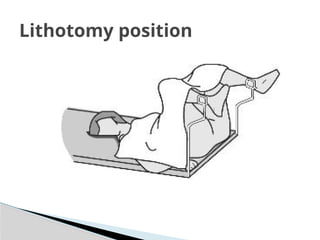
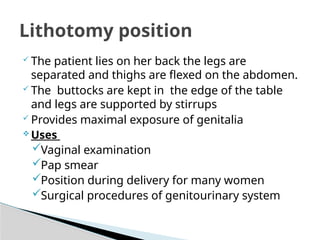
The patientlies on her back the legs are
separated and thighs are flexed on the abdomen.
The buttocks are kept in the edge of the table
and legs are supported by stirrups
Provides maximal exposure of genitalia
Uses
Vaginal examination
Pap smear
Position during delivery for many women
Surgical procedures of genitourinary system
Lithotomy position
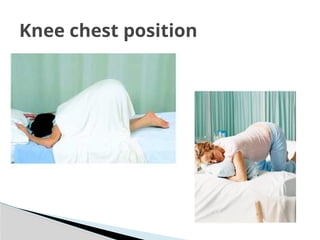
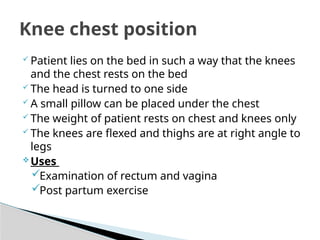
Patient lieson the bed in such a way that the knees
and the chest rests on the bed
The head is turned to one side
A small pillow can be placed under the chest
The weight of patient rests on chest and knees only
The knees are flexed and thighs are at right angle to
legs
Uses
Examination of rectum and vagina
Post partum exercise
Knee chest position
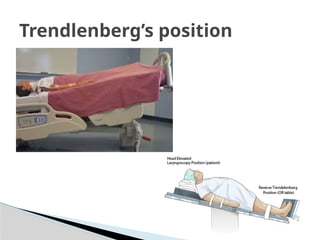
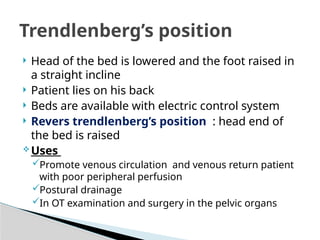
Head ofthe bed is lowered and the foot raised in
a straight incline
Patient lies on his back
Beds are available with electric control system
Revers trendlenberg’s position : head end of
the bed is raised
Uses
Promote venous circulation and venous return patient
with poor peripheral perfusion
Postural drainage
In OT examination and surgery in the pelvic organs
Trendlenberg’s position
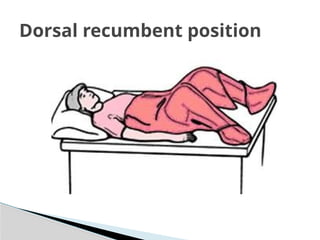
Patient lieson back, knees fully flexed and
legs separated, thighs flexed and externally
rotated and feet flat on the bed.
Pillow is placed under the head
Uses
Examination of vagina and rectum
Catheterization and care
For doing procedures in the rectum, vulva
and vagina
Dorsal recumbent position