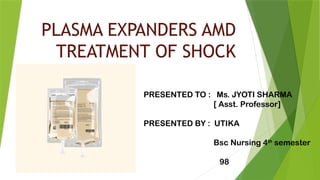
PLASMA EXPANDERS AMD
TREATMENT OF SHOCK
PRESENTED TO : Ms. JYOTI SHARMA
[ Asst. Professor]
PRESENTED BY : UTIKA
Bsc Nursing 4th
semester
98
CONTENT
 INTRODUCTION
 CLASSIFICATION OF PLASMA EXPANDERS
 MECHANISM OF ACTION
 DIFFERENT DRUGS
 INDICATIONS
 CONTRAINDCATIONS
 SIDE EFFECTS
 NURSING RESPONSIBILITIES
 QUESTIONS
 BIBLIOGRAPHY
INTRODUCTION
Plasma expanders are high-molecular-weight substances
used to increase plasma volume.
They temporarily maintain blood pressure & circulation in
shock.
Useful when blood loss or dehydration reduces effective
blood volume.
SHOCK
Shock is life-threatening condition where tissues do not
get enough blood and oxygen.
It Leads to organ failure if not treated quickly.
Types include hypovolemic, cardiogenic, septic,
neurogenic, anaphylactic.
CLASSIFICATION OF PLASMA
EXPANDERS
1. Human Albumin
2. Dextran
3. Hetastarch
4. Polygeline
MECHANISM OF ACTION
1️Administration of Plasma Expander via IV
[Human Albumin / Dextran / Heta Starch / Polygeline]
⬇
2️Plasma Expander Remains in Blood Vessels
[Molecules stay in circulation]
⬇
3️ Fluid Moves from Tissues into Blood
[Plasma volume increases
Helps restore blood pressure]
⬇
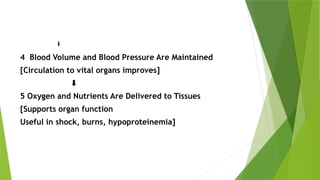
4️ Blood Volume and Blood Pressure Are Maintained
[Circulation to vital organs improves]
⬇
5️Oxygen and Nutrients Are Delivered to Tissues
[Supports organ function
Useful in shock, burns, hypoproteinemia]
ALBUMIN
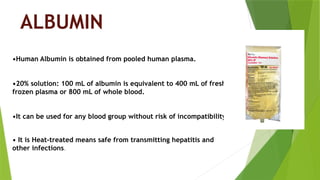
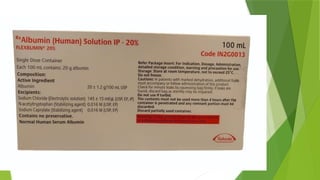
•Human Albumin is obtained from pooled human plasma.
•20% solution: 100 mL of albumin is equivalent to 400 mL of fresh
frozen plasma or 800 mL of whole blood.
•It can be used for any blood group without risk of incompatibility.
• It is Heat-treated means safe from transmitting hepatitis and
other infections.
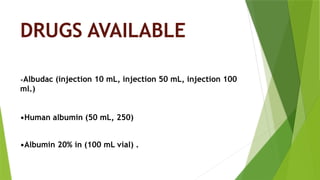
DRUGS AVAILABLE
•Albudac (injection 10 mL, injection 50 mL, injection 100
ml.)
•Human albumin (50 mL, 250)
•Albumin 20% in (100 mL vial) .
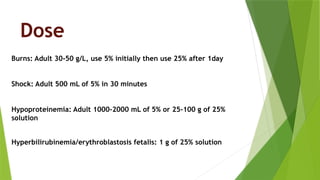
Dose
Burns: Adult 30-50 g/L, use 5% initially then use 25% after 1day
Shock: Adult 500 mL of 5% in 30 minutes
Hypoproteinemia: Adult 1000-2000 mL of 5% or 25-100 g of 25%
solution
Hyperbilirubinemia/erythroblastosis fetalis: 1 g of 25% solution
INDICATIONS
•Hypovolemic shock
•Burns
•Hypoproteinemia
•Cerebral edema
•During cardiopulmonary bypass surgery
•Nephrotic syndrome
•Hepatic failure
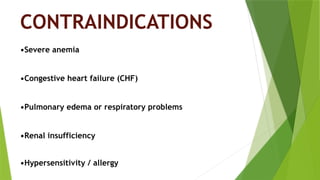
CONTRAINDICATIONS
•Severe anemia
•Congestive heart failure (CHF)
•Pulmonary edema or respiratory problems
•Renal insufficiency
•Hypersensitivity / allergy
Side effects
•Fever, chills (rash)
•Nausea, vomiting
•Tachycardia (fast heartbeat), headache, hypotension
•Allergic
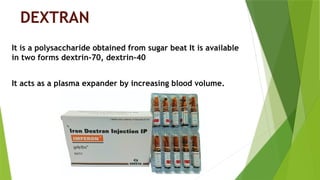
DEXTRAN
It is a polysaccharide obtained from sugar beat It is available
in two forms dextrin-70, dextrin-40
It acts as a plasma expander by increasing blood volume.
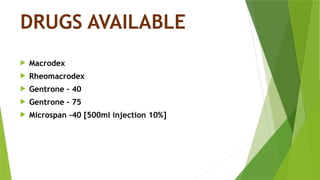
DRUGS AVAILABLE
 Macrodex
 Rheomacrodex
 Gentrone – 40
 Gentrone – 75
 Microspan -40 [500ml injection 10%]
INDICATIONS
•Hypovolemic shock
•Haemorrhagic shock
•Peritoneal adhesions after abdominal surgeries
DOSE
•Adults: Maximum 20 mL per kg in 24 hours
•Children: Not recommended
CONTRAINDICATIONS
•Severe anemia
•Cardiac failure
•Pulmonary edema
•Renal insufficiency
•Thrombocytopenia
•Bleeding
•Hypersensitivity
SIDE EFFECTS
 Nasal congestion
 Nausea
 vomiting
 Hypersensitivity
 fever
HETA STARCH
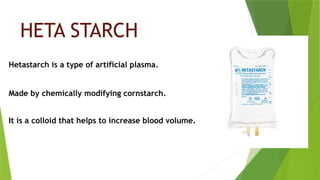
Hetastarch is a type of artificial plasma.
Made by chemically modifying cornstarch.
It is a colloid that helps to increase blood volume.
DRUG AVAILABLE
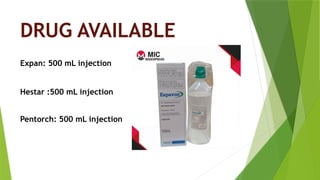
Expan: 500 mL injection
Hestar :500 mL injection
Pentorch: 500 mL injection
Doses
 Hemorrhagic shock: Adult 500–1000 mL (max 1500
mL/day)
 Children: Not recommended
INDICATIONS
Shock
Burns
Trauma
Leukapheresis( during blood procedure)
Surgery
CONTRAINDICATIONS
Hypersensitivity to HES
Severe bleeding disorders
Severe anemia
Renal failure
CHF (Congestive Heart Failure)
Fever
ADVERSE EFFECTS
Cardiovascular: Circulatory overload, CHF, peripheral
edema
CNS: Chills, fever, headache, intracranial bleeding
Dermatologic: Rash, pruritus, itching
Hematologic: Bleeding, thrombocytopenia
Gastrointestinal: Vomiting, diarrhea
POLYGELINE
Polygeline is a polymer of urea and polypeptides derived
from degraded gelatin.
Average molecular weight: 35,000 (range: 5,000–50,000).
Available as 3.5% solution in 500 mL plastic bottles.
Contains sodium, potassium, calcium, and chloride ions.
DRUG AVAILABLE
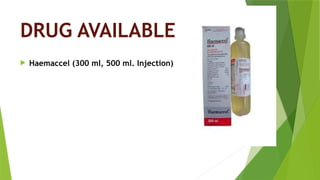
 Haemaccel (300 ml, 500 ml. Injection)
DOSE
 Adults: Maximum 1500 mL/24 hours
 Children: Not recommended
INDICATIONS
 Prevention or treatment of shock associated with
reduction in effective circulating blood volume due to
hemorrhage, loss of plasma (burns, crush injuries).
 Loss of water and electrolytes from persistent vomiting
and diarrhea.
 Isolated organ perfusion
CONTRAINDICATIONS
Severe anemia
Cardiac failure
Pulmonary edema
Renal insufficiency
Hypersensitivity
ADVERSE EFFECTS
 Redness
 shivering or chills
 allergic skin reactions
 respiratory difficulty in sensitive individuals
 Hypotension
Nursing responsibilities....
 BEFORE ADMINISTRATION
1.Verify doctor’s prescription, correct drug, dose, and route.
2. Check patient allergies and contraindications (e.g., severe anemia,

heart failure, renal insufficiency).
3. Assess baseline vital signs (BP, HR, RR, temperature) and overall fluid
status.
4. Ensure IV access patency and proper infusion set; prepare equipment
under aseptic technique.
 DURING ADMINISTRATION
 1. Monitor infusion rate strictly as per recommended
dose.


 2. Observe for immediate adverse reactions: wheezing,
hypotension, rigors.


 3. Maintain sterility while handling the infusion to
prevent infection.


4. Reassess vital signs frequently to detect early signs of
AFTER ADMINSTRATION
1. Record total volume infused, time, and patient
response in the nursing chart.
2. Monitor for delayed adverse effects: edema,
hypotension, allergic reactions, or respiratory difficulty.
3. Assess urine output and renal function if large volumes
were administered.
Summary....🐝🌸
 INTRODUCTION
 CLASSIFICATION OF PLASMA EXPANDERS
 MECHANISM OF ACTION
 DIFFERENT DRUGS
 INDICATIONS
 CONTRAINDCATIONS
 SIDE EFFECTS
 NURSING RESPONSIBILITIES
Questions..
. Which of the following is a natural plasma protein used
as a plasma expander?
A) Dextran
b) Albumin
c) Hetastarch
d) Polygeline
 Answer: b) Albumin
Which plasma expander is a synthetic colloid derived from
cornstarch?
A) Albumin
b) Dextran
c) Hetastarch
d) Polygeline
 Answer: c) Hetastarch
A common adverse effect of Dextran is:
a) Flushing
b) Bleeding
c) Hypotension
d) All of the above
 Answer: d) All of the above
Which of the following is a synthetic polymer of glucose
used as a plasma expander?
A) Albumin
b) Dextran
c) Polygeline
d) Hetastarch
 Answer: b) Dextran
Thankyou
BIBLIOGRAPHY 🌸
Textbook of pharmacology and pathology for
nurses -1 by Suresh Sharma
PAGE NO : 190-195