Planning, Monitoring, Reporting and Review: Global Review of Collective Progress in the Implementation of the Kunming-Montreal Global Biodiversity Framework
Planning, Monitoring, Reporting and Review: Global Review of Collective Progress in the Implementation of the Kunming-Montreal Global Biodiversity Framework
Similar to Planning, Monitoring, Reporting and Review: Global Review of Collective Progress in the Implementation of the Kunming-Montreal Global Biodiversity Framework
PDF
National Reporting Under the UN CBD: Experiences and Lessons Learned from Pre...
Planning, Monitoring, Reporting and Review: Global Review of Collective Progress in the Implementation of the Kunming-Montreal Global Biodiversity Framework
1.
Views and opinionsexpressed are those of the author(s) only and do not necessarily reflect those of the
European Union or the European Commission. Neither the EU nor the EC can be held responsible for them.
Understanding CBD ‘Planning,
Monitoring, Reporting and Review
mechanisms’: what’s at stake?
Training session / September 3rd
2025 / Online
Juliette Landry, Senior Research Fellow – International biodiversity governance
Institute for Sustainable Development and International Relations
(IDDRI)
Roos Immerzeel, Researcher – International biodiversity policy
The Netherlands Environmental Assessment Agency (PBL)
2.
Since 1992…
Key milestones
●1992 - CBD adopted, with obligation to submit national reports (Article 26) and national
biodiversity strategies and action plans (considered as the key mechanism to implement
the CBD)
● 2002 - 2010 Biodiversity Target failed
● 2010 - Aichi Targets: no accountability framework, progress insufficient
● 2022 - Kunming-Montreal GBF: adoption of an enhanced transparency and accountability
framework
3.
Why this matters?
•The “implementation gap” has been a persistent issue in the CBD as ambitious global targets were
not matched by national action and implementation (Maljean-Dubois et al., 2022; Friedman et al.,
2022; Petersson & Stoett, 2022; Smallwood et al., 2022).
• Failure of the Aichi Targets: despite global progress reports (GBO-4; Secretariat of the CBD, 2014;
Tittensor et al., 2014), no mechanisms or dialogues existed to trigger course corrections
• Accountability is not an end in itself: review processes must help understand problems, identify
solutions, and support strategy choices (Kramarz & Park, 2016)
• A purpose-oriented review enables learning, course correction and a “ratcheting effect” to
accelerate action while remaining facilitative and non-punitive (Landry et al., 2024)
• Integrating diverse knowledge and actors into review processes enhances credibility, inclusivity, and
the legitimacy of CBD governance (Tengö et al., 2014; Pascual et al., 2021).
Without robust accountability, ambitious biodiversity goals risk becoming aspirational only.
4.
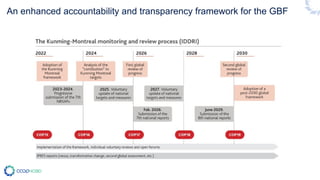
An enhanced accountabilityand transparency framework for the GBF
Adopted at COP15, Montreal (2022) ‘Mechanisms for planning, monitoring, reporting and review’
● Structured reporting templates and deadlines for national reports (with indicators adopted in the
monitoring framework decision)
● National targets and NBSAPs (to be submitted by all Parties on the online reporting tool) with guidance in
annex
● Global Review process (first one in 2026 to culminate at COP17 and second one in 2030 at COP19)
recognizing that “Parties may take the outcome of the global review into account in future revisions and
implementation of their” NBSAPs
● Other key mechanisms such as: further develop the “open-ended forum”, or “information on non-state
actors commitments”
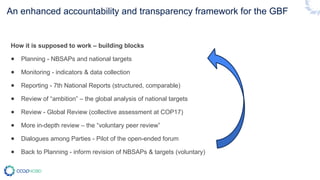
An enhanced accountabilityand transparency framework for the GBF
How it is supposed to work – building blocks
● Planning - NBSAPs and national targets
● Monitoring - indicators & data collection
● Reporting - 7th National Reports (structured, comparable)
● Review of “ambition” – the global analysis of national targets
● Review - Global Review (collective assessment at COP17)
● More in-depth review – the “voluntary peer review”
● Dialogues among Parties - Pilot of the open-ended forum
● Back to Planning - inform revision of NBSAPs & targets (voluntary)
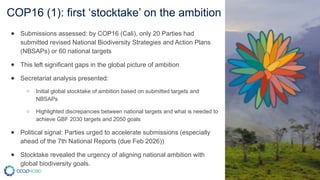
COP16 (1): first‘stocktake’ on the ambition
● Submissions assessed: by COP16 (Cali), only 20 Parties had
submitted revised National Biodiversity Strategies and Action Plans
(NBSAPs) or 60 national targets
● This left significant gaps in the global picture of ambition
● Secretariat analysis presented:
○ Initial global stocktake of ambition based on submitted targets and
NBSAPs
○ Highlighted discrepancies between national targets and what is needed to
achieve GBF 2030 targets and 2050 goals
● Political signal: Parties urged to accelerate submissions (especially
ahead of the 7th National Reports (due Feb 2026))
● Stocktake revealed the urgency of aligning national ambition with
global biodiversity goals.
9.
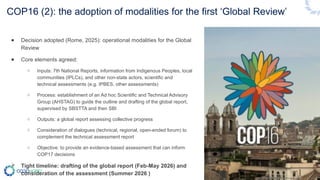
COP16 (2): theadoption of modalities for the first ‘Global Review’
● Decision adopted (Rome, 2025): operational modalities for the Global
Review
● Core elements agreed:
○ Inputs: 7th National Reports, information from Indigenous Peoples, local
communities (IPLCs), and other non-state actors, scientific and
technical assessments (e.g. IPBES, other assessments)
○ Process: establishment of an Ad hoc Scientific and Technical Advisory
Group (AHSTAG) to guide the outline and drafting of the global report,
supervised by SBSTTA and then SBI
○ Outputs: a global report assessing collective progress
○ Consideration of dialogues (technical, regional, open-ended forum) to
complement the technical assessment report
○ Objective: to provide an evidence-based assessment that can inform
COP17 decisions
Tight timeline: drafting of the global report (Feb-May 2026) and
consideration of the assessment (Summer 2026 )
10.
COP16 (2): theadoption of modalities for the first ‘Global Review’
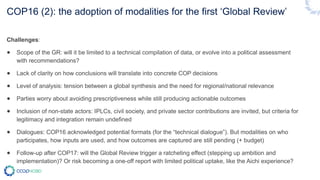
Challenges:
● Scope of the GR: will it be limited to a technical compilation of data, or evolve into a political assessment
with recommendations?
● Lack of clarity on how conclusions will translate into concrete COP decisions
● Level of analysis: tension between a global synthesis and the need for regional/national relevance
● Parties worry about avoiding prescriptiveness while still producing actionable outcomes
● Inclusion of non-state actors: IPLCs, civil society, and private sector contributions are invited, but criteria for
legitimacy and integration remain undefined
● Dialogues: COP16 acknowledged potential formats (for the “technical dialogue”). But modalities on who
participates, how inputs are used, and how outcomes are captured are still pending (+ budget)
● Follow-up after COP17: will the Global Review trigger a ratcheting effect (stepping up ambition and
implementation)? Or risk becoming a one-off report with limited political uptake, like the Aichi experience?
Next steps
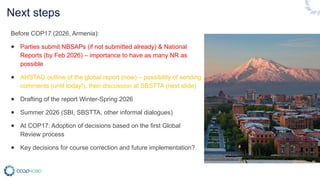
Before COP17(2026, Armenia):
● Parties submit NBSAPs (if not submitted already) & National
Reports (by Feb 2026) – importance to have as many NR as
possible
● AHSTAG outline of the global report (now) – possibility of sending
comments (until today!), then discussion at SBSTTA (next slide)
● Drafting of the report Winter-Spring 2026
● Summer 2026 (SBI, SBSTTA, other informal dialogues)
● At COP17: Adoption of decisions based on the first Global
Review process
● Key decisions for course correction and future implementation?
13.
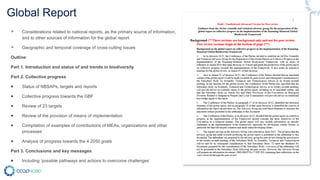
Global Report
Considerationsrelated to national reports, as the primary source of information,
and to other sources of information for the global report
Geographic and temporal coverage of cross-cutting issues
Outline:
Part 1. Introduction and status of and trends in biodiversity
Part 2. Collective progress
● Status of NBSAPs, targets and reports
● Collective progress towards the GBF
● Review of 23 targets
● Review of the provision of means of implementation
● Compilation of examples of contributions of MEAs, organizations and other
processes
● Analysis of progress towards the 4 2050 goals
Part 3. Conclusions and key messages
● Including ‘possible pathways and actions to overcome challenges’
14.
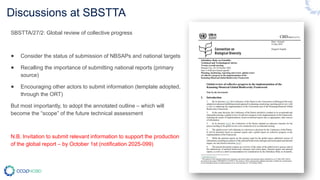
Discussions at SBSTTA
SBSTTA/27/2:Global review of collective progress
● Consider the status of submission of NBSAPs and national targets
● Recalling the importance of submitting national reports (primary
source)
● Encouraging other actors to submit information (template adopted,
through the ORT)
But most importantly, to adopt the annotated outline – which will
become the “scope” of the future technical assessment
N.B. Invitation to submit relevant information to support the production
of the global report – by October 1st (notification 2025-099)
15.
Several key challengesfor an transformative Global Review
● Tensions: persistent debates on who should act, who should pay, and what counts as fair ambition
● Risk of stalemate if financing and means of implementation are not addressed
● Data and reporting gaps: delays in NBSAPs and 7th National Reports submission jeopardize the
quality and legitimacy of the Global Review
● Uneven capacities between countries to provide structured and comparable data (as well as
participating to “dialogues”)
● Inclusivity and equity: despite creation of the new body at COP16 (article 8(j)), voices of vulnerable
countries, civil society, and local actors remain underrepresented. Procedural equity is essential for
legitimacy but still fragile
● Lessons from the climate GST: risk that conclusions remain too general and not translated into
actionable policies. Need to avoid “dialogue fatigue” and ensure political uptake of technical findings.
● Parties want the process to remain non-intrusive and facilitative, but too much caution could limit its
potential to deliver transformative impact
16.
What can bereinforced over time for an impactful Global Review
● Diagnose progress & gaps: provide an honest stocktake of successes, failures, and lessons learned
● Foster peer learning & mutual support: build trust, enable exchange of practices, and strengthen ownership among
Parties & stakeholders
● Expose financing & implementation barriers: identify where additional support is needed and highlight systemic obstacles
● Drive political momentum toward 2030 & 2050 goals: translate technical findings into actionable pathways and COP
decisions
● Key messages from dialogues (organized by PBL and IDDRI):
○ the Global Review must be continuous, not a one-off to foster a culture of accountability
○ needs to go beyond CBD circles to speak to other sectors, incl. business & finance
○ balance ambition & feasibility for credible but realistic outputs
○ Inclusivity is key. IPLCs, local actors, and private sector must be engaged early
○ Political uptake matters, the global review should inform declarations, other multilateral processes, and public debate.
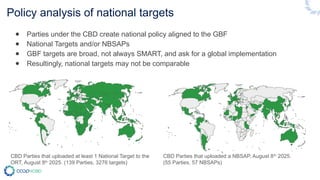
Policy analysis ofnational targets
● Parties under the CBD create national policy aligned to the GBF
● National Targets and/or NBSAPs
● GBF targets are broad, not always SMART, and ask for a global implementation
● Resultingly, national targets may not be comparable
CBD Parties that uploaded at least 1 National Target to the
ORT, August 8th
2025. (139 Parties, 3276 targets)
CBD Parties that uploaded a NBSAP, August 8th
2025.
(55 Parties, 57 NBSAPs)
19.
Policy analysis ofnational targets
● Analysis of National Targets uploaded to the CBD’s Online Reporting Tool (ORT)
● GBF targets 1 – 12 and 16, directly relevant for Goals A and B
● Clustering method by use of large language model
○ Clustering questions defined based on target text, guidance notes, monitoring framework
and expert talks
● Aim is to get a better understanding of the overall patterns of how the GBF is translated to the
national level
20.
Policy analysis ofnational targets
Guiding questions:
1. What elements of the GBF targets translated to the national level (and in what way)?
2. What quantified commitments are described?
3. What policy instruments do Parties use?
4. Which linkages do Parties make between GBF targets?
5. Which linkages do Parties make between policy fields?
21.
Outputs
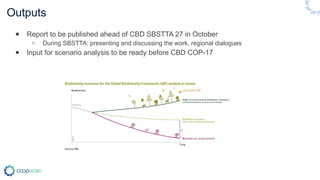
● Report tobe published ahead of CBD SBSTTA 27 in October
○ During SBSTTA: presenting and discussing the work, regional dialogues
● Input for scenario analysis to be ready before CBD COP-17
22.
Preliminary results
Target 1:Plan and Manage all Areas To Reduce
Biodiversity Loss
Ensure that all areas are under participatory, integrated
and biodiversity inclusive spatial planning and/or effective
management processes addressing land- and sea use
change, to bring the loss of areas of high biodiversity
importance, including ecosystems of high ecological
integrity, close to zero by 2030, while respecting the rights
of indigenous peoples and local communities.
23.
Preliminary results
Target 1:Plan and Manage all Areas To Reduce
Biodiversity Loss
Ensure that all areas are under participatory, integrated
and biodiversity inclusive spatial planning and/or effective
management processes addressing land- and sea use
change, to bring the loss of areas of high biodiversity
importance, including ecosystems of high ecological
integrity, close to zero by 2030, while respecting the rights
of indigenous peoples and local communities.
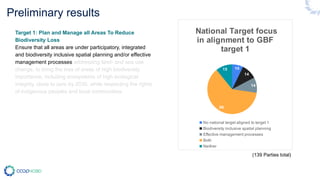
10
14
14
86
15
National Target focus
in alignment to GBF
target 1
No national target aligned to target 1
Biodiversity inclusive spatial planning
Effective management processes
Both
Neither
(139 Parties total)
24.
Preliminary results
Target 1:Plan and Manage all Areas To Reduce
Biodiversity Loss
Ensure that all areas are under participatory, integrated
and biodiversity inclusive spatial planning and/or effective
management processes addressing land- and sea use
change, to bring the loss of areas of high biodiversity
importance, including ecosystems of high ecological
integrity, close to zero by 2030, while respecting the rights
of indigenous peoples and local communities.
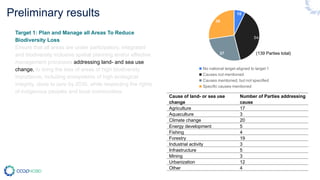
Cause of land- or sea use
change
Number of Parties addressing
cause
Agriculture 17
Aquaculture 3
Climate change 20
Energy development 5
Fishing 4
Forestry 19
Industrial activity 3
Infrastructure 5
Mining 3
Urbanization 12
Other 4
10
54
37
38
No national target aligned to target 1
Causes not mentioned
Causes mentioned, but not specified
Specific causes mentioned
(139 Parties total)
25.
Preliminary results
Target 1:Plan and Manage all Areas To Reduce
Biodiversity Loss
Ensure that all areas are under participatory, integrated
and biodiversity inclusive spatial planning and/or effective
management processes addressing land- and sea use
change, to bring the loss of areas of high biodiversity
importance, including ecosystems of high ecological
integrity, close to zero by 2030, while respecting the rights
of indigenous peoples and local communities.
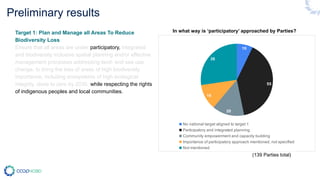
(139 Parties total)
10
55
20
16
38
No national target aligned to target 1
Participatory and integrated planning
Community empowerment and capacity building
Importance of participatory approach mentioned, not specified
Not mentioned
In what way is ‘participatory’ approached by Parties?