Physiological Role and Nutritional Significance of
Lipids
(Nutritional Biochemistry BC24/1C/NBC -Unit II )
Dr.R.Bhuvaneswari
Assistant Professor,
Department of Biochemistry,
Ethiraj College for Women,
Chennai-600 008
bhuvaneswari_r@ethirajcollege.edu.in
jrbhuvan@gmail.com
Introduction
Lipids are a heterogeneous group of organic compounds
that are insoluble in water but soluble in non-polar organic
solvents (E.g., chloroform, benzene, and diethyl ether etc.).
Lipids are one of the three major macronutrients, along with
carbohydrates and proteins, and serve as a concentrated source
of energy as well as important structural and functional
components of the body.
Classification of lipids
Lipids are classified into three major groups based on their
hydrolysis products and structural composition:
1. Simple Lipids
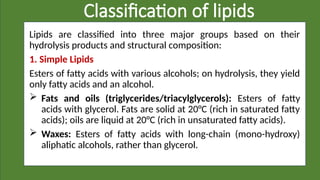
Esters of fatty acids with various alcohols; on hydrolysis, they yield
only fatty acids and an alcohol.
 Fats and oils (triglycerides/triacylglycerols): Esters of fatty
acids with glycerol. Fats are solid at 20°C (rich in saturated fatty
acids); oils are liquid at 20°C (rich in unsaturated fatty acids).
 Waxes: Esters of fatty acids with long-chain (mono-hydroxy)
aliphatic alcohols, rather than glycerol.
Classification of lipids
2. Compound (Complex) Lipids
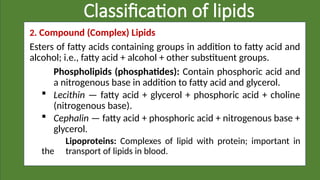
Esters of fatty acids containing groups in addition to fatty acid and
alcohol; i.e., fatty acid + alcohol + other substituent groups.
Phospholipids (phosphatides): Contain phosphoric acid and
a nitrogenous base in addition to fatty acid and glycerol.
 Lecithin — fatty acid + glycerol + phosphoric acid + choline
(nitrogenous base).
 Cephalin — fatty acid + phosphoric acid + nitrogenous base +
glycerol.
Lipoproteins: Complexes of lipid with protein; important in
the transport of lipids in blood.
Classification of lipids
Glycolipids (cerebrosides): Complex lipids containing carbohydrate
in combination with fatty acid and glycerol (or sphingosine) — i.e.,
fatty acid + carbohydrate + glycerol. May be classed as
glyceroglycolipids or sphingoglycolipids.
3. Derived Lipids
 Substances derived from the hydrolysis of simple and
compound lipids that still possess the general characteristics of
lipids.
 Fatty acids (saturated and unsaturated), Glycerol and other
alcohols, Sphingosine
 Sterols (e.g., cholesterol) and steroid derivatives, including
steroid hormones and fat-soluble vitamins
Classification of lipids
Fatty acids themselves, the building blocks common to most lipid
classes, are classified as:
 Saturated fatty acids: long-chain fatty acids with no double
bonds between carbon atoms; solid at room temperature (e.g.,
butyric acid, caproic acid, caprylic acid).
 Unsaturated fatty acids: contain one or more double bonds;
liquid at room temperature (e.g., oleic acid, linoleic acid). These
may be further divided into monounsaturated (one C=C bond)
and polyunsaturated (more than one C=C bond) fatty acids.
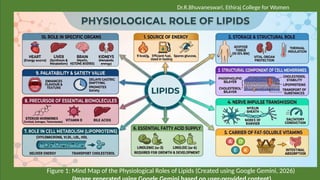
Figure 1: Mind Map of the Physiological Roles of Lipids (Created using Google Gemini, 2026)
Dr.R.Bhuvaneswari, Ethiraj College for Women
Physiological Role (Functions) of lipids
1. Source of Energy
Most concentrated source of energy:
 Fat is the most concentrated source of dietary energy. It
provides approximately 9 kcal per gram, compared with 4 kcal
per gram from carbohydrates and proteins.
Provides more energy:
 Fat provides about 2¼ times more energy than an equal weight
of carbohydrate or protein. Therefore, a small amount of fat can
supply a large amount of energy.
Animal and plant sources: Examples include butter, ghee, meat fat,
nuts, seeds, and vegetable oils.
Physiological Role (Functions) of lipids
Efficient fuel for the body:
 Fat is an efficient source of energy for the body,
particularly during prolonged physical activity. It helps
spare glucose and glycogen for tissues that depend more
heavily on them.
Provides energy during carbohydrate shortage:
 When carbohydrate intake is low, stored fat can be broken
down and used to produce energy. This becomes
particularly important during fasting and prolonged
exercise.
Physiological Role (Functions) of lipids
2. Storage and Structural Role of Fat
Storage in adipose tissue:
 Fat is stored mainly in adipose tissue, which normally
constitutes about 10–15% of body weight in a healthy adult.
This proportion may rise to about 30% or more in obese
individuals.
Protection of vital organs:
 A web-like padding of adipose tissue surrounds vital organs
such as the kidneys.
 It protects these organs from mechanical shock and provides
supporting structure.
Physiological Role (Functions) of lipids
Thermal insulation:
 The layer of subcutaneous fat directly beneath the skin provides
thermal insulation. It helps maintain body temperature within
the range necessary for life.
Protection from mechanical injury:
 Adipose tissue acts as a protective cushion around organs and
body structures. It absorbs mechanical shocks and reduces the
risk of physical injury.
Storage of fat-soluble vitamins:
 Body fat helps store fat-soluble vitamins A, D, E, and K. Vitamins
can be released and utilised by the body when required.
Physiological Role (Functions) of lipids
3. Structural Component of Cell Membranes
 Formation of cell membrane:
Phospholipids are the major lipid components of the cell membrane.
They form a bilayer that separates the cell interior from the external
environment.
 Role of cholesterol:
Cholesterol is an important sterol present in cell membranes. It helps
maintain membrane stability, fluidity, and flexibility.
 Formation of lipoproteins:
Lipoproteins primarily function in the transport of lipids in
blood.
Physiological Role (Functions) of lipids
 Transport of substances:
Membrane lipids provide a suitable environment for membrane
proteins involved in the transport of nutrients, ions, and
metabolites across the cell membrane.
 Maintenance of membrane integrity:
Lipids help maintain the structural integrity and selective
permeability of biological membranes. This allows cells to
control the movement of substances into and out of the cell.
 Cell signalling:
Certain membrane lipids act as precursors for signalling
molecules. These molecules participate in cellular
communication and regulate various cellular processes.
Physiological Role (Functions) of lipids
4. Nerve Impulse Transmission
 Formation of myelin sheath:
Certain lipids, particularly phospholipids and cholesterol, are major
components of the myelin sheath surrounding nerve fibres. The
myelin sheath acts as an insulating layer around the axon.
 Electrical insulation:
Myelin prevents the leakage of electrical signals from the nerve
fibre. This allows nerve impulses to travel efficiently along the axon.
 Increases the speed of nerve impulses:
Myelinated nerve fibres transmit impulses much faster than non-
myelinated fibres.
Physiological Role (Functions) of lipids
 The impulse appears to jump between the Nodes of Ranvier, a
process called saltatory conduction.
 Protection of nerve fibres:
The myelin sheath provides physical protection to the axon. It also
helps maintain the structural and functional integrity of nerve
fibres.
 Efficient nerve signalling:
Proper myelination ensures rapid and coordinated transmission of
nerve impulses. This is important for movement, sensation, and
communication between the nervous system and other parts of
the body.
Physiological Role (Functions) of lipids
5. Carrier of Fat-Soluble Vitamins
 Facilitates absorption:
Dietary fat helps in the intestinal absorption of fat-soluble vitamins
A, D, E, and K. These vitamins are absorbed more efficiently when
adequate dietary fat is present.
 Acts as a solvent:
Fat acts as a solvent and carrier for fat-soluble vitamins in the
digestive tract. It facilitates their incorporation into micelles, which
are necessary for absorption.
 Helps absorb carotenoids:
Dietary fat improves the absorption of carotenoids, such as β-
carotene, from plant foods.
Physiological Role (Functions) of lipids
 Therefore, consuming vegetables such as carrots with a small
amount of fat can improve carotenoid absorption.
 Supports vitamin utilisation:
Adequate dietary fat helps ensure the body receives and utilises
these vitamins effectively. The absorbed vitamins can subsequently
be transported and stored in body tissues.
6. Essential Fatty Acid and Cholesterol Supply
 Source of essential fatty acids:
Dietary fats provide essential fatty acids, particularly linoleic acid
(omega-6) and α-linolenic acid (omega-3).
Physiological Role (Functions) of lipids
 Role in growth and development:
Essential fatty acids are important for normal growth,
development, and maintenance of body tissues. They are
particularly important during infancy and childhood.
 Precursor of signalling molecules:
Essential fatty acids serve as precursors for the synthesis of
eicosanoids and other lipid-derived signalling molecules. These
substances participate in inflammation, blood vessel regulation,
and other physiological processes.
Physiological Role (Functions) of lipids
 Source of cholesterol
Dietary fats can provide cholesterol, which is required for
several important functions in the body. However, unlike
essential fatty acids, the body can synthesise cholesterol, mainly
in the liver.
 Precursor for important compounds
Cholesterol serves as a precursor for the synthesis of steroid
hormones, bile acids, and vitamin D. It is also an important
structural component of cell membranes.
Physiological Role (Functions) of lipids
7. Role of Lipoproteins in Lipid Transport and Metabolism
 Transport of dietary lipids:
Lipoproteins transport dietary and endogenous lipids between the
intestine, liver, and peripheral tissues.
 Energy supply to tissues:
Triglycerides carried by lipoproteins can be broken down into fatty
acids, which are taken up by cells and oxidised to produce energy.
 Different types of lipoproteins:
Major lipoproteins include chylomicrons, VLDL, LDL, and HDL, each
having specific roles in lipid transport and metabolism.
Physiological Role (Functions) of lipids
 Energy supply to tissues:
Triglycerides carried by lipoproteins can be broken down into fatty
acids, which are taken up by cells and oxidized to produce energy.
 Role of HDL:
HDL helps transport excess cholesterol from peripheral tissues back
to the liver for processing or elimination. This process is known as
reverse cholesterol transport.
 Role in cellular metabolism:
By delivering fatty acids and cholesterol to cells, lipoproteins
contribute to energy production, membrane synthesis, hormone
synthesis, and other metabolic processes
Physiological Role (Functions) of lipids
8. Precursor of Essential Biomolecules
 Precursor of steroid hormones:
Cholesterol serves as the precursor for the synthesis of steroid
hormones such as cortisol, aldosterone, estrogen, progesterone,
and testosterone. These hormones regulate metabolism,
reproduction, stress responses, and electrolyte balance.
 Synthesis of vitamin D:
Cholesterol-derived compounds in the skin participate in the
synthesis of vitamin D when exposed to ultraviolet (UV-B) radiation.
Vitamin D is important for calcium and phosphorus metabolism and
bone health.
Physiological Role (Functions) of lipids
 Formation of bile acids:
Cholesterol is converted in the liver into bile acids and bile salts.
They help emulsify dietary fats and facilitate the absorption of lipids
and fat-soluble vitamins.
 Role in tissue growth and repair:
Fatty acids are incorporated into membrane lipids and other cellular
components.
9. Palatability and Satiety Value
Enhances flavour:
Fat improves the flavour and aroma of food by dissolving and
carrying many flavour compounds. This makes foods more
appealing and enjoyable to eat.
Physiological Role (Functions) of lipids
 Production of eicosanoids:
Certain polyunsaturated fatty acids act as precursors for
eicosanoids, including prostaglandins, thromboxanes, and
leukotrienes. These compounds participate in inflammation,
blood clotting, and vascular regulation.
 Cell membrane synthesis:
Fatty acids and cholesterol are important components of cellular
membranes. They help maintain membrane structure, fluidity,
and functional integrity.
Physiological Role (Functions) of lipids
Provides smooth texture:
Fat contributes to the creamy, soft, and smooth texture of foods.
It improves mouthfeel and makes foods such as dairy products,
sauces, and baked foods more palatable.
 Delays gastric emptying:
Fat remains in the stomach longer than carbohydrates and therefore
slows gastric emptying and delays the onset of hunger after a
meal.
 Promotes satiety:
The slower digestion and absorption of fat contribute to a
prolonged feeling of fullness or satiety. This can help regulate food
intake between meals.
Physiological Role (Functions) of lipids
10. Role in Specific Organs
 Heart:
The heart can use fatty acids as an important source of energy for
continuous cardiac muscle contraction. Fatty acid oxidation
provides a substantial portion of the ATP required by the heart
under normal conditions.
 Liver:
The liver is a major site of fatty acid oxidation, triglyceride
synthesis, and cholesterol metabolism. It also synthesises
lipoproteins and bile acids and plays an important role in
maintaining lipid homeostasis.
Physiological Role (Functions) of lipids
 Adipose tissue:
Adipose tissue is the major site for storage of excess energy as
triglycerides. During fasting or increased energy demand, stored
triglycerides are broken down, and fatty acids are released for use
by other tissues.
 Kidneys:
Fatty acids provide an important source of energy for the kidneys,
particularly for maintaining energy-demanding transport and
metabolic processes. Lipid metabolism also contributes to normal
renal cellular function
Physiological Role (Functions) of lipids
 Brain and nervous system:
Lipids are essential structural components of the brain and
nervous tissue, particularly in myelin and neuronal membranes.
During prolonged fasting, the brain can also utilize ketone bodies
derived from fatty acids as an alternative energy source.
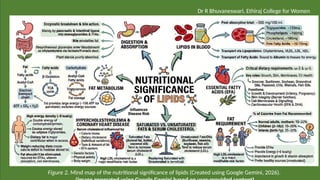
Figure 2. Mind map of the nutritional significance of lipids (Created using Google Gemini, 2026).
Dr R Bhuvaneswari, Ethiraj College for Women
Nutritional significance of lipids
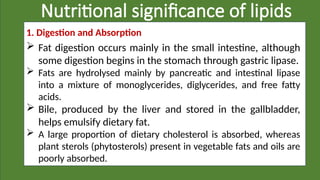
1. Digestion and Absorption
 Fat digestion occurs mainly in the small intestine, although
some digestion begins in the stomach through gastric lipase.
 Fats are hydrolysed mainly by pancreatic and intestinal lipase
into a mixture of monoglycerides, diglycerides, and free fatty
acids.
 Bile, produced by the liver and stored in the gallbladder,
helps emulsify dietary fat.
 A large proportion of dietary cholesterol is absorbed, whereas
plant sterols (phytosterols) present in vegetable fats and oils are
poorly absorbed.
Nutritional significance of lipids
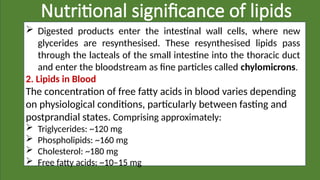
 Digested products enter the intestinal wall cells, where new
glycerides are resynthesised. These resynthesised lipids pass
through the lacteals of the small intestine into the thoracic duct
and enter the bloodstream as fine particles called chylomicrons.
2. Lipids in Blood
The concentration of free fatty acids in blood varies depending
on physiological conditions, particularly between fasting and
postprandial states. Comprising approximately:
 Triglycerides: ~120 mg
 Phospholipids: ~160 mg
 Cholesterol: ~180 mg
 Free fatty acids: ~10–15 mg
Nutritional significance of lipids
 Transport by lipoproteins:
Since most lipids are poorly soluble in water, they are transported
through the blood mainly as lipoprotein complexes. Major
lipoproteins include chylomicrons, VLDL, LDL, and HDL.
 Transport of fatty acids:
Free fatty acids are transported in the blood mainly bound to
albumin. They are delivered to tissues such as muscle, heart, and
liver, where they can be oxidised to produce energy.
3. Essential Fatty Acids (EFA)
 Essential fatty acids are fatty acids that the human body cannot
synthesise in sufficient amounts and therefore must be
obtained from the diet. (E.g) linoleic acid and α-linolenic acid.
Nutritional significance of lipids
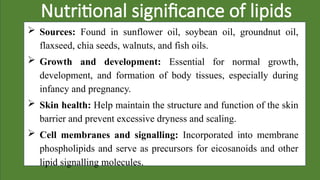
 Sources: Found in sunflower oil, soybean oil, groundnut oil,
flaxseed, chia seeds, walnuts, and fish oils.
 Growth and development: Essential for normal growth,
development, and formation of body tissues, especially during
infancy and pregnancy.
 Skin health: Help maintain the structure and function of the skin
barrier and prevent excessive dryness and scaling.
 Cell membranes and signalling: Incorporated into membrane
phospholipids and serve as precursors for eicosanoids and other
lipid signalling molecules.
Nutritional significance of lipids
Cardiovascular health: Omega-3 fatty acids, particularly EPA
(eicosapentaenoic acid) and DHA (docosahexaenoic acid), support
normal cardiovascular and vascular function.
4. Fat requirement
 Provides essential fatty acids: Supplies linoleic acid and α-
linolenic acid required for growth, development, and normal
cellular functions.
 Provides energy: Supplies about 9 kcal/g and contributes to the
daily energy requirement.
 Adequate intake during infancy: Supports rapid growth, brain
development, and absorption of fat-soluble vitamins.
Nutritional significance of lipids
 Pregnancy and lactation: Provides energy and essential fatty
acids needed for maternal, fetal, and infant development.
 Prefer healthy fat sources: Emphasise unsaturated fats from
vegetable oils, nuts, seeds, and fish while limiting saturated and
trans fats.
5. Saturated vs. Unsaturated Fats and Serum Cholesterol
 Saturated fats: Excess intake can increase LDL-cholesterol;
major sources include butter, ghee, fatty meats, and full-fat
dairy products.
 Unsaturated fats: Replacing saturated fats with unsaturated fats
can help reduce LDL-cholesterol
Nutritional significance of lipids
 Type of dietary fat: Saturated and trans fats can increase LDL-
cholesterol levels, whereas unsaturated fats are generally
considered healthier choices.
 Essential fatty acids: Linoleic acid and α-linolenic acid support
normal physiological functions and healthy lipid levels.
 Cardiovascular health: Limiting saturated and trans fats and
replacing them with unsaturated fats can help maintain a
healthier lipid profile and support cardiovascular health.
 Dietary cholesterol: Cholesterol from food may influence blood
cholesterol, but its effect varies among individuals.
Nutritional significance of lipids
6. Hypercholesterolemia and Coronary Heart Disease
Serum cholesterol level is influenced by:
 Calorie intake
 Cholesterol intake
 Fat intake
 Essential fatty acid content of the fat consumed
 Genetic factors
 Physical activity and body weight
Nutritional significance of lipids
7. Fat Metabolism
 β-Oxidation: Fatty acids are broken down in mitochondria by β-
oxidation to produce acetyl-CoA, NADH, and FADH₂.
 Energy production: Acetyl-CoA enters the TCA cycle, leading to
the production of ATP, CO₂, and H₂O; palmitate yields
approximately 106 ATP.
 Fat synthesis: Excess carbohydrate and energy can be
converted into fatty acids and triglycerides for storage in
adipose tissue.
Nutritional significance of lipids
Fat storage and obesity: Excess energy intake promotes
triglyceride storage, and prolonged energy surplus can
contribute to obesity.
Fat mobilisation: During a calorie deficit, stored triglycerides
are broken down into fatty acids and glycerol to provide energy.
Nutritional importance: Fat should not be eliminated
completely because it provides essential fatty acids and aids the
absorption of vitamins A, D, E, and K.
References
References
1. Srilakshmi, B. Nutrition Science. New Age International Publishers, New Delhi.
2. Swaminathan, M. Handbook of Food and Nutrition.
3. Indian Council of Medical Research (ICMR) – National Institute of Nutrition (NIN). Dietary
Guidelines for Indians – A Manual. Hyderabad.
Image credits
Image generated using Google Gemini (2026) based on user-provided content.
Thank You