GRADE 11 -GENERAL SCIENCE
IN MOTION – THE SCIENCE
BEHIND EVERYDAY ACTIONS
2.
in daily life
CONTENTSTANDARDS:
The learners learn that physics principles
apply to numerous aspects of everyday living;
and understanding linear and angular
quantities to describe motion helps in the
design of efficient machines.
3.
in daily life
PERFORMANCESTANDARDS
The learners identify general physics principles and their
applications in daily life. They use scientific principles to
solve problems, make informed decisions, and illustrate
the applications of physics for self, society, and the
environment.
They design simple and compound machines and
hydraulic systems to demonstrate appliction of force,
torque, center of mass, and hydraulic-related principles.
4.
in daily life
LEARNINGOBJECTIVES
Identify various ways physic enhances our quality
of life across different areas, including household
activities, health and safety, work productivity,
and leisure.
Compare and contrast translational and
rotational motion terms of their respective linear
and angular quantities.
5.
in daily life
Howdo translational and rotational motions
work together to make our daily tasks and
transportation more efficient?
ESSENTIAL QUESTION:
6.
in daily life
Thecombination of translational and rotational
motion, governed by linear and angular
quantities like torque, and efficiency of modern
machines and vehicles.
ENDURING UNDERSTANDING:
7.
in daily life
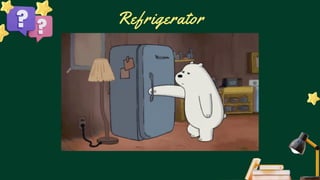
1.Which physics principle helps a
refrigerator keep food fresh?
A) Gravity
B) Thermodynamics
C) Magnetism
D) Buoyancy
PRE-ASSESSMENT
8.
in daily life
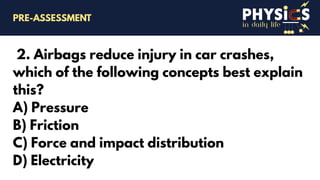
2.Airbags reduce injury in car crashes,
which of the following concepts best explain
this?
A) Pressure
B) Friction
C) Force and impact distribution
D) Electricity
PRE-ASSESSMENT
9.
in daily life
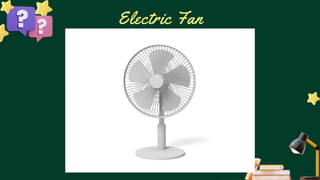
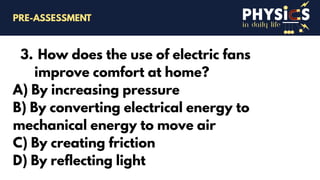
3.How does the use of electric fans
improve comfort at home?
A) By increasing pressure
B) By converting electrical energy to
mechanical energy to move air
C) By creating friction
D) By reflecting light
PRE-ASSESSMENT
10.
in daily life
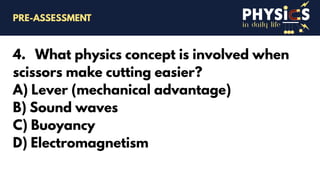
4.What physics concept is involved when
scissors make cutting easier?
A) Lever (mechanical advantage)
B) Sound waves
C) Buoyancy
D) Electromagnetism
PRE-ASSESSMENT
11.
in daily life
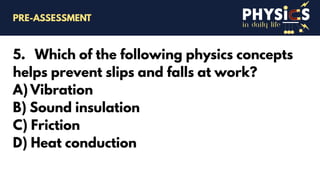
5.Which of the following physics concepts
helps prevent slips and falls at work?
A) Vibration
B) Sound insulation
C) Friction
D) Heat conduction
PRE-ASSESSMENT
12.
in daily life
6.How does a pendulum clock maintain
accurate time?
A) Sound waves
B) Pendulum motion (periodic motion) and
gravity
C) Electricity
D) Magnetism
PRE-ASSESSMENT
13.
in daily life
7.What principle is used in ultrasound
scans to create images inside the body?
A) Sound waves and their reflection
B) Light reflection
C) Electric current
D) Gravity
PRE-ASSESSMENT
14.
in daily life
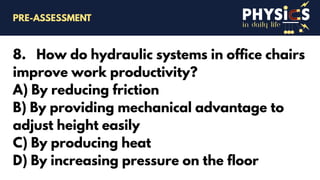
8.How do hydraulic systems in office chairs
improve work productivity?
A) By reducing friction
B) By providing mechanical advantage to
adjust height easily
C) By producing heat
D) By increasing pressure on the floor
PRE-ASSESSMENT
15.
in daily life
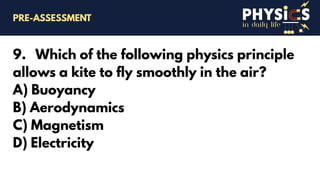
9.Which of the following physics principle
allows a kite to fly smoothly in the air?
A) Buoyancy
B) Aerodynamics
C) Magnetism
D) Electricity
PRE-ASSESSMENT
16.
in daily life
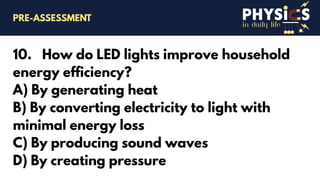
10.How do LED lights improve household
energy efficiency?
A) By generating heat
B) By converting electricity to light with
minimal energy loss
C) By producing sound waves
D) By creating pressure
PRE-ASSESSMENT
17.
in daily life
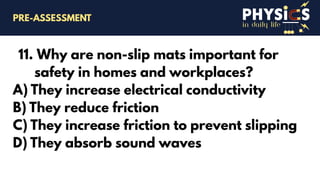
11.Why are non-slip mats important for
safety in homes and workplaces?
A) They increase electrical conductivity
B) They reduce friction
C) They increase friction to prevent slipping
D) They absorb sound waves
PRE-ASSESSMENT
18.
in daily life
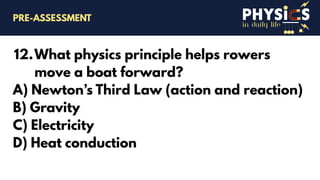
12.Whatphysics principle helps rowers
move a boat forward?
A) Newton’s Third Law (action and reaction)
B) Gravity
C) Electricity
D) Heat conduction
PRE-ASSESSMENT
19.
in daily life
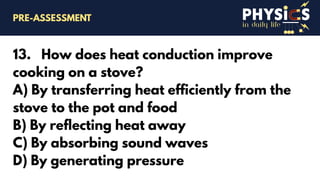
13.How does heat conduction improve
cooking on a stove?
A) By transferring heat efficiently from the
stove to the pot and food
B) By reflecting heat away
C) By absorbing sound waves
D) By generating pressure
PRE-ASSESSMENT
20.
in daily life
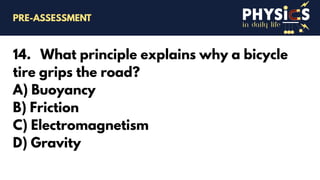
14.What principle explains why a bicycle
tire grips the road?
A) Buoyancy
B) Friction
C) Electromagnetism
D) Gravity
PRE-ASSESSMENT
21.
in daily life
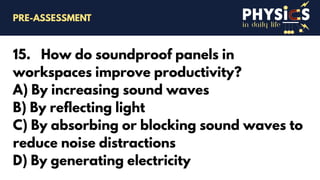
15.How do soundproof panels in
workspaces improve productivity?
A) By increasing sound waves
B) By reflecting light
C) By absorbing or blocking sound waves to
reduce noise distractions
D) By generating electricity
PRE-ASSESSMENT
in daily life
Direction:Read carefully the short story then answer the questions that follow.
LET’S RECALL
1. How did Maya's perception of physics change by the end of the story, and what
caused this shift?
2. What are three specific examples that demonstrate physics in action from Maya’s
morning?
3. Why does the teacher refer to physics as the “invisible hero of everyday life”? Do
you agree with this idea? Why or why not?
4. How about you? What are the things that you do, which involves Physics principles?
24.
“THE INVISIBLE HER0"
Mayanever liked physics. To her, it was simply a mix of formulas, graphs
and words such as ‘refraction’ and ‘momentum’ which made absolutely
no sense. But one rainy morning, things get changed.
Maya overslept and woke up late, groggy and irritated. The alarm buzz
did not awake her up because of the outage of power in the night. With
a sigh, she hurriedly put on her clothes. As she was turning on the
faucet, the water flowed in a beautiful arch instead of splashing over
the side. Lo and behold, she later realized water being graceful as it
was poured. Gravity and fluid dynamics, she realized later.
25.
With a fullyopened umbrella, she walked out of the house.
The rain bounced off the fabric, neatly rolling down the
sloped surface. Surface tension and hydrophobic materials
at work. Her bus arrived late, splashing through puddles. As
it braked gently to a stop, she stayed upright because of
the seatbelt and how the bus was designed to decelerate
smoothly, a perfect example of Newton’s laws and friction.
“THE INVISIBLE HER0"
26.
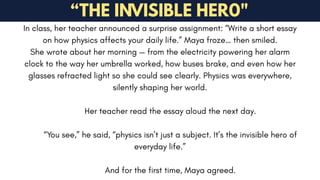
In class, herteacher announced a surprise assignment: “Write a short essay
on how physics affects your daily life.” Maya froze… then smiled.
She wrote about her morning — from the electricity powering her alarm
clock to the way her umbrella worked, how buses brake, and even how her
glasses refracted light so she could see clearly. Physics was everywhere,
silently shaping her world.
Her teacher read the essay aloud the next day.
“You see,” he said, “physics isn’t just a subject. It’s the invisible hero of
everyday life.”
And for the first time, Maya agreed.
“THE INVISIBLE HER0"
27.
in daily life
Direction:Read carefully the short story then answer the questions that follow.
LET’S RECALL
1. How did Maya's perception of physics change by the end of the story, and what
caused this shift?
2. What are three specific examples that demonstrate physics in action from Maya’s
morning?
3. Why does the teacher refer to physics as the “invisible hero of everyday life”? Do
you agree with this idea? Why or why not?
4. How about you? What are the things that you do, which involves Physics principles?
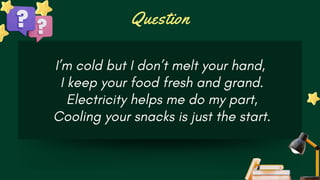
Question
I’m small andround, I roll with ease,
On roads or floors, I handle the
squeeze.
Friction, pressure, grip, and spin,
Physics helps me take you in.
What do youthink Physics is, and why is it
important to study it? Where do you see force,
energy, and motion impacting your daily life, your
community, or global challenges?
42.
in daily life
THINK– PAIR – SHARE
List 3 examples of physics in your daily life and explain
how does physics make your daily life easier?
Discuss your answers with
your partner.
43.
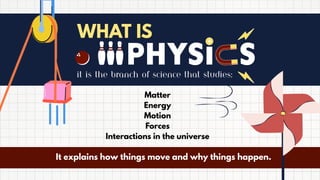
WHAT IS
it isthe branch of science that studies:
Matter
Energy
Motion
Forces
Interactions in the universe
It explains how things move and why things happen.
44.
in daily life
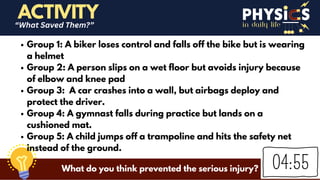
Group1: A biker loses control and falls off the bike but is wearing
a helmet
Group 2: A person slips on a wet floor but avoids injury because
of elbow and knee pad
Group 3: A car crashes into a wall, but airbags deploy and
protect the driver.
Group 4: A gymnast falls during practice but lands on a
cushioned mat.
Group 5: A child jumps off a trampoline and hits the safety net
instead of the ground.
ACTIVITY
“What Saved Them?”
What do you think prevented the serious injury?
45.
in daily life
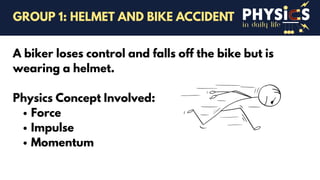
Abiker loses control and falls off the bike but is
wearing a helmet.
Physics Concept Involved:
Force
Impulse
Momentum
GROUP 1: HELMET AND BIKE ACCIDENT
46.
in daily life
Aperson slips on a wet floor but avoids
injury because of elbow and knee pad.
Physics Concept Involved
Force distribution
Energy absorption
GROUP 2: SLIPPING WITH ELBOW AND KNEE PADS
47.
in daily life
Achild jumps off a trampoline and hits the
safety net instead of the ground.
Physics Concept Involved:
Elastic Potential Energy
Force Reduction
GROUP 5: TRAMPOLINE SAFETY NET
48.
in daily life
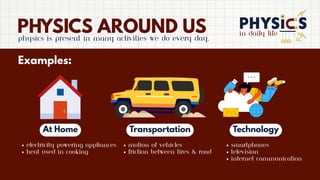
PHYSICSAROUND US
Physics is present in many activities we do every day.
Examples:
At Home Transportation Technology
Electricity powering appliances
Heat used in cooking
Motion of vehicles
Friction between tires & road
Smartphones
Television
Internet communication
49.
in daily life
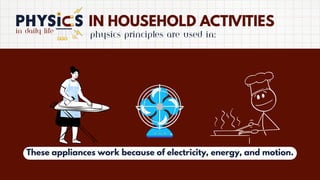
INHOUSEHOLD ACTIVITIES
Physics principles are used in:
These appliances work because of electricity, energy, and motion.
50.
in daily life
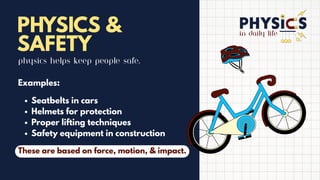
PHYSICS&
SAFETY
Physics helps keep people safe.
Examples:
Seatbelts in cars
Helmets for protection
Proper lifting techniques
Safety equipment in construction
These are based on force, motion, & impact.
51.
in daily life
WHYIS PHYSICS IMPORTANT?
Physics helps us:
Understand how the world works
Develop technology and machines
Improve health and safety
Make everyday tasks easier and more efficient
Physics plays an important role in modern life.
 Most read
 Most read
 Most read