Physics in Everyday Life: Enhancing Quality of Life Through Science
1.
General Science: Physicsin Everyday
Life
1. Term 1 / Week 1
2. Grade 11
3. Learning Area: General Science
4. Teachers: Jerome M. Boado & Diana Jane
T. Lagundino
2.
Learning Objectives
1. Identifyvarious ways physics enhances our quality of life across different
areas, including:
2. Household activities
3. Health and safety
4. Work productivity
5. Leisure and recreation
3.
Day 1: Introductionto Physics in
Everyday Life
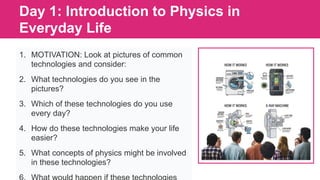
1. MOTIVATION: Look at pictures of common
technologies and consider:
2. What technologies do you see in the
pictures?
3. Which of these technologies do you use
every day?
4. How do these technologies make your life
easier?
5. What concepts of physics might be involved
in these technologies?
4.
Importance of Physicsin Daily Life
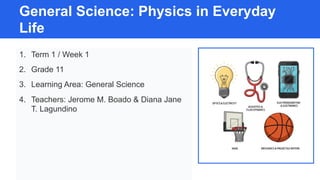
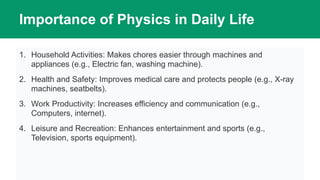
1. Household Activities: Makes chores easier through machines and
appliances (e.g., Electric fan, washing machine).
2. Health and Safety: Improves medical care and protects people (e.g., X-ray
machines, seatbelts).
3. Work Productivity: Increases efficiency and communication (e.g.,
Computers, internet).
4. Leisure and Recreation: Enhances entertainment and sports (e.g.,
Television, sports equipment).
5.
Day 1: GuideQuestions & Home Activity
1. GUIDE QUESTIONS:
2. 1. How does physics affect our daily activities?
3. 2. Why is physics important?
4. HOME-BASED ACTIVITY:
5. List five objects at home that apply physics principles.
6.
Day 2: Physicsin Household Activities
(Part 1)
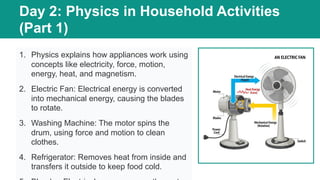
1. Physics explains how appliances work using
concepts like electricity, force, motion,
energy, heat, and magnetism.
2. Electric Fan: Electrical energy is converted
into mechanical energy, causing the blades
to rotate.
3. Washing Machine: The motor spins the
drum, using force and motion to clean
clothes.
4. Refrigerator: Removes heat from inside and
transfers it outside to keep food cold.
7.
Day 2: Physicsin Household Activities
(Part 2)
1. Microwave Oven: Microwaves transfer energy to food particles, causing
them to vibrate and produce heat.
2. Flat Iron: Electrical energy is converted into thermal energy to remove
wrinkles.
3. Flashlight: Batteries provide electrical energy converted into light energy.
4. Bicycle: Pedaling applies force that causes the bicycle to move forward.
8.
Day 2: GuideQuestions & Home Activity
1. GUIDE QUESTIONS:
2. 1. How do appliances make work easier?
3. 2. What principles of physics are involved?
4. HOME-BASED ACTIVITY:
5. Identify three appliances and explain their uses.
9.
Day 3: Physicsin Health and Safety -
Motivation
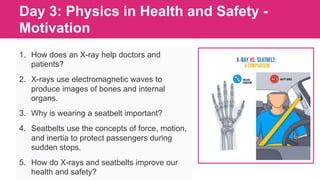
1. How does an X-ray help doctors and
patients?
2. X-rays use electromagnetic waves to
produce images of bones and internal
organs.
3. Why is wearing a seatbelt important?
4. Seatbelts use the concepts of force, motion,
and inertia to protect passengers during
sudden stops.
5. How do X-rays and seatbelts improve our
health and safety?
10.
Physics in MedicalTechnology
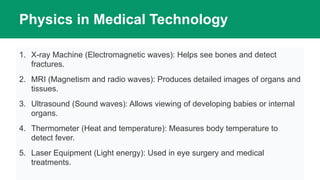
1. X-ray Machine (Electromagnetic waves): Helps see bones and detect
fractures.
2. MRI (Magnetism and radio waves): Produces detailed images of organs and
tissues.
3. Ultrasound (Sound waves): Allows viewing of developing babies or internal
organs.
4. Thermometer (Heat and temperature): Measures body temperature to
detect fever.
5. Laser Equipment (Light energy): Used in eye surgery and medical
treatments.
11.
Physics in SafetyDevices
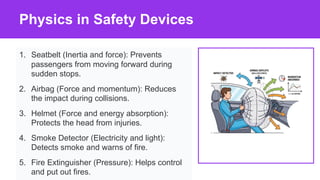
1. Seatbelt (Inertia and force): Prevents
passengers from moving forward during
sudden stops.
2. Airbag (Force and momentum): Reduces
the impact during collisions.
3. Helmet (Force and energy absorption):
Protects the head from injuries.
4. Smoke Detector (Electricity and light):
Detects smoke and warns of fire.
5. Fire Extinguisher (Pressure): Helps control
and put out fires.
12.
Day 3: GuideQuestions & Home Activity
1. GUIDE QUESTIONS:
2. 1. How does physics improve health care?
3. 2. Why are safety devices important?
4. HOME-BASED ACTIVITY:
5. Research one medical device that uses physics.
13.
Day 4: Physicsand Work Productivity
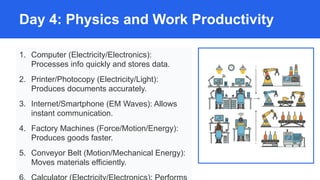
1. Computer (Electricity/Electronics):
Processes info quickly and stores data.
2. Printer/Photocopy (Electricity/Light):
Produces documents accurately.
3. Internet/Smartphone (EM Waves): Allows
instant communication.
4. Factory Machines (Force/Motion/Energy):
Produces goods faster.
5. Conveyor Belt (Motion/Mechanical Energy):
Moves materials efficiently.
14.
Day 4: GuideQuestions & Home Activity
1. GUIDE QUESTIONS:
2. 1. How do machines help workers?
3. 2. How has technology changed work?
4. HOME-BASED ACTIVITY:
5. Interview an adult about technologies used in their workplace.
15.
Day 5: Physicsin Leisure (Sports)
1. Basketball (Force/Motion): Applied force
determines speed and direction.
2. Soccer (Force/Momentum): Kicking the ball
changes its motion.
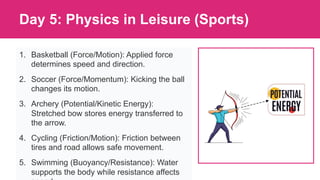
3. Archery (Potential/Kinetic Energy):
Stretched bow stores energy transferred to
the arrow.
4. Cycling (Friction/Motion): Friction between
tires and road allows safe movement.
5. Swimming (Buoyancy/Resistance): Water
supports the body while resistance affects
16.
Day 5: Physicsin Leisure (Music &
Recreation)
1. Guitar (Vibrations/Sound Waves): Vibrating strings produce sound.
2. Drum (Vibrations): Striking the drumhead creates sound waves.
3. Piano (Force/Sound): Pressing keys causes strings to vibrate.
4. Microphone/Speakers (Electricity/Sound Waves): Convert sound into
electrical signals and back.
17.
Day 5: GuideQuestions & Home Activity
1. GUIDE QUESTIONS:
2. 1. How does physics improve recreation?
3. 2. What technologies do you use during leisure time?
4. HOME-BASED ACTIVITY:
5. Bring your phones and laptops for the activity next meeting.
18.
Day 6: Synthesisand Application
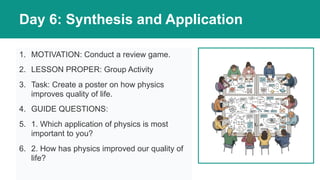
1. MOTIVATION: Conduct a review game.
2. LESSON PROPER: Group Activity
3. Task: Create a poster on how physics
improves quality of life.
4. GUIDE QUESTIONS:
5. 1. Which application of physics is most
important to you?
6. 2. How has physics improved our quality of
life?