SCHOOL OF PHARMACY
(Approved by PCI, New Delhi)
SBV Chennai Campus
B.PHARMACY - III SEMESTER
BP302T.PHYSICAL PHARMACEUTICS-1 (Theory)
UNIT 1
SOLUBILITY OF DRUGS
V.DHARSHAN M.Pharm
ASSISTANT PROFESSOR
1. Introduction to Solubility
2. Why should you study solubility?
3. Important Definitions Related to Solubility
4. Types of Solutions
5. Solubility Expressions
6. Mechanism of Solute–Solvent Interaction
7. Importance of solubility in pharmacy
8. Summary
9. Quiz
10.References
CONTEXT
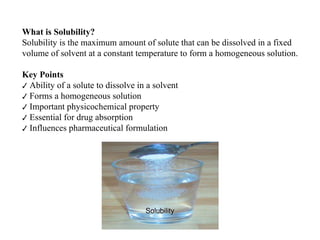
What is Solubility?
Solubility is the maximum amount of solute that can be dissolved in a fixed
volume of solvent at a constant temperature to form a homogeneous solution.
Key Points
✔ Ability of a solute to dissolve in a solvent
✔ Forms a homogeneous solution
✔ Important physicochemical property
✔ Essential for drug absorption
✔ Influences pharmaceutical formulation
Why Should You Study Solubility?
Importance for B.Pharm Students
✅ Essential for understanding drug dissolution, absorption, and
bioavailability.
✅ Important in the design and development of pharmaceutical dosage
forms.
✅ Helps in the selection of suitable solvents and excipients.
✅ Plays a key role in drug stability and therapeutic effectiveness.
✅ Important for formulation development and quality control.
✅ Forms a fundamental concept in Physical Pharmaceutic
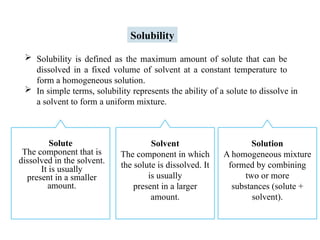
 Solubility is defined as the maximum amount of solute that can be
dissolved in a fixed volume of solvent at a constant temperature to
form a homogeneous solution.
 In simple terms, solubility represents the ability of a solute to dissolve in
a solvent to form a uniform mixture.
Solubility
Solute
The component that is
dissolved in the solvent.
It is usually
present in a smaller
amount.
Solvent
The component in which
the solute is dissolved. It
is usually
present in a larger
amount.
Solution
A homogeneous mixture
formed by combining
two or more
substances (solute +
solvent).
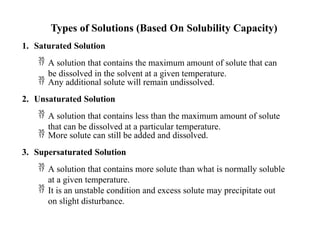
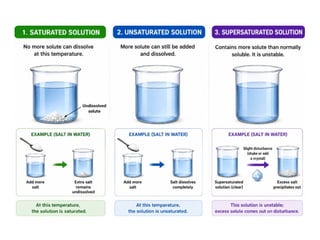
Types of Solutions (Based On Solubility Capacity)
1. Saturated Solution
 A solution that contains the maximum amount of solute that can
be dissolved in the solvent at a given temperature.
 Any additional solute will remain undissolved.
2. Unsaturated Solution
 A solution that contains less than the maximum amount of solute
that can be dissolved at a particular temperature.
 More solute can still be added and dissolved.
3. Supersaturated Solution
 A solution that contains more solute than what is normally soluble
at a given temperature.
 It is an unstable condition and excess solute may precipitate out
on slight disturbance.
SOLUBILITY EXPRESSIONS
Solubility of a substance can be expressed in two main ways:
1. QUANTITATIVE EXPRESSION
2. QUALITATIVE EXPRESSION
1. Quantitative Expression
This method expresses solubility in numerical terms using various
concentration units.
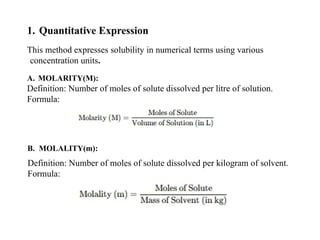
A. MOLARITY(M):
Definition: Number of moles of solute dissolved per litre of solution.
Formula:
B. MOLALITY(m):
Definition: Number of moles of solute dissolved per kilogram of solvent.
Formula:
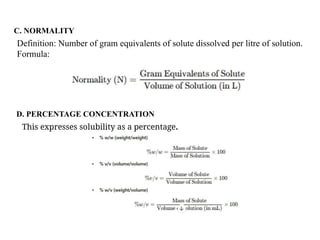
Definition: Number of gram equivalents of solute dissolved per litre of solution.
Formula:
C. NORMALITY
This expresses solubility as a percentage.
D. PERCENTAGE CONCENTRATION
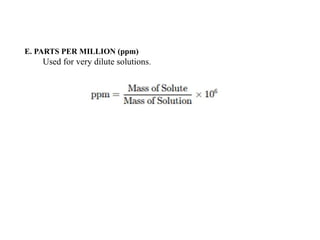
E. PARTS PER MILLION (ppm)
Used for very dilute solutions.
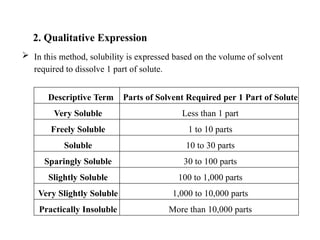
2. Qualitative Expression
 In this method, solubility is expressed based on the volume of solvent
required to dissolve 1 part of solute.
Descriptive Term Parts of Solvent Required per 1 Part of Solute
Very Soluble Less than 1 part
Freely Soluble 1 to 10 parts
Soluble 10 to 30 parts
Sparingly Soluble 30 to 100 parts
Slightly Soluble 100 to 1,000 parts
Very Slightly Soluble 1,000 to 10,000 parts
Practically Insoluble More than 10,000 parts
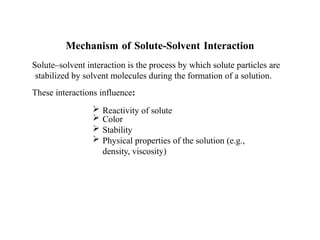
Mechanism of Solute-Solvent Interaction
Solute–solvent interaction is the process by which solute particles are
stabilized by solvent molecules during the formation of a solution.
These interactions influence:
 Reactivity of solute
 Color
 Stability
 Physical properties of the solution (e.g.,
density, viscosity)
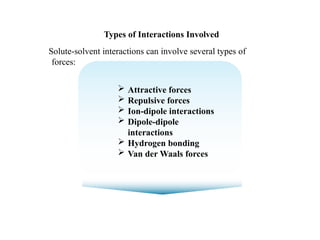
Types of Interactions Involved
Solute-solvent interactions can involve several types of
forces:
 Attractive forces
 Repulsive forces
 Ion-dipole interactions
 Dipole-dipole
interactions
 Hydrogen bonding
 Van der Waals forces
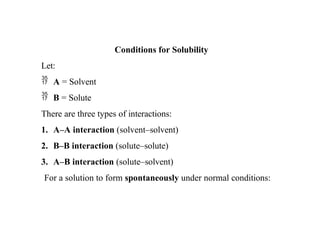
Conditions for Solubility
Let:
 A = Solvent
 B = Solute
There are three types of interactions:
1. A–A interaction (solvent–solvent)
2. B–B interaction (solute–solute)
3. A–B interaction (solute–solvent)
For a solution to form spontaneously under normal conditions:
Mechanism of Solute–Solvent Interaction
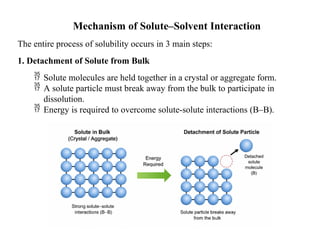
The entire process of solubility occurs in 3 main steps:
1. Detachment of Solute from Bulk
 Solute molecules are held together in a crystal or aggregate form.
 A solute particle must break away from the bulk to participate in
dissolution.
 Energy is required to overcome solute-solute interactions (B–B).
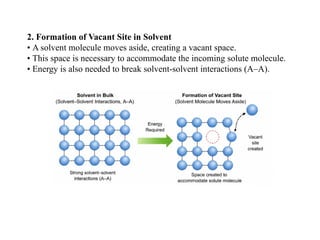
2. Formation of Vacant Site in Solvent
• A solvent molecule moves aside, creating a vacant space.
• This space is necessary to accommodate the incoming solute molecule.
• Energy is also needed to break solvent-solvent interactions (A–A).
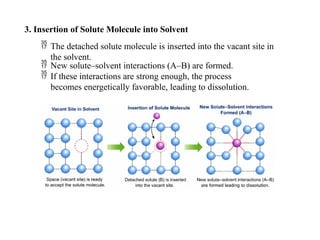
3. Insertion of Solute Molecule into Solvent
 The detached solute molecule is inserted into the vacant site in
the solvent.
 New solute–solvent interactions (A–B) are formed.
 If these interactions are strong enough, the process
becomes energetically favorable, leading to dissolution.
Importance of Solubility In Pharmacy
Solubility plays a crucial role in pharmaceutical sciences for the
following reasons:
1. To select the appropriate solvent for preparing drug solutions or
formulations.
2. To ensure bioavailability of a drug — only dissolved drugs can
be absorbed by the body.
3. To overcome formulation challenges during the manufacturing
of syrups, suspensions, and injections.
4. To study drug interactions and compatibility with different solvents
or excipients.
5. To identify poorly water-soluble drugs which may need
solubility enhancement techniques.
6. To understand the role of intermolecular forces (like hydrogen
bonding, van der Waals forces) and molecular structure on
solubility.
Summary
 Solubility is the maximum amount of solute that dissolves in a solvent at a
constant temperature.
 A solution consists of a solute and a solvent forming a homogeneous
mixture.
 Solutions are classified as unsaturated, saturated, and supersaturated.
 Solubility can be expressed quantitatively (M, m, N, %, ppm) and
qualitatively (very soluble to practically insoluble).
 Solubility depends on intermolecular interactions between solute and solvent
molecules.
 Important forces involved are hydrogen bonding, ion-dipole, dipole-dipole,
and van der Waals forces.
 Dissolution occurs through detachment of solute, formation of a vacant
site in solvent, and insertion of solute into the solvent.
 Strong solute–solvent (A–B) interactions favor dissolution.
1. What is solubility?
A) Amount of solvent present
B) Maximum amount of solute dissolved in a solvent at a constant temperature
C) Volume of solution formed
D) Weight of solvent
2. Which component is dissolved in a solvent?
A) Solute
B) Solvent
C) Solution
D) Excipient
3. A solution that can dissolve more solute is called:
A) Saturated solution
B) Supersaturated solution
C) Unsaturated solution
D) Concentrated solution
4. Which type of solution is unstable and may precipitate on disturbance?
A) Unsaturated solution
B) Saturated solution
C) Supersaturated solution
D) Dilute solution
QUIZ
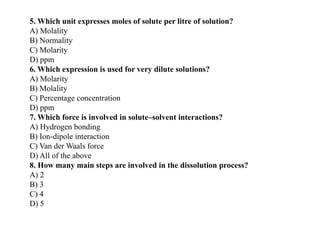
5. Which unit expresses moles of solute per litre of solution?
A) Molality
B) Normality
C) Molarity
D) ppm
6. Which expression is used for very dilute solutions?
A) Molarity
B) Molality
C) Percentage concentration
D) ppm
7. Which force is involved in solute–solvent interactions?
A) Hydrogen bonding
B) Ion-dipole interaction
C) Van der Waals force
D) All of the above
8. How many main steps are involved in the dissolution process?
A) 2
B) 3
C) 4
D) 5
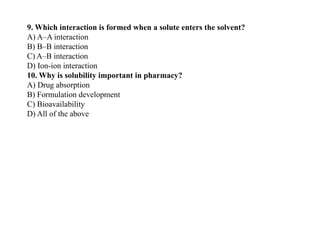
9. Which interaction is formed when a solute enters the solvent?
A) A–A interaction
B) B–B interaction
C) A–B interaction
D) Ion-ion interaction
10. Why is solubility important in pharmacy?
A) Drug absorption
B) Formulation development
C) Bioavailability
D) All of the above
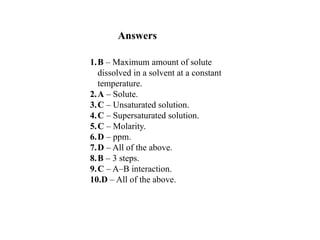
Answers
1.B – Maximum amount of solute
dissolved in a solvent at a constant
temperature.
2.A – Solute.
3.C – Unsaturated solution.
4.C – Supersaturated solution.
5.C – Molarity.
6.D – ppm.
7.D – All of the above.
8.B – 3 steps.
9.C – A–B interaction.
10.D – All of the above.
Text Book References
1.Martin's Physical Pharmacy and Pharmaceutical Sciences
Patrick J. Sinko, 7th Edition, Wolters Kluwer Health.
2.Physical Pharmaceutics
C.V.S. Subrahmanyam, Vallabh Prakashan.
3.Aulton's Pharmaceutics: The Design and Manufacture of
Medicines
Michael E. Aulton & Kevin M.G. Taylor, Elsevier.
Online References
1. NCBI Bookshelf – Biochemistry, Dissolution and Solubility
NCBI Bookshelf – Dissolution and Solubility
REFERENCE
Physical Pharmaceutics-Unit 1(Solubility of drugs).pptx