Philosophy of Education
Presented By:
Deepa Manandhar
lecturer
Introduction
• The term Philosophy is derived from Greek word
Philosophia.
• Philos means “love of” or “search for”
• Sophia means “knowledge “or “wisdom.”
Deepa Manandhar 2
Introduction
• Therefore the literal meaning of philosophy is
“love of wisdom” or search for knowledge.
Deepa Manandhar 3
Introduction
• Philosophy is a scientific and systematic
inquiry /study about the universe, truth and
knowledge.
Deepa Manandhar 4
Definition
According to Henderson,
Philosophy is the search for comprehensive view
of nature, an attempt at a universal explanation of
nature of things.
Deepa Manandhar 5
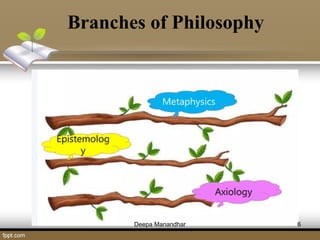
Branches of Philosophy
Deepa Manandhar 6
Metaphysics
• Deals with the ultimate true nature of the things.
• Metaphysics is the branch of philosophy that deals with
nature of existence and reality.
Deepa Manandhar 7
Metaphysics
• It is a fundamental view of the world around us. It is sub
divided into two categories.
 Ontology: It is concerned with philosophical inquiry
into the nature of being itself. It deals with questions of
what issues related to nature, existence, or beings?
 Cosmology: It is branch of philosophy that studies the
origin, evolution, and structure of the universe
Deepa Manandhar 8
Epistemiology
• Deals with the origin and source of knowledge. Logic
is key dimension to epistemology. It searches for what is
the nature of knowlwdge. The bases of knowing are:
scientific inquiry, senses and feelings, reasoning or logic.
Deepa Manandhar 9
Axiology
• It is concerned with the nature of morality and value.
Axiology studies mainly two types of values.
Deepa Manandhar 10
Axiology
 Ethics: It investigates the concept of “right” and
“wrong” in individual and social conduct.
 Aesthetics: It studies the concepts of “beauty” and
“harmony”.
Deepa Manandhar 11
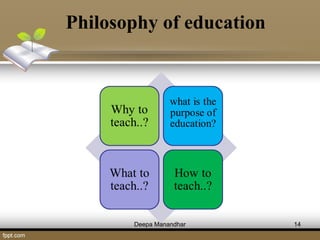
Philosophy of education
• The philosophy of education seeks to study the process
and discipline of education in order to understand how
it works; to improve its method; and perfect its
applications in society.
• The philosophy of education ultimately seeks to improve
education and its systems and methods for the betterment
of humanity.
Deepa Manandhar 12
Philosophy of education
• A set of values and beliefs about education that guide the
professional behavior of educators.
Deepa Manandhar 13
Philosophy of education
Deepa Manandhar 14
Types of educational
philosophies
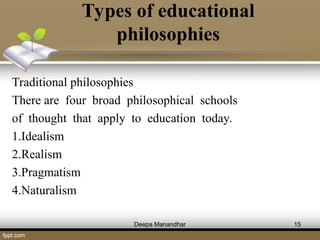
Traditional philosophies
There are four broad philosophical schools
of thought that apply to education today.
1.Idealism
2.Realism
3.Pragmatism
4.Naturalism
Deepa Manandhar 15
Idealism
 Idealism is the Oldest philosophy
Plato is the Father of Idealism
• Idealism has been derived from ‘ideal’ or ‘ideas’.
• Ideals or higher values are much more significant in
human life than anything else.
Deepa Manandhar 16
Idealism
• Idealism believe that man is a combination of spiritual
material aspects, of which the spiritual aspects is more
real and important
• Idealism believes in the “universal mind” or God
• Idealist gives more important to Mind and Self rather
than Matter and Body.
Deepa Manandhar 17
Idealism
• It believes that the purpose of life is to know the
ultimate truth.
• Plato believed that the ultimate reality consists of ideas.
• It believes God creates the entire world.
Deepa Manandhar 18
Idealism
• It adheres to the view that nothing exists except an idea
in the mind of a man.
• To the idealist the reality is spiritual in nature. Ideas are
eternal and unchanging.
Deepa Manandhar 19
Principles of Idealism
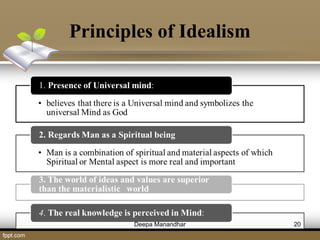
Deepa Manandhar 20
Principles of Idealism
The world of ideas and values are superior than the
materialistic world:
– Idealism believes in the worth of ideals or higher values.
– Higher values, which makes the human life more
meaningful are not created by man and have prior existence
as a gift from god.
– According to Plato: the higher values are Truth, goodness,
glory and beauty
Deepa Manandhar 22
Principles of Idealism
The real knowledge is perceived in Mind:
– Knowledge attained through activity and creativity of
mind is valid than the knowledge acquired through senses.
– The principle is simply against mugging up of bookish
knowledge and recognizes the importance of critical
thinking and activity in gaining knowledge or skills.
Deepa Manandhar 23
Educational implications of idealism
• Idealism considers student as an individual with
inner potentialities.
• Education should help the student to realize these
potentialities.
• The aim of education should be exaltation of the
self, which implies self realization.
Deepa Manandhar 24
Educational implications of idealism
• The child should be taught the ways and means to
acquire and verify knowledge.
• The teacher should impart essentials of
knowledge and assist to develop moral and
aesthetic values in the child.
Deepa Manandhar 25
Idealism and curriculum
• The aim of idealistic curriculum is the overall
development of child.
• To achieve this overall development, subjects
who assist the child to develop morally,
aesthetically, intellectually and physically are
included in the curriculum.
Deepa Manandhar 26
Idealism and curriculum
• For aesthetic and moral development: subjects
like fine arts, poetry, ethics and religion are
provided.
• Whereas for intellectual advancement of child,
subjects like language, literature, sciences,
social studies and mathematics are included in
curriculum.
Deepa Manandhar 27
Idealism and curriculum
• Idealistic philosophy of education insists on the
creation of a sound mind in a sound body. It is
essential to keep physical activities like physical
exercise, hygiene, gymnastics and athletics.
• Thus the idealistic curriculum comprises of
physical, intellectual and spiritual activities
which will enable a man to develop completely.
Deepa Manandhar 28
Methods of teaching adopted
• Self Education involving self activity, project method,
play way method
• Questioning
• Discussion and lecture method
• Single and group projects
• Froebel Kindergarden method
• Imitations
Deepa Manandhar 30
Idealism and discipline
• Idealism believes in inner discipline.
• Strict discipline is essential for self-realization.
• Teacher`s guidance is necessary at every step.
Deepa Manandhar 31
Teacher and Idealism
• It assigns a special role to the teacher.
• It considers teacher as a spiritual guide for the child.
• It regards the teacher as the priest of man’s spiritual
heritage.
• It holds the teacher as a friend, philosopher and
guide.
Deepa Manandhar 32
Deepa Manandhar 33
Naturalism
Deepa Manandhar 34
Naturalism
• Rousseau and Aristotle have been the proponents of
naturalism.
• Naturalism is a philosophy that regards Nature as the
ultimate reality.
• Naturalism is concerned with natural self and believes
that reality and nature are identical and beyond nature
there is no reality.
• Separates nature from God.
Deepa Manandhar 35
Naturalism
• Naturalism in education is a philosophical approach that
believes nature is the ultimate source of knowledge and
values. It holds that education should be based on the
natural processes of human development and that the
role of the educator is to facilitate and support the
natural growth of the learner
Deepa Manandhar 36
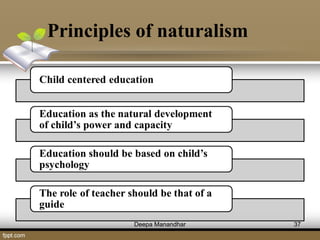
Principles of naturalism
Deepa Manandhar 37
Naturalism and curriculum
• As per naturalism , there is no need for a rigid
curriculum and consider nature as a grand book from
which children can learn everything to become an
individual.
• It emphasizes the importance of experiential learning,
where learners are encouraged to explore the natural
world and discover knowledge through their
observations and experiences.
Deepa Manandhar 38
Child centered education
 Here prime importance has to be given to be given to
the child than teachers and others.
 The present day education system neither teacher
centered nor subject matter centered but child centered
only. Today, teacher`s role is limited to a facilitator of
learning.
Deepa Manandhar 39
Education as the natural development of
child’s power and capacity:
• Education pattern should coincide with the natural
development and learning capacity of the child.
Deepa Manandhar 40
Education should be based on
child psychology
• The principle advocates the need for considering
individual difference among students. Individual
differences in intelligence, temperament and emotions
among students should be identified and taken into
account.
Deepa Manandhar 41
The role of the teacher should be
that of guide
 The principle is that instead of passively transferring the
knowledge, the teacher has to arrange an environment
with necessary opportunity and materials required for
personal development of the child and guide the child as
needed.
Deepa Manandhar 42
Naturalism and curriculum
• The curriculum of the naturalists is more activity-
centered than book-centered.
• It is a combination of actual living and preparation for
living.
Deepa Manandhar 43
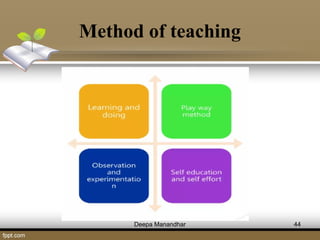
Method of teaching
Deepa Manandhar 44
Learning by doing
• Naturalism appreciates direct experiences and believes
in the principle of learning by doing.
Deepa Manandhar 45
Play way method
• Good learning often is a result of Spontaneous effort
and free interest rather than compulsion and forced
application. Play approach enhances quality of teaching
by offering elements of freedom, interest, reality and
spontaneity.
Deepa Manandhar 46
Observation and
experimentation
Observation simplifies the learning process and helps the
student in retaining the learned skills and facts.
Deepa Manandhar 47
Self education or self effort
More or less education is viewed as a lifelong process. The
concept of self education or self effort have motivated the
modern educationists to consider education as a lifelong
process.
Deepa Manandhar 48
Naturalism and discipline
• Naturalism favours total freedom and oppose
punishment or extreme discipline.
• Child should be allowed to face the natural
consequences of his actions and this exposure to
consequences will naturally result in the development of
self-discipline.
Deepa Manandhar 49
Naturalism and teacher
• In naturalism, teacher`s place is behind the scene.
Teacher contributes passively by arranging environment
and necessary materials for the personal development of
the child and guide or directs the child as needed.
Deepa Manandhar 50
Naturalism and the School
• School environment should be completely free, flexible
and without any rigidity.
• Nature will do all the planning and processing for the
natural development of the child.
Deepa Manandhar 51
Deepa Manandhar 52
Realism
• The term ‘realism’ derieved from the word ‘real’, find
its origin in the Greek word: ‘Res’, which means object.
Realism believes in the world as it is.
• It is based on the view that reality is what we observe.
Deepa Manandhar 53
Realism
• First valid explanation regarding this ideology was given
by Aristotle and later modifired by GE Moore, Russel
and John wild.
• Realist believe that knowledge acquired by senses is true
and accepts the existence of real things which can be
comprehended.
• By observation, experimentation and examination if it is
found to be true can be considered as real.
Deepa Manandhar 54
Principles of Realism
It does not believe in the existence of any absoulate truth.
It accepts only sensory experiences of the external world as
real.
It looks at man like a physical being controlled by rules and
laws.
Real knowledge is obtained by analyzing and experiencing
sensations.

Deepa Manandhar 55
Deepa Manandhar 56
Aims of Education
• Realist educational theory is to provide the pupil with
the essential knowledge requires for survival in the
natural world.
• Such knowledge will provide the skills necessary to
achieve a secure and happy life.
Deepa Manandhar 57
Curriculum
• Realistic curriculum prefers subjects and activities
which can prepare children for day to day living. Hence
science and vocational subjects enjoy predominant
position in curriculum, followed by art, literature and
languages.
Deepa Manandhar 58
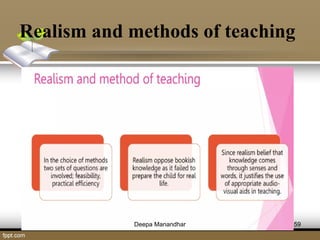
Realism and methods of teaching
Deepa Manandhar 59
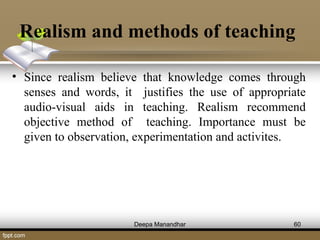
Realism and methods of teaching
• Since realism believe that knowledge comes through
senses and words, it justifies the use of appropriate
audio-visual aids in teaching. Realism recommend
objective method of teaching. Importance must be
given to observation, experimentation and activites.
Deepa Manandhar 60
Realism and methods of teaching
• The teacher must assure that the pupil be able to recall,
explain and compare facts; to interpret relationships,
and to infer new meanings.
Deepa Manandhar 61
Realism and discipline
• Realism believes in self-discipline and advocate
moral and religion education for the development of
self-discipline among children.
Deepa Manandhar 62
Realism and teacher
• A realist teacher is interested in research and
transferring knowledge in a clear and intelligible way
by employing psychological and scientific principles.
Deepa Manandhar 63
Realism and teacher
• A realist teacher is interested in research and
transferring knowledge in a clear and intelligible way
by employing psychological and scientific principles.
Deepa Manandhar 64
Realism and school
• Realists have different views about school.
• Some do not feel any need of school at all. They
prescribe wide travelling, tours and teaching by private
tutors as the best means of education.
Deepa Manandhar 65
Realism and school
On the contrary others realists emphasize the importance
of school.
According to them, the school is an agency which meets
the needs of the child.
Deepa Manandhar 66
Pragmatism
• derived from the Greek word "Pragma" which means
activity, work done, practice or action.
• the philosophical theory that states that experience is the
source of all knowledge.
• It has been expounded by the American philosophers
like William James and John Dewey.
Deepa Manandhar 67
Principles
• Change is the essence of this universe. Nothing is
permanent or final.
• Reality is what one experiences. There is no absolute
reality.
• There is no absolute truth. Truth always changes
according to time, place, and person.
• Problems form the motivation for the search of truth.
Deepa Manandhar 68
Principles
• Action must precede knowledge. True experience is
knowledge and it is functional. Action is more
important than knowledge or thought.
• Man is a biological organism getting a social
stimulation. Human personality can be developed only
in a social context.
• The present is stressed, neither the past nor the future.
Deepa Manandhar 69
Principles
• There are no absolute values or universal moral
principles. Man creates his own values.
• What is good is what works; what works for all
• Means are more important than ends. They are closely
related. The ends once realized, become means for
realization of further ends.
Deepa Manandhar 70
Principles
• Mind is dynamic. The growth of personality is the
interaction of the individual with the environment.
• Critical intelligence is of great value.
Deepa Manandhar 71
Educational implications of
Pragmatism
Pragmatism and aims of education
• Creation of new values in light of his/her own
experience and felt needs.
• Reconstruction of experience
• Continuous experiences.
• Social efficiency
• All-round Development
Deepa Manandhar 72
Pragmatism and curriculum
 Principle of utility:
Based on this principle those subjects, experience and
activities which can satisfy the present and future needs
or expectations of the child should be included in the
curriculum.
Deepa Manandhar 73
Pragmatism and curriculum
 Principle of interest: curriculum should be based on
the child`s interest. Subjects, activites and experience
that suits to the interest, attitude and needs of the child
should be included in the curriculum.
Deepa Manandhar 74
Pragmatism and curriculum
 Principle of experience: this principle focuses on the
child`s activity, vocation and experience. Student
achieve experiences from the activites of library,
classroom, laboratory and playground.
Deepa Manandhar 75
Pragmatism and curriculum
 Principle of integration: It deals with the integration of
various subjects and experiences. Pragmatism considers
knowledge as a single unit.
Deepa Manandhar 76
Pragmatism and method of
teaching
• Project method & practical-oriented (learning by
doing): It includes activities which lead to learning
through experiences.
• Provision of real life situation touching and handling of
objects, tools and making things
Deepa Manandhar 77
Pragmatism and discipline
• Pragmatism does not believe in strict and rigid
discipline.
• Discipline should grow out of purposeful group activity.
Deepa Manandhar 78
Pragmatism and discipline
• They believe in social discipline.
• Social discipline may develop in child from experience
and help which the child receive from the society,
school and home.
Deepa Manandhar 79
Pragmatism and teacher
• Pragmatism consider teacher as a friend, philosopher
and guide to the children. The pragmatist teacher
teaches his pupil to think and act themselves rather than
to know or react.
Deepa Manandhar 80
Pragmatism and school
• The school is a miniature society where a child gets a
real experience to act and behave according to his
interests, aptitudes and capacities.
Deepa Manandhar 81
Modern philosophies of
education
Humanism: focus on the value and agency of human
beings, emphasizing reason, ethics, and justice. In
education, it promotes critical thinking, empathy and
development of well-rounded individuals.
Deepa Manandhar 82
Modern philosophies of
education
Existentialism:
•This philosophy view man as, participating in a world of
things and events.
•Examine the individual`s experience of existence,
freedom, and responsibility.
•Emphasize self-discovery, authenticity
Deepa Manandhar 83
Modern philosophies of
education
 Progressivism
According to this philosophy the development of an
individual and the society is only possible, when
education facilitates the growth of every phase of the
child.
Deepa Manandhar 84
Modern philosophies of
education
 Eclecticism: To familiarize with different philosophies,
draw the best and essential points inspiration from all of
them and make into one harmonious whole and build
one’s own philosophy of education.It is known as the
‘eclectic tendency’ in education.
Deepa Manandhar 85
Definition of Nursing Philosophy
• Nursing philosophy can be defined as the system of
motivating beliefs, concepts, and principles that directs
the actions of nurses as a particular group in the pursuit
of nursing goals.
Deepa Manandhar 86
Philosophy of nursing
 The philosophy of nursing is a personal perspective
and attitude that is part of ones belief about the field of
nursing and the purpose of their nursing education and
practice.
 It is how a person perceives the profession of nursing
and the reason behind their actions and participation in
the nursing field.
Deepa Manandhar 87
Philosophy of nursing
• The philosophy of nursing encompasses ones beliefs,
attitudes, actions, hopes, dream and desires and
drives the ethical behaviors of the individual or group
in which the particular philosophy belongs to, therefore
the philosophy is a vital component in nursing practice
and the well-being of the patients personal health as
well as for the mental, emotional and physical health of
the nurses to which the philosophy belongs to.
Deepa Manandhar 88
Philosophy of nursing
• The philosophy of nursing in general concerns itself
with the beliefs about health and role of nursing in
health care delivery system
• In the philosophy of nursing emphasis is placed on the
patients. Objectives may have to be formulated to
provide comprehensive nursing care by identifying the
patient needs, meeting those needs and evaluating the
care.
Deepa Manandhar 89
Implication of philosophy in Nursing
Education
• Philosophy of nursing education is the written
statement of the believe , values, attitudes and ideas
which the faculty as a group agreed upon in relation to
the nursing educational program such as health ,
disease, nursing , nurse , nursing as a profession ,
education, learner, society, patient , nursing education
and preparation of nurses.
Deepa Manandhar 90
Implication of philosophy in Nursing
Education
• A philosophy of nursing education is the application of
these fundamental beliefs to the field of nursing
education.
Deepa Manandhar 91
Implication of philosophy in Nursing
Education
 Philosophy gives direction to nursing education by
certain guideline.
 It attempts to establish coherent meaning within the
whole domain of thought.
Deepa Manandhar 92
Implication of philosophy in Nursing
Education
• The philosophy will decide the nature of student
selection process, objectives of the educational
programs, curriculum development, type of practical
experiences provided to the students, selection and
placement of staff, teaching methods and evaluation
system.
Deepa Manandhar 93
Implication of philosophy in Nursing
Education
• Nursing is a healing science and as a belief construct,
philosophy decides the healing approach. For instance,
behavior of a nursing student while discharging a
recorded patient is different from the behavior exhibited
while caring a critically ill patient.
Deepa Manandhar 94
Implication of philosophy in Nursing
Education
• Nursing is a healing science and as a belief construct,
philosophy decides the healing approach. For instance,
behavior of a nursing student while discharging a
recorded patient is different from the behavior exhibited
while caring a critically ill patient.
Deepa Manandhar 95
References
1. Singh I. Essentials of education. Mr.J.B. singh,.Hisi
offset printers Pvt ltd.
2. Neerja KP. Textbook of Nursing Education.Jaypee
Brother Medical Publishers (P) LTD
3. Sudha R. Nursing Education: Principles and Concepts.
New Delhi: Jaypee Brothers Medical Publications; 2013.
4. Basavanthappa BT., Nursing Education, 1st
Edition,
Jaypee Brothers Medical Publishers (P) Ltd., New Delhi
(2003).
Deepa Manandhar 96
Deepa Manandhar 97